The Logic of Logic

If pure mathematics is a language, then numbers and variables constitute letters, definitions constitute words, and theorems constitute short paragraphs, all building up to a unified story that explains the explanation for the world. What is its grammar? Logic.

Definition 1. A proposition is a sentence that is either true, denoted \mathrm T, or not, denoted \neg \mathrm T, but not both. A true proposition \mathrm T is called a theorem. We will always make the following notations:

\mathrm T =\mathrm T,\quad \neg \mathrm T = \neg \mathrm T,\quad \mathrm T \neq \neg \mathrm T,\quad \neg \mathrm T\neq \mathrm T.

This is technically known as the law of excluded middle, which agrees with our intuition of truth. We will use this starting point for further discussion.

It helps us at times to make the abbreviation \mathrm F := \neg \mathrm T, called false. These are called truth values. This gives us the following definition for the negation.

Definition 2. The negation \neg is defined as follows:

\neg \mathrm T = \mathrm F,\quad \neg \mathrm F := \mathrm T.

To condense our definitions, we can use a truth table:
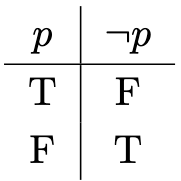
This gives us the following observation by repeated uses of said notation:

\neg(\neg \mathrm T) = \mathrm T,\quad \neg(\neg \mathrm F) = \mathrm F.

More generally, we can discuss logic from an algebraic lens.

Definition 3. A propositional variable p is a placeholder that takes on exactly one of the truth values \mathrm T or \mathrm F.

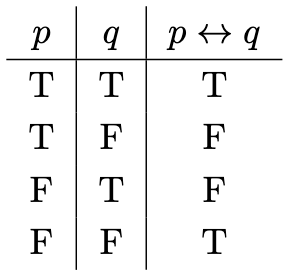
We want to discuss the truth values of two propositional variables p, q. To do that, we need to define the biconditional.

Definition 4. Define the biconditional \leftrightarrow using the following truth table:

For any propositional variable p and any proposition variable q defined in terms of p, we write p = q if (p \leftrightarrow q) is a theorem for any substitution of p.

Theorem 1. Let p be a propositional variable. Then \neg(\neg p) = p.

Proof. We use the following truth table argument:
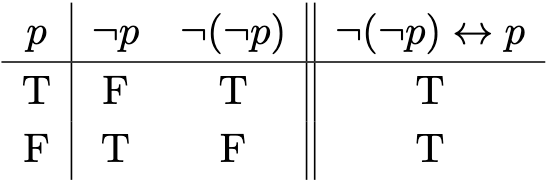
Many a time, we want to treat theorems as propositional variables. Propositions formed using existing propositions are known as compound statements. We can formalise this using tautologies, with their negations being contradictions.

Definition 5. A compound statement t is a tautology if t is a theorem regardless of substitution of truth values.

With this vocabulary, for any compound statement p and any compound statement q defined in terms of p, we write p = q to mean that (p \leftrightarrow q) = t.

A corollary is a theorem that, for readability purposes, is a straightforward consequence of a previously established theorem.

Corollary 1. For any propositional variable p, (\neg(\neg p) \leftrightarrow p) = t.

A compound statement c is a contradiction if c = \neg t for some tautology t.

Corollary 2. Let t be a tautology and c be a contradiction. Then c is always false, and \neg c = t.

Based on the starting points \mathrm T and \mathrm F = \neg \mathrm T, we can define many logical connectors. One crucial one is known as the conjunction.

Definition 6. Define the conjunction \wedge using the following truth table:
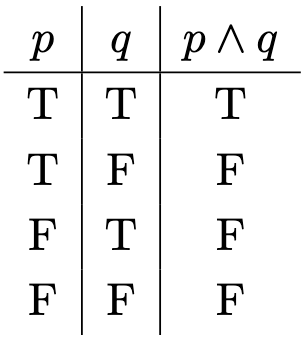
The conjunction has many useful properties. But first, we need to establish some results pertaining tautologies and contradictions. These will be lemmas—theorems that, for readability sake, are intermediate steps to prove more significant theorems.

Lemma 1. Let p be any propositional variable. Then

p \wedge t = p = t \wedge p, \quad  p \wedge c = c = c \wedge p.

Proof. Use a truth table argument.

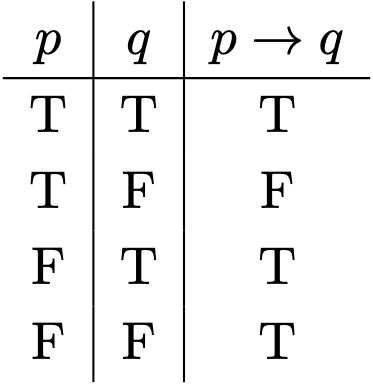
We want to eventually prove propositions such as p \wedge q = q \wedge p. However, we first need to prove that we can chain equalities, i.e. that p=q and q=r implies p=r.

Definition 7. Define the implication \to using the following truth table:

To prove our famous results, we need lemmas, which are theorems that, for readability purposes again, are intermediate steps required to prove a theorem.

Lemma 2. For any propositional variable p,

(t \to p) = p,\quad (p \to p) = t,\quad (c \to p) = t.

Proof. Use a truth table argument.

Our next lemma requires us to chain equalities of propositional variables. This helps us prove the commutativity of conjunction.

Lemma 3. For propositional variables p, q, r,

(((p=q) \wedge (q=r)) \to (p=r)) = t.

Proof. We remark that for any substitution of truth values into p,q,r, if ((p=q) \wedge (q=r)) = \mathrm F, then

(((p=q) \wedge (q=r)) \to (p=r)) = \mathrm T

automatically. Thus, we will suppose that ((p=q) \wedge (q=r)) = \mathrm T. By definition of the truth value of the conjunction, we have p = q and q = r.

  • Substituting p with \mathrm T, q=\mathrm T and r = \mathrm T = p.
  • Substituting p with \mathrm F, q=\mathrm F and r = \mathrm F = p.

Therefore, p = r, as required.

Finally, we can prove the commutativity and associativity property of conjunction.

Theorem 2. Let p, q, r be propositional variables. Then the following hold.

\begin{aligned} p \wedge q = q \wedge p, \quad (p \wedge q) \wedge r = p \wedge (q \wedge r). \end{aligned}

Proof. For the first result, use a truth table argument. For the second result, when we substitute p with \mathrm T, we have p = t with respect to q, so that by chaining equalities,

(p \wedge q) \wedge r = (t \wedge q) \wedge r = q \wedge r = t \wedge (q \wedge r) = p \wedge (q \wedge r) .

We get the same result when substituting p with \mathrm F.

There is more to say about propositional logic, such as disjunctions and even argument forms, but this post is getting as long as it needs to. Crucially, we have implemented the core elements of propositional logic which we can take advantage of in future topics.

—Joel Kindiak, 15 Nov 24, 2359H


Responses

  1. Doing Logic the Lazy Way – KindiakMath

    […] the previous post, we introduced what we mean by logic, which agrees largely with our intuitive process of making […]

    Like

  2. The Logic of Predicates – KindiakMath

    […] particular, we want to consider the set . Let be a propositional variable, and let be a propositional variable defined in terms of […]

    Like

  3. The Massive Impact of Applied Logic – KindiakMath

    […] whole point of examining logic is to develop crucial proof techniques that will aid us for future studies. This is the primary […]

    Like

  4. Surjections as Sets – KindiakMath

    […] far, we have developed mathematics in the following manner: propositional logic, then predicate logic, then a sufficiently naïve set […]

    Like

Leave a comment