In the previous post, we introduced what we mean by logic, which agrees largely with our intuitive process of making sense of the world. We defined truth values, negations, and conjunctions. The parallel to the conjunction is the disjunction, defined as follows.
Definition 1. Define the disjunction 
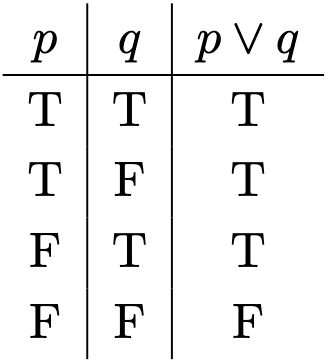
We can verify that 

The disjunction share many properties with the conjunction. In fact, one key result that connects (pun intended) all three connectives 
Theorem 1 (de Morgan’s Laws). Let 

Proof. For the first property, we use the following truth table argument:
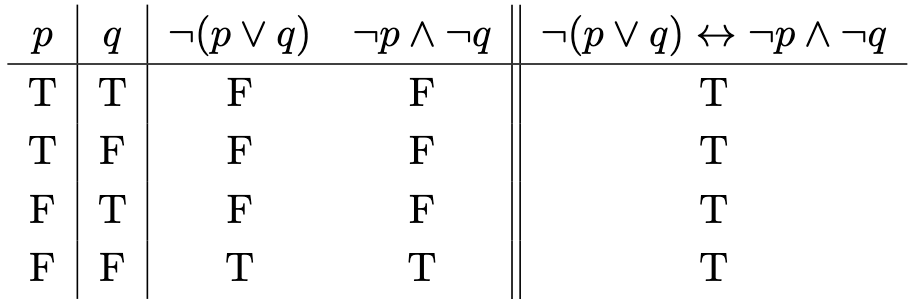
For the second property, we apply the first property but replace 


Negating both sides and applying the double negative property again,

These automatically yield the disjunction properties.
Corollary 1. Let 

Proof. We illustrate the proof of the first property. Applying double negatives, de Morgan’s laws, and commutativity of 

The second property follows similarly.
The conjunction and disjunction connectors distribute (i.e. split) over each other.
Theorem 2. Let 

Proof. For the first property, observe that the results hold for 

The disjunction is intimately connected to the implication, and has massive implications in studying logic, pun intended.
Theorem 3. Let 

Proof. One can the first result by substituting
These results affords us an incredibly powerful result, which is to chain logical implications with one another.
Theorem 4. Let

To abbreviate, we assume the following order of operations when parentheses are omitted in descending priority: 
Proof. Applying the various logical properties,

Can we chain biconditionals? That is, if 


Lemma 1. For propositional variables

Proof. For the first result, first verify that 


For the second result (i.e. the second 


Here, we used the results 

Lemma 2. For propositional variables 

Proof. Writing the implication as a disjunction,

With these tools in place, we can now prove our main result for the biconditional.
Theorem 5. Let

Proof. Unraveling the previous lemmas,

Why did we care about logic? We have completed what amounts to verification of various truth values, given certain combinations of propositional variables. We even derived several useful tautologies. These tautologies form the bedrock of proof techniques, which are the ligaments of mathematics. We discuss this next time.
—Joel Kindiak, 16 Nov 24, 2034H
 KindiakMath
Leave a comment