Questions have not been uploaded due to copyright reasons. Do comment if you spot any errors.
Question 1. Sequences and Series
Solution. (a) Setting 

(b) Using summation notation,

Solving the equation yields 
Question 2. Arithmetic and Geometric Progression
Solution. (a) Let 


For the next 


Solving the system of linear equations yields 

(b) By considering the ratio of consecutive terms,

which is constant. Therefore, the sequence having a common ratio 
Question 3. Complex Numbers
Solution. (a) We first compute the modulus and argument of 

Therefore,

(b) The Argand diagram is drawn below.
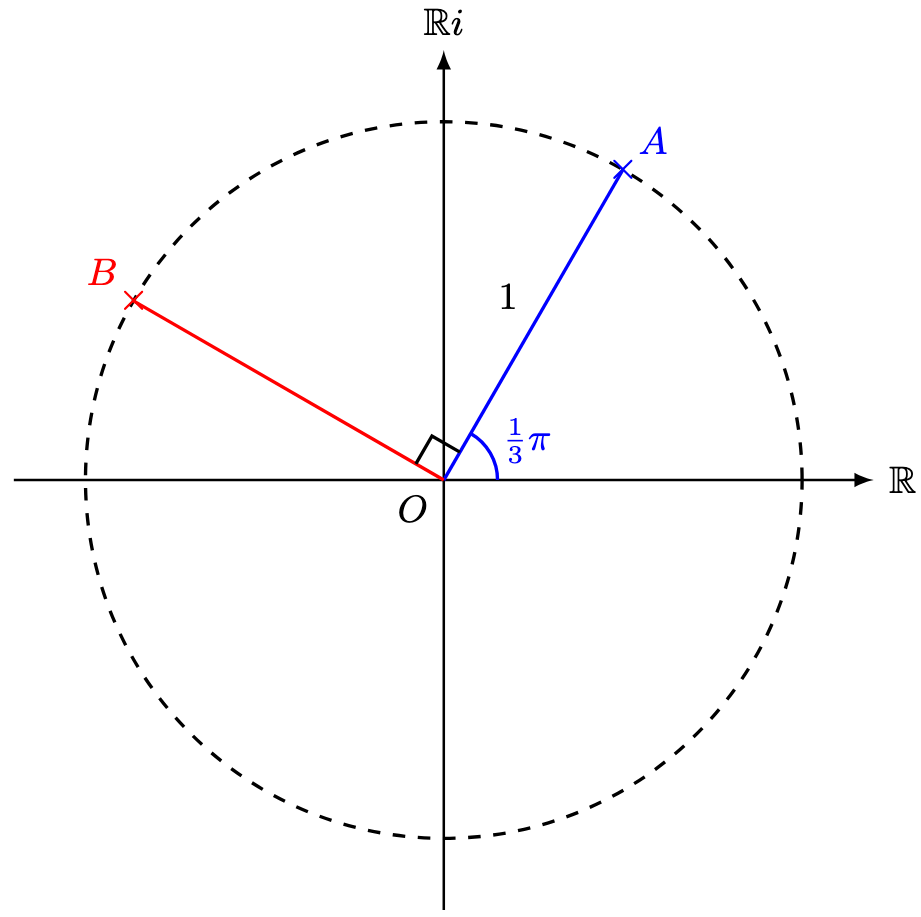
The point 

Question 4. Optimisation
Solution. (a) We first write the function as 

At the turning point, 

(b) We use the product rule again to obtain

At the turning point, 

Hence, the turning point is a local minimum.
Question 5. Inequalities
Solution. (a) Make the substitution 

Therefore, 


(b) By part (a),

We first calculate the indefinite integral for convenience:

Since 

Question 6. Radioactive Decay
Solution. (a) Using the method of separable variables,

By the question, setting 

Furthermore, 


(b) Letting 

Therefore the plant died 
Question 7. Volume of Revolution
Solution. (a) Using linearity and the product rule,

(b) Using (a),

At the 


![\begin{aligned}V_1 &= \pi \int_1^e (\ln x)^2\, \mathrm dx \\ &= \pi \left( \left[\underbrace{ (x \ln x - x) }_{\mathrm I} \cdot \underbrace{ \ln x }_{\mathrm S}\right]_1^e - \int_1^e \underbrace{ (x \ln x - x) }_{\mathrm I} \cdot \underbrace{ \frac 1x }_{\mathrm D}\, \mathrm dx \right) \\ &= \pi \left( (0 - 0) - \int_1^e (\ln x - 1)\, \mathrm dx \right) \\ &= \pi \int_1^e (1 - \ln x )\, \mathrm dx \\ &= \pi [ x - (x \ln x - x)]_1^e \\ &= \pi [ 2x - x \ln x ]_1^e \\ &= \pi \cdot ( (2e - e) - (2 - 0) ) \\ &= \pi (e-2)\, \text{units}^3.\end{aligned}](https://s0.wp.com/latex.php?latex=%5Cbegin%7Baligned%7DV_1+%26%3D+%5Cpi+%5Cint_1%5Ee+%28%5Cln+x%29%5E2%5C%2C+%5Cmathrm+dx+%5C%5C+%26%3D+%5Cpi+%5Cleft%28+%5Cleft%5B%5Cunderbrace%7B+%28x+%5Cln+x+-+x%29+%7D_%7B%5Cmathrm+I%7D+%5Ccdot+%5Cunderbrace%7B+%5Cln+x+%7D_%7B%5Cmathrm+S%7D%5Cright%5D_1%5Ee+-+%5Cint_1%5Ee+%5Cunderbrace%7B+%28x+%5Cln+x+-+x%29+%7D_%7B%5Cmathrm+I%7D+%5Ccdot+%5Cunderbrace%7B+%5Cfrac+1x+%7D_%7B%5Cmathrm+D%7D%5C%2C+%5Cmathrm+dx+%5Cright%29+%5C%5C+%26%3D+%5Cpi+%5Cleft%28+%280+-+0%29+-+%5Cint_1%5Ee+%28%5Cln+x+-+1%29%5C%2C+%5Cmathrm+dx+%5Cright%29+%5C%5C+%26%3D+%5Cpi+%5Cint_1%5Ee+%281+-+%5Cln+x+%29%5C%2C+%5Cmathrm+dx+%5C%5C+%26%3D+%5Cpi+%5B+x+-+%28x+%5Cln+x+-+x%29%5D_1%5Ee+%5C%5C+%26%3D+%5Cpi+%5B+2x+-+x+%5Cln+x+%5D_1%5Ee+%5C%5C+%26%3D+%5Cpi+%5Ccdot+%28+%282e+-+e%29+-+%282+-+0%29+%29+%5C%5C+%26%3D+%5Cpi+%28e-2%29%5C%2C+%5Ctext%7Bunits%7D%5E3.%5Cend%7Baligned%7D&bg=ffffff&fg=000&s=0&c=20201002)
(c) The curve 


Remark 1. The exact volume for 
Question 8. Vectors
Solution. (a) We first write 

The line 


The foot of perpendicular 

Therefore,

(b) Let 

Therefore,

(c) The normal vector of 

The acute angle 


Question 9. Power Series
Solution. (a) Using implicit differentiation,

(b) Using implicit differentiation two more times,

Setting 

Therefore, the Maclaurin series for 


(c) Differentiating term-by-term,

Setting 


Question 10. Functions
Solution. (a) The graph has asymptotes 


(b) We first use algebra (or long division) to obtain

Therefore, we make the following transformations:
- Translate by
- Scale by a factor of
parallel to the
- Translate by
units in the positive
(c) Denote 

Furthermore, 
(d) Given 

Since 

Question 11. Roller Coaster
Solution. (a) Differentiating with respect to 

By an application of the chain rule,

(b) (i) At 


Therefore, 
(b) (ii) The 


(c) (i) We solve the equation

Therefore, 


respectively. Hence, 
(c) (ii) Furthermore, 
(c) (iii) Consequently, 
(d) The 

Therefore, 

the margin of error 

In particular, we require

which does not hold. In particular, this section of the track does not satisfy the safety condition.
Question 12. Complex Numbers
(a) Since the coefficients of the given polynomial equation are all real, by the conjugate root theorem, a second root is given by 
(b) Given 


Therefore, substituting

Comparing real and imaginary parts,

Solving the system of linear equations, 
The given polynomial has a quadratic factor given by

Therefore, we factorise

Therefore, the third root is 
(c) Dividing by 

Therefore, 

For 

Finally, for 


—Joel Kindiak, 4 Nov 25, 1525H
 KindiakMath
Leave a comment