Nontrivial Rates of Change

Big Idea

The rate of change of a quantity x(t) in terms of time t is \displaystyle \frac{\mathrm dx}{\mathrm dt}. Furthermore, given y \equiv y(x), the chain rule yields

\displaystyle \frac{\mathrm dy}{\mathrm dt} = \frac{\mathrm dy}{\mathrm dx} \cdot \frac{\mathrm dx}{\mathrm dt}.

Questions

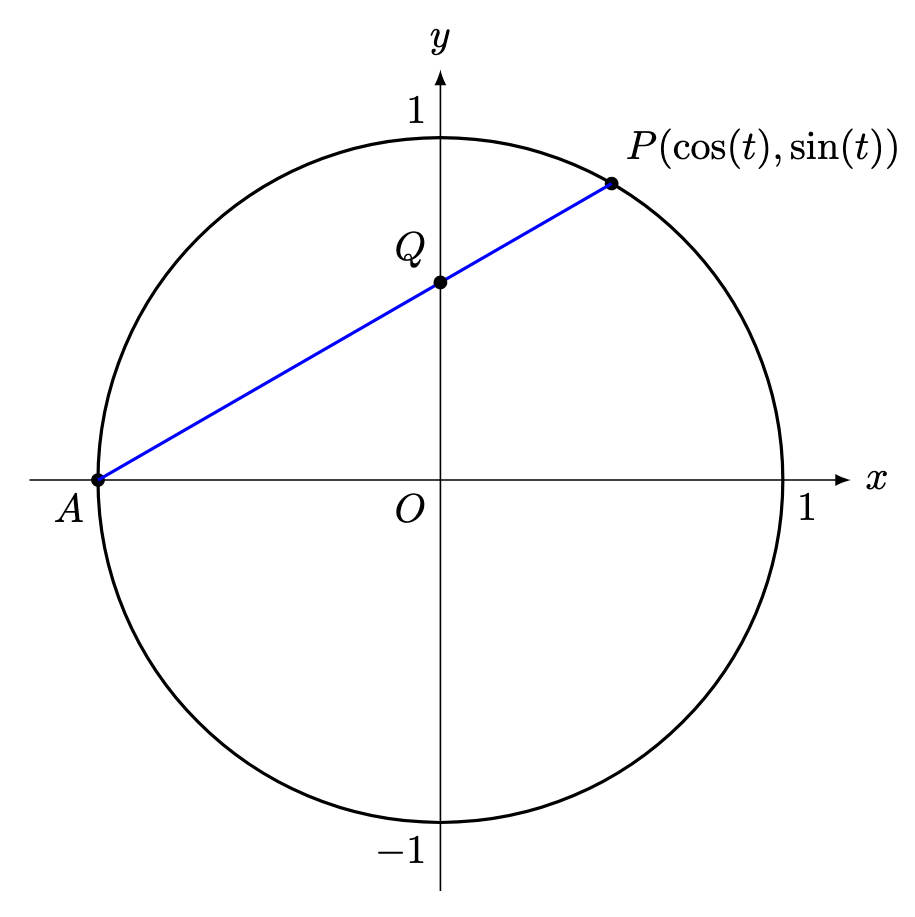
Question 1. The point P(x, y) above the y-axis at time t is defined by the equations

x = \cos (t), \quad y = \sin (t),\quad 0 \leq t < \pi.

Define A(-1, 0). Let Q denote the intersection of AP with the y-axis.

Evaluate the rate of change of the y-coordinate of Q at the point the gradient of the tangent to the curve at P is -1/\sqrt{3}.

(Click for Solution)

Solution. Differentiating with respect to t,

\displaystyle \frac{\mathrm dx}{\mathrm dt} = -\sin(t),\quad \frac{\mathrm dy}{\mathrm dt} = \cos(t).

By the chain rule,

\begin{aligned} \frac{\mathrm dy}{\mathrm dt} &= \frac{\mathrm dy}{\mathrm dx} \cdot \frac{\mathrm dx}{\mathrm dt} \\ \cos(t) &= -\frac 1{\sqrt 3} \cdot -\sin(t)\\ \tan(t) &= \sqrt{3} \\ t &= \pi/3. \end{aligned}

Let y_Q denote the y-coordinate of Q. The equation of AP is given by

\displaystyle \frac{ y - 0 }{ x- (-1) } = \frac{\sin(t) - 0}{\cos(t) - (-1)}\quad\Rightarrow \quad y = \frac{\sin(t)}{1 + \cos(t)} \cdot (x+1).

At the y-axis, x = 0, so that

\displaystyle y_Q = \frac{\sin(t)}{1 + \cos(t)}.

Applying the quotient rule,

\begin{aligned} \frac{\mathrm dy_Q}{\mathrm dt} &= \frac{\mathrm d}{\mathrm dt} \left( \frac{\sin(t)}{1 + \cos(t)} \right) \\ &= \frac{\displaystyle (1 + \cos(t)) \cdot \frac{\mathrm d}{\mathrm dt}(\sin(t)) - \sin(t) \cdot \frac{\mathrm d}{\mathrm dt}(1 + \cos(t))}{( 1 + \cos(t) )^2} \\ &= \frac{(1 + \cos(t)) \cdot \cos(t) - \sin(t) \cdot (0 + (-\sin(t))}{( 1 + \cos(t) )^2} \\ &= \frac{(\cos(t) + \cos^2(t)) + \sin^2(t) }{( 1 + \cos(t) )^2} \\ &= \frac{\cos(t) + (\cos^2(t) + \sin^2(t)) }{( 1 + \cos(t) )^2} \\ &= \frac{ \cos(t) + 1 }{( 1 + \cos(t) )^2} = \frac{ 1 }{ 1 + \cos(t) }. \end{aligned}

Therefore, at t = \pi/3, since \cos(t) = 1/2,

\begin{aligned} \frac{\mathrm dy_Q}{\mathrm dt} &= \frac{ 1 }{ 1 + 1/2 } = \frac 23\, \text{units}/\text{s}. \end{aligned}

Alternate Solution. Using double-angle formulae,

\displaystyle y_Q = \frac{\sin(t)}{1 + \cos(t)} = \frac{2 \sin(t/2) \cos (t/2)}{2 \cos^2(t/2)} = \tan(t/2).

Differentiating,

\displaystyle \frac{ \mathrm dy_Q }{ \mathrm dt } = \frac 12 \sec^2(t/2).

The rest of the question follows as per usual.

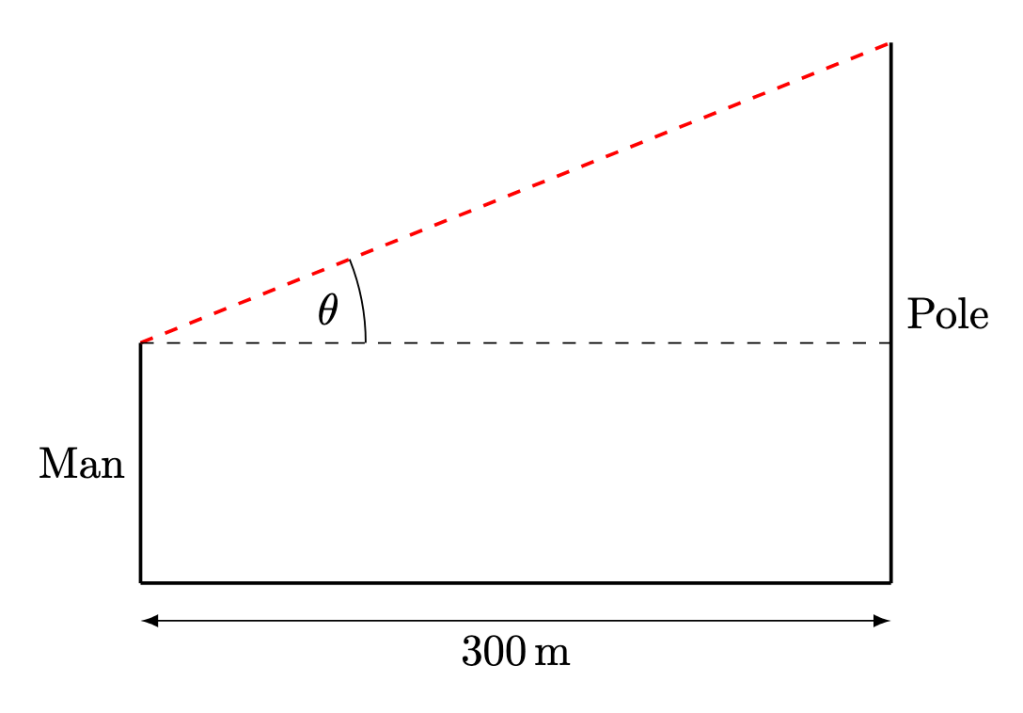
Question 2. A man of height 1.6\, \text{m} metres is currently 300\, \text{m} away from a pole of height 3.6\, \text{m}. He runs in a straight line towards the pole at a speed of 3\, \text{m}/\text{s}. Let \theta denote the angle of elevation from the man to the top of the pole.

Evaluate the rate of change of \theta when the man is at the pole.

(Click for Solution)

Solution. The man’s distance from the pole at time t is given by (300 - 3t) metres. By considering the height difference between the pole and the man,

\displaystyle \tan(\theta(t)) = \frac{3.6-1.6}{300 - 3t}\quad \Rightarrow \quad \theta(t) = \tan^{-1}\left( \frac{2}{3(100- t)} \right).

Applying the chain rule,

\begin{aligned} \frac{\mathrm d\theta}{\mathrm dt} &= \frac{ \mathrm d }{ \mathrm dt } \left( \tan^{-1}\left( \frac{2}{3(100- t)} \right) \right) \\ &= \frac 1{1 + \left( \frac{2}{3(100- t)} \right)^2} \cdot \frac{\mathrm d}{\mathrm dt}\left( \frac{2}{3(100- t)} \right) \\ &= \frac 1{1 + \frac{4}{9(100- t)^2}} \cdot \frac 23 \cdot \frac{\mathrm d}{\mathrm dt}\left( (100-t)^{-1} \right) \\ &= \frac {9(100- t)^2}{4 + 9(100- t)^2} \cdot \frac 23 \cdot (-1)(100-t)^{-2} \cdot \frac{\mathrm d}{\mathrm dt}(100 - t) \\ &= \frac {9(100- t)^2}{4 + 9(100- t)^2} \cdot \frac 23 \cdot (-1)(100-t)^{-2} \cdot (-1) \\ &= \frac {6}{4 + 9(100- t)^2}.  \end{aligned}

At the pole, t = 100, so that

\displaystyle \frac{\mathrm d\theta}{\mathrm dt} = \frac 6{4 + 9(100-100)^2} = 1.5\, \text{rad}/\text{s}.

—Joel Kindiak, 4 Sept 25, 1149H

,

Published by


Leave a comment