Big Idea
To maximise (or minimise) a quantity 

and check that the corresponding value 
- a local maximum is obtained at
when
,
- a local minimum is obtained at
.
Recall that we denote

for brevity.
Questions
Question 1. Evaluate the area of the largest rectangle contained inside the ellipse graphed below.
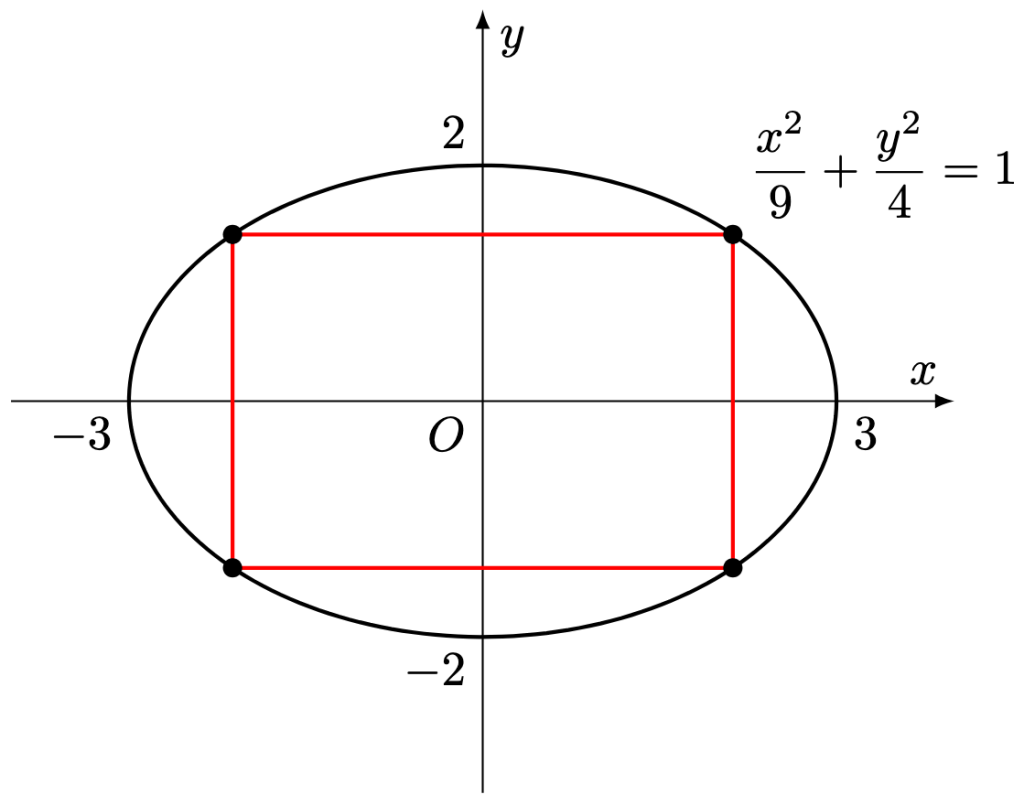
(Click for Solution)
Solution. Given 


On the other hand, given the ellipse 

Therefore,

By the zero-derivative condition, if 


Plugging back into the equation of the ellipse,

since 


To apply second derivative test, we differentiate

so 

Question 2. The diagram below shows a movie theatre with a screen 

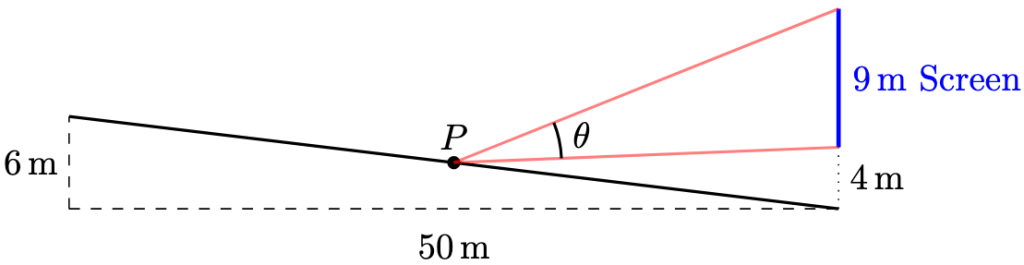
The permissible viewing area is 


(Click for Solution)
Solution. Let 

By observation,

We remark that if 


By the zero-derivative condition, if 

We need to (painfully) solve this equation:

since
To apply second derivative test, we differentiate again:

When 


so indeed 
Question 3. Determine the smallest perimeter of a rectangle with area 
(Click for Solution)
Solution. Let 


Differentiating twice,

Solving 


Remark 1. The result remains true even if we consider rectangles of other areas; the rectangle with area 
Question 4. Given that 

(Click for Solution)
Solution. Define 

Solving 


so that 


Remark 2. Using the same technique, we can prove that for any 


with equality at 

Question 5. Given that 
(Click for Solution)
Solution. Define 

Therefore,
![\displaystyle 18x^2 - 35x^{-6} = 0 \quad \Rightarrow \quad x^8 = \frac{35}{18} \quad \Rightarrow \quad x = \sqrt[8]{ \frac{ 35 }{ 18 } },](https://s0.wp.com/latex.php?latex=%5Cdisplaystyle+18x%5E2+-+35x%5E%7B-6%7D+%3D+0+%5Cquad+%5CRightarrow+%5Cquad+x%5E8+%3D+%5Cfrac%7B35%7D%7B18%7D+%5Cquad+%5CRightarrow+%5Cquad+x+%3D+%5Csqrt%5B8%5D%7B+%5Cfrac%7B+35+%7D%7B+18+%7D+%7D%2C&bg=ffffff&fg=000&s=0&c=20201002)
since
Remark 3. In general, the value of 

—Joel Kindiak, 4 Sept 25, 1213H
 KindiakMath
Leave a comment