Here’s our question today: what is the sum of angles in a triangle?
Previously, we have seen how linear equations 


so that the line has gradient 


- If
, then
. In this case, if
, then
, and the line is vertical with
-intercept
.
We can make a few more basic observations about our lines below, properly constructed here, which uses many tools from linear algebra.
Firstly, we use the word “angle” to describe the amount of separation between two lines. The simplest case occurs when the two lines are at right angles (i.e. ortho-gonal) to each other. We use the symbol 

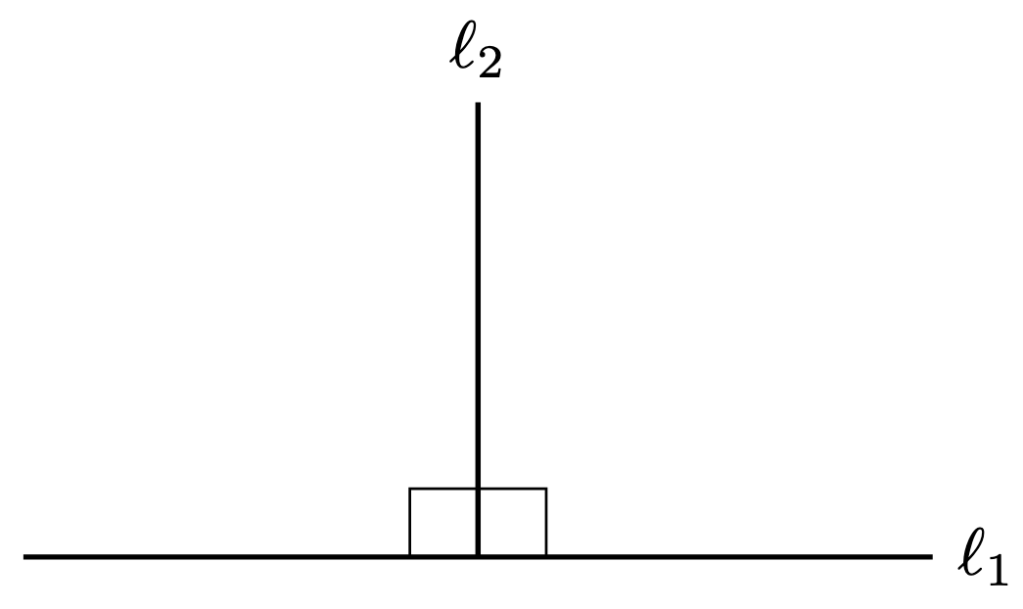
By convention, we declare one right angle to equal 


Definition 1. An angle 
- right if
,
- acute if
(i.e. smaller than a right angle),
- obtuse if
(i.e. larger than a right angle).
For example, the angle 

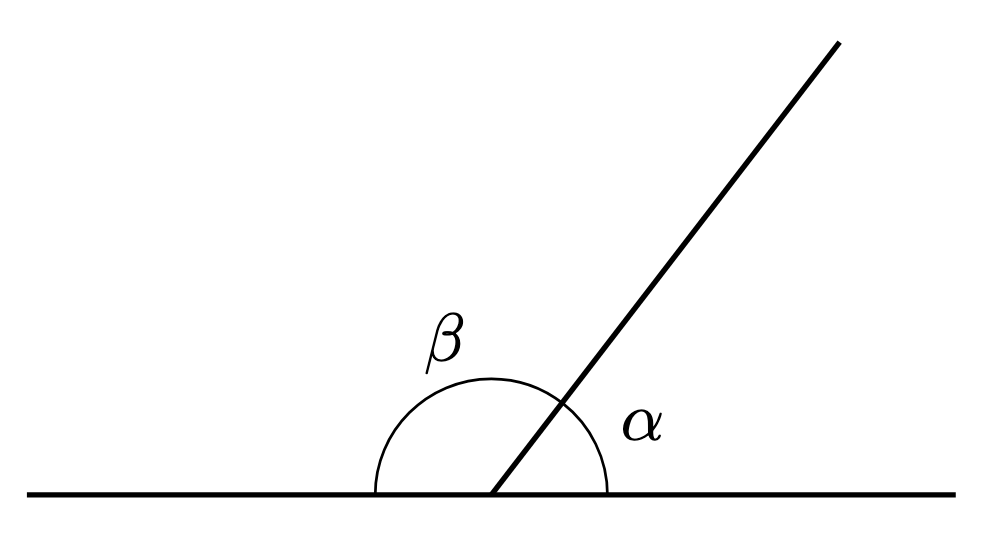
Eventually, we will consider angles that are reflex (i.e. if 
Remark 1. Usually, the Greek letter ‘theta’ 
Remark 2. We can formalise the idea of angles using calculus (i.e. the study of rates of change), discussed elsewhere. The choice of the number 

Consider two lines 
- We call two non-identical lines
.
- In this case, we will use the decorations
,
, etc to denote parallel lines.
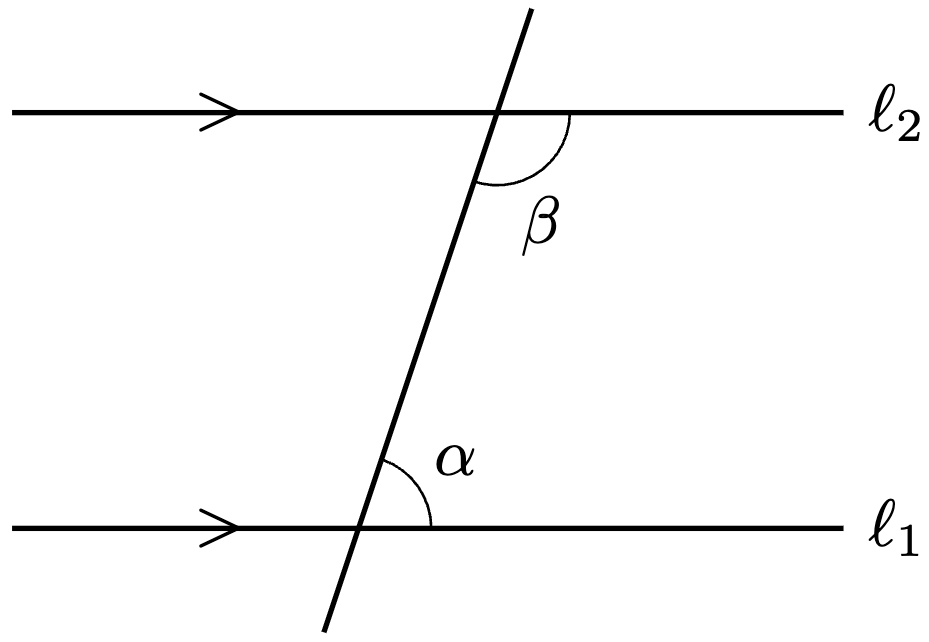
- We call the pair of angles
a pair of interior angles if
.
We make the key observation that assuming a flat screen,
We can also use our construction to conclude Playfair’s axiom:
Lemma 1 (Playfair’s Axiom). Let 


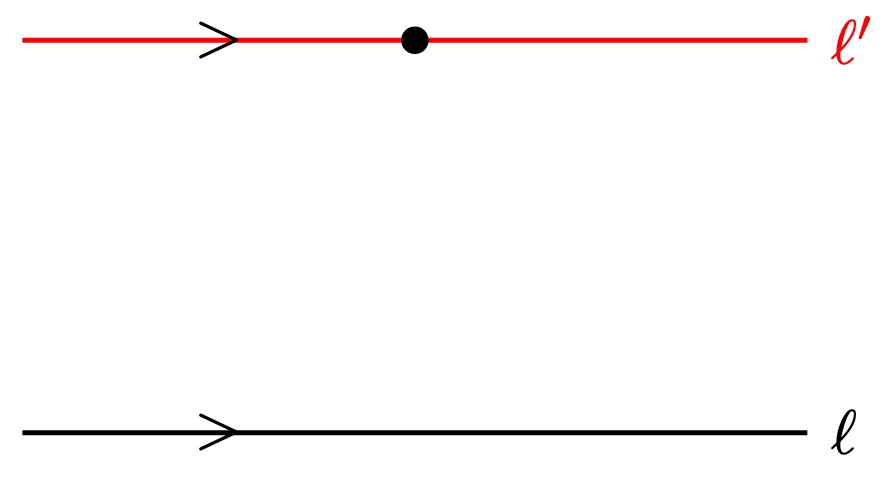
Proof. See this post.
Going forward, we will take advantage of these basic observations to derive several foundational tools for geometric inference, and resolve the sum-of-angles question that we started with.
Theorem 1. Given two non-parallel lines, the vertically opposite angles
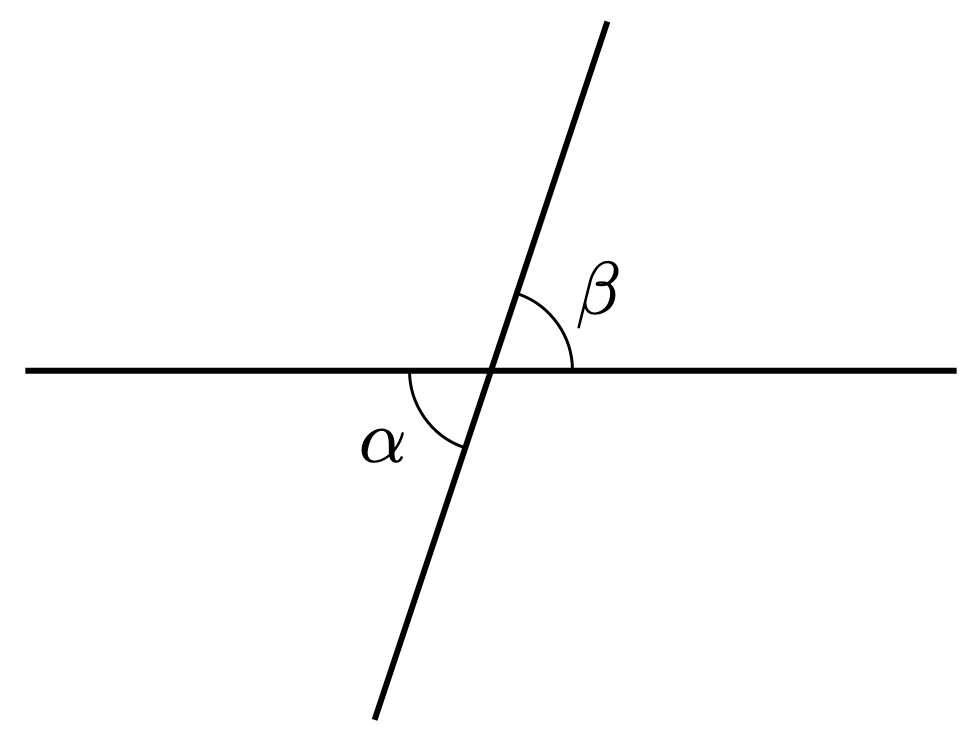
Proof. Construct the angle
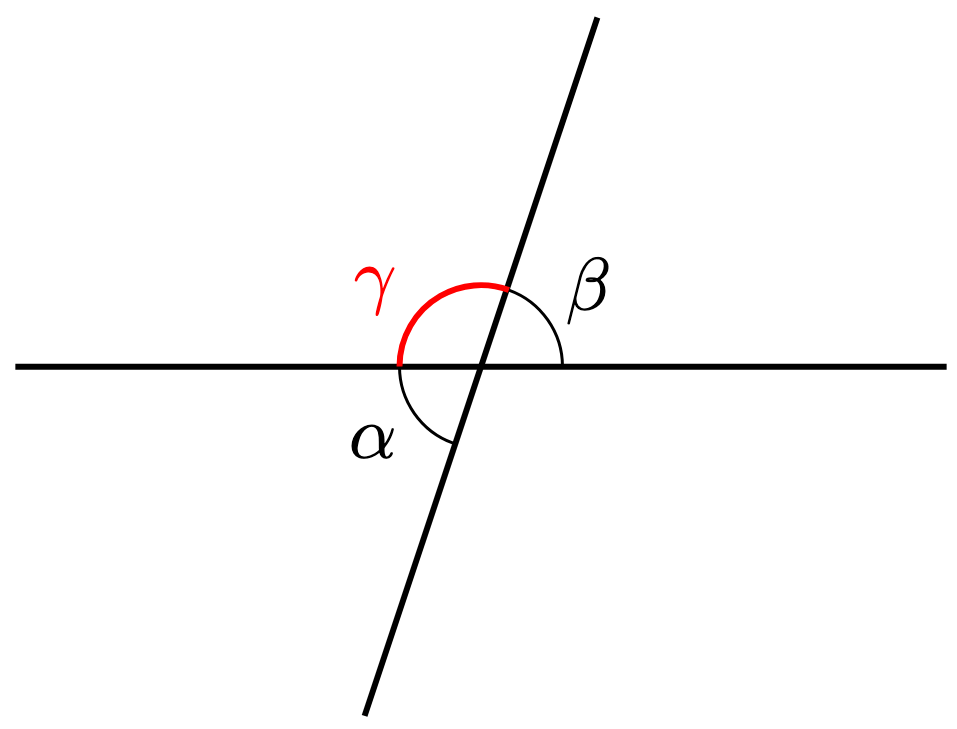
Since adjacent non-overlapping angles on a straight line sum to 

Therefore, since we can cancel the

Theorem 2. The two lines
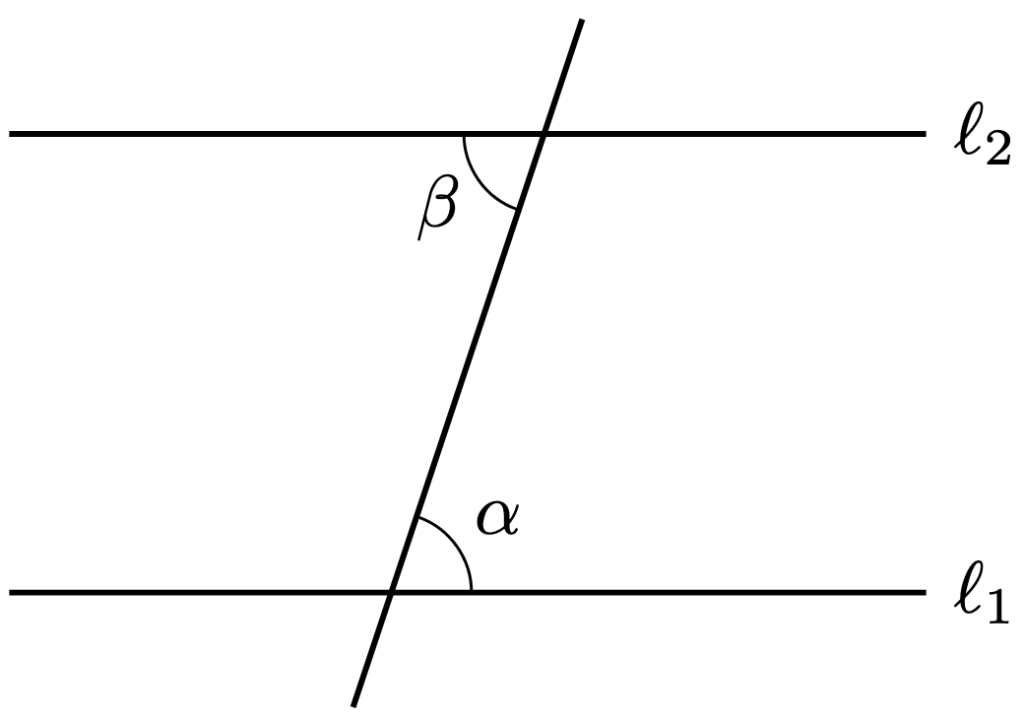
Proof. Construct the angle

Since adjacent non-overlapping angles on a straight line sum to

By the parallel postulate,

Using the cancellation law in Theorem 1,

Theorem 3. The two lines
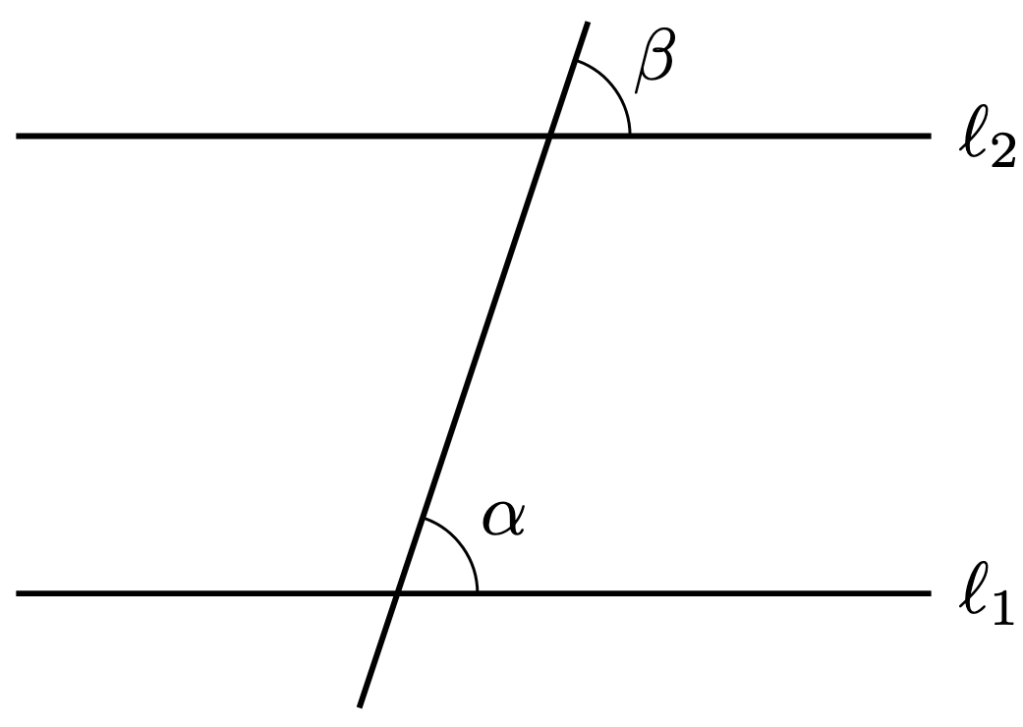
Proof. Construct the angle
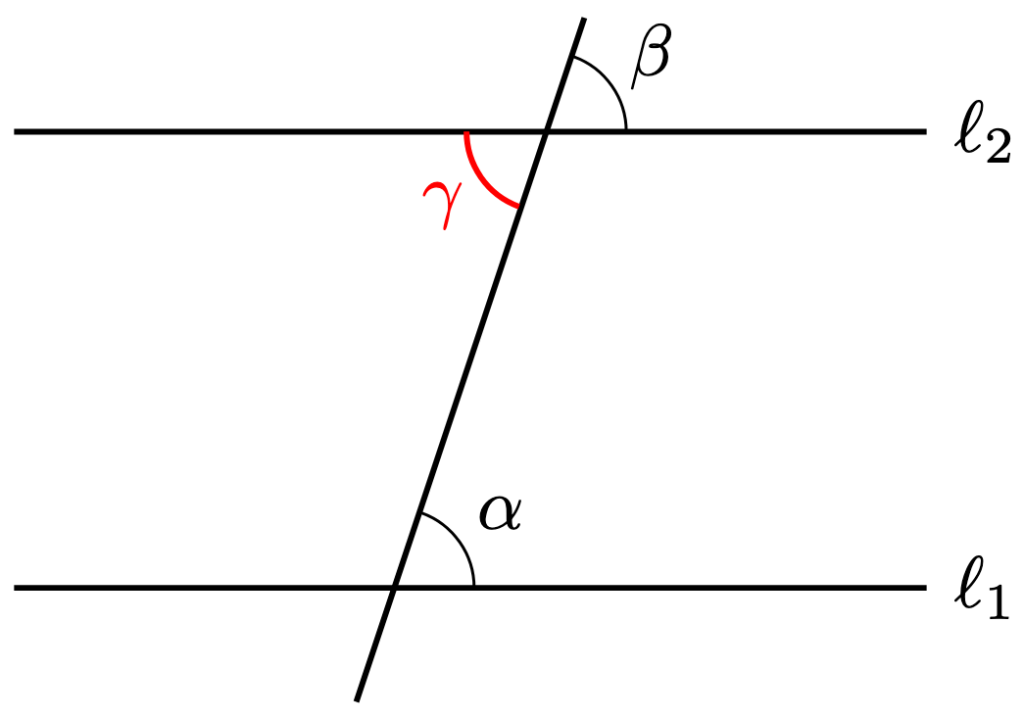
Then 

Furthermore, 

Remark 2. In most school problems, you would be hand-given the parallel lines 


At least, this working got me full credit when I was a secondary school student.
Theorem 4. The angles in a triangle sum to
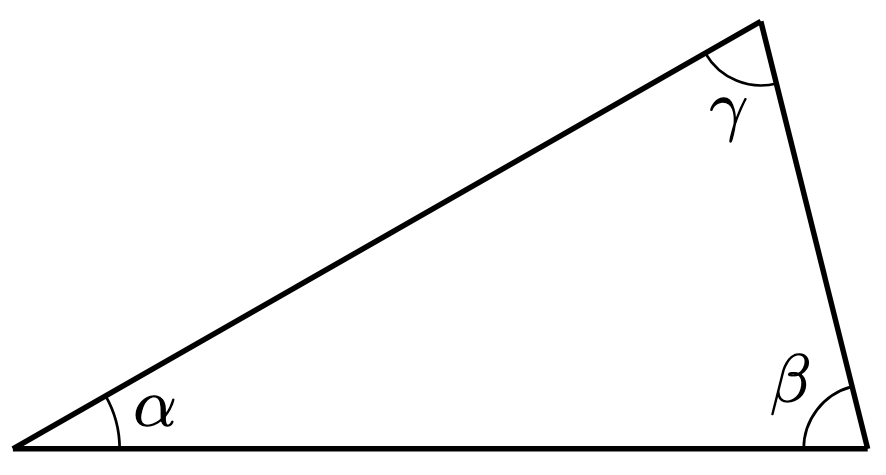
Proof. Consider the triangle below without loss of generality.
We need to prove that 
Use Playfair’s axiom to construct a line 
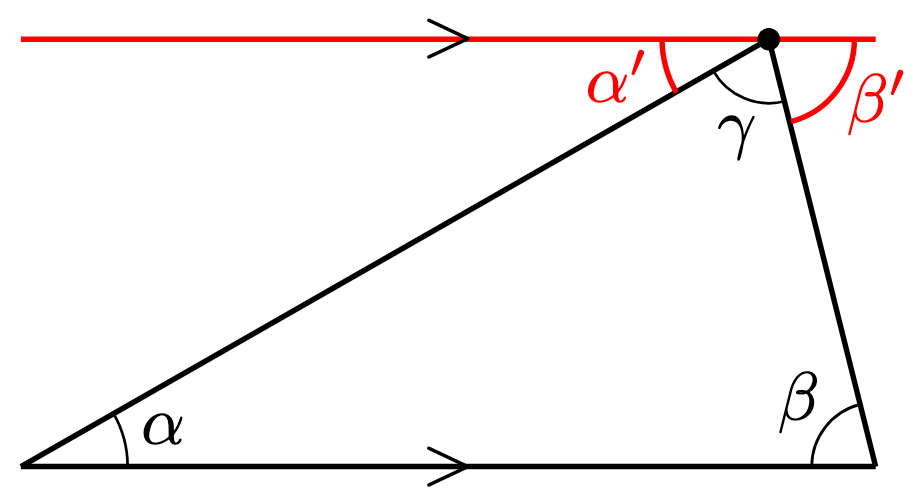
Construct the angles 

Since 

We also observe that 


Therefore, using the usual rules of addition,

While there are many results that can and should be proven using these basic results, we will delay them to connect their usefulness with other geometric objects. For example:
- The fact that a triangle is isosceles if and only if its base angles are equal is a consequence of our discussion on congruent triangles.
- Two angles in the same segment in a circle must equal each other, and we will explore this idea when considering circles in more depth.
Rather than explore these results all in one post, we will smatter them throughout our discussion in connection with other parts of geometry.
For now, we will use Theorem 4 to prove one of the most important results in secondary school (and hence higher-level) mathematics—Pythagoras’ theorem.
—Joel Kindiak, 6 Oct 25, 2100H
 KindiakMath
Leave a comment