Pythagoras’ theorem is the most important idea in geometry, all of mathematics even. But before discussing it, let’s ask a simple question.
Given a unit length 


Recall that 

(A proper construction, as with many other geometric ideas, relies on real analysis.)
Theorem 1 (Pythagoras’ Theorem). Given a right-angled triangle below,

We call the longest side with length 
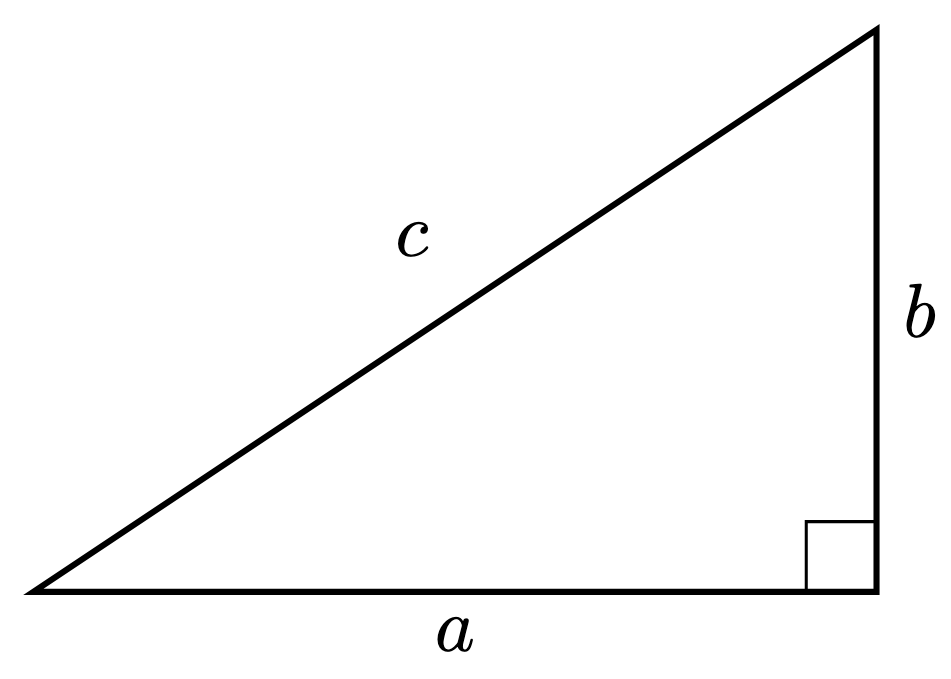
If 


Proof. Draw three extra identical triangles, so that we get a large square with side length 
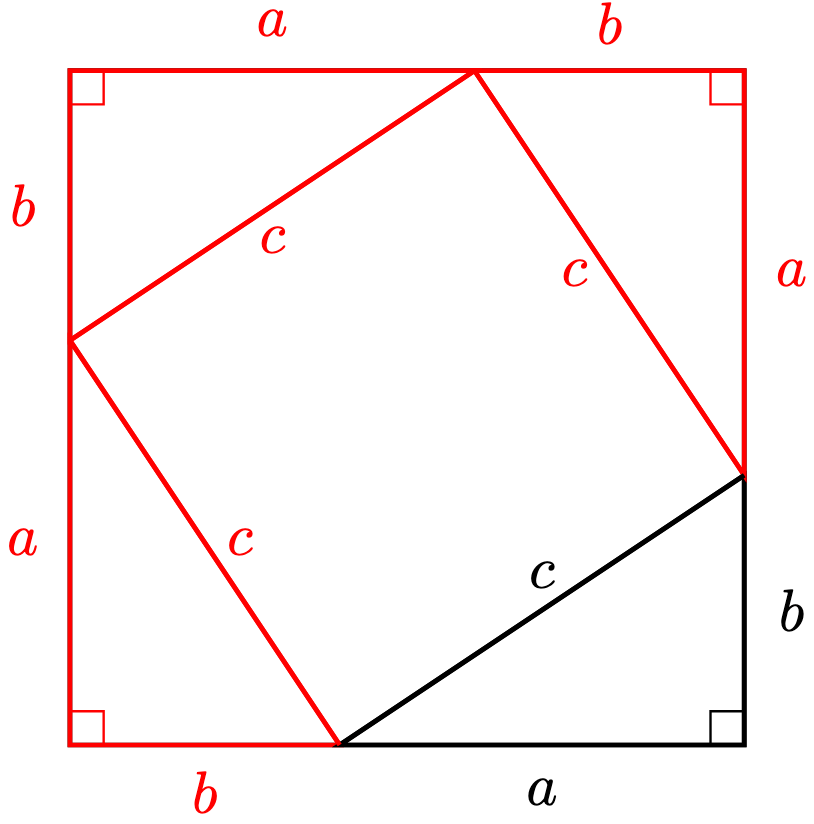
We claim that the slanted four-sided shape (i.e. a quadrilateral) in the middle is indeed a square.
Since the right-angled triangles are identical, we take two adjacent triangles and label their angles as follows.
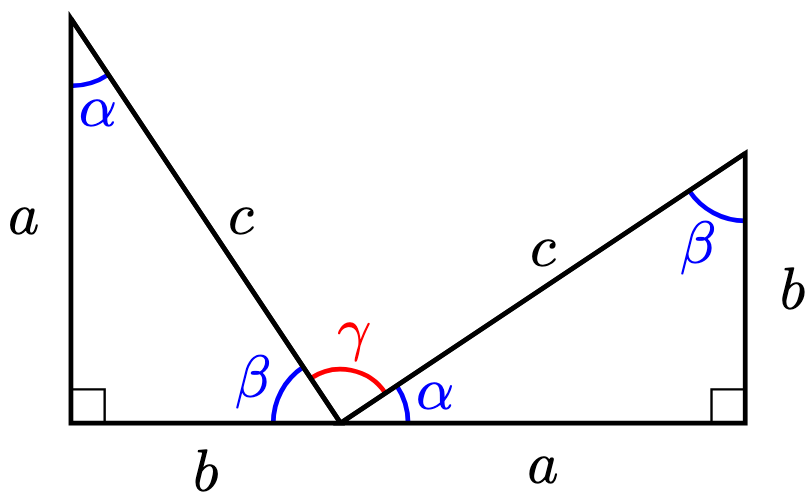
We want to prove that 

On the other hand, since the angles in a triangle sum to 

Therefore, using usual calculations,

Since the hypotenuses are all equal, we know that the quadrilateral has four equal sides. Hence, we have a square in the middle whose area is 

There are many applications of Pythagoras theorem that, in my humble opinion, are not worth discussing outside a tuition class. Yet, Pythagoras’ theorem can resolve for us a simple yet non-trivial question: what is a circle?
You might say, “a circle is a non-straight bendy or curvy line that closes in on itself”. This formulation is valid when formalised in the language of algebraic topology and homology theory.
Let’s keep things simple for now.
Definition 1. A circle with centre 

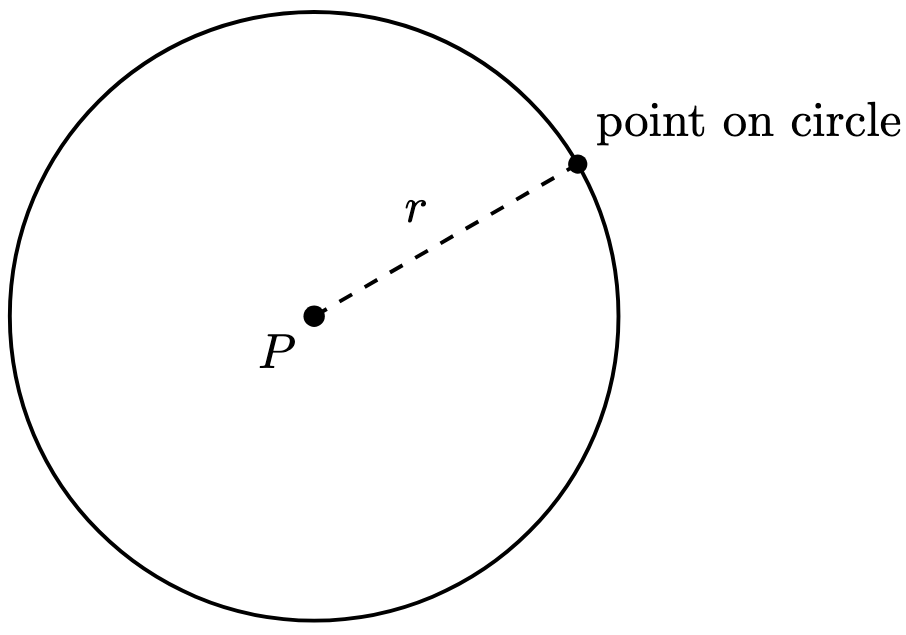
There is one problem with this definition: how do we calculate the distance between two points without requiring any additional measurement?
Lemma 1. The distance 


Proof Sketch. Suppose the special case 

Construct the right-angled triangle below.
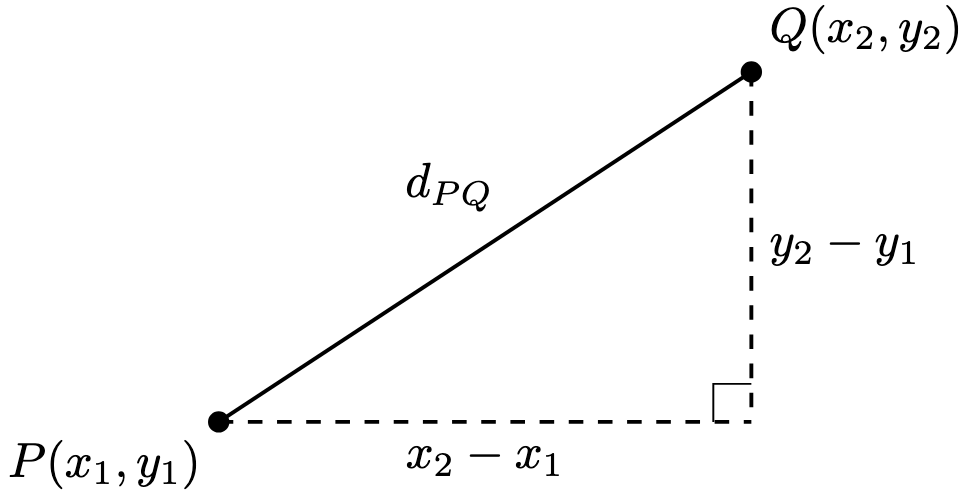
Then the hypotenuse of this right-angled triangle has length

Taking square roots gives the desired result.
The other cases involving 

Call any collection of points a graph.
Theorem 2. The graph 


In particular, the unit circle has equation 
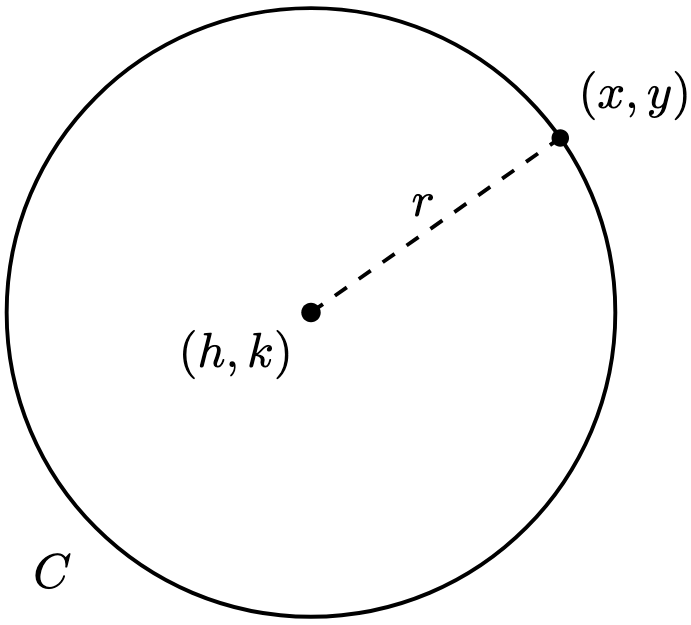
Proof. By definition, a point 

Squaring on both sides, since 

as required.
Once we can properly discuss circles, all sorts of interesting mathematics arise. But we will revisit circles later on.
For now, let’s answer the question we opened with: constructing
Theorem 3. Fix 


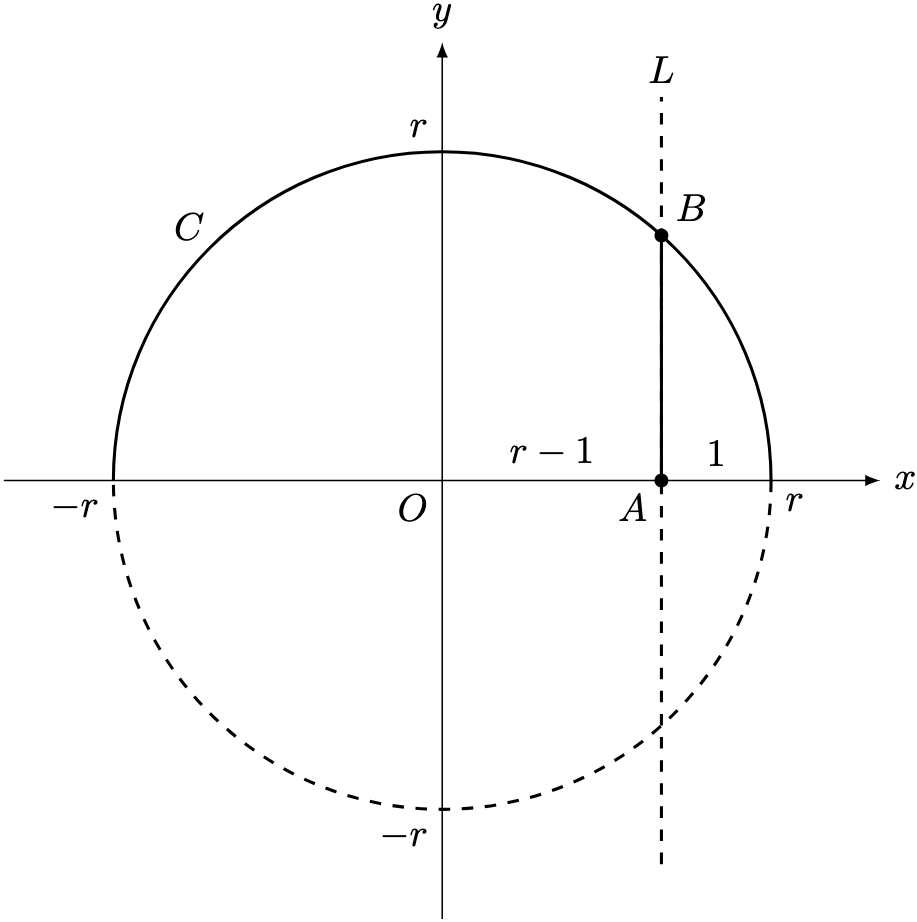
Then 
Proof. By Theorem 2,

To obtain the coordinates of 

and require 

Since 


There is a lot more to circles than this one example, but for now, we return to triangles in the next post. In particular, the isosceles triangle will be a central tool in our geometric expedition.
—Joel Kindiak, 10 Oct 25, 2026H
 KindiakMath
Leave a comment