This is our motivating question for today:
What is the size of an angle in a triangle whose side lengths are equal to each other?
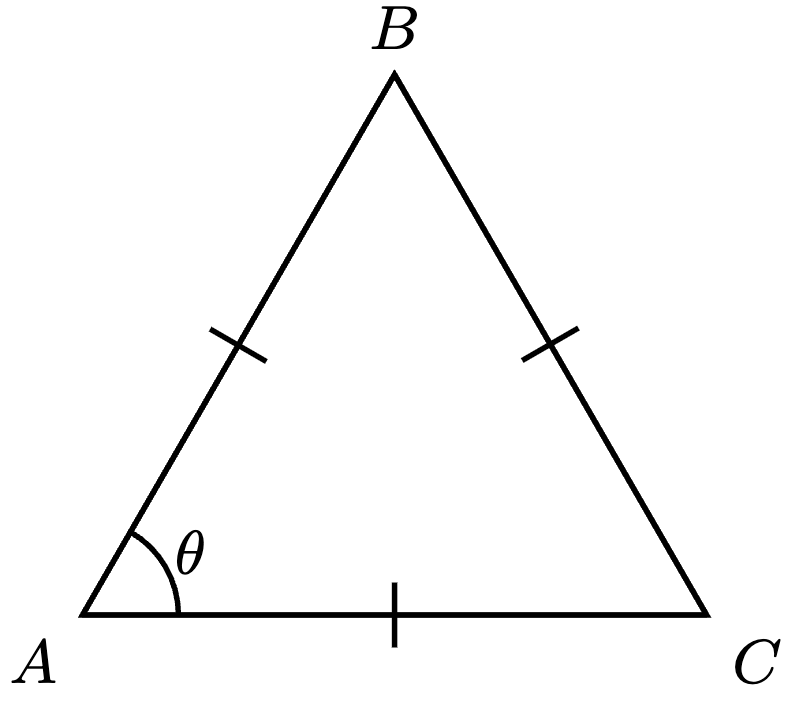
You might laugh at this question and reply: it is obviously

And your final answer is right—but how did you know that all three angles are equal to each other?
To answer this question properly, we need to properly discuss congruent triangles, from which we can discuss isosceles triangles, of which equilateral triangles are a special case.
Definition 1. Consider the two triangles in the diagram below.
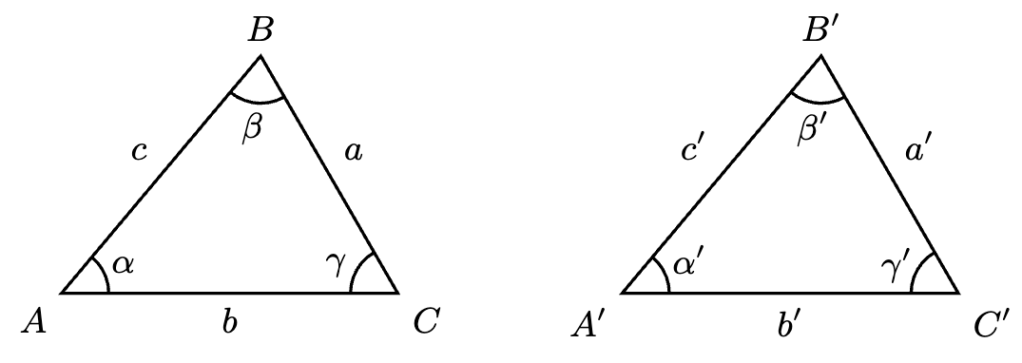
We say that 


In ordered tuple notation:

The topic of congruent triangles is commonly presented as a collection of “cookbook recipes” to determine if two triangles are effectively the same.
But how do we know that these recipes actually work? It turns out that we have the necessary “meta-recipes” to construct these recipes, and that’s what we shall do.
Theorem 1 (RHS Criterion). Let 

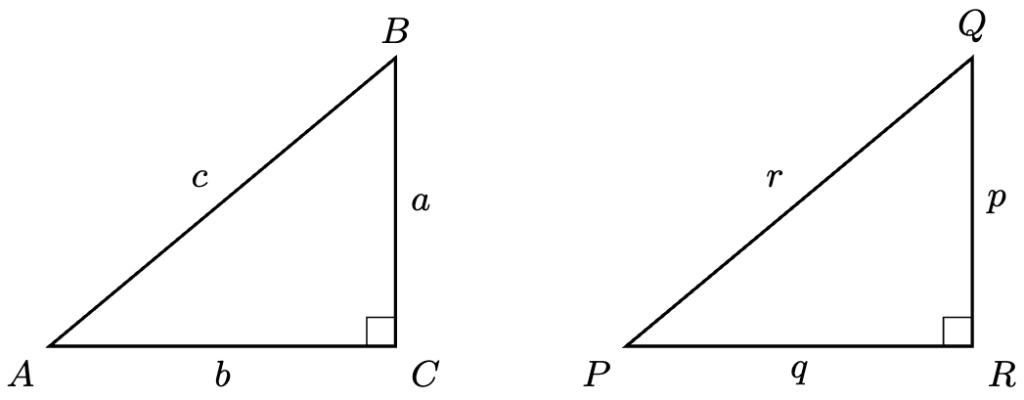
Then 

Proof. In the direction 
For the direction 

We will deal with the case 

We claim that the remaining two cases are impossible.
Suppose 

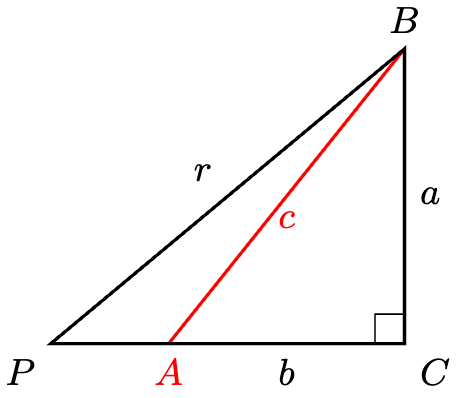
Hence, 


a contradiction, ruling out the case
The case 


Therefore, 
Finally, since angles in a triangle sum to 

Since all corresponding sides and angles equal each other,
For the case

so that 


which, as shown just now, implies
The RHS Criterion only describes congruence between right-angled triangles. Yet, more is true. Since right angles open our discussion on general angles, right-angled triangles also open our exploration of general triangles.
Theorem 2 (SAS Criterion). Let
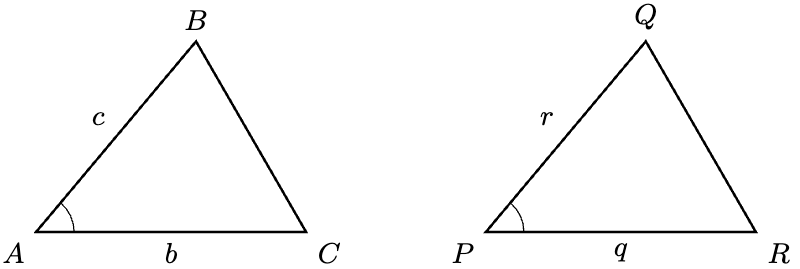
Then

Proof. The direction
For the direction

Construct the perpendicular heights (i.e. the altitudes) below.
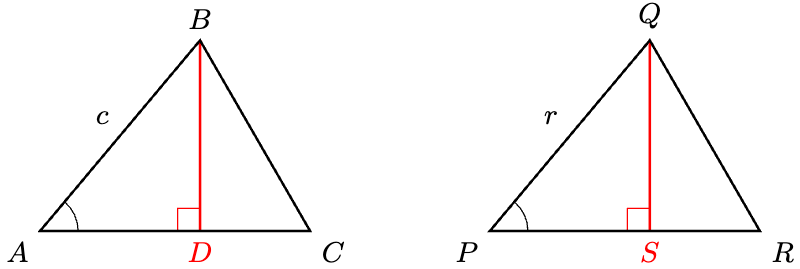
Using rotation, we can assume 

are all right-angled triangles. Our line of attack is as follows:
- Show that
.
- Deduce that
using the RHS Criterion.
- Similarly,
.
- Conclude that
The first point is the most challenging.
Since 


If 


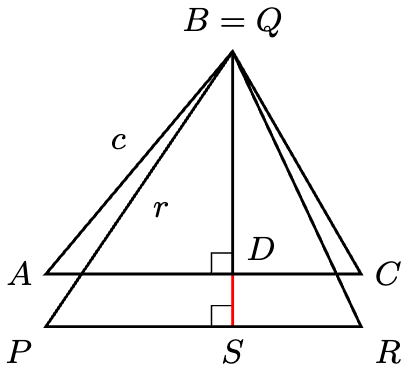
By Pythagoras’ theorem,

Since 


By the RHS Criterion,
We next establish

By Pythagoras’ theorem,

Since 


Finally,

Remark 1. This proof holds true in all three cases (i.e. 

Once we have a congruence criterion test that involves both sides and angles, we can derive many other useful congruence criterion tests.
Theorem 3 (SSS Criterion). Let
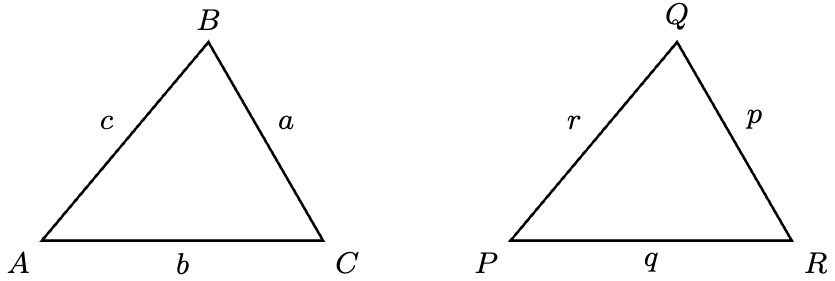
Then

Proof. The direction
For the direction 
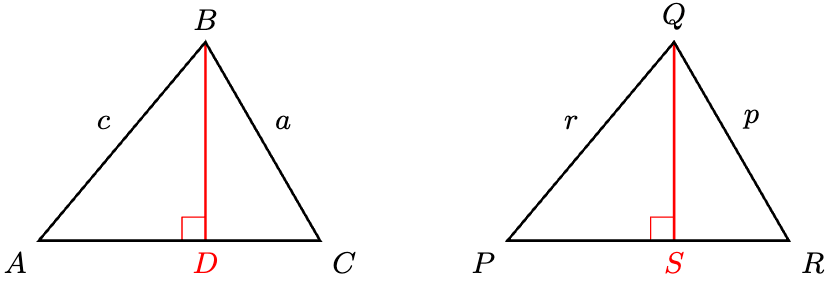
If 


so that 
By the RHS Criterion,

By hypothesis,

as required.
Example 1. Consider the triangle
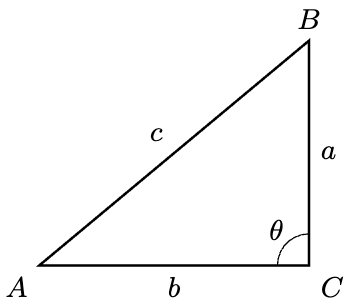
Prove that 

Solution. The direction
For the direction 


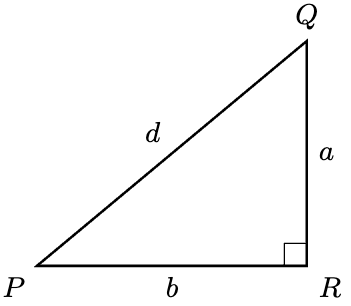
By the vanilla Pythagoras’ theorem, 

Since 

By the SSS Criterion,

Theorem 4 (ASA Criterion). Let
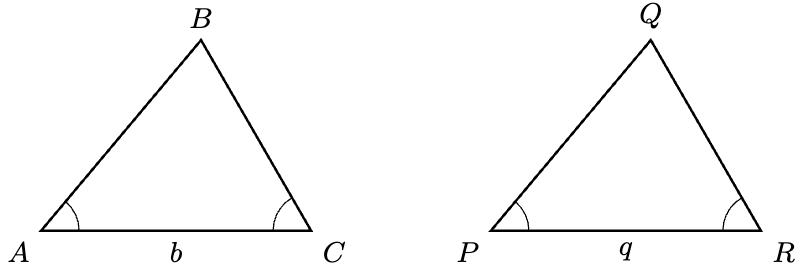
Then

Proof. It suffices to prove

Similar to the proof of Theorem 2, we claim that 

Since the corresponding angles 


Therefore, 
By hypothesis, 
Theorem 5 (AAS Criterion). Let
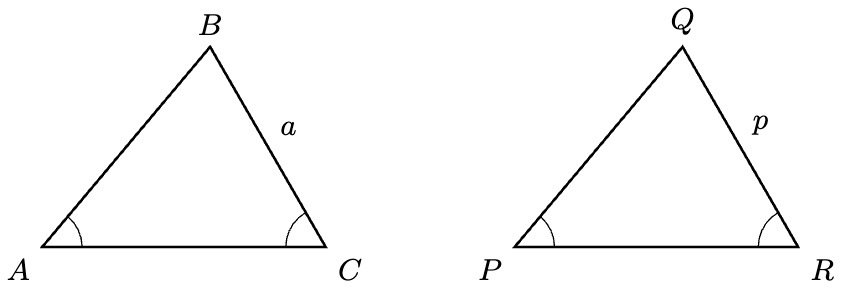
Then

Proof. Since angles sum to

Therefore, by the ASA Criterion,
Definition 2. A triangle is said to be isosceles if it has two sides with equal length.
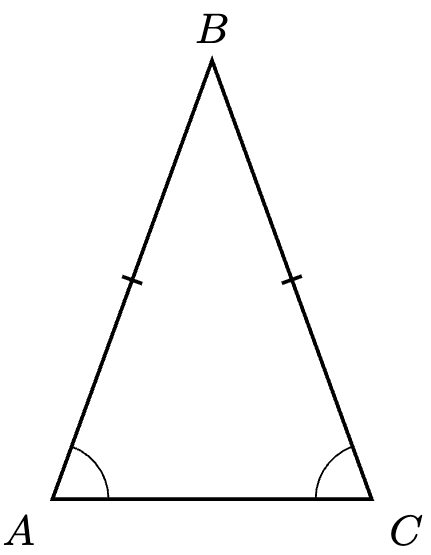
Example 2. Consider the triangle 

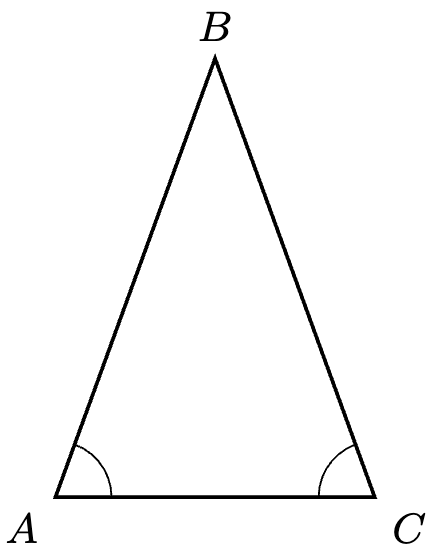
Prove that 

Solution. Our proof boils down to the analysis of 

We prove in two directions. For the direction 


The direction 


Definition 3. A triangle is said to be equilateral if all three sides have the same length.
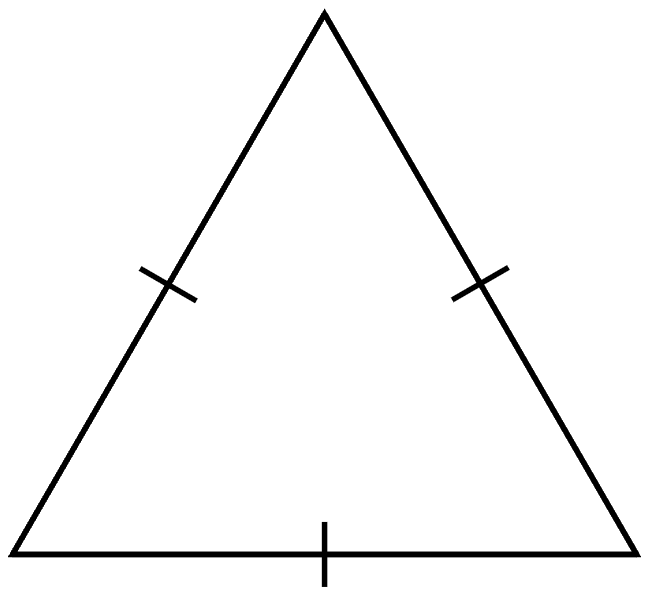
Example 3. Determine the size of any interior angle in an equilateral triangle.
Proof. Denote the equilateral triangle by 
Since 

Since 

Since the angles in a triangle sum to

Therefore,

That is, each angle in an equilateral triangle has a size of 
If the geometry on a triangle is fascinating, the geometry on a circle is even more astounding! We will visit the geometry of circles in the next post.
—Joel Kindiak, 14 Oct 25, 1920H
 KindiakMath
Leave a comment