The Rules of Shapes

If the sum of angles in a 3-sided polygon (i.e. a 3-gon / tri-gon / triangle) is 180^\circ, what is the sum of angles in an n-sided polygon (i.e. an n-gon)?

Theorem 1. The sum of interior angles in an n-gon is (n-2) \times 180^\circ.

Proof. In the case n = 3, we have an angle sum of 180^\circ = (3-2) \times 180^\circ, as required.

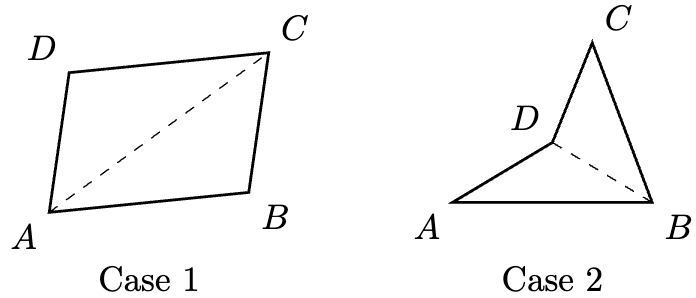
In the case n = 4, the key observation is to split the 4-gon into a triangle and a 3-gon.

In Case 1, there is no reflex interior angle. In Case 2, there is at least one reflex interior angle. In either case, since the interior angle sum of a 3-gon is 180^\circ, the 4-gon must have an interior angle sum of

\begin{aligned} 180^\circ + (3-2) \times 180^\circ &= (1 + (3-2)) \times 180^\circ \\ &= (4-2) \times 180^\circ = 360^\circ. \end{aligned}

Roughly speaking, we can generalise this case using mathematical induction. Suppose that a k-gon has interior angle sum of (k-2) \times 180^\circ. Then we can split the (k+1)-gon into a triangle and a k-gon. Since the triangle has interior angle sum of 180^\circ and the k-gon has interior angle sum of (k-2) \times 180^\circ, the (k+1)-gon has interior angle sum of

\begin{aligned} 180^\circ + (k-2) \times 180^\circ &= (1 + (k-2)) \times 180^\circ \\ &= ((k+1) - 2) \times 180^\circ. \end{aligned}

Therefore, if the result holds for k = 3, it holds for k = 4, and subsequently, k = 5, and so on and so forth. Therefore, any n-gon must have an interior angle sum of (n-2) \times 180^\circ.

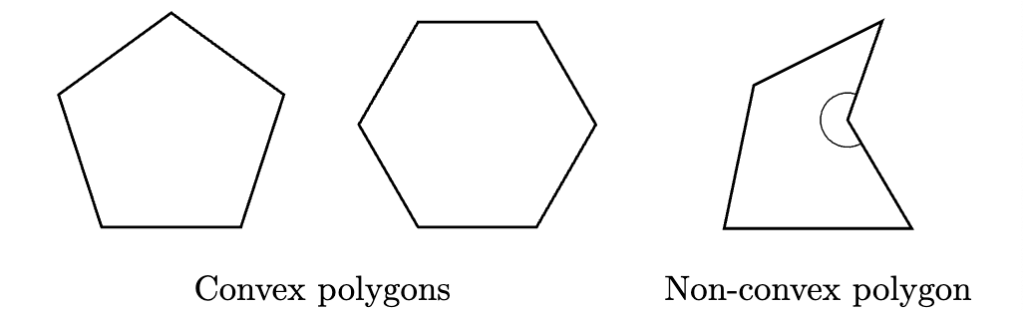
Definition 1. An n-sided polygon is convex if it does not have any reflex interior angle.

Theorem 2. The sum of exterior angles for any convex n-gon is 360^\circ.

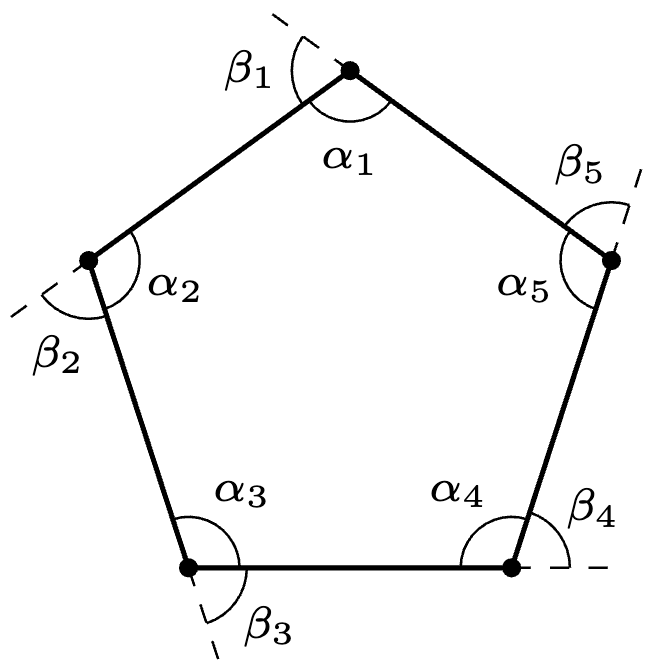
Proof. Recall that the exterior angle is the angle that lies on the same straight line as the interior angle that it is adjacent to (the diagram shows the case of a 5-gon, and there’s no requirement that the polygon be regular).

Let \alpha_k, \beta_k denote the k-th interior and exterior angle respectively. Since adjacent non-overlapping angles on a straight line sum to 180^\circ,

\alpha_k + \beta_k = 180^\circ.

Adding all n pairs of angles together,

\begin{aligned} (\alpha_1 + \beta_1) + \cdots + (\alpha_n +\beta_n) &= \underbrace{ 180^\circ + \cdots + 180^\circ }_{n} \\ (\alpha_1 + \cdots + \alpha_n) + (\beta_1 + \cdots + \beta_n) &= n \times 180^\circ \\ \text{(sum of interior angles)} + \text{(sum of exterior angles)} &= n \times 180^\circ \end{aligned}

By Theorem 1,

\text{(sum of interior angles)} = (n-2) \times 180^\circ.

Therefore, substituting into the original equation,

\begin{aligned}\text{(sum of exterior angles)} &= n \times 180^\circ - \text{(sum of interior angles)} \\ &= n \times 180^\circ - (n-2) \times 180^\circ \\ &= (n - (n-2)) \times 180^\circ \\ &= 2 \times 180^\circ = 360^\circ.  \end{aligned}

Definition 2. A polygon is regular if all of its interior angles are equal.

Corollary 1. The interior angle of a regular n-gon is (1-2/n) \times 180^\circ.

What about circles? Circles have an interesting cousin that we will care about a lot. Recall that a circle is a set of points that are located a fixed distance r, called the radius, away some fixed centre point.

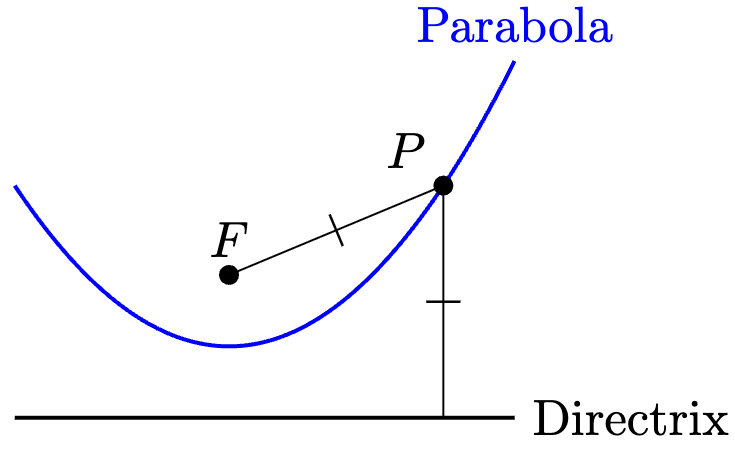
Definition 3. Let \ell be a point and F be a point not on \ell. A parabola with focus F and directrix \ell is the set of points whose distance to F and \ell are equal.

Theorem 3. Fix d > 0. The equation of a parabola with focus F(0, d) and directrix y = -d is given by x^2 = 4dy. In particular, it contains the point (0, 0).

Proof. Let P(x,y) be any point on the parabola. Using Pythagoras’ theorem,

FP = \sqrt{ (x - 0)^2 + (y - d)^2 }.

By definition of the distance to a line, its distance from \ell is given by \sqrt{(y+d)^2}. By the definition of a parabola,

\begin{aligned} \sqrt{ (x - 0)^2 + (y - d)^2 } &= \sqrt{(y+d)^2} \\ (x-0)^2 + (y-d)^2 &= (y+d)^2 \\ x^2 + y^2 - 2dy + d^2 &= y^2 + 2dy + d^2 \\ x^2 &= 4dy. \end{aligned}

Remark 1. Defining a := 1/(4d), we get the equation y = ax^2. Since it must pass through the points (0, 0) and (1,a) = (1, 1/(4d)), d decreases as a increases, so that the resulting parabola becomes steeper.

Theorem 4. Let a > 0, b, c be constants. Then the quadratic graph with equation y = ax^2 + bx + c will always be a parabola with some focus F(h, d) and horizontal directrix y = k - d, where h,k are constants in terms of a,b,c.

Proof. We claim that there exists real constants h, k in terms of a, b, c such that

y = a(x-h)^2 + k\quad \iff \quad y - k = a(x-h)^2.

In this case, we can define d := 1/(4a) and obtain a focus of F(h, d) and a directrix with equation y-k = -d \iff y = k - d.

To make our case, expand the right-hand side:

\begin{aligned} a(x-h)^2 + k &= a(x^2 - 2xh + h^2) + k \\ &= ax^2 - (2ah)x + (ah^2 + k) \\ &= ax^2 + bx + c. \end{aligned}

Therefore, ensure b = -(2ah) and c = ah^2 + k by setting

\displaystyle h := -\frac{b}{2a}, \quad k := c - ah^2.

If we expand the right-hand side of k, we get

\begin{aligned} k &= c - a \left( - \frac b{2a} \right)^2 \\ &= c - a \cdot \frac{b^2}{4a^2} \\ &= c - \frac{b^2}{4a} = -\frac{b^2 -4ac}{4a}, \end{aligned}

where the quantity \Delta := b^2 - 4ac is called the discriminant of the quadratic function ax^2 + bx + c. Finally, we have (h, k) as the turning point of the parabola.

Remark 1. The derivation of h, k is known as completing the square on the right-hand side.

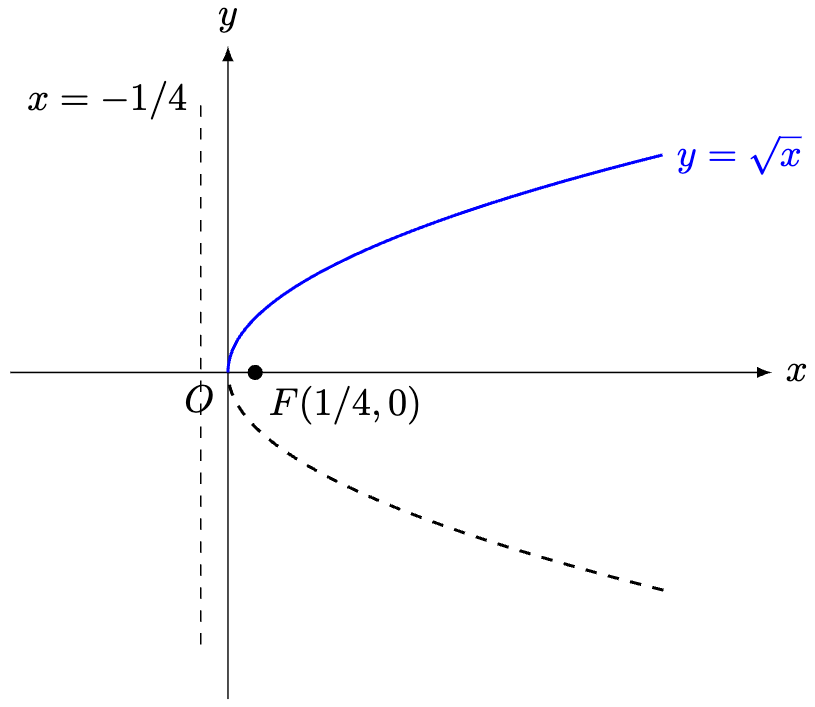
Corollary 2. The graph of y = \sqrt x lies on a parabola with focus (1/4, 0) and directrix x = -1/4.

Proof. By considering the equation y = x^2, we set (a,b,c) = (1,0,0) in Theorem 4 to obtain (h,k, d) = (0,0, 1/4), so that we recover a focus of (0, 1/4) and directrix of y = -1/4. Now replace (x,y) with (y,x) to obtain the desired result.

The cousins of the circle and the parabola would be the ellipse and hyperbola respectively, and together, these shapes constitute the four famous conic sections. Deriving their equations follows in spirit with the parabola, albeit requiring a little more tedious bookkeeping. Perhaps these graphs are better left as an exercise.

Before we proceed to the next large sub-topic in secondary school mathematics, namely algebra, it might help us to explore its bridge, linear algebra, with a little more detail. The main object of interest would be the vector, and vectors turn out to help us conceptualise many geometric ideas using coordinates and algebraic calculations.

—Joel Kindiak, 18 Oct 25, 2134H

Published by


Leave a comment