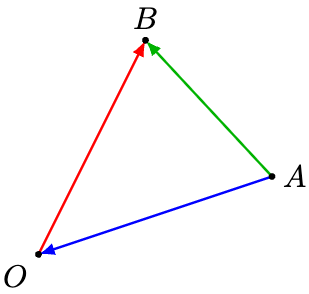
Visualising Vectors

So far, we have discussed numbers that:

  • either have no direction, or
  • have one dimension of direction.

We use positive numbers to represent either quantities with no direction, or quantities with some reasonable notion of “increase”. The larger the positive number, the larger the quantity.

Definition 1. For any positive number x, define the magnitude of x by |x| := x.

For the second case, we use negative numbers, namely numbers of the form -x for some positive number x, to represent quantities with some reasonable notion of “decrease”.

  • The quantity x describes the magnitude of the decrease.

Since x = -(-x), we have the following more refined definition of a magnitude.

Definition 2. For any real number x, define the magnitude of x by

|x| := \begin{cases} x, & x \geq 0, \\ -x, & x < 0. \end{cases}

We also call |x| the absolute value of x.

  • Note that we define |0| = 0; indeed, the number 0 should denote some quantity with non-existent size.

Many a time, however, since we live in a three-dimensional world, it helps to have quantities that describe three-dimensional change. While what follows easily extends to three dimensions, we will keep discussions simple by working with just two dimensions.

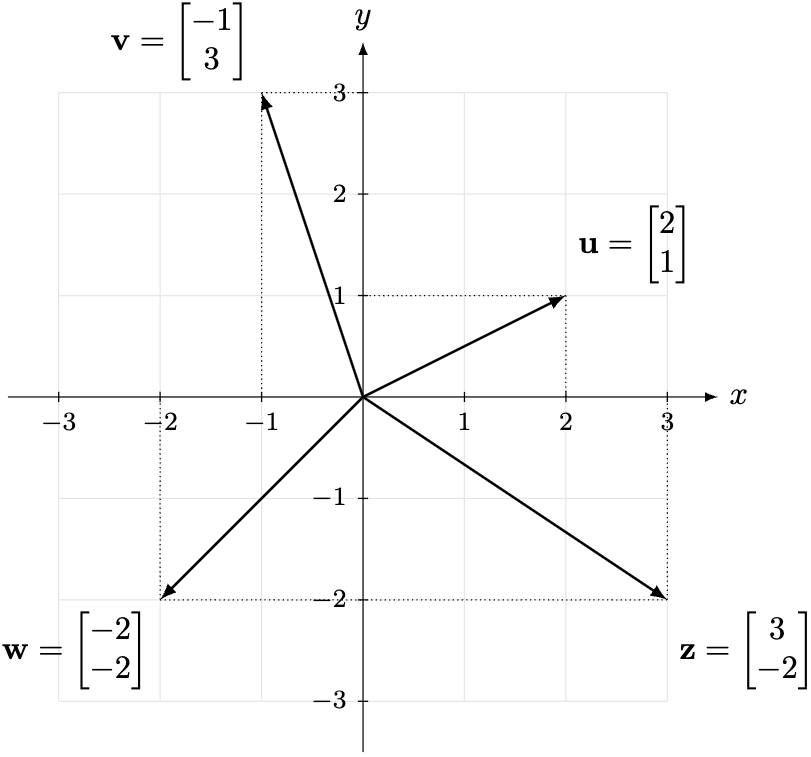
Definition 3. Define a two-dimensional vector by the object \begin{bmatrix} x \\ y \end{bmatrix}, visualised using a two-dimensional arrow in the xy plane.

Using Pythagoras’ theorem, define the magnitude or the norm of the vector \begin{bmatrix} x \\ y \end{bmatrix} by

\left\| \begin{bmatrix} x \\ y \end{bmatrix} \right\| := \sqrt{x^2 + y^2}.

Example 1. Using the diagram above,

\|\mathbf u\| = \left\| \begin{bmatrix} 2 \\ 1 \end{bmatrix} \right\| = \sqrt{2^2 + 1^2} = \sqrt{5}.

We leave it as an exercise to verify that

\|\mathbf v\| = \sqrt{10},\quad \|\mathbf w\| = \sqrt{8},\quad \| \mathbf z\| = \sqrt{13}.

Example 2. Let x be a real number. Show that \left\| \begin{bmatrix} x \\ 0 \end{bmatrix} \right\| = |x|.

Solution. By Definition 3,

\left\| \begin{bmatrix} x \\ 0 \end{bmatrix} \right\| = \sqrt{x^2 + 0^2} = \sqrt{x^2}.

Now we consider two cases:

  • If x \geq 0, then \sqrt{x^2} = x.
  • If x < 0, then -x > 0 and \sqrt{x^2} = \sqrt{(-x)^2} = -x.

By Definition 2, \sqrt{x^2} = |x|. Therefore,

\left\| \begin{bmatrix} x \\ 0 \end{bmatrix} \right\| = \sqrt{x^2} = |x|.

Remark 1. Example 2 illustrates vectors as extensions of the numbers that we are familiar with (not without its limitations). Hence, we can describe |x| as the norm or the magnitude of x.

This characterisation of vectors turns out to be incredibly useful in making sense of two-dimensional quantities. However, we need to define meaningful calculations to actually use them.

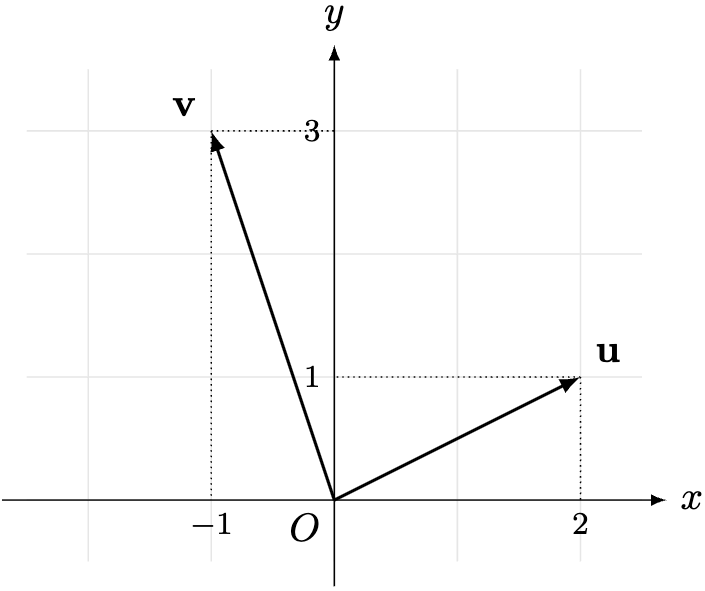
Consider the vectors \mathbf u = \begin{bmatrix} 2 \\ 1 \end{bmatrix} and \mathbf v = \begin{bmatrix} -1 \\ 3 \end{bmatrix} below.

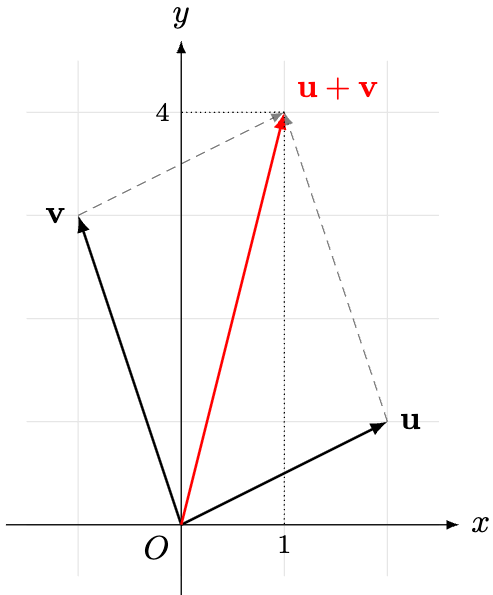
What do we mean by \mathbf u + \mathbf v? Intuitively, it means that starting from the point (0, 0), we first travel according to \mathbf u, then continue our journey according to \mathbf v. This process is equivalent to sliding the ‘tail’ of \mathbf v to the ‘tip’ of \mathbf u, also known as tip-to-tail addition.

An equivalent interpretation is to create a parallelogram using \mathbf u and \mathbf v as sides, and \mathbf u + \mathbf v, by definition is the ‘final point’ regardless how we travel. In either case, we notice that

\begin{bmatrix}2 \\ 1 \end{bmatrix} + \begin{bmatrix} -1 \\ 3 \end{bmatrix} = \mathbf u + \mathbf v = \begin{bmatrix}1 \\ 4\end{bmatrix} = \begin{bmatrix} 2 + (-1) \\ 1 + 3 \end{bmatrix}.

Therefore, we are justified in making the following definition for vector addition. We include scalar multiplication using similar intuitions.

Definition 4. Define vector addition and scalar multiplication as follows:

\begin{bmatrix} x_1 \\ y_1\end{bmatrix} + \begin{bmatrix} x_2 \\ y_2\end{bmatrix} := \begin{bmatrix} x_1+x_2 \\ y_1+y_2\end{bmatrix},\quad \alpha \begin{bmatrix} x \\ y \end{bmatrix} := \begin{bmatrix} \alpha x \\ \alpha y \end{bmatrix}.

In particular, given the two-dimensional vectors \mathbf u, \mathbf v, define:

  • -\mathbf v := (-1)\mathbf v, and
  • \mathbf u -\mathbf v := \mathbf u + (-\mathbf v).

Example 3. Let \mathbf v be any two-dimensional vector. Define the vector \mathbf 0 := \begin{bmatrix} 0 \\ 0 \end{bmatrix}. Evaluate separately the quantities \mathbf v + \mathbf 0, 0 \mathbf v , and \mathbf v - \mathbf v.

Solution. Suppose \mathbf v = \begin{bmatrix} x \\ y \end{bmatrix}. By the definition of vector addition,

\begin{aligned}\mathbf v + \mathbf 0 &= \begin{bmatrix} x \\ y \end{bmatrix} + \begin{bmatrix} 0 \\ 0 \end{bmatrix} = \begin{bmatrix} x + 0 \\ y + 0 \end{bmatrix} = \begin{bmatrix} x \\ y \end{bmatrix} = \mathbf v.\end{aligned}

By the definition of scalar multiplication,

\begin{aligned} 0\mathbf v  &= 0\begin{bmatrix} x \\ y \end{bmatrix} = \begin{bmatrix} 0x \\ 0y \end{bmatrix} = \begin{bmatrix} 0 \\ 0 \end{bmatrix} = \mathbf 0.\end{aligned}

Finally by the definition of vector subtraction and scalar multiplication,

\begin{aligned}\mathbf v - \mathbf v &= \mathbf v + (-1)\mathbf v \\ &= \begin{bmatrix} x \\ y \end{bmatrix} + (-1) \begin{bmatrix} x \\ y \end{bmatrix} \\ &= \begin{bmatrix} x \\ y \end{bmatrix} + \begin{bmatrix} (-1)x \\ (-1)y \end{bmatrix} \\ &= \begin{bmatrix} x + (-1)x \\ y + (-1)y \end{bmatrix} \\ &= \begin{bmatrix} x -x \\ y -y \end{bmatrix} =\begin{bmatrix} 0 \\ 0 \end{bmatrix}  = \mathbf 0.\end{aligned}

For much more detail and insight, check out my fuller suite of posts on linear algebra here. Linear algebra, at its core, is the very first bridge between geometry and algebra that any student encounters.

Theorem 1. Consider the line \ell : y = mx + c. Then there exist two-dimensional vectors \mathbf r_0, \mathbf d such that

\begin{bmatrix} x \\ y \end{bmatrix} = \mathbf r_0 + \lambda \mathbf d, \quad \lambda \in \mathbb R.

In this case, we call the vector \mathbf d the direction vector of \ell.

Proof Sketch. Define \mathbf r_0 = \begin{bmatrix} 0 \\ c \end{bmatrix} and \mathbf d = \begin{bmatrix} 1 \\ d \end{bmatrix}, and verify that the equation holds.

Theorem 2. Define the lines \ell_1 : y = m_1 x and \ell_2 : y = m_2 x, where m_1 \neq 0. Then \ell_1 \perp \ell_2 if and only if m_1 \cdot m_2 = -1.

Proof Sketch. Consider the diagram below.
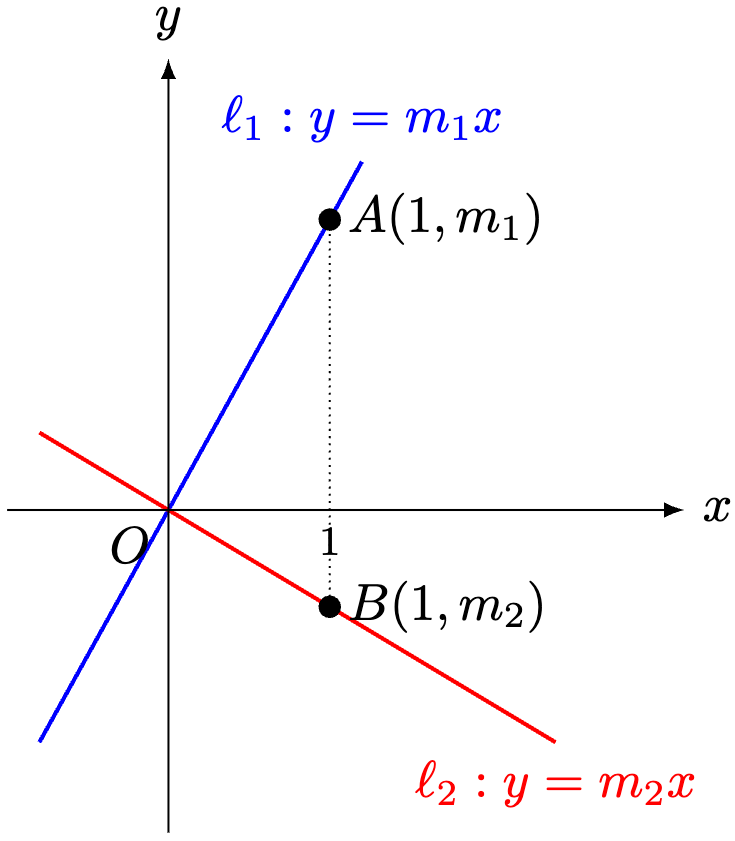
Using Pythagoras’ theorem,

OA = \sqrt{1 + m_1^2},\quad OB = \sqrt{1 + m_2^2},\quad AB = \sqrt{(m_1 - m_2)^2}.

Therefore, by Pythagoras’ theorem and its converse, OA \perp OB if and only if OA^2 + OB^2 = AB^2:

\begin{aligned} (1 + m_1^2) + (1 + m_2^2) &= (m_1 - m_2)^2.\end{aligned}

We leave it as an exercise in algebra to simplify this equation to

m_1 \cdot m_2 = -1.

Theorem 3. Define the lines \ell_1 : y = m_1 x and \ell_2 : y = m_2 x + c, where m_1\neq 0. Then \ell_1 \parallel \ell_2 if and only if m_1 = m_2.

Remark 2. Observe the deliberate omission of a diagram in Theorem 3. The power of vectors (i.e. linear algebra) is to describe geometry without a need for visual representation (though the latter will be useful for us in the process of proving the result).

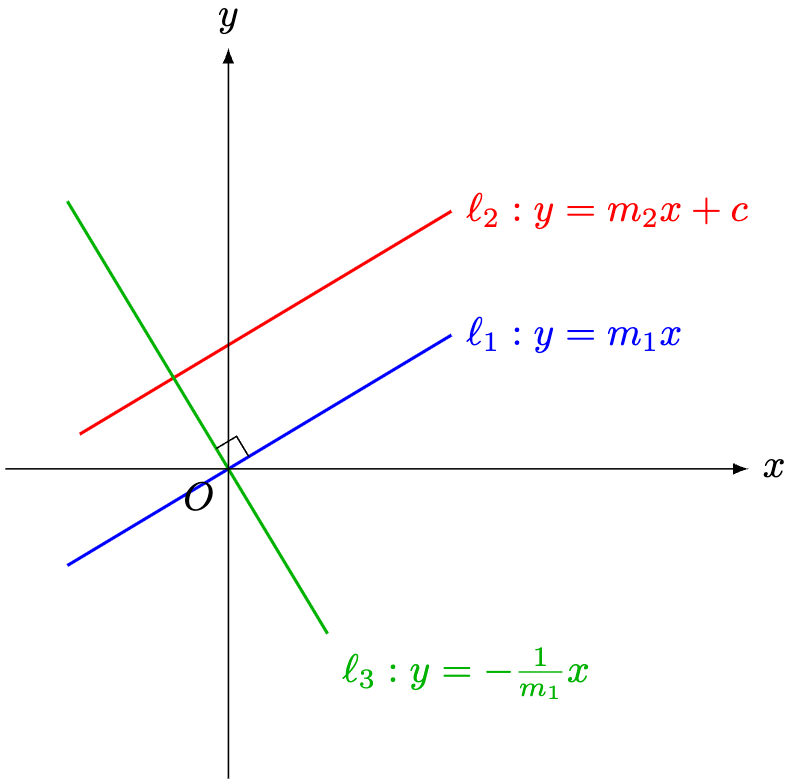
Proof Sketch. Define the line \ell_3 : y = -(1/m_1 ) x. By Theorem 2, since m_1 \cdot (-1/m_1 ) = -1, \ell_1 \perp \ell_3.

Since the interior angles of a pair of lines sum to 180^\circ if and only if the lines are parallel,

\begin{aligned} \ell_1 \parallel \ell_2 \quad &\iff \quad \ell_2 \perp \ell_3  \\ &\iff \quad m_2 \cdot \left(-\frac 1{m_1 } \right) = -1 \\ & \iff \quad m_1 = m_2 . \end{aligned}

Corollary 1. Consider the lines

\begin{aligned} \ell_1 : y &= m_1 x + c_1, \\ \ell_2 : y &= m_2 x + c_2, \end{aligned}

where m_1\neq 0. Then \ell_1 \parallel \ell_2 if and only if m_1 = m_2.

Proof. Define \ell_3 : y = m_1 x. By Theorem 3, \ell_1 \parallel \ell_3. Then by Theorem 3 again,

\begin{aligned} \ell_1 \parallel \ell_2\quad &\iff \quad \ell_2 \parallel \ell_3 \\ &\iff \quad m_1 = m_2. \end{aligned}

Theorem 4. Let \mathbf r_1,\mathbf r_2, \mathbf d_1,\mathbf d_2 be two-dimensional vectors and \mathbf d_1 \neq \mathbf 0, \mathbf d_2 \neq \mathbf 0. Using Theorem 1, consider the lines \ell_1,\ell_2 defined by

\begin{aligned} \ell_1 : \mathbf r &= \mathbf r_1 + \lambda \mathbf d_1,\quad \lambda \in \mathbb R, \\ \ell_2 : \mathbf r &= \mathbf r_2 + \mu \mathbf d_2,\quad \mu \in \mathbb R, \end{aligned}

where we abbreviate \mathbf r = \begin{bmatrix} x \\ y \end{bmatrix}. Then \ell_1 \parallel \ell_2 if and only if there exists some real number k such that \mathbf d_2 = k\mathbf d_1.

Proof Sketch. Use Theorems 1 and 3.

There are many more implications of thinking in terms of vectors, but we conclude with the famous intercept theorem.

Lemma 1. Given two points A, B, denote the vector starting at A and ending at B by \overrightarrow{AB}.

Then \overrightarrow{AB} = \overrightarrow{OB} - \overrightarrow{OA}.

Proof. Using vector addition,

\begin{aligned} \overrightarrow{AB} &= \overrightarrow{AO} + \overrightarrow{OB} \\ &= (-1)\, \overrightarrow{OA} + \overrightarrow{OB} \\ &= \overrightarrow{OB} + (-1)\, \overrightarrow{OA} \\ &= \overrightarrow{OB} - \overrightarrow{OA}. \end{aligned}

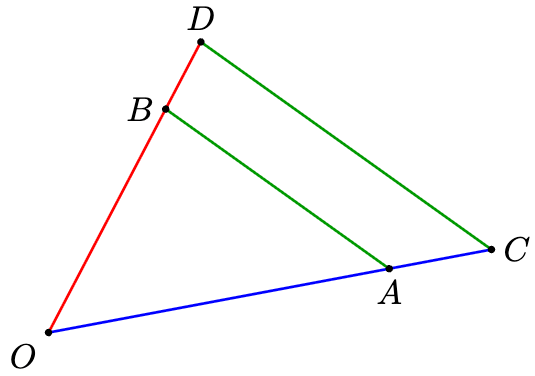
Theorem 5 (Intercept Theorem). Given three distinct points O,A,B and positive numbers k_1, k_2, define the points C, D by \overrightarrow{OC} = k_1 \overrightarrow{OA} and \overrightarrow{OD} = k_2 \overrightarrow{OB} below.

(Here, we assume k_1 > 1, k_2 > 1 for simplicity.)

Then AB \parallel CD if and only if k_1 = k_2. In this case,

\displaystyle \frac{OA}{OC} = \frac{OB}{OD} = \frac{AB}{CD}.

Proof Sketch. Denote \overrightarrow{OA} = \mathbf a and \overrightarrow{OB} = \mathbf b. By Lemma 1,

\overrightarrow{AB} = \mathbf b - \mathbf a,\quad \overrightarrow{CD} = k_2 \mathbf b - k_1 \mathbf a.

In the direction (\Leftarrow), suppose k_1 = k_2 =: k. Then

\overrightarrow{CD} = k \mathbf b - k \mathbf a = k(\mathbf b - \mathbf a) = k \overrightarrow{AB}.

By Theorem 4, AB \parallel CD.

In the direction (\Rightarrow), Theorem 4 yields some real number k such that

\begin{aligned} \overrightarrow{CD} &= k \overrightarrow{AB} \\ k_2 \mathbf b - k_1 \mathbf a &= k\mathbf b - k\mathbf a \\ (k - k_1) \mathbf a &= (k - k_2)\mathbf b  \end{aligned}

Now \mathbf a, \mathbf b are non-zero. If k_2 \neq k, then it can be shown that OA \parallel OB, a contradiction. Therefore, we must have k_2 = k. Similarly, k_1 = k. Therefore, k_1 = k_2 = k, in which case,

\displaystyle OC = k \cdot OA \quad \Rightarrow \quad \frac{OA}{OC} = \frac 1{k}.

In a similar manner with the other sides,

\displaystyle \frac{OA}{OC} = \frac{OB}{OD} = \frac 1{k} = \frac{AC}{CD}.

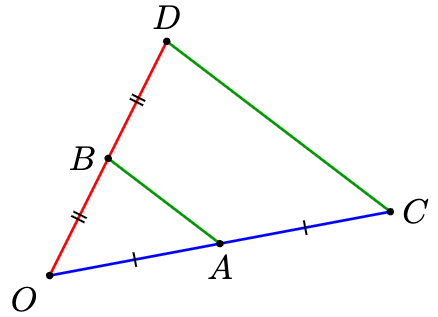
Corollary 2 (Midpoint Theorem). If we have

\displaystyle \frac{OA}{OC} = \frac{OB}{OD} = \frac 12,

then AB \parallel CD and AB/CD = 1/2.

Proof. By hypothesis, set k_1 = k_2 = 2 in Theorem 5 to obtain AB \parallel CD, and consequently, AB/CD = 1/2.

In this case, we call \Delta OAB and \Delta OCD similar triangles, which we will revisit later on.

Using this idea of describing shapes using coordinates, we turn to parabolas, and namely, analyse graphs of the form y = ax^2 + bx + c.

—Joel Kindiak, 22 Oct 25, 2217H

Published by


Leave a comment