Big Idea
The main use of integration is to determine the area under the graph of a function: given any function 
![[a, b]](https://s0.wp.com/latex.php?latex=%5Ba%2C+b%5D&bg=ffffff&fg=000&s=0&c=20201002)

where 
![[a,b] = [0,1]](https://s0.wp.com/latex.php?latex=%5Ba%2Cb%5D+%3D+%5B0%2C1%5D&bg=ffffff&fg=000&s=0&c=20201002)
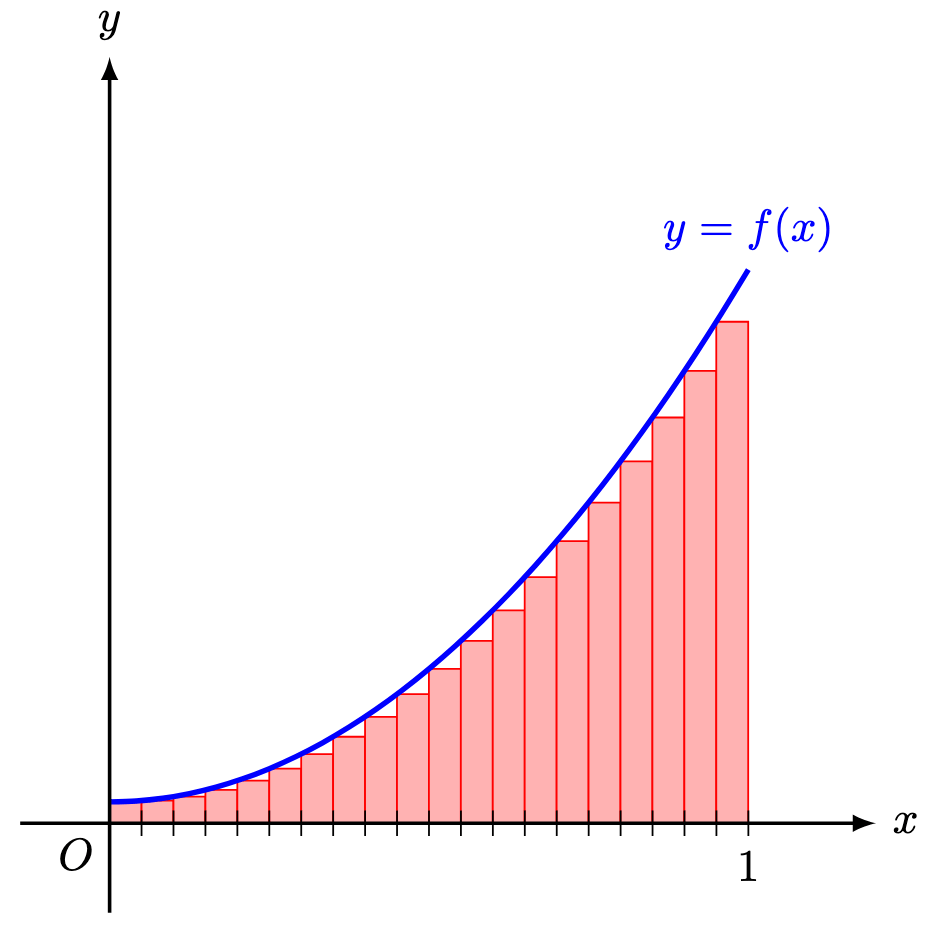
For example, by considering the area of a circle,

This base application is usually adapted to formulate many other geometric definitions in terms of integrals.
Questions
Question 1. Evaluate the area enclosed by the ellipse below.
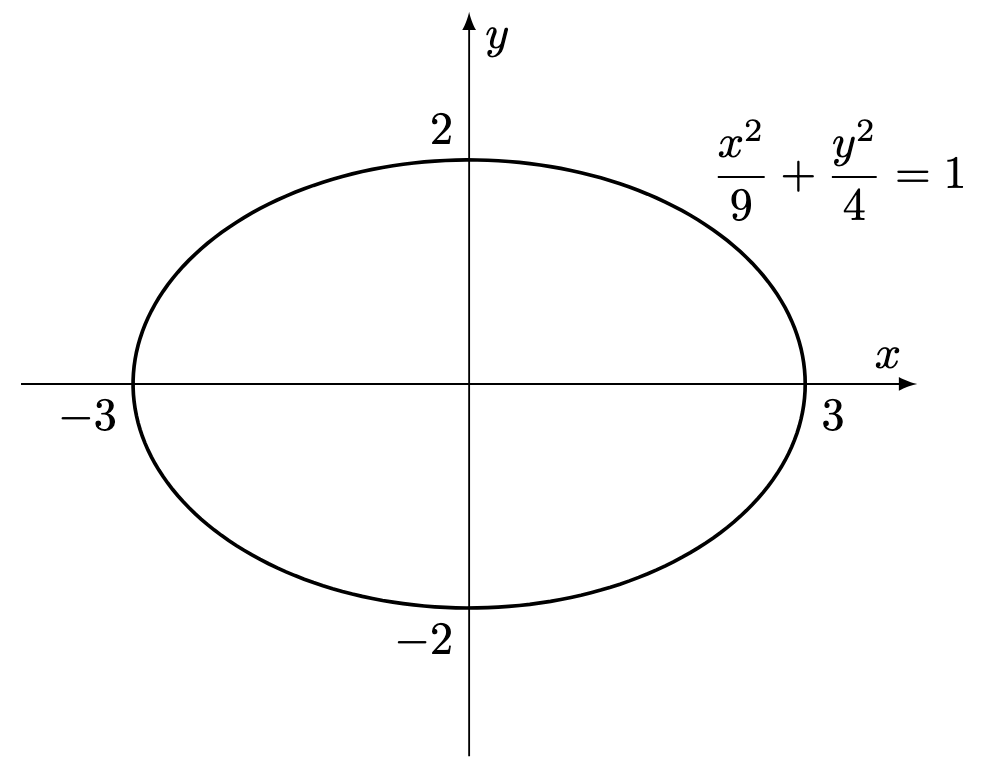
(Click for Solution)
Solution. By symmetry, the required area 

Making 


so that the required integral is

Make the substitution 

The integral on the right-hand side corresponds to the area of the quadrant of a unit circle, which equals 

Remark 1. The same technique can be used to prove that

In particular, an ellipse with equation 

Question 2. Evaluate the integral 
(Click for Solution)
Solution. Make the substitution 


where the last equality follows from simply replacing the dummy variable. Consequently,

Hence,

Remark 2. The same technique can be used to prove that

Question 3. Evaluate the limit ![\displaystyle \lim_{n \to \infty} \frac{\sqrt[3]{1} + \sqrt[3]{2} + \cdots + \sqrt[3]{n}}{n\sqrt[3]{n}}](https://s0.wp.com/latex.php?latex=%5Cdisplaystyle+%5Clim_%7Bn+%5Cto+%5Cinfty%7D+%5Cfrac%7B%5Csqrt%5B3%5D%7B1%7D+%2B+%5Csqrt%5B3%5D%7B2%7D+%2B+%5Ccdots+%2B+%5Csqrt%5B3%5D%7Bn%7D%7D%7Bn%5Csqrt%5B3%5D%7Bn%7D%7D&bg=ffffff&fg=000&s=0&c=20201002)
(Click for Solution)
Solution. Using the Big Idea, setting 

![\begin{aligned} \lim_{n \to \infty} \frac{\sqrt[3]{1} + \sqrt[3]{2} + \cdots + \sqrt[3]{n}}{n\sqrt[3]{n}} &= \lim_{n \to \infty} \sum_{k=1}^n \frac{\sqrt[3]{k}}{n\sqrt[3]{n}} = \lim_{n \to \infty} \sum_{k=1}^n \sqrt[3]{\frac kn } \cdot \frac 1n \\ &= \lim_{n \to \infty} \sum_{k=1}^n \sqrt[3]{x_k} \cdot \Delta x_k = \int_0^1 \sqrt[3]{x}\, \mathrm dx \\ &= \int_0^1 x^{1/3}\, \mathrm dx = \left[ \frac{x^{4/3}}{4/3} \right]_0^1 = \frac 34. \end{aligned}](https://s0.wp.com/latex.php?latex=%5Cbegin%7Baligned%7D+%5Clim_%7Bn+%5Cto+%5Cinfty%7D+%5Cfrac%7B%5Csqrt%5B3%5D%7B1%7D+%2B+%5Csqrt%5B3%5D%7B2%7D+%2B+%5Ccdots+%2B+%5Csqrt%5B3%5D%7Bn%7D%7D%7Bn%5Csqrt%5B3%5D%7Bn%7D%7D+%26%3D+%5Clim_%7Bn+%5Cto+%5Cinfty%7D+%5Csum_%7Bk%3D1%7D%5En+%5Cfrac%7B%5Csqrt%5B3%5D%7Bk%7D%7D%7Bn%5Csqrt%5B3%5D%7Bn%7D%7D+%3D+%5Clim_%7Bn+%5Cto+%5Cinfty%7D+%5Csum_%7Bk%3D1%7D%5En+%5Csqrt%5B3%5D%7B%5Cfrac+kn+%7D+%5Ccdot+%5Cfrac+1n+%5C%5C+%26%3D+%5Clim_%7Bn+%5Cto+%5Cinfty%7D+%5Csum_%7Bk%3D1%7D%5En+%5Csqrt%5B3%5D%7Bx_k%7D+%5Ccdot+%5CDelta+x_k+%3D+%5Cint_0%5E1+%5Csqrt%5B3%5D%7Bx%7D%5C%2C+%5Cmathrm+dx+%5C%5C+%26%3D+%5Cint_0%5E1+x%5E%7B1%2F3%7D%5C%2C+%5Cmathrm+dx+%3D+%5Cleft%5B+%5Cfrac%7Bx%5E%7B4%2F3%7D%7D%7B4%2F3%7D+%5Cright%5D_0%5E1+%3D+%5Cfrac+34.+%5Cend%7Baligned%7D&bg=ffffff&fg=000&s=0&c=20201002)
—Joel Kindiak, 5 Sept 25, 1358H
 KindiakMath
Leave a comment