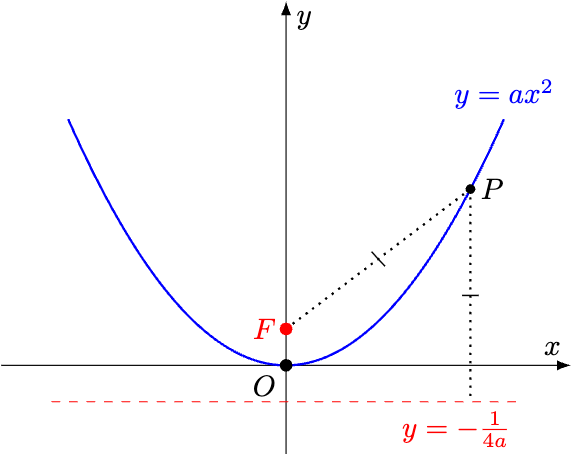
Previously, we have seen that given , the graph of looks like the diagram below.
For any point on the graph, it has the same distance to the (focal) point and the (directrix) line . Hence, its shape is known as a parabola. In particular, it has a minimum point .
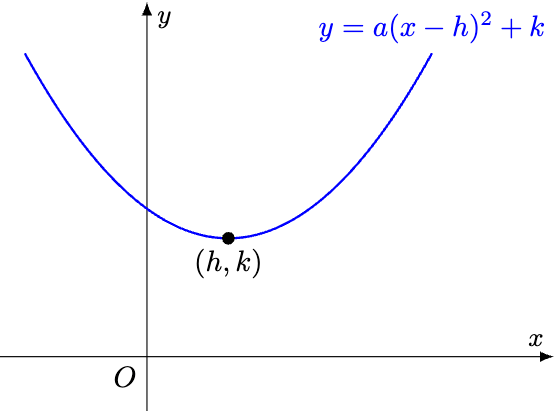
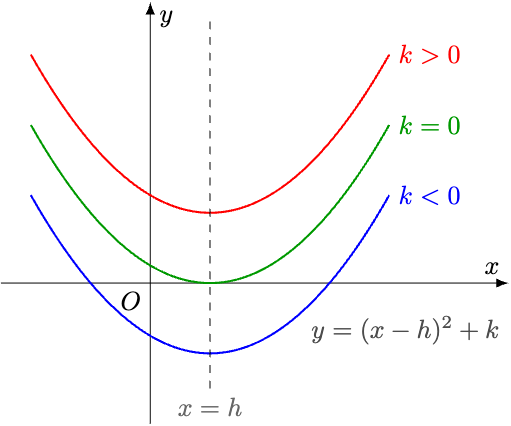
If we shifted the graph rightwards by and upwards by , we recover a more general parabola with minimum point .
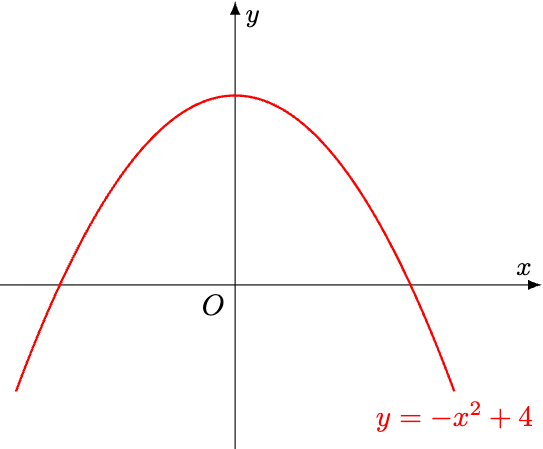
Of course, if , then the whole graph gets “flipped” to the downside:
The diagram above shows the graph of .
Example 1. Determine the -intercept of the quadratic graph .
Solution. To determine the -intercept of the quadratic graph, we need to find the intersection of the graph and the -axis, whose equation is . Since the -values should match, we can substitute the latter equation into the former:
Therefore, our -intercept is . No surprises there.
Example 2. Determine the two -intercepts of the quadratic graph .
Solution. To determine the two -intercepts of the quadratic graph, we need to find the intersections of the graph and the -axis, whose equation is . Since the -values should match, we can substitute the latter equation into the former:
It is tempting at this stage to write so that our -intercept is . However, this solution is only partially correct. Just like any solution in Singapore or US politics.
Notice in the graph that we have a second-intercept to the left of the -axis. This is because could have been a negative number as well. Notice that
are both correct equations. (Furthermore, these are the only two correct equations). Therefore, if , we must conclude either possibility, namely, that or . To abbreviate, we use the notation: . This notation states that either or are plausible values that represents.
To answer our original question, since and in both cases, there are two -intercepts: and .
Example 3. Determine the -intercept(s) of the quadratic graph .
Solution. To determine the two -intercepts of the quadratic graph, we need to find the intersections of the graph and the -axis, whose equation is . Since the -values should match, we can substitute the latter equation into the former:
By Example 2, we have the solutions . Therefore, there are two -intercepts: and .
Remark 1. Different graphs can yield the same roots.
Example 4. Determine the -intercept(s) of the quadratic graph , where respectively.
Solution. We recall that . Therefore,
To find the -intercepts of the graph, we set :
Now we analyse this equation case-by-case.
If , then . Taking square roots,
Hence, or , yielding the -intercepts and .
If , then . Taking square roots,
Hence, or , yielding the -intercepts and .
If , then . Taking square roots,
Hence, , yielding only one -intercept .
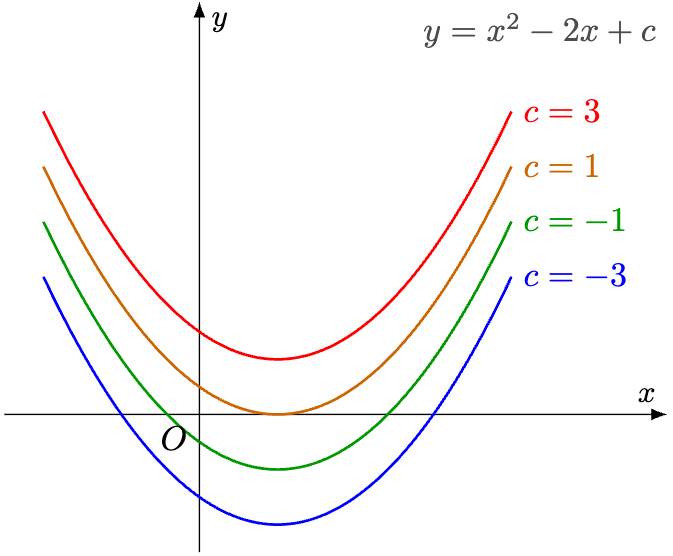
If , then . Now, if is a real number, then is a real number too, which implies that . Therefore, . This can only mean that the equation has no real solutions, and therefore, the graph of no -intercepts.
The diagram below shows the graphs of all four cases.
Example 5. Given real numbers and , determine the number of -intercepts of the quadratic graph , and determine them in terms of and if they exist.
Solution. Repeating the calculations in Example 4, we set :
There are three cases: , , or .
In the case , , so that . Hence,
Therefore, the graph has two -intercepts and .
In the case ,
Therefore, the graph has only one -intercept .
In the case , , so that
Therefore, the equation has no real solutions, and the graph has no -intercepts.
Remark 2. The line is called the line of symmetry of the graph, and the point is the turning point of the graph.
Definition 1. We say that is a real numbersolution of the quadratic equation if . Equivalently,
is a real numbersolution of the equation,
is a root of the function,
is an -intercept of the graph .
Theorem 1. Let be a quadratic equation, where . Define the discriminant of the quadratic equation by
Then the equation has
real number solutions if ,
real number solution if , and
real number solutions if .
In the first two cases, the roots are given by the quadratic formula:
Proof Sketch. We first leave it as an exercise to find constants in terms of such that
This process is called completing the square, and done correctly, should yield the results
Then set and apply the calculation in Example 5. In the case and ,
Once again, the square roots make their return. In Example 4, the equation has the roots given by . We will explore expressions of this form in the next post.













,
is an
.


real number solutions if
,
real number solution if
, and
real number solutions if
.


 KindiakMath
Leave a comment