Questions have not been uploaded due to copyright reasons. Do comment if you spot any errors.
Section A: Pure Mathematics [40 marks]
Question 1. System of Linear Equations
Solution. (a) Using the question,

Solving the system of linear equations, 
(b) By the question, Sam scored 


Furthermore, we are given that 

Since the sum is 


By trial-and-error, 


Question 2. Vectors
Solution. (a) Firstly,

Since 


Hence,

(b) Firstly,

Since 

(c) Hence,

Therefore the required angle 

Question 3. Differential Equations
Solution. (a) By the method of separable variables,

Since the initial condition is 

Therefore, 

(b) (i) By the graph 

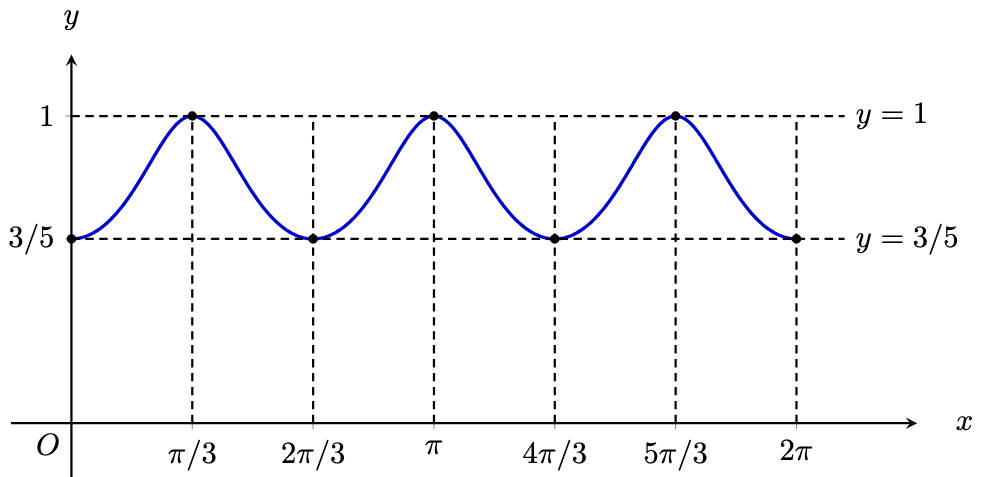
(b) (ii) We first note that the graph of 

![[0, 2\pi]](https://s0.wp.com/latex.php?latex=%5B0%2C+2%5Cpi%5D&bg=ffffff&fg=000&s=0&c=20201002)


(b) (iii) Since 


Hence,

(c) Using the product rule and the chain rule,

where 
Question 4. Rate of Change
Solution. (a) Letting 

(b) Using the chain rule,

At 

(c) The total volume poured into the bowl after

Since 

(d) At 

Solving the cubic equation, 
![h \in [0, 15]](https://s0.wp.com/latex.php?latex=h+%5Cin+%5B0%2C+15%5D&bg=ffffff&fg=000&s=0&c=20201002)

Therefore,

Section B: Probability and Statistics [60 marks]
Question 5. Probability
Solution. (a) The total number of counters is 

Hence, the required probability is its complement 
(b) By pattern-recognition, the required equation to solve is:

The left-hand side, using factorials, simplifies to

Hence, we need to solve the quadratic equation

Solving, we get 
Question 6. Normal Distribution
Solution. (a) Using the symmetry of the normal distribution,

(b) Since 

Using 

(c) Using independence,

By algebruh,

Since 

Using

(d) Using complements,

Since 

Question 7. Permutations and Combinations
Solution. (a) The total number of arrangements, including repetitions, is

(b) We first choose the start and end numbers, then place the third even number in the middle four spaces, and then permute the odd numbers:

(c) The total number of even-number groups (consisting of 


(d) We first count the number of arrangements where the even digits are all together and the odd digits are all together:

The required probability is given by a conditional probability as follows:

Question 8. Correlation and Linear Regression
Solution. (a) Since 
(b) (i) The diagram suggests that there is a positive, though non-linear, correlation between 

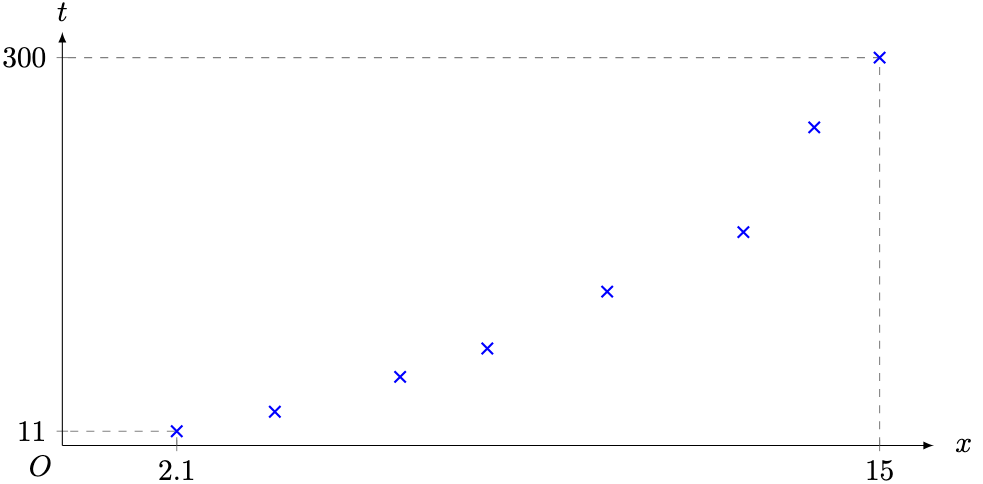
(ii) For the model 


(iii) At 

Since 

Question 9. Binomial Distribution
Solution. (a) The two assumptions are as follows:
- The probability that a randomly chosen refrigerator is faulty is constant.
- The faultiness of any refrigerator is independent of other refrigerators.
(b) Since 

(c) Let 


(d) Since 


(e) Since 

Question 10. Flour-Production
Solution. (a) In the question, 


(b) Let 

![\begin{aligned} \mathbb E[X - Y] &= 2.2 - 2.1 = 0.1, \\ \mathrm{Var}(X - Y) &= 0.1^2 + 0.05^2 = 0.0125, \\ X- Y &\sim \mathcal N(0.1, 0.0125). \end{aligned}](https://s0.wp.com/latex.php?latex=%5Cbegin%7Baligned%7D+%5Cmathbb+E%5BX+-+Y%5D+%26%3D+2.2+-+2.1+%3D+0.1%2C+%5C%5C+%5Cmathrm%7BVar%7D%28X+-+Y%29+%26%3D+0.1%5E2+%2B+0.05%5E2+%3D+0.0125%2C+%5C%5C+X-+Y+%26%5Csim+%5Cmathcal+N%280.1%2C+0.0125%29.+%5Cend%7Baligned%7D&bg=ffffff&fg=000&s=0&c=20201002)
Hence, the required probability is

(c) Defining the random variable 
![\begin{aligned} \mathbb E[W] &= 3 \cdot 2.2 + 5 \cdot 2.1 = 17.1, \\ \mathrm{Var} (W) &= 3 \cdot 0.1^2 + 5 \cdot 0.05^2 = 0.0425. \end{aligned}](https://s0.wp.com/latex.php?latex=%5Cbegin%7Baligned%7D+%5Cmathbb+E%5BW%5D+%26%3D+3+%5Ccdot+2.2+%2B+5+%5Ccdot+2.1+%3D+17.1%2C+%5C%5C+%5Cmathrm%7BVar%7D+%28W%29+%26%3D+3+%5Ccdot+0.1%5E2+%2B+5+%5Ccdot+0.05%5E2+%3D+0.0425.+%5Cend%7Baligned%7D&bg=ffffff&fg=000&s=0&c=20201002)
Hence, 

(d) Let 


(e) Let 


and

(f) Suppose 

Since we are conducting a two-tailed test, the required 

Since 

(g) If fewer than 

(h) If the sample had not been chosen randomly, it is plausible that the packets of flour chosen have masses that are not independent with one another, so that
—Joel Kindiak, 7 Nov 25, 1522H
 ,
,

 .
. denote the
  -th term of the arithmetic sequence,
  . By considering the sum of the first
  terms, we have first term
  and last term
  so that
 terms, we have first term
  and last term
  so that
 and
and  .
.
 is a geometric sequence.
 :
:

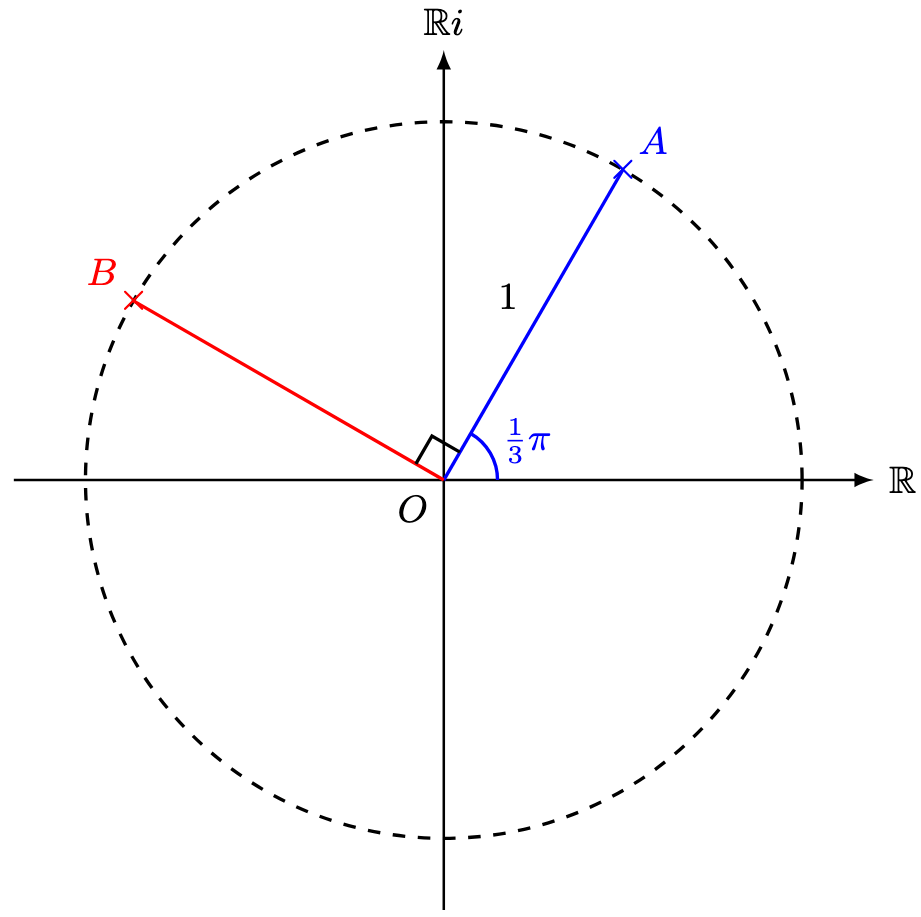
 represents the complex number
  .
. . Using the product rule,
 so that

 yields
 , so that we solve the inequality
 (which we reject since
  ) or
) or


 , we split the integral into two parts:

 yields
 when
when  :
:

 years ago, correct to 3 significant figures.

 . Therefore, the required volume of revolution
  is
is![\begin{aligned}V_1 &= \pi \int_1^e (\ln x)^2\, \mathrm dx \\ &= \pi \left( \left[\underbrace{ (x \ln x - x) }_{\mathrm I} \cdot \underbrace{ \ln x }_{\mathrm S}\right]_1^e - \int_1^e \underbrace{ (x \ln x - x) }_{\mathrm I} \cdot \underbrace{ \frac 1x }_{\mathrm D}\, \mathrm dx \right) \\ &= \pi \left( (0 - 0) - \int_1^e (\ln x - 1)\, \mathrm dx \right) \\ &= \pi \int_1^e (1 - \ln x )\, \mathrm dx \\ &= \pi [ x - (x \ln x - x)]_1^e \\ &= \pi [ 2x - x \ln x ]_1^e \\ &= \pi \cdot ( (2e - e) - (2 - 0) ) \\ &= \pi (e-2)\, \text{units}^3.\end{aligned}](https://s0.wp.com/latex.php?latex=%5Cbegin%7Baligned%7DV_1+%26%3D+%5Cpi+%5Cint_1%5Ee+%28%5Cln+x%29%5E2%5C%2C+%5Cmathrm+dx+%5C%5C+%26%3D+%5Cpi+%5Cleft%28+%5Cleft%5B%5Cunderbrace%7B+%28x+%5Cln+x+-+x%29+%7D_%7B%5Cmathrm+I%7D+%5Ccdot+%5Cunderbrace%7B+%5Cln+x+%7D_%7B%5Cmathrm+S%7D%5Cright%5D_1%5Ee+-+%5Cint_1%5Ee+%5Cunderbrace%7B+%28x+%5Cln+x+-+x%29+%7D_%7B%5Cmathrm+I%7D+%5Ccdot+%5Cunderbrace%7B+%5Cfrac+1x+%7D_%7B%5Cmathrm+D%7D%5C%2C+%5Cmathrm+dx+%5Cright%29+%5C%5C+%26%3D+%5Cpi+%5Cleft%28+%280+-+0%29+-+%5Cint_1%5Ee+%28%5Cln+x+-+1%29%5C%2C+%5Cmathrm+dx+%5Cright%29+%5C%5C+%26%3D+%5Cpi+%5Cint_1%5Ee+%281+-+%5Cln+x+%29%5C%2C+%5Cmathrm+dx+%5C%5C+%26%3D+%5Cpi+%5B+x+-+%28x+%5Cln+x+-+x%29%5D_1%5Ee+%5C%5C+%26%3D+%5Cpi+%5B+2x+-+x+%5Cln+x+%5D_1%5Ee+%5C%5C+%26%3D+%5Cpi+%5Ccdot+%28+%282e+-+e%29+-+%282+-+0%29+%29+%5C%5C+%26%3D+%5Cpi+%28e-2%29%5C%2C+%5Ctext%7Bunits%7D%5E3.%5Cend%7Baligned%7D&bg=ffffff&fg=000&s=0&c=20201002)
 is equivalently given by
  . Therefore, the required volume of revolution
  is
is
 , left as a simple exercise in integration.
 in scalar product form:
 perpendicular to
 is given by the intersection of


 is given by the cross product:
 between
  is given by the dot product between their normal vectors:


 ,
,
 up to and including the term in
  is given by

 (so that
  ) yields the series expansion
 ,
,  and axial intercepts
  ,
,  .
.

 parallel to the
  units in the positive
  so that
 .
. ,
,
 ,
,


 and
and  , the denominator of
  is
is  :
:
 .
. are
are  and
and  respectively. Hence,

 or
or  . By substituting into expression for
 .
. at
at  .
. and
and 
 . Since
 is given by

 .
. , we evaluate
  and
and  :
:


 .
.

 .
. on both sides,
 . For
. For 
 ,
,
 . Therefore, the three roots are
  and
and  .
. KindiakMath