Warning. All questions below are non-trivial.
Section A (48 marks)
Each question in this section is worth 8 marks.
Question 1. Solve the differential equation

(Click for Solution)
Solution. By the method of separable variables,

Question 2. Solve the differential equation

(Click for Solution)
Solution. By algebraic manipulation,

Compute the integrating factor

Thus, the general solution is given by

where we integrated by parts twice on the right-hand side.
Question 3. Use the substitution  to solve the differential equation

(Click for Solution)
Solution. Writing  , use the quotient rule to deduce

Making the substitutions,

Since the auxiliary equation  has real and distinct roots
  , the general solution is given by

Question 4. Evaluate  .
.
(Click for Solution)
Solution. First carry out some simplifications:

Then taking Laplace transforms,

Question 5. Evaluate  .
.
(Click for Solution)
Solution. We first note that  , so that by the factor theorem,
  is a factor of
  . Hence, we factorise
  . This suggests us to employ the partial fraction decomposition

where we will obtain  later and completed the square in the last term. We recall the following well-known inverse Laplace transforms:

Since taking inverse Laplace transforms is linear,

All that remains is for us to obtain  . To that end, clear denominators by multiplying
  on all sides:

Comparing coefficients,

Solving simultaneous linear equations,  . Substituting and simplifying,

Question 6. Evaluate 
(Click for Solution)
Solution. Apply partial fractions again (left as an exercise) to obtain

Therefore,

Section B (52 marks)
Each question in this section is worth 13 marks.
Question 1. Solve the differential equation

(Click for Solution)
Solution. The auxiliary equation  has repeated real roots
  . Therefore, the complementary function is given by

For the particular integral,

Therefore, the general solution is given by

Question 2. Given the function  defined by

evaluate  .
.
(Click for Solution)
Solution. We first observe that

Therefore,

Taking Laplace transforms,

Question 3. Use Laplace transforms to solve the initial value problem

(Click for Solution)
Solution. Taking Laplace transforms on both sides,

To evaluate the left-hand side,

Therefore, the left-hand side simplifies to

To evaluate the right-hand side,

Putting it all together,

By algebraic manipulation,

It remains to (painfully) compute each of the following inverse Laplace transforms, by observing that  .
.
Define  so that

By the shift theorems,

Similarly, defining  and
and  so that

we have

Piecing them all together,

Question 4. Evaluate the Fourier series of the function defined by

and periodic extension  .
.
(Click for Solution)
Solution. We need to evaluate each of the Fourier coefficients  with
with  . For
. For  ,
,

For  , we need to integrate by parts:
![\begin{aligned} a_n &= \int_{-1}^1 f(t) \cos(n \pi t) \, \mathrm dt \\ &= \int_{-1}^0 \cos(n \pi t)\, \mathrm dt + \int_0^1 2t \cos(n \pi t)\, \mathrm dt \\ &= \left[ \frac{\sin(n \pi t)}{n \pi} \right]_{-1}^0 + \left[ \frac{2 t \sin(n \pi t)}{n \pi} \right]_0^1 + \left[ \frac{2\cos(n \pi t)}{n^2 \pi^2} \right]_0^1 \\ &= 0 + 0 + \frac 2{n^2 \pi^2} ((-1)^n - 1) \\ &= \frac {2 ((-1)^n - 1) }{n^2 \pi^2} . \end{aligned}](https://s0.wp.com/latex.php?latex=%5Cbegin%7Baligned%7D+a_n+%26%3D+%5Cint_%7B-1%7D%5E1+f%28t%29+%5Ccos%28n+%5Cpi+t%29+%5C%2C+%5Cmathrm+dt+%5C%5C+%26%3D+%5Cint_%7B-1%7D%5E0+%5Ccos%28n+%5Cpi+t%29%5C%2C+%5Cmathrm+dt+%2B+%5Cint_0%5E1+2t+%5Ccos%28n+%5Cpi+t%29%5C%2C+%5Cmathrm+dt+%5C%5C+%26%3D+%5Cleft%5B+%5Cfrac%7B%5Csin%28n+%5Cpi+t%29%7D%7Bn+%5Cpi%7D+%5Cright%5D_%7B-1%7D%5E0+%2B+%5Cleft%5B+%5Cfrac%7B2+t+%5Csin%28n+%5Cpi+t%29%7D%7Bn+%5Cpi%7D+%5Cright%5D_0%5E1+%2B+%5Cleft%5B+%5Cfrac%7B2%5Ccos%28n+%5Cpi+t%29%7D%7Bn%5E2+%5Cpi%5E2%7D++%5Cright%5D_0%5E1+%5C%5C+%26%3D+0+%2B+0+%2B+%5Cfrac+2%7Bn%5E2+%5Cpi%5E2%7D+%28%28-1%29%5En+-+1%29+%5C%5C+%26%3D+%5Cfrac+%7B2+%28%28-1%29%5En+-+1%29+%7D%7Bn%5E2+%5Cpi%5E2%7D+.+%5Cend%7Baligned%7D&bg=ffffff&fg=000&s=0&c=20201002)
Similarly for  , we need to integrate by parts:
![\begin{aligned} b_n &= \int_{-1}^1 f(t) \sin(n \pi t) \, \mathrm dt \\ &= \int_{-1}^0 \sin(n \pi t)\, \mathrm dt + \int_0^1 2t \sin(n \pi t)\, \mathrm dt \\ &= \left[ \frac{-\cos(n \pi t)}{n \pi} \right]_{-1}^0 + \left[ \frac{-2 t \cos(n \pi t)}{n \pi} \right]_0^1 + \left[ \frac{2\sin(n \pi t)}{n^2 \pi^2} \right]_0^1 \\ &= -\frac 1{n\pi} (1 - (-1)^n) - \frac 2{n \pi} (-1)^n \\ &= -\frac 1{n\pi} ( (-1)^n + 1). \end{aligned}](https://s0.wp.com/latex.php?latex=%5Cbegin%7Baligned%7D+b_n+%26%3D+%5Cint_%7B-1%7D%5E1+f%28t%29+%5Csin%28n+%5Cpi+t%29+%5C%2C+%5Cmathrm+dt+%5C%5C+%26%3D+%5Cint_%7B-1%7D%5E0+%5Csin%28n+%5Cpi+t%29%5C%2C+%5Cmathrm+dt+%2B+%5Cint_0%5E1+2t+%5Csin%28n+%5Cpi+t%29%5C%2C+%5Cmathrm+dt+%5C%5C+%26%3D+%5Cleft%5B+%5Cfrac%7B-%5Ccos%28n+%5Cpi+t%29%7D%7Bn+%5Cpi%7D+%5Cright%5D_%7B-1%7D%5E0+%2B+%5Cleft%5B+%5Cfrac%7B-2+t+%5Ccos%28n+%5Cpi+t%29%7D%7Bn+%5Cpi%7D+%5Cright%5D_0%5E1+%2B+%5Cleft%5B+%5Cfrac%7B2%5Csin%28n+%5Cpi+t%29%7D%7Bn%5E2+%5Cpi%5E2%7D+%5Cright%5D_0%5E1+%5C%5C+%26%3D+-%5Cfrac+1%7Bn%5Cpi%7D+%281+-+%28-1%29%5En%29+-+%5Cfrac+2%7Bn+%5Cpi%7D+%28-1%29%5En+%5C%5C+%26%3D+-%5Cfrac+1%7Bn%5Cpi%7D+%28+%28-1%29%5En+%2B+1%29.+%5Cend%7Baligned%7D&bg=ffffff&fg=000&s=0&c=20201002)
Therefore, the Fourier series of is given by

—Joel Kindiak, 19 Aug 25, 1613H


 and compute the integrating factor


 -notation:
 . To compute the complementary function
  , we solve
  . Since the characteristic equation
  has complex conjugate roots
  , the general solution is given by
 , we use inverse-


 . Taking Laplace transforms on both sides and applying linearity,


 . Then
 , which is a nontrivial task. However, if we complete the square on the denominator,

 . Then

 . Replacing
  with
with  yields the final answer
 is defined by
  for
for  and periodic extension


 is even,
 is odd, we
 ![\displaystyle \begin{aligned} b_n &= 2 \int_0^1 t \sin (\pi n t) \, \mathrm dt \\ &= 2 \cdot \left[ t \cdot \frac{-\cos(\pi n t)}{\pi n} + \frac{\sin(\pi n t)}{\pi^2 n^2} \right]_0^1 \\ &= 2 \left( - \frac{\cos(\pi n)}{\pi n}\right) = \frac{2(-1)^{n+1}}{\pi n}. \end{aligned}](https://s0.wp.com/latex.php?latex=%5Cdisplaystyle+%5Cbegin%7Baligned%7D+b_n+%26%3D+2+%5Cint_0%5E1+t+%5Csin+%28%5Cpi+n+t%29+%5C%2C+%5Cmathrm+dt+%5C%5C+%26%3D+2+%5Ccdot+%5Cleft%5B+t+%5Ccdot+%5Cfrac%7B-%5Ccos%28%5Cpi+n+t%29%7D%7B%5Cpi+n%7D+%2B+%5Cfrac%7B%5Csin%28%5Cpi+n+t%29%7D%7B%5Cpi%5E2+n%5E2%7D+%5Cright%5D_0%5E1+%5C%5C+%26%3D+2+%5Cleft%28+-+%5Cfrac%7B%5Ccos%28%5Cpi+n%29%7D%7B%5Cpi+n%7D%5Cright%29+%3D+%5Cfrac%7B2%28-1%29%5E%7Bn%2B1%7D%7D%7B%5Cpi+n%7D.+%5Cend%7Baligned%7D&bg=ffffff&fg=000&s=0&c=20201002)
 , we integrate by parts to obtain
![\displaystyle \begin{aligned} a_n &= 2 \left( \left[ t^2 \cdot \frac{\sin (\pi n t)}{\pi n} \right]_0^1 - \frac 1{\pi n} \cdot 2 \int_0^1 t \sin(\pi n t)\, \mathrm dt \right) \\ &= 2\left( (0 - 0) -\frac 1{\pi n} \cdot b_n \right) = \frac {4(-1)^n}{\pi^2 n^2}.\end{aligned}](https://s0.wp.com/latex.php?latex=%5Cdisplaystyle+%5Cbegin%7Baligned%7D+a_n+%26%3D+2+%5Cleft%28+%5Cleft%5B+t%5E2+%5Ccdot+%5Cfrac%7B%5Csin+%28%5Cpi+n+t%29%7D%7B%5Cpi+n%7D+%5Cright%5D_0%5E1+-+%5Cfrac+1%7B%5Cpi+n%7D+%5Ccdot+2+%5Cint_0%5E1+t+%5Csin%28%5Cpi+n+t%29%5C%2C+%5Cmathrm+dt+%5Cright%29+%5C%5C+%26%3D+2%5Cleft%28+%280+-+0%29+-%5Cfrac+1%7B%5Cpi+n%7D+%5Ccdot+b_n+%5Cright%29+%3D+%5Cfrac+%7B4%28-1%29%5En%7D%7B%5Cpi%5E2+n%5E2%7D.%5Cend%7Baligned%7D&bg=ffffff&fg=000&s=0&c=20201002)
 ,
,![\displaystyle a_0 = 2 \cdot \int_0^1 t^2\, \mathrm dt = 2 \cdot \left[ \frac{t^3}{3} \right]_0^1 = \frac 23.](https://s0.wp.com/latex.php?latex=%5Cdisplaystyle+a_0+%3D+2+%5Ccdot+%5Cint_0%5E1+t%5E2%5C%2C+%5Cmathrm+dt+%3D+2+%5Ccdot+%5Cleft%5B+%5Cfrac%7Bt%5E3%7D%7B3%7D+%5Cright%5D_0%5E1+%3D+%5Cfrac+23.&bg=ffffff&fg=000&s=0&c=20201002)

 , since
  ,
,

 , then

 -periodic function (that is differentiable on
  for some
  ) using its Fourier series given by

 for
for  with periodic extension
  , evaluate the Fourier series of
  :
:

 so that
 ![[-2, 2]](https://s0.wp.com/latex.php?latex=%5B-2%2C+2%5D&bg=ffffff&fg=000&s=0&c=20201002) . Since
. Since  is odd on
  . For the even term, since
  is even on
 ![[-2 ,2]](https://s0.wp.com/latex.php?latex=%5B-2+%2C2%5D&bg=ffffff&fg=000&s=0&c=20201002) ,
,


 and
and

![\begin{aligned} a_n &= \frac 4{ n^2 \pi^2 } \left[u \sin(u) + \cos(u) \right]_0^{n \pi} \\ &= \frac 4{ n^2 \pi^2 } ((0 + \cos(n \pi)) - (0 + 1)) \\ &= \frac 4{ n^2 \pi^2 } ( (-1)^n - 1) \\ &= \begin{cases} -\frac{8}{ n^2 \pi^2 }, & n\ \text{odd}, \\ 0, & n\ \text{even}. \end{cases} \end{aligned}](https://s0.wp.com/latex.php?latex=%5Cbegin%7Baligned%7D+a_n+%26%3D+%5Cfrac+4%7B+n%5E2+%5Cpi%5E2+%7D+%5Cleft%5Bu+%5Csin%28u%29+%2B+%5Ccos%28u%29+%5Cright%5D_0%5E%7Bn+%5Cpi%7D+%5C%5C+%26%3D+%5Cfrac+4%7B+n%5E2+%5Cpi%5E2+%7D+%28%280+%2B+%5Ccos%28n+%5Cpi%29%29+-+%280+%2B+1%29%29+%5C%5C+%26%3D+%5Cfrac+4%7B+n%5E2+%5Cpi%5E2+%7D+%28+%28-1%29%5En+-+1%29+%5C%5C+%26%3D+%5Cbegin%7Bcases%7D+-%5Cfrac%7B8%7D%7B+n%5E2+%5Cpi%5E2+%7D%2C+%26+n%5C+%5Ctext%7Bodd%7D%2C+%5C%5C+0%2C+%26+n%5C+%5Ctext%7Beven%7D.+%5Cend%7Bcases%7D+%5Cend%7Baligned%7D&bg=ffffff&fg=000&s=0&c=20201002)

 , use the Fourier series of
 :
:

 so that
![\displaystyle a_0 = \frac 4{\pi} \int_0^{\pi/2} \sin(t)\, \mathrm dt = \frac 4{\pi} \left[-{\cos(t)}\right]_0^{\pi/2} = \frac 4{\pi}(0 - (-1)) = \frac 4{\pi}.](https://s0.wp.com/latex.php?latex=%5Cdisplaystyle+a_0+%3D+%5Cfrac+4%7B%5Cpi%7D+%5Cint_0%5E%7B%5Cpi%2F2%7D+%5Csin%28t%29%5C%2C+%5Cmathrm+dt+%3D+%5Cfrac+4%7B%5Cpi%7D+%5Cleft%5B-%7B%5Ccos%28t%29%7D%5Cright%5D_0%5E%7B%5Cpi%2F2%7D+%3D+%5Cfrac+4%7B%5Cpi%7D%280+-+%28-1%29%29+%3D+%5Cfrac+4%7B%5Cpi%7D.&bg=ffffff&fg=000&s=0&c=20201002)


![\begin{aligned} a_n &= \frac 4{\pi} \left[\frac{ \cos(t) \cos(2nt) + 2n \sin(t) \sin(2nt)}{4n^2 - 1} \right]_0^{\pi/2} \\ &= \frac 4{\pi} \left( 0 - \frac 1{4n^2 - 1}\right) = -\frac{4}{\pi(4n^2 - 1)}. \end{aligned}](https://s0.wp.com/latex.php?latex=%5Cbegin%7Baligned%7D+a_n+%26%3D+%5Cfrac+4%7B%5Cpi%7D+%5Cleft%5B%5Cfrac%7B+%5Ccos%28t%29+%5Ccos%282nt%29+%2B+2n+%5Csin%28t%29+%5Csin%282nt%29%7D%7B4n%5E2+-+1%7D+%5Cright%5D_0%5E%7B%5Cpi%2F2%7D+%5C%5C+%26%3D+%5Cfrac+4%7B%5Cpi%7D+%5Cleft%28+0+-+%5Cfrac+1%7B4n%5E2+-+1%7D%5Cright%29+%3D+-%5Cfrac%7B4%7D%7B%5Cpi%284n%5E2+-+1%29%7D.+%5Cend%7Baligned%7D&bg=ffffff&fg=000&s=0&c=20201002)


 ,
,


 yields
  . By the shift theorems,


 and performing partial fraction decomposition,
 . By the shift theorems,

 .
.
 .
.
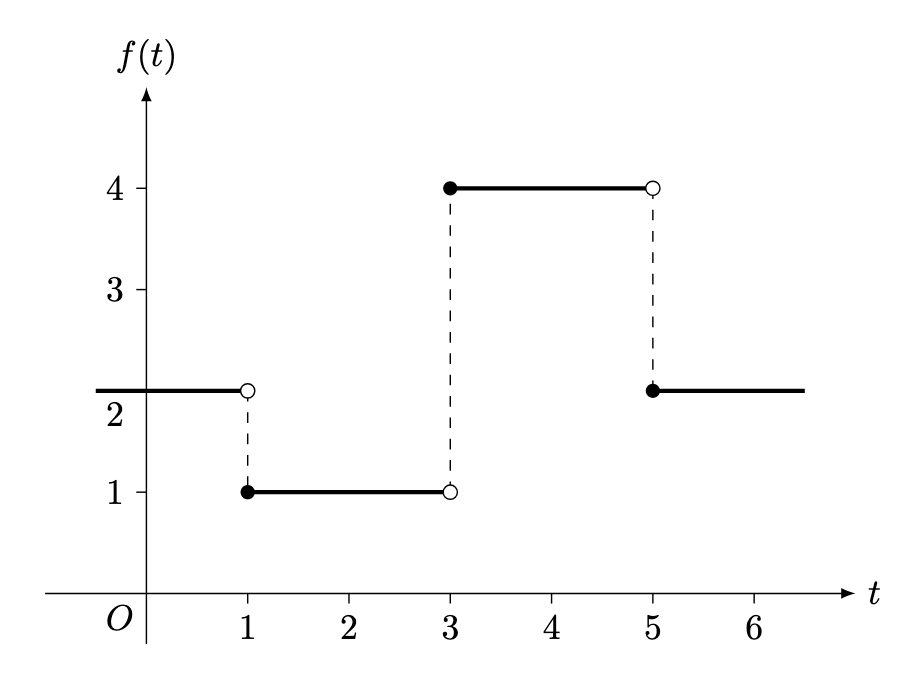
 and
and  .
.

 .
. :
:


 . Taking Laplace transforms,
 .
.
 .
. ,
,
 . It suffices to evaluate

 .
. , define
 with
with 
 . By the shift theorems,
 :
:
 .
. .
. , define

 ,
,


 .
. . By the shift theorems,
 using partial fractions,


 is linear and
  . Recall that the unit step function is defined by
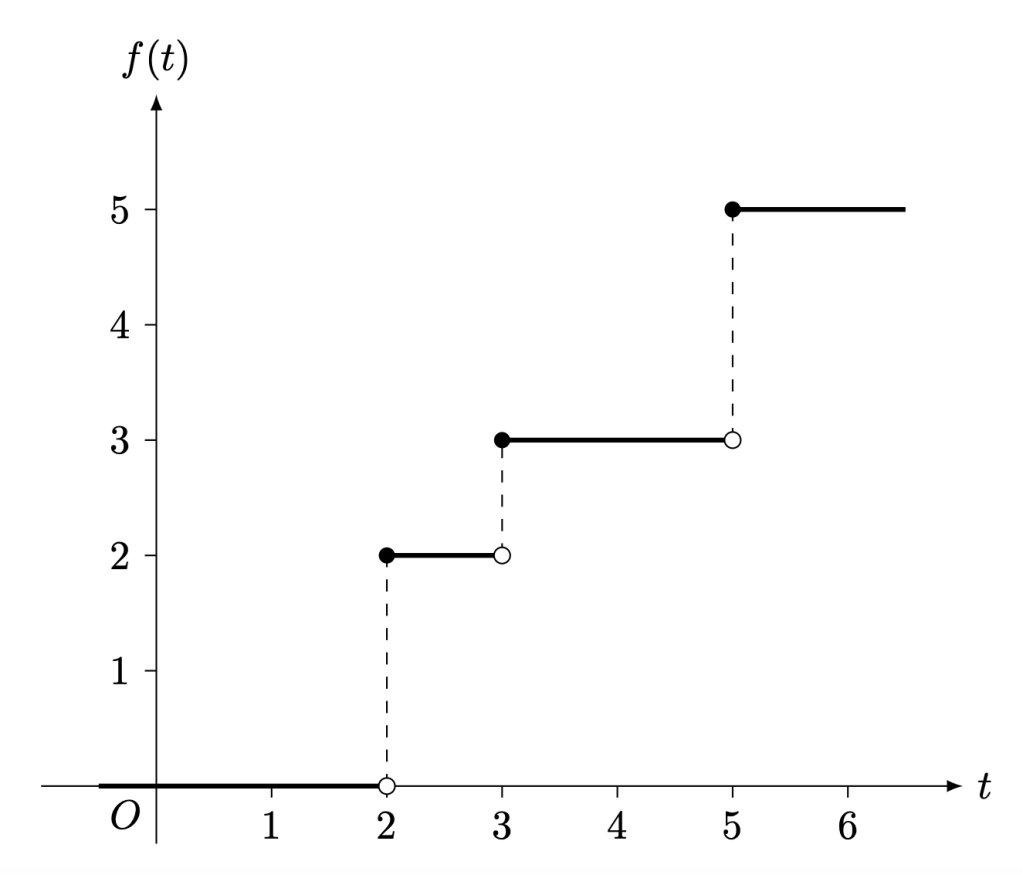
 and
and  .
.


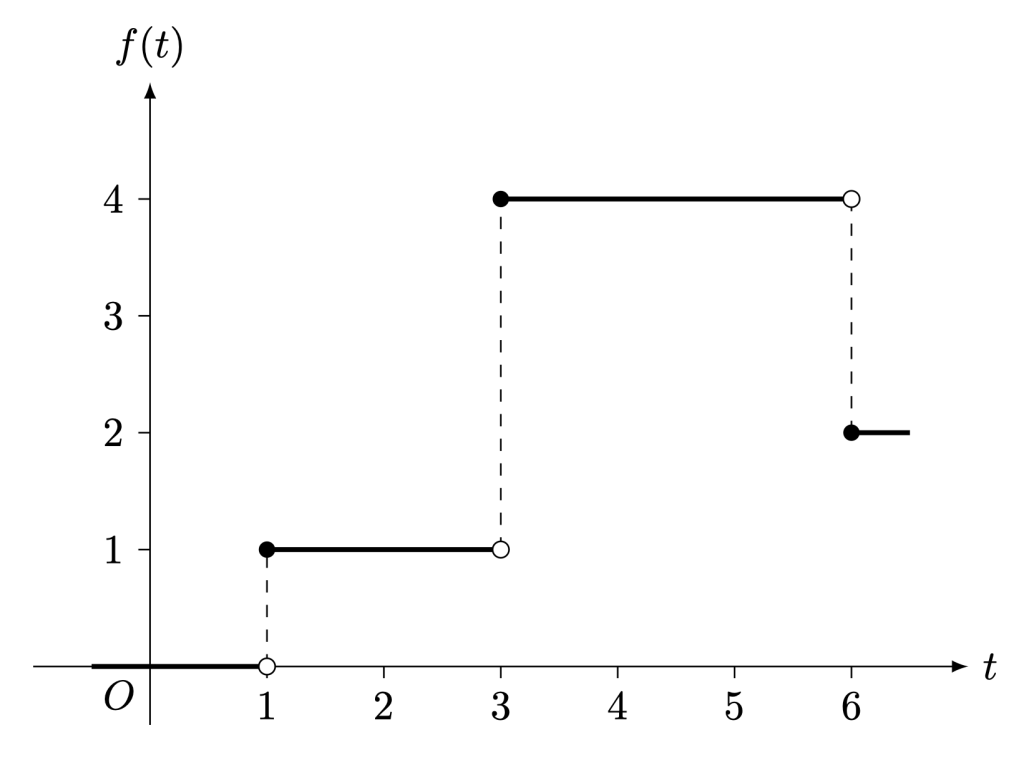
 and
and  .
.


 ,
,


 ,
,


 .
.


 .
. .
.


 has real and distinct auxiliary roots
  , the general solution is given by

 . For the simpler term
  ,
,
 , we first replace each
  to obtain


 .
.

 .
. .
.
 with respect to
  . In more technical notation,
 just means that we will treat

 , prove that
  .
.


 with respect to
  yields
![\displaystyle \int_s^\infty e^{-ut}\, \mathrm du = \left[ \frac{e^{-ut}}{-t} \right]_s^\infty = 0 - \frac{e^{-st}}{-t} = \frac{e^{-st}}{t}.](https://s0.wp.com/latex.php?latex=%5Cdisplaystyle+%5Cint_s%5E%5Cinfty+e%5E%7B-ut%7D%5C%2C+%5Cmathrm+du+%3D+%5Cleft%5B+%5Cfrac%7Be%5E%7B-ut%7D%7D%7B-t%7D+%5Cright%5D_s%5E%5Cinfty+%3D+0+-+%5Cfrac%7Be%5E%7B-st%7D%7D%7B-t%7D+%3D+%5Cfrac%7Be%5E%7B-st%7D%7D%7Bt%7D.&bg=ffffff&fg=000&s=0&c=20201002)


![\displaystyle \begin{aligned} \mathcal L\left\{ \int_0^t f(u)\,\mathrm du \right\} &= \int_0^\infty \left(\int_0^t f(u)\,\mathrm du \right) \cdot e^{-st}\, \mathrm dt \\ &= \int_0^\infty \int_0^t f(u) e^{-st}\, \mathrm du\, \mathrm dt \\ &= \int_0^\infty \int_u^\infty f(u) e^{-st}\, \mathrm dt\, \mathrm du \\ &= \int_0^\infty f(u) \int_u^\infty e^{-st}\, \mathrm dt\, \mathrm du \\ &= \int_0^\infty f(u) \left[ \frac{e^{-st}}{-s} \right]_u^\infty\, \mathrm du \\ &= \int_0^\infty f(u) \left( 0 - \frac{e^{-su}}{-s} \right)\, \mathrm du \\ &= \frac 1s \int_0^\infty f(u) e^{-su}\, \mathrm du = \frac 1s \cdot F(s) = \frac{F(s)}{s}. \end{aligned}](https://s0.wp.com/latex.php?latex=%5Cdisplaystyle+%5Cbegin%7Baligned%7D+%5Cmathcal+L%5Cleft%5C%7B+%5Cint_0%5Et+f%28u%29%5C%2C%5Cmathrm+du+%5Cright%5C%7D+%26%3D+%5Cint_0%5E%5Cinfty+%5Cleft%28%5Cint_0%5Et+f%28u%29%5C%2C%5Cmathrm+du+%5Cright%29+%5Ccdot+e%5E%7B-st%7D%5C%2C+%5Cmathrm+dt+%5C%5C+%26%3D+%5Cint_0%5E%5Cinfty+%5Cint_0%5Et+f%28u%29+e%5E%7B-st%7D%5C%2C+%5Cmathrm+du%5C%2C+%5Cmathrm+dt+%5C%5C+%26%3D+%5Cint_0%5E%5Cinfty+%5Cint_u%5E%5Cinfty+f%28u%29+e%5E%7B-st%7D%5C%2C+%5Cmathrm+dt%5C%2C+%5Cmathrm+du+%5C%5C+%26%3D+%5Cint_0%5E%5Cinfty+f%28u%29+%5Cint_u%5E%5Cinfty+e%5E%7B-st%7D%5C%2C+%5Cmathrm+dt%5C%2C+%5Cmathrm+du+%5C%5C+%26%3D+%5Cint_0%5E%5Cinfty+f%28u%29+%5Cleft%5B+%5Cfrac%7Be%5E%7B-st%7D%7D%7B-s%7D+%5Cright%5D_u%5E%5Cinfty%5C%2C+%5Cmathrm+du+%5C%5C+%26%3D+%5Cint_0%5E%5Cinfty+f%28u%29+%5Cleft%28+0+-+%5Cfrac%7Be%5E%7B-su%7D%7D%7B-s%7D+%5Cright%29%5C%2C+%5Cmathrm+du+%5C%5C+%26%3D+%5Cfrac+1s+%5Cint_0%5E%5Cinfty+f%28u%29+e%5E%7B-su%7D%5C%2C+%5Cmathrm+du+%3D+%5Cfrac+1s+%5Ccdot+F%28s%29+%3D+%5Cfrac%7BF%28s%29%7D%7Bs%7D.+%5Cend%7Baligned%7D&bg=ffffff&fg=000&s=0&c=20201002)
 with Laplace transform
  , prove that
 and
and  ,
,
 ,
,
 ,
, KindiakMath