You may think that constructing the real numbers is the foundation of real analysis. Theoretically, that is true. How can you analyse the real numbers if there aren’t real numbers to begin with?
The practical foundation of real analysis, however, is more properly seen as the notion of limits. Why is that so? The Cauchy construction of real numbers boils down to creating the real numbers using the limits (or lack thereof) of sequences of rational numbers, so we could have started here if we wanted to.
So let’s start by talking about sequences, then limits. For limits, we will need to measure the notion of “closeness”, and that will require us to define the absolute value function. For real analysis, we will adopt the convention  so that
  .
.
Definition 1. Let  be a set. A -sequence is a function
  . Commonly, we denote
  for each
  , and
, and  . A real-valued sequence is an
  -sequence.
When  is a field, we inherit many properties of functions into a field.
Theorem 1. Let be a field. For -sequences  and any number
  ,
,  ,
,  are -sequences. In particular,
  is a -sequence.
We can also define division of sequences, but care needs to be taken to handle zeroes. We will define the reciprocal sequence in one way for simplicity.
Theorem 2. Let  be a -sequence. Suppose there exists
  such that for
  ,
,  . Then we can define the sequence
  by
by

such that for ,  .
.
We also want to talk about limits. Roughly speaking, we want to write  to mean
  when is large. To define
  in this context requires a notion of closeness (of which one of its most general forms is described using topology; but not in this discussion).
To do that, our tool of choice will be the absolute value function. For the rest of this post, we will let be an ordered field.
Lemma 1. For any  ,
,  . Furthermore, if
  , then
  . In particular,
  .
.
Proof. By the antisymmetry of  ,
,  or
or  . In the former case,

In the latter case, implies  so that

Finally, if , then

a contradiction. Thus,  . Combined with , we have . For the final result,
  .
.
Definition 2. The absolute value function  is the function defined by

There are many intriguing properties involving the absolute value function, which we list in the theorem below.
Theorem 3. The absolute value function satisfies the following properties:
- For any ,
 .
.
- For any ,
 .
.
- For any
 ,
,  .
.
- (Triangle Inequality) For any ,
 .
.
Proof. For the first property,  and
and

For the second property,  .
.
The third property is an exercise in case-splitting (there are four cases to compute), which we omit. For the fourth property, we first observe that for any ,

Adding the inequalities,

by case-splitting.
Corollary 1. We have as a consequence the following useful properties of the absolute value function:
- For any ,
 .
.
- For any ,
 if and only if for any
  ,
,  .
.
Proof. The first property follows from

For the second property, first assume  . The direction
  is immediate. For the direction
  , suppose for any
  that
that

This implies  . By definition of
  , . Hence,

For the general case,

With a sufficiently robust idea of the absolute value function, we are now ready to define the limit of a sequence, if it exists.
Definition 3. Let  be a -sequence. For any
  , we write to mean that

We say that converges in  if there exists
  such that .
Actually, a very useful perspective to adopt is to view sequences with limits in terms of sequences with limit  .
.
Theorem 4. Let  be a -sequence. Then
  . More generally,
  .
.
Proof. Use the observation that implies  .
.
Let’s do arithmetic with sequences, but start with limit for simplicity (we’ll perform some tricks later on to handle general limits).
Now for sequences with other kinds of limits, how do we know they are unique? For -sequences it turns out that limits must be unique.
Lemma 2. For , define the constant sequence  by
by  ,
,  . Then
  implies
  .
.
Proof. Fix . Since , there exists such that implies

This implies , as required.
Lemma 3. Let ,  be -sequences such that
  and
and  and . Then

Proof. Fix . Since , for any  , there exists
  such that

Since , for any  , there exists
  such that

To prove all of these limit laws, the key is to particularise  so that the result is bounded by
  . For the first identity, use the triangle inequality so that for
  ,
,

Thus, stipulating  does the trick. Then there will be corresponding
  such that

For the second identity, the result is obvious if . If  , then
  so that setting
  yields

For the third identity,

For the fourth identity, we aren’t assuming that  , and so will avoid the use of
  , which may or may not be well-defined. Instead, we set
  so that for
  ,
,

The squeeze theorem is a ridiculously useful limit property.
Lemma 4. Let , ,  be -sequences such that and . Suppose there exists such that

Then  .
.
Proof. Fix . Since , for any , there exists such that

Since , for any , there exists such that

Setting  , for
, for  ,
,

Therefore, , as required.
Now we want to talk about general limits. Let’s first show that limits in ordered fields must be unique.
Theorem 5. Let be a -sequence. Suppose  and
and  . Then
  . This allows us to write

without ambiguity, whenever such an  exists.
Proof. Observe that  and
and  so that

Since  are constants,
  so that .
This brings us to the star of any analysis on limits: the limit laws.
Theorem 6 (Limit Laws). Let  be -sequences. Suppose
  ,
,  , and . Then

Furthermore, if there exists such that

then  . Finally, if
  and there exists such that

then  .
.
Proof. The first set of limit laws can be proven algebraically:

as required. The squeeze theorem also works since we can apply the zero-limit case to

so that  implies
  .
.
For the monotonicity property, fix . Since , find  so that for
  ,
,

For  ,
,  . Since is arbitrary,
  , as required.
There is one more question worth asking: if , does it always hold that  ? Well, if
  , then we’ll run into problems, and if , this result is plausibly true. You’ll be pleased to know that this result is true. However, this exploration is worth its own exercise since we won’t be needing it as much in our real-analytic discussion.
—Joel Kindiak, 19 Dec 24, 1508H


![\displaystyle \begin{aligned} \int_0^1 x \sec(x^2) \tan(x^2)\, \mathrm dx &= \frac 12 [\sec(x^2)]_0^1\\ &= \frac 12 (\sec(1) - \sec(0)) \\ &= \frac 1{2 \cos(1)} - \frac 12 \\ &\approx 0.425, \end{aligned}](https://s0.wp.com/latex.php?latex=%5Cdisplaystyle+%5Cbegin%7Baligned%7D+%5Cint_0%5E1+x+%5Csec%28x%5E2%29+%5Ctan%28x%5E2%29%5C%2C+%5Cmathrm+dx+%26%3D+%5Cfrac+12+%5B%5Csec%28x%5E2%29%5D_0%5E1%5C%5C+%26%3D+%5Cfrac+12+%28%5Csec%281%29+-+%5Csec%280%29%29+%5C%5C+%26%3D+%5Cfrac+1%7B2+%5Ccos%281%29%7D+-+%5Cfrac+12+%5C%5C+%26%5Capprox+0.425%2C+%5Cend%7Baligned%7D&bg=ffffff&fg=000&s=0&c=20201002)


![\displaystyle \begin{aligned} \int_0^2 x \sin(x^2 + 5)\, \mathrm dx &= \frac 12 \int_0^2 \sin(x^2 + 5) \cdot 2x\, \mathrm dx \\ &= \frac 1{2}\int_5^9 \sin(u)\, \mathrm du \\ &= \frac 12 [-\cos(u)]_5^9 \\ &= \frac 12 (-\cos(9) - (-\cos(5))) \\ &= \frac 12 (\cos(5) - \cos(9)) \approx 0.597, \end{aligned}](https://s0.wp.com/latex.php?latex=%5Cdisplaystyle+%5Cbegin%7Baligned%7D+%5Cint_0%5E2+x+%5Csin%28x%5E2+%2B+5%29%5C%2C+%5Cmathrm+dx+%26%3D+%5Cfrac+12+%5Cint_0%5E2+%5Csin%28x%5E2+%2B+5%29+%5Ccdot+2x%5C%2C+%5Cmathrm+dx+%5C%5C+%26%3D+%5Cfrac+1%7B2%7D%5Cint_5%5E9+%5Csin%28u%29%5C%2C+%5Cmathrm+du+%5C%5C+%26%3D+%5Cfrac+12+%5B-%5Ccos%28u%29%5D_5%5E9+%5C%5C+%26%3D+%5Cfrac+12+%28-%5Ccos%289%29+-+%28-%5Ccos%285%29%29%29+%5C%5C+%26%3D+%5Cfrac+12+%28%5Ccos%285%29+-+%5Ccos%289%29%29+%5Capprox+0.597%2C+%5Cend%7Baligned%7D&bg=ffffff&fg=000&s=0&c=20201002)


 then
then 


![\begin{aligned} \displaystyle \int_0^{2} f(x^2-1)\, \mathrm dx &= \int_0^1 f(x^2 - 1)\, \mathrm dx + \int_1^{\sqrt 2} f(x^2 - 1)\, \mathrm dx + \int_{\sqrt 2}^{2} 0\, \mathrm dx \\ &= \int_0^1 x^2\, \mathrm dx + \int_1^{\sqrt 2} (2 - x^2)\, \mathrm dx+ 0 \\ &= \left[ \frac{x^3}{3}\right]_0^1 + \left[ 2x - \frac{x^3}{3} \right]_1^{\sqrt 2} \\ &= \left( \frac 13 - 0 \right) + \left( 2\sqrt 2 - \frac{2\sqrt 2}{3} \right) \\ &= \frac 13 + \frac{4}{3}\sqrt 2. \end{aligned}](https://s0.wp.com/latex.php?latex=%5Cbegin%7Baligned%7D+%5Cdisplaystyle+%5Cint_0%5E%7B2%7D+f%28x%5E2-1%29%5C%2C+%5Cmathrm+dx+%26%3D+%5Cint_0%5E1+f%28x%5E2+-+1%29%5C%2C+%5Cmathrm+dx+%2B+%5Cint_1%5E%7B%5Csqrt+2%7D+f%28x%5E2+-+1%29%5C%2C+%5Cmathrm+dx+%2B+%5Cint_%7B%5Csqrt+2%7D%5E%7B2%7D+0%5C%2C+%5Cmathrm+dx+%5C%5C+%26%3D+%5Cint_0%5E1+x%5E2%5C%2C+%5Cmathrm+dx+%2B+%5Cint_1%5E%7B%5Csqrt+2%7D+%282+-+x%5E2%29%5C%2C+%5Cmathrm+dx%2B+0+%5C%5C+%26%3D+%5Cleft%5B+%5Cfrac%7Bx%5E3%7D%7B3%7D%5Cright%5D_0%5E1+%2B+%5Cleft%5B+2x+-+%5Cfrac%7Bx%5E3%7D%7B3%7D+%5Cright%5D_1%5E%7B%5Csqrt+2%7D+%5C%5C+%26%3D+%5Cleft%28+%5Cfrac+13+-+0+%5Cright%29+%2B+%5Cleft%28+2%5Csqrt+2+-+%5Cfrac%7B2%5Csqrt+2%7D%7B3%7D+%5Cright%29+%5C%5C+%26%3D+%5Cfrac+13+%2B+%5Cfrac%7B4%7D%7B3%7D%5Csqrt+2.+%5Cend%7Baligned%7D&bg=ffffff&fg=000&s=0&c=20201002)
 , we say that
  with
with  , there exists
  such that
  . For this definition, we do not assume
  .
. is dense in
  such that
  . By the Archimedean property, find
  such that
 and
and  . To formulate this rigorously, the definition of the floor function
  yields the estimate

 to obtain the desired result.
 is dense in
  yields
  . By Problem 1, find a nonzero rational number
  such that
 , as required.
 . Then
  such that
  such that
  is dense in
  , since
  (so that
  , a contradiction).
 such that
  . Apply the density of
  such that
  .
. . Therefore,
 and
and  , then
  .
. . For each
  such that
  . Taking
  , since
  is continuous,
 ,
,
 , the continuous exponential
  with base
  , is unique.
 , or not, denoted
  , but not both. A true proposition
 , called false. These are called truth values. This gives us the following definition for the negation.
 is defined as follows:
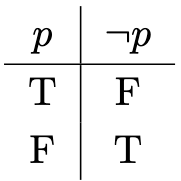
 .
. is a placeholder that takes on exactly one of the truth values
  .
. . To do that, we need to define the biconditional.
  using the following truth table: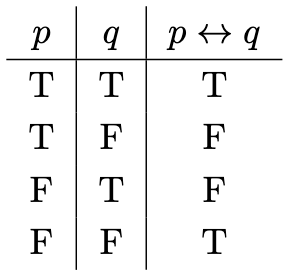
 defined in terms of
  if
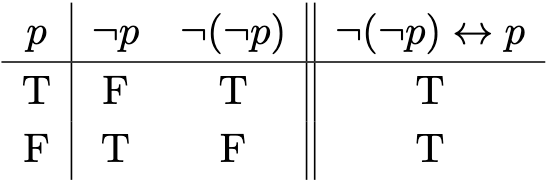
if  is a theorem for any substitution of
  .
.
 is a tautology if
  .
. .
. is a contradiction if
  for some tautology
  .
. , we can define many logical connectors. One crucial one is known as the conjunction.
 using the following truth table: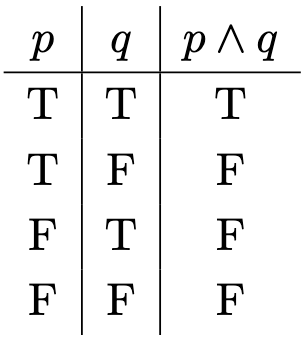

 . However, we first need to prove that we can chain equalities, i.e. that
  and
and  implies
  .
. using the following truth table: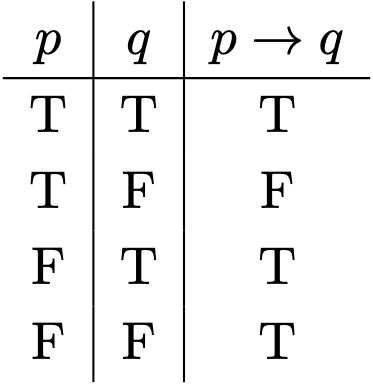

 ,
,
 , if
, if  , then
 . By definition of the truth value of the conjunction, we have
  .
. and
and  .
. and
and  .
. , as required.
 be propositional variables. Then the following hold.
 with respect to
 and
and  .
. , which satisfies the property since
  and
and  trivially. The core idea is to
  in terms of
  so that both integers satisfy
  and
and  .
. such that
  . We claim that
  and
and  . By definition of
  , we observe that
 , find an integer
  such that
  . Since the left-hand side is odd, the right-hand side must be odd, so that
 . Since
  , by the factor theorem,
  is a factor of
  . In particular,
  . Let
. Let  denote an integer such that


 so that
 such that
  . Then

 such that
  , prove that
  if the limit exists.
 . Fix
. Fix  . By hypothesis, for any
  such that
  implies
 , choose
  so that
  implies

 to be chosen, there exists
 for any
  for some
  . Define
  so that for
  . Then
 yields
 such that
 and using the fact that
 ,
,
 for
for  so that
 ,
,
 and applying the fundamental theorem of calculus,
 ,
,
 be a predicate on
  . Suppose
  and for any
  ,
,  . Then for any
  .
. . By the first condition,
  . By the second condition, we obtain the equivalent formulation
  . By a
  .
. . Then for any
  be the predicate defined on
 ,
,  . Since
  , this implies
  . Then
  holds. Therefore,
  .
. . By definition, for any
  ,
,  implies
  . Therefore,
  . By the second condition,
  . Therefore, for any
  implies
  . Therefore,
  , there exist primes
  such that
 and
and  are primes such that
 and for any
  ,
,  .
. can be factored into primes. Clearly,
  is factored into the prime
  , so that
  . There are two cases. Either
  is prime, or not. If
  such that
  . Since
  , by the induction hypothesis, there exist primes
  and
and  such that
 denote the primes in non-decreasing sequence,

 . Repeating the argument
  times then yields the result. Fix
  . By Euclid’s lemma, there exists
  such that
  . Thus, there exists some integer
  . Since
  or
or  .
. . Then
  , a contradiction.
 .
. . By Euclid’s lemma again, there exists
  . A similar argument yields
  , a contradiction.
 , from which we need to prove
 ![[a, b]](https://s0.wp.com/latex.php?latex=%5Ba%2C+b%5D&bg=ffffff&fg=000&s=0&c=20201002) and differentiable on
and differentiable on  . Suppose
  and
and  . Using the mean value theorem, find
  such that
 .
. such that
 yields the vanilla
 ![h : [a, b] \to \mathbb R](https://s0.wp.com/latex.php?latex=h+%3A+%5Ba%2C+b%5D+%5Cto+%5Cmathbb+R&bg=ffffff&fg=000&s=0&c=20201002) by
by
 is differentiable on
 , by Rolle’s theorem, there exists
  :
:
 as
as  .
. be differentiable at
  . Suppose
  as
as  as
as  between
 as
as  : the revenue the firm earns by selling
  : the cost the firm incurs by producing
  : the profit the company earns by selling
  . Note that we are adopting economists’ convention to denote profit by
  , not to be confused with the
  .
. and
and  respectively.
 is strictly decreasing, though that actually can be proven from more
  . Since
 . Assuming that
  is decreasing so that
  ,
,
 on some subset
  , or maximising it. How do we do that?
 be a function.
 is a global minimum point of
  if for any
  ,
,  .
. such that
  .
. .
. .
. be a function that is differentiable at
  .
.![f: [a, b] \to \mathbb R](https://s0.wp.com/latex.php?latex=f%3A+%5Ba%2C+b%5D+%5Cto+%5Cmathbb+R&bg=ffffff&fg=000&s=0&c=20201002) be a continuous function that is differentiable on
be a continuous function that is differentiable on  or interior points
  is undefined or
  and the function
  . How then do we determine the nature of this stationary point?
 (resp.
  ). to mean that there exists
  (resp.
  ),
),  (resp.
  ). We can use the first derivative test to answer our aforementioned question.
![f : [a, b] \to \mathbb R](https://s0.wp.com/latex.php?latex=f+%3A+%5Ba%2C+b%5D+%5Cto+%5Cmathbb+R&bg=ffffff&fg=000&s=0&c=20201002) be differentiable at
be differentiable at  and
and  , then
  or
or  , then
  such that for
  ,
,  such that for
  ,
,  . We claim that for any
  ,
,  . By the
 , such that
 yields
 .
. , then
  , then
  ,
,
 , which after taking
  , implies that
 .
. for
for  for
for  for
for  .
. KindiakMath