Definition 1. Let 


Example 1. We have 

Problem 1. Prove that the following propositions:
.
.
(Click for Solution)
Solution. By definition,

Therefore,

Problem 2. Prove the following propositions:
,
, where
,
.
(Click for Solution)
Solution. The proofs of the various equalities are straightforward applications of the definition of the indicator function.
For the first result, fix 


The second result follows from 
The third result follows from case splitting:
Suppose 


In all other cases, 
If 

If 

If

Therefore,
Problem 3. Use the previous problems to deduce the following set identities.
,
,
,
,
.
(Click for Solution)
Solution. By Problem 1, for each equality of the form 

,
,
since
and
,
.
The fifth result is slightly longer, but not too difficult to verify:

Problem 4. Prove the following distributivity property

(Click for Solution)
Solution. We first observe that

Applying Problem 1 and Problem 2,

Problem 5. Prove the following propositions:
,
,
,
,
,
.
(Click for Solution)
Solution. By Problem 1,

For the second result,

For the third result,

For the fourth result,

Therefore,

For the fifth result,

For the sixth result,

Problem 6. Use the previous problems to deduce the following set identities.
,
,
,
,
.
(Click for Solution)
Solution. We use Problem 1, Problem 2, and Problem 5.
,
,
,
.
The fifth identity takes a bit more effort, and is useful to analyse in the context of complements.

Problem 7. Prove the distributivity properties:

(Click for Solution)
Solution. The first identity is the content of Problem 4.
Applying Problem 5,

Taking complements,

Problem 8. Prove that the following propositions are equivalent:
,
,
,
.
Furthermore, in this case, prove that 
(Click for Solution)
Solution. We first note that by propositional logic

Taking complements, the first proposition implies the second via

Recalling that 

Applying Problem 1 and Problem 2, the third proposition implies the fourth via

The fourth proposition implies the first via 

Finally, by Problem 5, if

Problem 9. Define the symmetric difference by

Prove that

(Click for Solution)
Solution. We first observe that

Furthermore, 

Therefore,

—Joel Kindiak, 7 Feb 25, 1729H
 .
. ,
,
 .
. ,
,
 follows from Problem 1.
 .
.
 at
at  .
. and
and  . By definition of the
 at
at 
 .
. , evaluate
  .
.
 .
. .
.
 .
.
 .
.
 .
.
 .
.
 .
. ,
,
![\displaystyle \begin{aligned} \int_1^2 x\ln (x^2+1)\, \mathrm dx &= \left[ \frac 12 \left( (x^2 + 9) \ln (x^2 + 9) - (x^2 + 9) \right) \right]_1^2 \\ &= \frac 12 \left( 13 \ln 13 - 13 \right) - \frac 12 \left( 10 \ln 10 - 10 \right) \\ &= \frac {13}2 \ln 13 - 5 \ln 10 - \frac 32.\end{aligned}](https://s0.wp.com/latex.php?latex=%5Cdisplaystyle+%5Cbegin%7Baligned%7D+%5Cint_1%5E2+x%5Cln+%28x%5E2%2B1%29%5C%2C+%5Cmathrm+dx+%26%3D+%5Cleft%5B+%5Cfrac+12+%5Cleft%28+%28x%5E2+%2B+9%29+%5Cln+%28x%5E2+%2B+9%29+-+%28x%5E2+%2B+9%29+%5Cright%29+%5Cright%5D_1%5E2+%5C%5C+%26%3D+%5Cfrac+12+%5Cleft%28+13+%5Cln+13+-+13+%5Cright%29+-+%5Cfrac+12+%5Cleft%28+10+%5Cln+10+-+10+%5Cright%29+%5C%5C+%26%3D+%5Cfrac+%7B13%7D2+%5Cln+13+-+5+%5Cln+10+-+%5Cfrac+32.%5Cend%7Baligned%7D&bg=ffffff&fg=000&s=0&c=20201002)
 .
. ,
,
 . Then

 .
. and integrating by parts,
 .
.


 yields
  .
. , and
, and  .
.
 .
. and applying the result from Problem 15,
 as
as  .
. . We first check that
  since taking
  -th roots to the inequality
  yields
  . We then employ the binomial theorem to obtain

 , by the squeeze theorem,
  , so that
  , as required.
 , if
, if  for some
  , then
  . Since
  , there exists
  such that for
  ,
,
 . Set
. Set  so that
  . Then
 such that
  and
and  , denote
  to mean that as
  .
. , prove that if
  , then
  . In this regard we can write
  without contradiction.
 for large
 and
and  . Prove that
  .
. . We observe that
 and
and  . Prove the common comparisons
 by conventional mathematical notation.
 , we observe that by Problem 1,
 is obvious since
  . Next, since
  ,
,
 , define
  . Then


 from the
  , and integrating on both sides:
 , the general solution to the differential equation
 , where
  .
.
 are
are  , the product rule tells us that

 such that
  , then

 be, though? Remember our key insight? Well, writing
  ,
,

 is any arbitrary nonzero constant. Denote
  so that
  . Making the substitution,
 . This yields the method of integrating factors.
 , the general solution to the differential equation

 , find the general solution to the differential equation
 and
and  . Then the integrating factor is given by

 are arbitrary constants.
 be a sequence that is bounded above (resp. bounded below) and non-decreasing (resp. non-increasing). Then
  . Fix
. Fix  . By definition, there exists
  . Then, for
  ,
,
 , so that
  is bounded above. Thus,
  for some
  , so that
  . Thus,
  such that the subsequence
  converges.
 that are bounded above (resp. bounded below),
  (resp.
  ). Since
  for some
  .
. a peak term if
  .
. has finitely many peak terms with the last peak term
  . Define
  . Define inductively
  as follows: for
  , there exists
  such that
  . Therefore, we have defined a non-decreasing subsequence
  . By the monotone convergence theorem,
  . By definition,
  , so is
 ![[a, b]](https://s0.wp.com/latex.php?latex=%5Ba%2C+b%5D&bg=ffffff&fg=000&s=0&c=20201002) . Then
. Then 
![x \in [a, b]](https://s0.wp.com/latex.php?latex=x+%5Cin+%5Ba%2C+b%5D&bg=ffffff&fg=000&s=0&c=20201002) , as required.
, as required.![f, g : [a, b] \to \mathbb R](https://s0.wp.com/latex.php?latex=f%2C+g+%3A+%5Ba%2C+b%5D+%5Cto+%5Cmathbb+R&bg=ffffff&fg=000&s=0&c=20201002) be Riemann-integrable.
be Riemann-integrable.![f + g : [a, b]\to \mathbb R](https://s0.wp.com/latex.php?latex=f+%2B+g+%3A+%5Ba%2C+b%5D%5Cto+%5Cmathbb+R&bg=ffffff&fg=000&s=0&c=20201002) ,
,![cf : [a, b]\to \mathbb R](https://s0.wp.com/latex.php?latex=cf+%3A+%5Ba%2C+b%5D%5Cto+%5Cmathbb+R&bg=ffffff&fg=000&s=0&c=20201002) for any
for any  .
. , find partitions
 ![P, Q \subseteq [a, b]](https://s0.wp.com/latex.php?latex=P%2C+Q+%5Csubseteq+%5Ba%2C+b%5D&bg=ffffff&fg=000&s=0&c=20201002) with
with  such that
![[x_{i-1}, x_i]](https://s0.wp.com/latex.php?latex=%5Bx_%7Bi-1%7D%2C+x_i%5D&bg=ffffff&fg=000&s=0&c=20201002) ,
,


 yields the desired result. We leave it as a bookkeeping exercise to verify that
 . Follow a similar proof for
  via the estimate
 , write
  . It suffices to establish the case
  . The proof is almost identical with the exception that


![f^2 : [a, b] \to \mathbb R](https://s0.wp.com/latex.php?latex=f%5E2+%3A+%5Ba%2C+b%5D+%5Cto+%5Cmathbb+R&bg=ffffff&fg=000&s=0&c=20201002) ,
,![fg : [a, b] \to \mathbb R](https://s0.wp.com/latex.php?latex=fg+%3A+%5Ba%2C+b%5D+%5Cto+%5Cmathbb+R&bg=ffffff&fg=000&s=0&c=20201002) ,
,![|f| : [a, b] \to \mathbb R](https://s0.wp.com/latex.php?latex=%7Cf%7C+%3A+%5Ba%2C+b%5D+%5Cto+%5Cmathbb+R&bg=ffffff&fg=000&s=0&c=20201002) ,
,![f^+ := \max\{0, f\} : [a, b] \to \mathbb R](https://s0.wp.com/latex.php?latex=f%5E%2B+%3A%3D+%5Cmax%5C%7B0%2C+f%5C%7D+%3A+%5Ba%2C+b%5D+%5Cto+%5Cmathbb+R&bg=ffffff&fg=000&s=0&c=20201002) ,
,![\max\{f, g\} : [a, b] \to \mathbb R](https://s0.wp.com/latex.php?latex=%5Cmax%5C%7Bf%2C+g%5C%7D+%3A+%5Ba%2C+b%5D+%5Cto+%5Cmathbb+R&bg=ffffff&fg=000&s=0&c=20201002) .
. are highly nontrivial.
![(\cdot)^2 : [0, \max f([a,b])] \to \mathbb R](https://s0.wp.com/latex.php?latex=%28%5Ccdot%29%5E2+%3A+%5B0%2C+%5Cmax+f%28%5Ba%2Cb%5D%29%5D+%5Cto+%5Cmathbb+R&bg=ffffff&fg=000&s=0&c=20201002) is continuous,
is continuous,  is Riemann-integrable.
 is Riemann-integrable.
![\sqrt{\cdot} : [0, \max |f([a,b])|] \to \mathbb R](https://s0.wp.com/latex.php?latex=%5Csqrt%7B%5Ccdot%7D+%3A+%5B0%2C+%5Cmax+%7Cf%28%5Ba%2Cb%5D%29%7C%5D+%5Cto+%5Cmathbb+R&bg=ffffff&fg=000&s=0&c=20201002) is continuous,
is continuous,  is Riemann-integrable.
 is Riemann-integrable.
 is Riemann-integrable.
 .
. .
. are Lebesgue-integrable implies that the following functions are Lebesgue-integrable:
![\phi \circ f : [a, b] \to \mathbb R](https://s0.wp.com/latex.php?latex=%5Cphi+%5Ccirc+f+%3A+%5Ba%2C+b%5D+%5Cto+%5Cmathbb+R&bg=ffffff&fg=000&s=0&c=20201002) , where
, where  is continuous,
 on the set of functions
 ![[a, b] \to \mathbb R](https://s0.wp.com/latex.php?latex=%5Ba%2C+b%5D+%5Cto+%5Cmathbb+R&bg=ffffff&fg=000&s=0&c=20201002) ) will imply the desired Lebesgue-integrability properties in Problem 2 and Problem 3.
) will imply the desired Lebesgue-integrability properties in Problem 2 and Problem 3. ![f : [a, b] \to \mathbb R](https://s0.wp.com/latex.php?latex=f+%3A+%5Ba%2C+b%5D+%5Cto+%5Cmathbb+R&bg=ffffff&fg=000&s=0&c=20201002) be an integrable function, and suppose
be an integrable function, and suppose  . Let
. Let ![\phi : [m, M] \to \mathbb R](https://s0.wp.com/latex.php?latex=%5Cphi+%3A+%5Bm%2C+M%5D+%5Cto+%5Cmathbb+R&bg=ffffff&fg=000&s=0&c=20201002) be continuous. Prove that
be continuous. Prove that  is integrable.
 , there exists
  such that for any
 ![u,v \in [m,M]](https://s0.wp.com/latex.php?latex=u%2Cv+%5Cin+%5Bm%2CM%5D&bg=ffffff&fg=000&s=0&c=20201002) ,
,
 is integrable, for any
  , there exists a partition
 ![P \subseteq [a, b]](https://s0.wp.com/latex.php?latex=P+%5Csubseteq+%5Ba%2C+b%5D&bg=ffffff&fg=000&s=0&c=20201002) such that
such that
 ,
,  as inputs to
  , then for any
 ![u,v \in [m_i(f, P), M_i(f, P)]](https://s0.wp.com/latex.php?latex=u%2Cv+%5Cin+%5Bm_i%28f%2C+P%29%2C+M_i%28f%2C+P%29%5D&bg=ffffff&fg=000&s=0&c=20201002) , the continuity of
, the continuity of 

 ,
,![\begin{aligned} M_i(\phi \circ f, P) - m_i(\phi \circ f, P) &= \sup_{u, v \in [x_{i-1}, x_i] } (\phi(u) - \phi(v)). \end{aligned}](https://s0.wp.com/latex.php?latex=%5Cbegin%7Baligned%7D+M_i%28%5Cphi+%5Ccirc+f%2C+P%29+-+m_i%28%5Cphi+%5Ccirc+f%2C+P%29+%26%3D+%5Csup_%7Bu%2C+v+%5Cin+%5Bx_%7Bi-1%7D%2C+x_i%5D+%7D+%28%5Cphi%28u%29+-+%5Cphi%28v%29%29.+%5Cend%7Baligned%7D&bg=ffffff&fg=000&s=0&c=20201002)
 ,
,
 , since
  . Then

 and the region under


 ,
,  yields the desired result.
![f : [0, 1] \to \mathbb R](https://s0.wp.com/latex.php?latex=f+%3A+%5B0%2C+1%5D+%5Cto+%5Cmathbb+R&bg=ffffff&fg=000&s=0&c=20201002) be the popcorn function and defining
be the popcorn function and defining ![\phi : [0, 1] \to \mathbb R](https://s0.wp.com/latex.php?latex=%5Cphi+%3A+%5B0%2C+1%5D+%5Cto+%5Cmathbb+R&bg=ffffff&fg=000&s=0&c=20201002) by
by  if
if  otherwise. Both
  are integrable. Then
 ![\phi \circ f = \mathbb I_{\mathbb Q} : [0, 1] \to \mathbb R](https://s0.wp.com/latex.php?latex=%5Cphi+%5Ccirc+f+%3D+%5Cmathbb+I_%7B%5Cmathbb+Q%7D+%3A+%5B0%2C+1%5D+%5Cto+%5Cmathbb+R&bg=ffffff&fg=000&s=0&c=20201002) is a bounded function known as the Dirichlet function. We claim that this function is not Riemann-integrable.
is a bounded function known as the Dirichlet function. We claim that this function is not Riemann-integrable. be any partition of
 ![[0, 1]](https://s0.wp.com/latex.php?latex=%5B0%2C+1%5D&bg=ffffff&fg=000&s=0&c=20201002) . For each
. For each ![\mathbb Q \cap [x_{i-1}, x_i]](https://s0.wp.com/latex.php?latex=%5Cmathbb+Q+%5Ccap+%5Bx_%7Bi-1%7D%2C+x_i%5D&bg=ffffff&fg=000&s=0&c=20201002) and
and ![[x_{i-1}, x_i]\backslash \mathbb Q](https://s0.wp.com/latex.php?latex=%5Bx_%7Bi-1%7D%2C+x_i%5D%5Cbackslash+%5Cmathbb+Q+&bg=ffffff&fg=000&s=0&c=20201002) are both dense in
are both dense in ![r \in \mathbb Q \cap [x_{i-1}, x_i]](https://s0.wp.com/latex.php?latex=r+%5Cin+%5Cmathbb+Q+%5Ccap+%5Bx_%7Bi-1%7D%2C+x_i%5D&bg=ffffff&fg=000&s=0&c=20201002) ,
, ![s \in [x_{i-1}, x_i]\backslash \mathbb Q](https://s0.wp.com/latex.php?latex=s+%5Cin+%5Bx_%7Bi-1%7D%2C+x_i%5D%5Cbackslash+%5Cmathbb+Q&bg=ffffff&fg=000&s=0&c=20201002) , yielding
, yielding
 ,
,  . Therefore,
 yields the result that the Dirichlet function is not integrable.
 , we say that
  if for any
  with
with  , there exists
  such that
  . For this definition, we do not assume
  is dense in
  .
. such that
  . By the Archimedean property, find
  such that
 and
and  . To formulate this rigorously, the definition of the floor function
  yields the estimate

 to obtain the desired result.
 is dense in
  yields
  . By Problem 1, find a nonzero rational number
  such that
 , as required.
 such that
  such that
  is dense in
  , since
  (so that
  , a contradiction).
 such that
  . Apply the density of
  such that
  .
. . Therefore,
 and
and  , then
  .
. . For each
  such that
  . Taking
  is continuous,
 , so that by the continuity of
 , the continuous exponential
  with base
  , is unique.
 , or not, denoted
  , but not both. A true proposition
 , called false. These are called truth values. This gives us the following definition for the negation.
 is defined as follows:
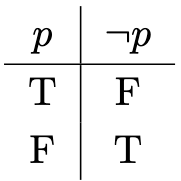
 .
. is a placeholder that takes on exactly one of the truth values
  .
. . To do that, we need to define the biconditional.
  using the following truth table: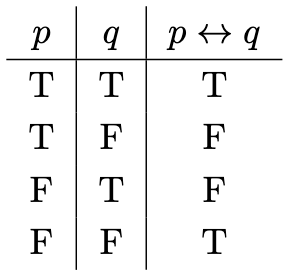
 defined in terms of
  if
if  is a theorem for any substitution of
  .
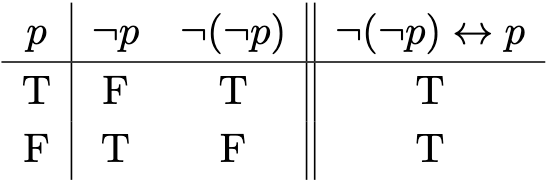
.
 is a tautology if
  .
. .
. is a contradiction if
  for some tautology
  .
. , we can define many logical connectors. One crucial one is known as the conjunction.
 using the following truth table: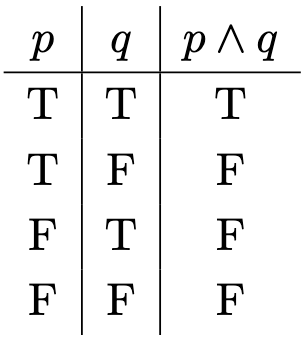

 . However, we first need to prove that we can chain equalities, i.e. that
  and
and  implies
  .
. using the following truth table: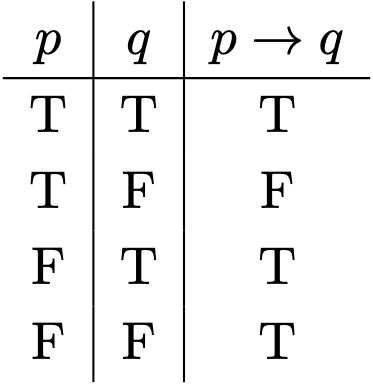

 ,
,
 , if
, if  , then
 . By definition of the truth value of the conjunction, we have
  .
. and
and  .
. and
and  .
. , as required.
 be propositional variables. Then the following hold.
 with respect to
 . Suppose
  and for any
  ,
,  . Then for any
  .
. . By the first condition,
  . By the second condition, we obtain the equivalent formulation
  . By a
  .
. . Then for any
 ,
,  . Since
  , this implies
  . Then
  , and by the first condition,
  holds. Therefore,
  .
. . By definition, for any
  ,
,  implies
  . Therefore,
  . By the second condition,
  . Therefore, for any
  implies
  . Therefore,
  , there exist primes
  such that
 and
and  are primes such that
 and for any
  ,
,  .
. can be factored into primes. Clearly,
  is factored into the prime
  , so that
  . There are two cases. Either
  is prime, or not. If
  such that
  . Since
  , by the induction hypothesis, there exist primes
  and
and  such that
 denote the primes in non-decreasing sequence,

 . Repeating the argument
  times then yields the result. Fix
  such that
  . Thus, there exists some integer
  such that
  . Since
  or
or  .
. such that
  . Then
  , a contradiction.
 .
. . By Euclid’s lemma again, there exists
  . A similar argument yields
  , a contradiction.
 , from which we need to prove
  KindiakMath