Completing the Derivative

Most students memorise the differentiation result

\displaystyle \frac{\mathrm d}{\mathrm d x} (x^n) = nx^{n-1}.

Fairly enough, students apply it to the special cases n = 2, 1/2, -1 to obtain the crucial results

\displaystyle \frac{\mathrm d}{\mathrm d x}(x^2) = 2x,\quad \frac{\mathrm d}{\mathrm d x}(\sqrt x) = \frac 1{2 \sqrt x},\quad \frac{\mathrm d}{\mathrm d x} \left( \frac 1x \right)= -\frac{1}{x^2} .

But nowhere have we proven any of them! Our goal is to formally prove these results, rather than believe them from on high. Our first step is to establish the result for non-negative integers n.

We will first state the definition of the derivative.

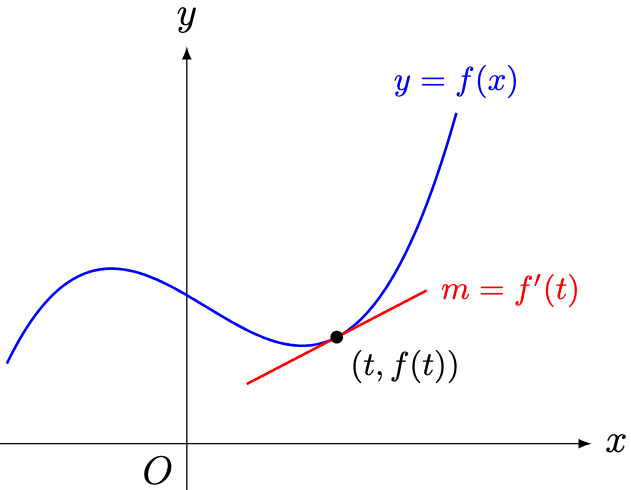
Definition 1. Let f be a real-valued function defined on (a-r,a+r). The derivative of f at x=a, denoted f'(a), is defined by

\displaystyle f'(a) := \lim_{x \to a} \frac{f(a+h) - f(a)}{h},

whenever the right-hand side exists. If f' is defined on \mathbb R, we let

\displaystyle f'(x) \equiv \frac{\mathrm d}{\mathrm d x}(f(x)) denote the gradient function of f.

Later on, we will take advantage of this definition to establish useful differentiation techniques. For now, we will use this definition to prove our key result.

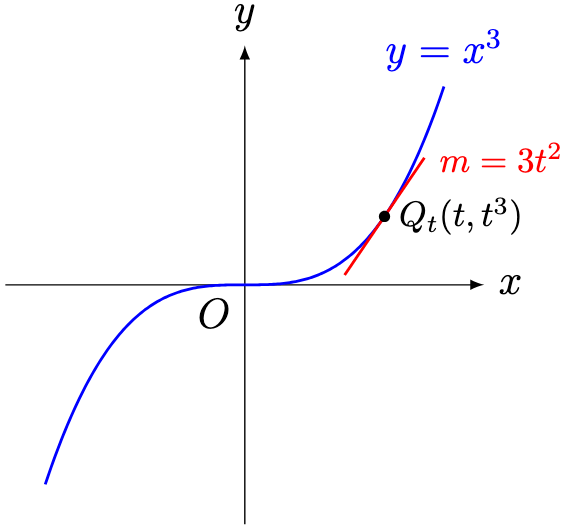
Theorem 1 (Power Rule). For any positive integer n, \displaystyle \frac{\mathrm d}{\mathrm d x}(x^n) = nx^{n-1}.

Proof of Power Rule (n=1). Fix any nonnegative integer n. Fix any real number a. By definition, we hope to compute

\displaystyle \frac{f(a+h) - f(a)}{h} = \frac{(a+h)^n - a^n}{h},

then take h \to 0. If n = 1, then f(x) = x^1, so that

\displaystyle \frac{f(a+h) - f(a)}{h} = \frac{(a+h) - a}{h}=\frac{h}{h} = 1.

Taking h \to 0, this tells us that f'(a) = 1. Since this holds for any real a,

\displaystyle \frac{\mathrm d}{\mathrm d x}(x^1) = f'(x) = 1 = 1x^{1-1},

where x^0 = 1 by convention. Thus, we have proven the result for n=1.

What about general n? There are various approaches, such as induction, but we will adopt the binomial theorem, which we will state without proof, but contextualised to the result we aim to establish.

Lemma 1 (Binomial Theorem). For any positive integer n,

\displaystyle {(a+h)}^n = \sum_{k=0}^n {n \choose k} a^{n-k} h^k ,

which implies

\displaystyle \frac{{(a+h)}^n -a^n}{h} = n a^{n-1} + h \cdot \sum_{k=1}^{n-1} {n \choose k+1} a^{n-k-1} h^{k-1}.

The proof of the binomial theorem pertains a clever insight in combinatorics. We might discuss this in a future writeup in combinatorics. Ironically, this was my weakest topic in mathematics.

Proof of Power Rule (General n). Using the binomial theorem,

\displaystyle \begin{aligned} \frac{f(a+h) - f(a)}{h} &= \frac{(a+h)^n - a^n}{h} \\ &= n a^{n-1} + \underbrace{h \cdot \sum_{k=1}^{n-1} {n \choose k+1} a^{n-k-1} h^{k-1}}_{P_{n-1}(h)} \\ &= na^{n-1} + P_{n-1}(h). \end{aligned}

Since n,a are constants, P_{n-1}(h) is a polynomial in h with degree n-1. This, in fact, is the property of continuity. Therefore, P_{n-1}(h) \to P_{n-1}(0) = 0 as h \to 0. Therefore, taking h \to 0,

\displaystyle \lim_{h \to 0} \frac{f(a+h) - f(a)}{h} = na^{n-1} + 0.

Since this holds for any real a,

\displaystyle \frac{\mathrm d}{\mathrm d x}(x^n) = f'(x) = nx^{n-1}.

Now, this formula works for positive values of n. But the result somehow should work for non-positive integers like n = 0,-1.

In the n = 0 case, we use x^0 = 1 for any real x \neq 0. In the n = -1 case, we will employ the calculation:

\displaystyle \frac{\frac 1{a+h} - \frac 1a}{h} = -\frac 1{a(a+h)} \xrightarrow{h \to 0} -\frac 1{a^2} = (-1)a^{-2},\quad a \neq 0.

Yet even more bizzarely, the works for non-integer rationals like n = 1/2. What’s going on?

For these results, the most straightforward tool we will need the chain rule, which we will explore more pertinently next time when discussing differentiation.

—Joel Kindiak, 18 Oct 24, 1338H

,

Published by


Responses

  1. Calculus Recap (Polytechnic) – KindiakMath

    […] Denote and . By definition of the gradient of the […]

    Like

  2. Who Cares about Laplace Transforms? – KindiakMath

    […] 2. Let be a differentiable function such that exists, is integrable on any and as . Then exists and is given […]

    Like

  3. The Linearity of Calculus – KindiakMath

    […] 3. For any , define the subset of functions differentiable at […]

    Like

  4. The Peculiar Dimensions of Polynomial Space – KindiakMath

    […] that differentiation is a linear transformation. In fact, techniques in calculus yield the famous […]

    Like

  5. The Separable Variables Method – KindiakMath

    […] What this equation tells us is that the derivative of is . Since integrals un-do […]

    Like

  6. What is Euler’s Number? – KindiakMath

    […] Proof of Theorem 2. Fix . By the definition of the derivative, we need to take of the difference quotient […]

    Like

  7. Exploring o-Calculus – KindiakMath

    […] definition for limits. We can therefore define (local) continuity and differentiability. For our next post, we will use the local definition of differentiability to compute the derivative of […]

    Like

  8. The Nuclear Weapon of Differentiation – KindiakMath

    […] have already seen that whenever , when is a positive integer, and in all cases, when […]

    Like

  9. The Meanest Theorem in Calculus – KindiakMath

    […] particular, so that . Since is differentiable at , we will compute its derivative in two […]

    Like

  10. Defining Integration – KindiakMath

    […] discussed differentiation, many courses define integration as the reverse of differentiation. While functionally useful in […]

    Like

  11. What with the +C? – KindiakMath

    […] Proof. Define . By the power rule, […]

    Like

  12. Proving that Pi is Irrational – KindiakMath

    […] that differentiating times and setting yields for . Differentiating one more time […]

    Like

  13. Several Differentiation Drills – KindiakMath

    […] till now, we have proven that only for integer values of . We extend this result to all real values of […]

    Like

Leave a reply to Who Cares about Laplace Transforms? – KindiakMath Cancel reply