Let’s talk linear algebra. This subject involves two key words: linear—referring to some nice vector-ish objects and related properties, and algebra—the manipulations and transformations we can perform on said vector-ish properties.
For an introduction to the topic, we will discuss 2D vectors. But we shall not (and will not) shy away from its more exciting abstractions.
Throughout this post, let 

Definition 1. The two-dimensional

where we will denote the ordered pairs in column notation. In particular, 
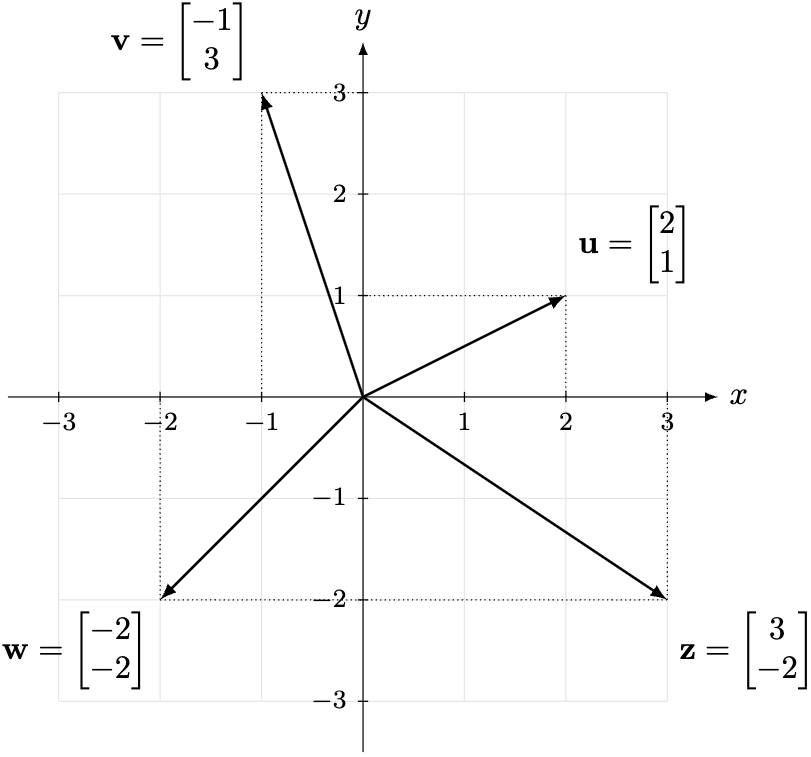
Very soon we will discuss ideas in much broader generality. But perhaps to motivate the subject, we can recall our usual vector operations that correspond to two-dimensional vectors used in high school physics.
Definition 2. Define addition and scalar multiplication on 

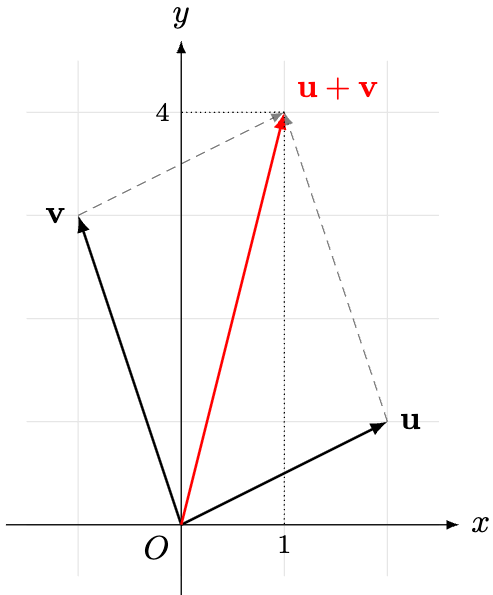
We expect these objects to behave like the vectors that we are familiar with, that in essence, encode directed distance. We call the set of these vectors a vector space.
Theorem 1. Let 

- For
,
.
- For
,
.
- There exists an element
such that for any
,
.
- For any
such that
.
In this case, we call 
- For any
.
In this case, we call
- For any
,
.
- For any
.
- For
,
.
- For any
.
In this case, we call
Proof Sketch. The proof is a matter of definition-checking. Nevertheless, we will complete some proofs to illustrate some of the techniques being used.
For the second property, we take advantage of the associativity of

For the third property, we define 

Notice that this idea is not unique to
Lemma 1. For any field 

Arguably the most important instances of vector spaces would be the function spaces. These spaces don’t always share all of the same properties as
Theorem 2. For any vector space 
For any 

Then 

and for any 


In particular, 
It is this last example that we want to emphasise as the twin brother of
Theorem 3. For any 


Then the function 

For any 

In this case, we call 

Proof Sketch. The proof is immediate after we recognise that for each 

which implies that

The bijectivity of
This connection allows us to define 
Definition 3. For any vector space 


We insist on defining the vector space
—Joel Kindiak, 19 Feb 25, 2233H

 KindiakMath
Leave a comment