The Magical Dot Product

Many linear algebra texts open with a definition of the dot product, say in three dimensions, as follows:

\begin{bmatrix} u_1 \\ u_2 \\ u_3 \end{bmatrix} \cdot \begin{bmatrix} v_1 \\ v_2 \\ v_3 \end{bmatrix} := u_1 v_1 + u_2 v_2 + u_3 v_3.

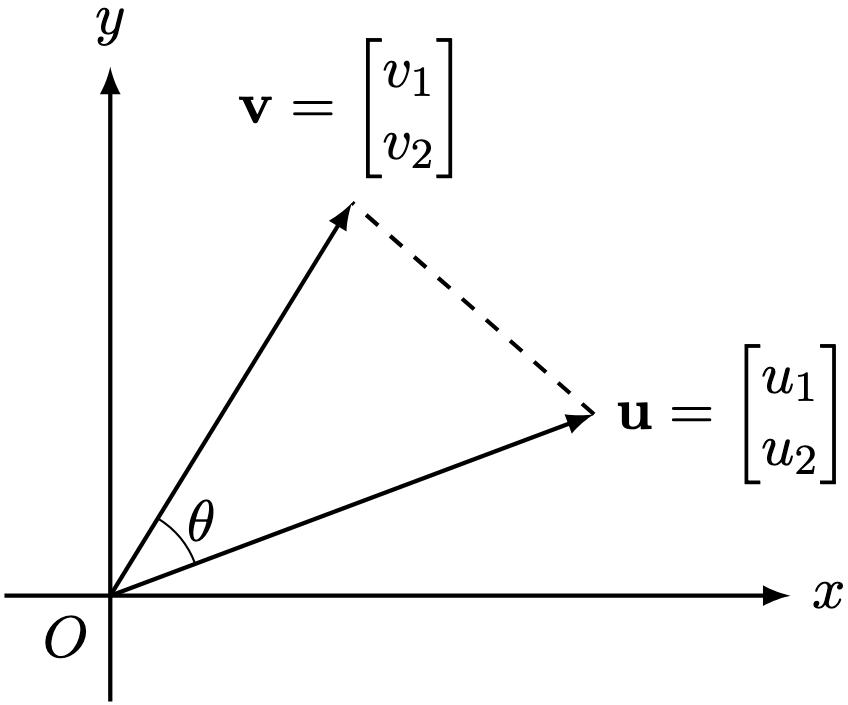
But where on earth did this formula arise from? Other authors open with a geometric definition with the dot product, but I shall open with a simple question: Given two vectors \mathbf u, \mathbf v \in \mathbb R^2 in two-dimensional space, what is the angle \theta between \mathbf u and \mathbf v?

Motivated by the Pythagorean theorem, we can define the length of a two-dimensional vector as follows.

Definition 1. Given \mathbf v = \begin{bmatrix} v_1 \\ v_2 \end{bmatrix}, the norm of \mathbf v is defined by

\|\mathbf v \| := \sqrt{v_1^2 + v_2^2}.

Intuitively, this quantity captures the length of \mathbf v.

Consider two vectors \mathbf u = \begin{bmatrix} u_1 \\ u_2 \end{bmatrix},\mathbf v = \begin{bmatrix} v_1 \\ v_2 \end{bmatrix} \in \mathbb R^2.

Consider the triangle \Delta OUV where O(0, 0), U(u_1,u_2), V(v_1, v_2):

\begin{aligned} \overrightarrow{VU} &= \overrightarrow{VO} + \overrightarrow{OU} \\ &= \overrightarrow{OU} - \overrightarrow{OV} \\ &= \begin{bmatrix} u_1 \\ u_2 \end{bmatrix} - \begin{bmatrix} v_1 \\ v_2 \end{bmatrix} \\ &= \begin{bmatrix} u_1 - v_1 \\ u_2 - v_2 \end{bmatrix}, \end{aligned}

so that

\begin{aligned} {VU}^2 &= (u_1 - v_1)^2 + (u_2 - v_2)^2 \\ &= (u_1^2 - 2 u_1 v_1 + v_1^2) + (u_2^2 - 2 u_2 v_2 + v_2^2) \\ &= (u_1^2 + u_2^2) + (v_1^2 + v_2^2) - 2(u_1 v_1 + u_2 v_2)\\ &= OU^2 + OV^2 - 2(u_1 v_1 + u_2 v_2) . \end{aligned}

Using the law of cosines (or re-deriving its algebraic equivalent),

\begin{aligned} VU^2 &= OU^2 + OV^2 - 2 \cdot OU \cdot OV \cdot \cos(\theta). \end{aligned}

Equating the two displays for VU^2 then doing algebruh,

u_1 v_1 + u_2 v_2 = OU \cdot OV \cdot \cos(\theta).

Therefore, the angle between \mathbf u, \mathbf v can be computed using the sum-product u_1 v_1 + u_2 v_2, which we abbreviate by the dot product notation

\mathbf u \cdot \mathbf v := u_1 v_1 + u_2 v_2,

so that we obtain the dot product equation

\mathbf u \cdot \mathbf v = \| \mathbf u \| \| \mathbf v \|  \cos(\theta).

Yet, the dot product is itself of considerable interest. We can generalise it and talk about angles between other kinds of objects using this idea. This generalisation also features heavily in STEM applications in the form of linear regression. We can even use the dot product to give a theoretically meaningful interpretation to the transpose of a matrix. More on these ideas in future posts.

Theorem 1. For any two vectors \mathbf u = \begin{bmatrix} u_1 \\ u_2 \end{bmatrix},\mathbf v = \begin{bmatrix} v_1 \\ v_2 \end{bmatrix} \in \mathbb R^2 in two-dimensional space, define their dot product by

\mathbf u \cdot \mathbf v := u_1 v_1 + u_2 v_2.

The dot product satisfies the following properties:

  • For any \mathbf v \in \mathbb R^2, \mathbf v \cdot \mathbf v \geq 0.
  • For any \mathbf v \in \mathbb R^2, \mathbf v \cdot \mathbf v = 0 implies \mathbf v = \mathbf 0.
  • For any \mathbf u, \mathbf v \in \mathbb R^2, \mathbf u \cdot \mathbf v = \mathbf v \cdot \mathbf u.
  • For any \mathbf u, \mathbf v \in \mathbb R^2, defining \langle \cdot , \cdot \rangle : \mathbb R^2 \times \mathbb R^2 \to \mathbb R by \langle \mathbf u, \mathbf v \rangle := \mathbf u \cdot \mathbf v, the functions \langle \mathbf u, \cdot \rangle and \langle \cdot, \mathbf v \rangle are linear over \mathbb R.

Furthermore, for nonzero \mathbf u,\mathbf v \in \mathbb R^2,

\mathbf u \cdot \mathbf v = \| \mathbf u \| \| \mathbf v \| \cos(\theta).

Proof. The second property is slightly tricky. Fix \mathbf v \in \mathbb R^2. Then

\mathbf v \cdot \mathbf v = 0 \quad \Rightarrow \quad 0 \leq v_1^2 = v_1^2 + v_2^2 = 0.

Hence, v_1 = 0. Similarly, v_2 = 0. Therefore, \mathbf v = \mathbf 0.

The dot product motivates the defining properties of the inner product, which we formulate to generalise the dot product.

Let \mathbb K be either \mathbb R or \mathbb C.

Definition 1. A map \langle \cdot , \cdot \rangle : V \times V \to \mathbb K is said to be an inner product on V if it satisfies the following properties:

  • For any \mathbf v \in V, \langle \mathbf v, \mathbf v \rangle \in \mathbb R_{\geq 0}.
  • For any \mathbf v \in V, \langle \mathbf v, \mathbf v \rangle = 0 implies \mathbf v = \mathbf 0.
  • For any \mathbf u, \mathbf v \in V, \langle \mathbf u, \mathbf v \rangle = \overline{\langle \mathbf v, \mathbf u \rangle}. When \mathbb K = \mathbb R, we recover usual symmetry.
  • For any \mathbf v \in V, the map \langle \cdot ,\mathbf v \rangle : V \to \mathbb K is linear.

The pair V \equiv (V, \langle \cdot, \cdot \rangle) is called a \mathbb Kinner product space.

Corollary 1. The dot product of two-dimensional vectors (i.e. in \mathbb R^2) as defined in Theorem 1 forms an inner product space.

Henceforth, suppose \langle \cdot, \cdot \rangle is an inner product on V.

Lemma 1. For any \mathbf v \in V, define the quadrance of \mathbf v by

Q(\mathbf v) := \langle \mathbf v, \mathbf v \rangle \in \mathbb R_{\geq 0}.

The following properties hold:

  • For any \mathbf v \in V, Q(\mathbf v) \in \mathbb R_{\geq 0}.
  • For any \mathbf v \in V, Q(\mathbf v) = 0 implies \mathbf v = \mathbf 0.
  • For any \mathbf v \in V, \alpha \in \mathbb K, Q(\alpha \mathbf v) = |\alpha|^2 Q(\mathbf v).

Proof. For the third property, we have

\begin{aligned}Q(\alpha \mathbf v) &= \langle \alpha \mathbf v, \alpha \mathbf v \rangle = \alpha \langle \mathbf v, \alpha \mathbf v \rangle \\ &= \alpha \overline{ \langle \alpha \mathbf v, \mathbf v \rangle  } = \alpha \overline{ \alpha \langle \mathbf v, \mathbf v \rangle  } \\ &= \alpha \overline{\alpha} \overline{ \langle \mathbf v, \mathbf v \rangle } = |\alpha|^2 \langle \mathbf v, \mathbf v \rangle = |\alpha|^2 Q(\mathbf v). \end{aligned}

Lemma 2 (Cauchy-Schwarz Inequality). For any \mathbf u, \mathbf v \in V,

|\langle \mathbf u, \mathbf v \rangle |^2 \leq Q(\mathbf u) Q(\mathbf v).

Proof. Fix \mathbf u, \mathbf v \in V. If \langle \mathbf u,  \mathbf v \rangle = 0, define \alpha := 1. Otherwise, define

\displaystyle \alpha := \frac{ | \langle \mathbf u,\mathbf v \rangle | }{\langle \mathbf u,\mathbf v \rangle}.

In either instance, we have |\alpha| = 1 and \alpha \langle \mathbf u,\mathbf v \rangle = | \langle \mathbf u,\mathbf v \rangle |.

Define the function f_{\alpha} : \mathbb R \to \mathbb R_{\geq 0} by

f_{\alpha}(t) := Q( \alpha t \mathbf u + \mathbf v).

By expanding the definition of Q, we obtain

\begin{aligned} f_{\alpha}(t) &= \alpha \bar \alpha Q(\mathbf u) t^2 + (\alpha \langle \mathbf u, \mathbf v \rangle + \bar \alpha \langle \mathbf v, \mathbf u \rangle )t + Q(\mathbf v) \\ &= |\alpha|^2 Q(\mathbf u) t^2 + (| \langle \mathbf u,\mathbf v \rangle | + | \langle \mathbf u,\mathbf v \rangle | )t + Q(\mathbf v) \\ &= Q(\mathbf u) t^2 +2 | \langle \mathbf u,\mathbf v \rangle | t + Q(\mathbf v).\end{aligned}

Since f_{\alpha}(t) \geq 0 for any t \in \mathbb R, we must have

( 2 | \langle \mathbf u,\mathbf v \rangle | )^2 - 4 Q(\mathbf u) Q(\mathbf v) \leq 0,

yielding |\langle \mathbf u, \mathbf v \rangle |^2 \leq Q(\mathbf u) Q(\mathbf v).

Theorem 2. For any \mathbf v \in V, define the norm of \mathbf v by \| \mathbf v\| := \sqrt{ Q( \mathbf v ) }. The following properties hold:

  • For any \mathbf v \in V, \| \mathbf v \| \geq 0.
  • For any \mathbf v \in V, \| \mathbf v \| = 0 implies \mathbf v = \mathbf 0.
  • For any \mathbf v \in V, \alpha \in \mathbb K, \|\alpha \mathbf v \| = |\alpha| \| \mathbf v \|.
  • For any \mathbf u, \mathbf v \in V, \|\mathbf u + \mathbf v \| \leq \| \mathbf u \| + \| \mathbf v \|.

We call V \equiv (V, \| \cdot \| ) a normed space.

Proof. For the last result, we use the Cauchy-Schwarz inequality to derive that

\begin{aligned} \|\mathbf u + \mathbf v \|^2 &= Q(\mathbf u + \mathbf v) \\ &= Q( \mathbf u )+ \langle \mathbf u,\mathbf v \rangle + \langle \mathbf v,\mathbf u \rangle + Q( \mathbf v ) \\ &= \| \mathbf u \|^2 + 2\, \text{Re}(\langle \mathbf u,\mathbf v \rangle) + \| \mathbf v \|^2 \\ &\leq \| \mathbf u \|^2 + 2 \| \mathbf u \| \| \mathbf v \| + \| \mathbf v \|^2 \\ &= (\| \mathbf u \| + \| \mathbf v \| )^2, \end{aligned}

where we defined \mathrm{Re}(x+iy) := x for x,y \in \mathbb R, and observe that for any z \in \mathbb C, -|z| \leq \mathrm{Re}(z) \leq |z|.

Corollary 2. For any nonzero \mathbf v \in V, define the unit vector \hat{\mathbf v} of \mathbf v by

\displaystyle \hat{\mathbf v} := \frac{ \mathbf v }{ \| \mathbf v \| }.

Then \|\hat{\mathbf v}\| = 1. In particular, if \mathbb K = \mathbb R, for nonzero \mathbf u, \mathbf v, define the angle between them \theta \in [0, \pi] by

\theta := \cos^{-1} (\langle \hat{\mathbf u}, \hat{\mathbf v} \rangle).

Then \langle \mathbf u, \mathbf v \rangle = \| \mathbf u \| \| \mathbf v \| \cos(\theta).

Proof. For the final result, we note that \mathbf u = \| \mathbf u \| \hat{\mathbf u}. Then

\langle \mathbf u, \mathbf v \rangle = \langle \| \mathbf u \| \hat{\mathbf u} , \| \mathbf v \| \hat{\mathbf v} \rangle = \| \mathbf u \| \| \mathbf v \| \langle \hat{\mathbf u}, \hat{\mathbf v} \rangle = \| \mathbf u \| \| \mathbf v \| \cos(\theta).

Corollary 3. Define the metric d : V \times V \to \mathbb R by the map

d(\mathbf u,\mathbf v) := \|\mathbf u - \mathbf v \|.

The following properties hold:

  • For any \mathbf u,\mathbf v \in V, d(\mathbf u, \mathbf v) \geq 0.
  • For any \mathbf v \in V, d(\mathbf v, \mathbf v) = 0 implies \mathbf v = \mathbf 0.
  • For any \mathbf u,\mathbf v \in V, d(\mathbf u, \mathbf v) = d(\mathbf v, \mathbf u).
  • For any \mathbf u, \mathbf v, \mathbf w \in V, d(\mathbf u,\mathbf v) \leq d(\mathbf u, \mathbf w) + d(\mathbf w, \mathbf v).

We call V \equiv (V, d ) a metric space.

Proof. For the last result, use the observation

\mathbf u - \mathbf v = (\mathbf u - \mathbf w) + (\mathbf w - \mathbf v).

Therefore, all inner product spaces are normed spaces, and all normed spaces are metric spaces. By some further investigation, every metric space forms a topological space too. If we took a different generalisation from the usual narrative, we would have explored the notion that all normed spaces are topological vector spaces, which in turn are topological spaces.

Each generalisation has their uses in modern mathematics, but for now, let’s focus on inner product spaces. We will first explore the theory of inner product spaces before exploring their ubiquitous applications across mathematics. In particular, let’s broaden the notion of perpendicularity into orthogonality.

—Joel Kindiak, 12 Mar 25, 1407H

,

Published by


Responses

  1. Generalised Diagonalisation – KindiakMath

    […] Next time, we pivot to generalising right angles using inner products. In fact, we revisit a somewhat familiar idea—dot products. […]

    Like

  2. Generalised Perpendicularity – KindiakMath

    […] inner product on a vector space over a field ( or ) gives us the generalised formulation of the dot product on . In particular, if , then two nonzero vectors have angle defined […]

    Like

  3. Baby Approximation Theory – KindiakMath

    […] more generally, if is an inner product space over , and is a linear transformation, what would be a “best-fit” solution to the […]

    Like

  4. Angle-Preserving Transformations – KindiakMath

    […] be an inner product space over , where equals or […]

    Like

  5. The Spectral Theorems – KindiakMath

    […] be a finite-dimensional inner product space over , and be a linear transformation (or if you’d prefer, linear operator on ). Recall that […]

    Like

  6. Constructing the Cross Product – KindiakMath

    […] our discussion on the dot product began with a simple question: What is the angle between two vectors? Our study on the cross product […]

    Like

  7. Defending Rational Trigonometry – KindiakMath

    […] be a field. In the case , we can define the usual inner product on […]

    Like

  8. Fréchet Derivatives – KindiakMath

    […] denotes the usual dot product on […]

    Like

Leave a comment