H2 Math 2025 Suggested Answers (Paper 2)

Questions have not been uploaded due to copyright reasons. Do comment if you spot any errors.

Section A: Pure Mathematics [40 marks]

Question 1. System of Linear Equations

Solution. (a) Using the question,

\displaystyle \left\{ \begin{matrix} 8c + 11t + 5b = 114, \\ 5c + 14t + 7b = 112, \\ 9c + 9t + 4b = 110. \end{matrix} \right.

Solving the system of linear equations, c = 7, t= 3, b = 5.

(b) By the question, Sam scored 113 points. Let x,y,z denote the number of car, train, and boat tokens respectively that Sam has. Hence,

\displaystyle 7x + 3y + 5z = 113.

Furthermore, we are given that x \geq 6, y \geq 6, z \geq 6, so that

\displaystyle 7x + 3y + 5z \geq 90.

Since the sum is 113, at least one of x,y,z must be odd. Furthermore, by fixing y = z = 6 for simplicity, we must have 7x \leq 65 \Rightarrow x \leq 9. Similarly, y \leq 13 and z \leq 10.

By trial-and-error, x = 6, y = 7, z = 10 works. Since there is only one solution, Sam had 6 car tokens, 7 train tokens, and 10 boat tokens.

Question 2. Vectors

Solution. (a) Firstly,

\overrightarrow{PQ} = \begin{bmatrix} 1 \\ 6 \\ 6 \end{bmatrix} - \begin{bmatrix} -2 \\ 3 \\ 0 \end{bmatrix} = \begin{bmatrix} 3 \\ 3 \\ 6 \end{bmatrix}.

Since \overrightarrow{QR} = \frac 43 \overrightarrow{PQ} and P,Q,R are collinear, we have

\begin{aligned} \overrightarrow{PR} &= \overrightarrow{PQ} + \overrightarrow{QR} \\ &= \overrightarrow{PQ} + {\textstyle \frac 43} \overrightarrow{PQ} \\ &= {\textstyle \frac 73} \overrightarrow{PQ} = {\textstyle \frac 73} \begin{bmatrix} 3 \\ 3 \\ 6 \end{bmatrix} = \begin{bmatrix} 7 \\ 7 \\ 14 \end{bmatrix}.\end{aligned}

Hence,

\overrightarrow{OR} = \overrightarrow{OP} + \overrightarrow{PR} = \begin{bmatrix} -2 \\ 3 \\ 0 \end{bmatrix} + \begin{bmatrix} 7 \\ 7 \\ 14 \end{bmatrix} = \begin{bmatrix} 5 \\ 10 \\ 14 \end{bmatrix}.

(b) Firstly,

\overrightarrow{ SQ } = \begin{bmatrix} 1\\ 6 \\ 6 \end{bmatrix} - \begin{bmatrix} -1 \\ -2 \\ c \end{bmatrix} .

Since \overrightarrow{ SQ } \perp \overrightarrow{ PQ }:

\begin{aligned} \left( \begin{bmatrix} 1\\ 6 \\ 6 \end{bmatrix} - \begin{bmatrix} -1 \\ -2 \\ c \end{bmatrix}  \right) \cdot \begin{bmatrix} 1 \\ 1 \\ 2 \end{bmatrix} &= 0 \\ (1+6+12) - (-1-2+2c) &= 0 \\ 19 - (2c-3) &= 0 \\  c &= 11 .\end{aligned}

(c) Hence,

\overrightarrow{ PS } =  \begin{bmatrix} -1 \\ -2 \\ 11 \end{bmatrix} - \begin{bmatrix} -2 \\ 3 \\ 0 \end{bmatrix} = \begin{bmatrix} 1 \\ -5 \\ 11 \end{bmatrix}.

Therefore the required angle \theta is given by

\begin{aligned} \begin{bmatrix}  1 \\ -5 \\ 11 \end{bmatrix} \cdot \begin{bmatrix} 1 \\ 1 \\ 2 \end{bmatrix} &= \left\| \begin{bmatrix} - 1 \\ -5 \\ 11 \end{bmatrix} \right\| \left\| \begin{bmatrix} 1 \\ 1 \\ 2 \end{bmatrix} \right\| \cos \theta \\ 18 &= \sqrt{147} \sqrt{6} \cos \theta \\ \cos \theta &= \frac{18}{\sqrt{147} \sqrt 6}\\ \theta &\approx 52.7^\circ. \end{aligned}

Question 3. Differential Equations

Solution. (a) By the method of separable variables,

\begin{aligned} \int y^{-2}\, \mathrm dy &= \int \sin 3x\, \mathrm dx \\ \frac{y^{-1}}{-1} &= -\frac 13 \cos 3x + C \\ \frac 1y &= \frac 13 \cos 3x - C \\ y &= \frac{1}{-C + \frac 13 \cos 3x}. \end{aligned}

Since the initial condition is y(\pi) = 1,

\displaystyle 1 = \frac{1}{-C + \frac 13 \cos 3\pi} \quad \Rightarrow \quad C = -\frac 43 .

Therefore, \displaystyle y = \frac{1}{\frac 43 + \frac 13 \cos 3x} = \frac 3{4 + \cos 3x}, where A = 3, B= 4.

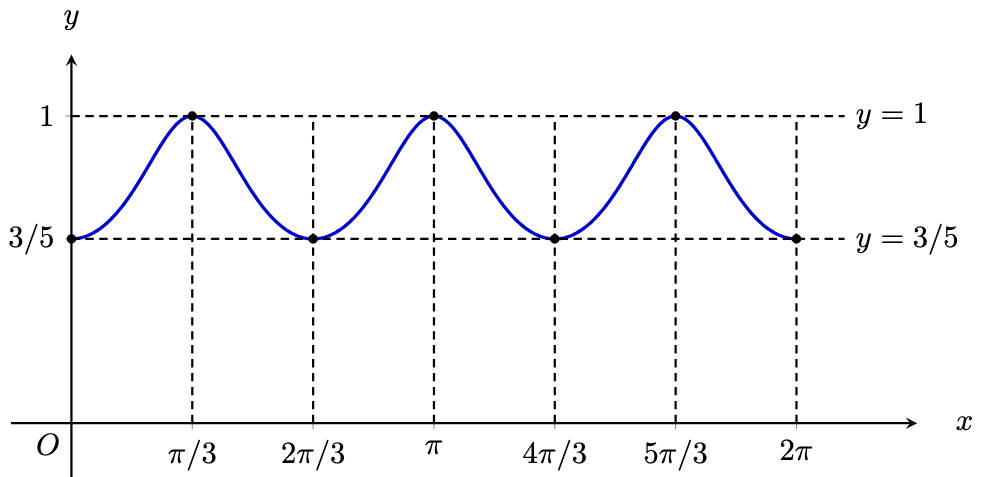
(b) (i) By the graph c = 3/5, 1 (these values correspond with \cos(x) = \pm 1).

(b) (ii) We first note that the graph of y = f(x) is defined on all of \mathbb R, not just the domain [0, 2\pi]. By considering reflections about vertical lines, we observe that the lines of symmetry of y = f(x) are all of the form x = k\pi/3, where k is any integer (positive, zero, or negative).

(b) (iii) Since \cos is 2\pi-periodic,

\begin{aligned} \cos(3(x+\pi)) &= \cos(3x + 3\pi) \\ &= \cos(3x + \pi) \\ &= -{ \cos 3x }. \end{aligned}

Hence,

\displaystyle f(x+\pi) = \frac{A}{B + \cos(3(x+\pi))} = \frac{A}{B - \cos 3x} = \frac{3}{4 - \cos 3x}.

(c) Using the product rule and the chain rule,

\begin{aligned} \frac{\mathrm d^2 y}{\mathrm dx^2} &= \frac{\mathrm d}{\mathrm dx}(y^2 \sin 3x) \\ &= 2y \cdot \frac{\mathrm dy}{\mathrm dx} \cdot \sin 3x + y^2 \cdot 3 \cos 3x \\ &= 2y \cdot y^2 \sin 3x \cdot \sin 3x + y^2 \cdot 3 \cos 3x \\ &= (3 \cos 3x) \cdot y^2 + (2 \sin^2 3x) \cdot y^3,\end{aligned}

where P(x) = 3 \cos 3x, Q(x) = 2 \sin^2 3x.

Question 4. Rate of Change

Solution. (a) Letting T denote the time taken to fill the bowl,

10\pi \cdot T = \frac 13 \pi \cdot 15^2 \cdot (45 - 15) \quad \Rightarrow \quad T = 225\, \text{s}.

(b) Using the chain rule,

\begin{aligned} \frac{\mathrm dV}{\mathrm dt} &= \frac{\mathrm dV}{\mathrm dh} \cdot \frac{\mathrm dh}{\mathrm dt} \\ &= {\textstyle \frac 13} \pi \cdot (2h \cdot (45-h) + h^2 \cdot (-1)) \cdot \frac{\mathrm dh}{\mathrm dt} \\ &= {\textstyle \frac 13} \pi \cdot h (90-3 h)  \cdot \frac{\mathrm dh}{\mathrm dt}. \end{aligned}

At h = 12,

\begin{aligned}  10\pi &=  {\textstyle \frac 13} \pi \cdot 12 (90-3 \cdot 12)  \cdot \frac{\mathrm dh}{\mathrm dt}\Big|_{h = 12} \quad \Rightarrow \quad  \frac{\mathrm dh}{\mathrm dt}\Big|_{h = 12} = \frac{5}{108 }\, \text{cm}\ \text{s}^{-1}.\end{aligned}

(c) The total volume poured into the bowl after T seconds is

\displaystyle \int_0^T 10\pi t\, \mathrm dt = 10\pi \cdot \frac{T^2}{2} = 5\pi \cdot T^2.

Since T > 0, the required time taken is given by solving the equation:

\displaystyle 5\pi \cdot T^2 = 972 \pi \quad \Rightarrow \quad T = \sqrt{194.4} \approx 13.9\, \text{s}.

(d) At V = 972\pi,

\frac 13 \pi h^2 (45 - h) = 972 \pi \quad \Rightarrow \quad h^3 -45h^2  + 2916= 0.

Solving the cubic equation, h = 43.455, 9, -7.4558. Since h \in [0, 15], we reject the first and last option and conclude h = 9.

Therefore,

\begin{aligned} 10\pi T &= {\textstyle \frac 13} \pi \cdot 9 (90-3 \cdot 9) \cdot \frac{\mathrm dh}{\mathrm dt}\Big|_{h = 9} \quad \Rightarrow \quad \frac{\mathrm dh}{\mathrm dt}\Big|_{h = 9} = \frac{10T}{189} \approx 0.738\, \text{cm}\ \text{s}^{-1}.\end{aligned}

Section B: Probability and Statistics [60 marks]

Question 5. Probability

Solution. (a) The total number of counters is 3+5+7 = 15. The probability that the counters are of the same colours is given by

\displaystyle \frac{3 \times 2 + 5 \times 4 + 7 \times 6}{15 \times 14} = \frac{34}{105}

Hence, the required probability is its complement 1 - \frac{34}{105} = \frac{71}{105}.

(b) By pattern-recognition, the required equation to solve is:

\displaystyle \frac{12!}{(13-n)!} \cdot \frac{(16-n)!}{15!} \cdot \frac{3}{16-n} = \frac{36}{455}.

The left-hand side, using factorials, simplifies to

\begin{aligned} \frac{12!}{(13-n)!} \cdot \frac{(16-n)!}{15!} \cdot \frac{3}{16-n} &= \frac{(15-n)(14-n)}{ 910 } . \end{aligned}

Hence, we need to solve the quadratic equation

\displaystyle \frac{(15-n)(14-n)}{ 910 } = \frac{36}{455}.

Solving, we get n = 6.

Question 6. Normal Distribution

Solution. (a) Using the symmetry of the normal distribution,

\mathbb P(X < 7) = \mathbb P(X < \mu) - \mathbb P(7 \leq X < \mu) = 0.5 - 0.45 = 0.05.

(b) Since X \sim \mathcal N(\mu, 1.8^2), we have

\begin{aligned} 0.05 = \mathbb P(X < 7) &= \mathbb P\left(Z < \frac{7 - \mu}{1.8}\right). \end{aligned}

Using z-scores,

\displaystyle \frac{7 - \mu}{1.8} = -1.6449 \quad \Rightarrow \quad \mu = 7 + 1.6449 \cdot 1.8 = 9.96082 \approx 9.96.

(c) Using independence,

\begin{aligned} 0.38 = \mathbb P((X > 7) \cap (Y > 7)) &= \mathbb P(X > 7) \cdot \mathbb P(Y > 7) \\ &= 0.95 \cdot \mathbb P(Y > 7). \end{aligned}

By algebruh,

\displaystyle \mathbb P(Y > 7) = \frac{0.38}{0.95} = 0.4\quad \Rightarrow \quad \mathbb P(Y \leq 7) = 0.6.

Since Y \sim \mathcal N(\lambda, 2.8^2),

\displaystyle \mathbb P\left(Z \leq \frac{7 - \lambda}{2.8} \right) = \mathbb P(Y \leq 7) = 0.6.

Using z-scores,

\displaystyle \frac{7 - \lambda}{2.8} = 0.25334 \quad \Rightarrow \quad \lambda = 7 - 2.8 \cdot 0.25334 = 6.2906 \approx 6.29.

(d) Using complements,

\begin{aligned} \mathbb P(Y \leq a) &= 1 - \mathbb P(Y > a) \\ &= 1 - 2 \cdot \mathbb P(Y > 7) \\ &= 1 - 2 \cdot 0.4 = 0.2.  \end{aligned}

Since Y \sim \mathcal N(6.2906, 2.8^2) by (c), a \approx 3.93.

Question 7. Permutations and Combinations

Solution. (a) The total number of arrangements, including repetitions, is

\displaystyle \frac{8!}{2! \cdot 2!} = 10\, 080.

(b) We first choose the start and end numbers, then place the third even number in the middle four spaces, and then permute the odd numbers:

\displaystyle (3 \times 2) \times {4 \choose 1} \times \frac{5!}{2! \cdot 2!} = 720.

(c) The total number of even-number groups (consisting of 2,4,8) is 3! = 6. Hence, the required total is

\displaystyle 3!  \cdot \frac{6!}{2! \cdot 2!} = 1080.

(d) We first count the number of arrangements where the even digits are all together and the odd digits are all together:

\displaystyle 3! \cdot \frac{5!}{2! \cdot 2!} \cdot 2! = 360.

The required probability is given by a conditional probability as follows:

\displaystyle \frac{ 360 }{ 1080 } = \frac 13.

Question 8. Correlation and Linear Regression

Solution. (a) Since r = 0.39 \in (0.3, 0.7), there is a weak positive linear correlation between the best performances of the athletes in the high jump and long jump events.

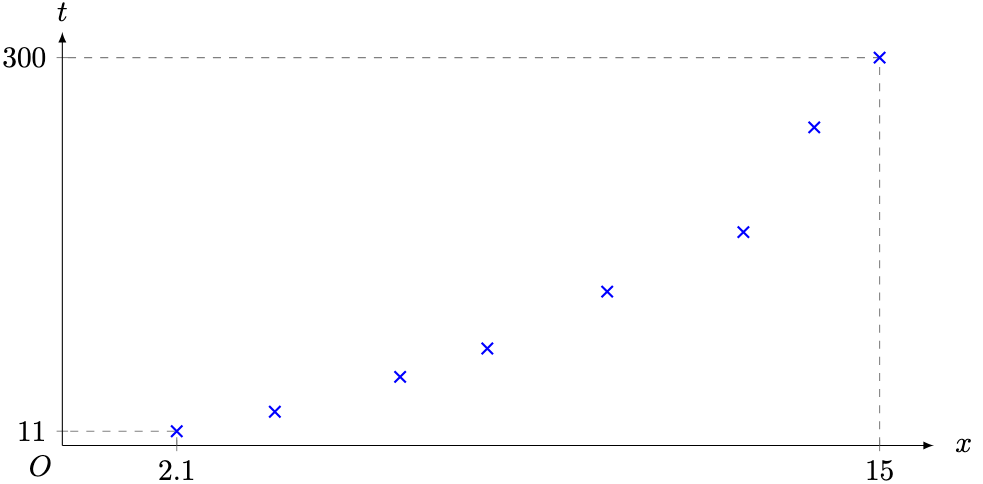
(b) (i) The diagram suggests that there is a positive, though non-linear, correlation between x and t, where x increases at an increasing rate as t increases.

(ii) For the model t = ax+ b, we obtain a correlation coefficient of r_1 \approx 0.958, and for the model t = cx^2 + d we obtain a correlation coefficient of r_2 \approx 0.990. Since 0 < r_1 < r_2 < 1 (i.e. |r_2| is closer to 1 than |r_1|), the model t = cx^2 + d is a better fit to the data. Furthermore, we obtain the regression equation

\begin{aligned} t &= 1.24969x^2 + 0.87580 \\ t &= 1.25x^2 + 0.876.\quad (\text{3sf}) \end{aligned}

(iii) At x = 11,

t = 1.24969 \cdot 11^2 + 0.87580 \approx 152\, \text{minutes}.

Since r_2 \approx 0.990 is close to 1, the correlation between t and x^2 is strongly positive. Hence, an interpolation x = 11 \in (2.1, 11) yields a reliable estimate.

Question 9. Binomial Distribution

Solution. (a) The two assumptions are as follows:

  • The probability that a randomly chosen refrigerator is faulty is constant.
  • The faultiness of any refrigerator is independent of other refrigerators.

(b) Since X \sim \mathrm{B}(90, 0.02), the required probability is

\mathbb P(X > 1) = 1 - \mathbb P(X \leq 1) = 1 - 0.46043 = 0.53956 \approx 0.540.

(c) Let V \sim \mathrm{B}(5, 0.53956) denote the number of days in a 5-day working week, on which Alan finds more than one faulty refrigerator. The required probability is

\mathbb P(V < 2) = \mathbb P(V \leq 1) = 0.14195 \approx 0.142.

(d) Since 90 \times 5 = 450, let W \sim \mathrm B(450, 0.02) denote the number of faulty refrigerators that Alan finds in total, in a 5-day work week. Then the required probability is

\mathbb P(W < 10 ) = \mathbb P(W \leq 9) = 0.58741 \approx 0.587.

(e) Since X \sim \mathrm{B}(90, 0.02) and X \sim \mathrm{B}(60, 0.03), the required probability is given by three cases:

\begin{aligned} \mathbb P(X + Y = 2) &= \mathbb P(X = 2) \cdot \mathbb P(Y = 0) + \mathbb P(X = 1) \cdot \mathbb P(Y = 1) + \mathbb P(X = 0) \cdot \mathbb P(Y = 2) \\ &= 0.27074 \cdot 0.16080 + 0.29812 \cdot 0.29840 + 0.16231 \cdot 0.27225 \\ &= 0.17668 \approx 0.177. \end{aligned}

Question 10. Flour-Production

Solution. (a) In the question, X denotes the mass, in kg, of packets produced by Machine P, and Y denotes the mass, in kg, of packets produced by Machine Q. Since the machines are different and not related in general, the masses of packets of flour produced would also not affect one another. Therefore, X,Y are independent.

(b) Let X \sim \mathcal N( 2.2, 0.1^2 ) denote the mass of a randomly chosen packet of flour produced by Machine P. Let Y \sim \mathcal N( 2.1, 0.05^2 ) denote the mass of a randomly chosen packet of flour produced by Machine Q. Then

\begin{aligned} \mathbb E[X - Y] &= 2.2 - 2.1 = 0.1, \\ \mathrm{Var}(X - Y) &= 0.1^2 + 0.05^2 = 0.0125, \\ X- Y &\sim \mathcal N(0.1, 0.0125). \end{aligned}

Hence, the required probability is

\mathbb P(X > Y) = \mathbb P(X - Y > 0)  = 0.81445 \approx 0.814.

(c) Defining the random variable W := X_1+ X_2 + X_3 + Y_1 + \cdots + Y_5,

\begin{aligned} \mathbb E[W] &= 3 \cdot 2.2 + 5 \cdot 2.1 = 17.1, \\ \mathrm{Var} (W) &= 3 \cdot 0.1^2 + 5 \cdot 0.05^2 = 0.0425. \end{aligned}

Hence, W \sim \mathcal N(17.1, 0.0425), so that the required probabiltiy is

\displaystyle \mathbb P(W > 17) = 0.68616 \approx 0.686.

(d) Let \mu denote the mean mass of a packet of flour, in kg, produced by the adjusted Machine P. Then the null hypothesis \mathrm H_0 and the alternative hypothesis \mathrm H_1 are given as follows:

\mathrm H_0 : \mu = 2.2,\quad \mathrm H_1 : \mu \neq 2.2.

(e) Let \bar x and s^2 denote the unbiased estimates of the population mean and variance of the relevant masses. Then

\displaystyle \bar x = 2 + \frac{4.5}{30} = 2.15

and

\displaystyle s^2 = \frac{1}{30-1} \left( 1.11 - \frac{4.5^2}{30} \right) = 0.015.

(f) Suppose \mathrm H_0 holds. Since the sample size n = 30 \geq 0 is sufficiently large, by the central limit theorem,

\displaystyle \bar X \sim \mathcal N \left( 2.2, \frac{0.015}{30} \right)\quad \text{approximately}.

Since we are conducting a two-tailed test, the required p-value is given by

p = 2 \cdot \mathbb P(\bar X \leq 2.15)= 2 \cdot 0.012673  \approx 0.0253 < 0.05.

Since p < 0.05, there is sufficient evidence to reject \mathrm H_0 and conclude that the mean mass of packets produced by the adjusted Machine P differs from 2.2 kg.

(g) If fewer than 30 packets has been used, then the central limit theorem would lead to a weaker approximate normal distribution for \bar X, yielding a possibly larger p-value.

(h) If the sample had not been chosen randomly, it is plausible that the packets of flour chosen have masses that are not independent with one another, so that \bar X may not follow a normal distribution, even approximately.

—Joel Kindiak, 7 Nov 25, 1522H

Published by


Responses

  1. xx Avatar
    xx

    is 9b supposed to be 1-P(X<= 1)?

    Like

    1. joelkindiak Avatar
      joelkindiak

      Yep I believe so; doing bug-fixing now (spotted several arithmetic bugs but now I believe they have been fixed)

      Like

Leave a reply to joelkindiak Cancel reply