What is a negative number?
Let’s say that you started investing 
- If the price increases to
, then you have gained
.
- If, however, the price decreases to
, then you have lost
.
A positive number, therefore, represents our idea of an increase in a certain amount. A negative number, therefore, represents our idea of a decrease in a certain amount—i.e. a reverse of an increase.
A useful way to visually think of these ideas is by considering the number line below.
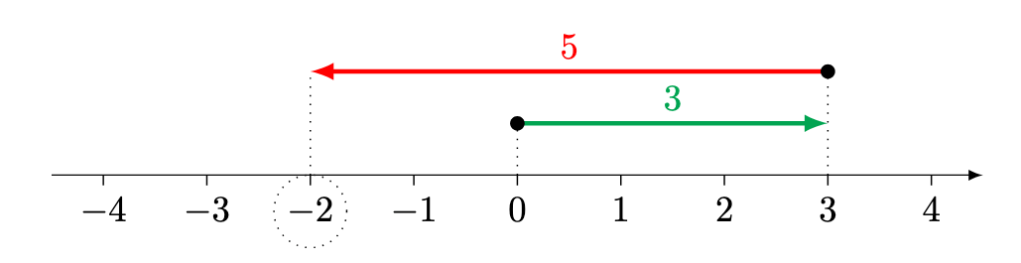
Here, we fix the “no-change” point 
- We represent a positive change using a rightward arrow
whose length describes the extent of said change.
- Likewise, we represent a negative change, by flipping the rightarrow
whose length describes the extent of said change. We denote points to the left of
.
It is clear that 


However, the number line can help us develop some needful ideas.
Example 1. Use the number line above to evaluate the expression
Solution. We re-draw the number line below.
We can read the expression
- start at
- move
units rightward
- move
leftward
The resulting position is 

Since there is nothing special about the numbers
Lemma 1. Given whole numbers 

Proof. Use the number line representation for negative numbers.
Definition 1. A negative number is a number of the form 

- The collection of positive whole numbers, negative numbers, and zero, is together called the collection of integers.
We define addition of integers according to the following rules, where 


Furthermore, we define subtraction of integers by 
For a more complete construction, see this post that uses higher-level mathematics.

Using the number line above, we see that flipping a

If we flip a leftward direction 

Definition 2. We define multiplication by 

whenever
Example 2. Evaluate 
Solution. By Definition 2, and our prior discussion,

Consolidating, we have the following sign conventions.
Lemma 2. The following multiplication of negative signs hold:

Example 3. Evaluate the expressions 


Solution. Using Definition 2,

Similarly,

Finally, using Example 2,

To shorten our working, we use the double negative rule:

Since there is nothing special about the numbers 
Theorem 1. Given integers

Proof. Use Definition 2 and Lemma 2 and adapt the solution in Example 3.
At last, expressions of the form 
What we have done works for positive and negative fractions as well. We call them rational numbers, since fractions are ratios of numbers. Filling in the holes between the rational numbers gives us the real numbers, which we picture using the number line. More on that in the next post!
—Joel Kindiak, 18 Sept 25, 1641H
 KindiakMath
Leave a reply to The Number Line – KindiakMath Cancel reply