Algebraic Calculus

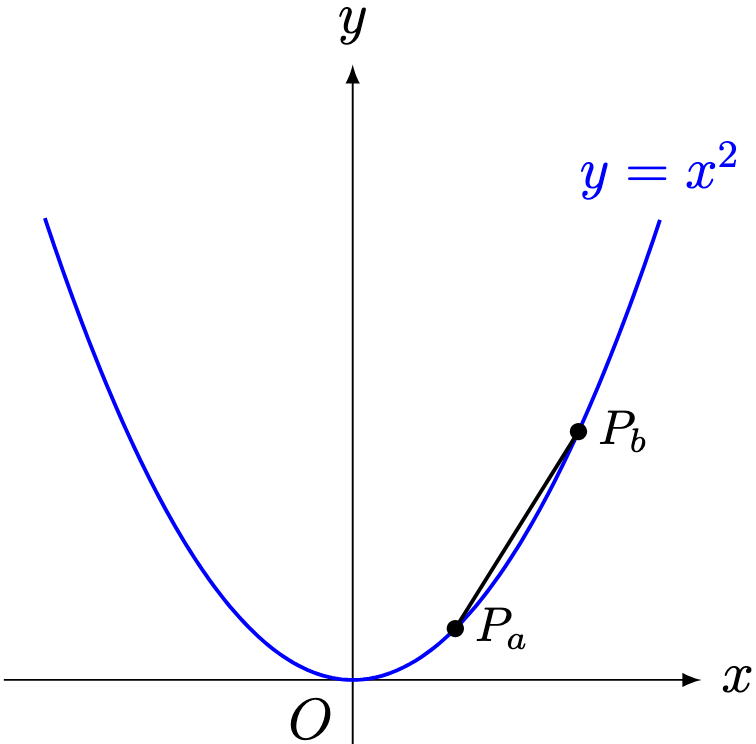
Consider the graph of y = x^2 below.

Define the point P_t on the graph by (t, t^2).

Use this graph to answer Problems 1–4.

Problem 1. Evaluate the gradient of P_1 P_2.

(Click for Solution)

Solution. Since P_1(1, 1) and P_2(2, 4), the gradient is given by

\displaystyle m_{P_1P_2} = \frac{4-1}{2-1} = \frac 31 = 3.

Problem 2. Given h, evaluate the gradient of P_1 P_{1+h}.

Verify your answer in Problem 1.

(Click for Solution)

Solution. Since P_{1+h}(1+h, (1+h)^2), the gradient is given by

\begin{aligned} m_{P_1P_{1+h}} &= \frac{(1+h)^2-1}{(1+h)-1} \\ &= \frac{(1+2h+h^2)-1}{(1+h)-1} \\ &= \frac{2h+h^2}{h} \\ &= \frac{(2+h)\cdot h}{h} \\ &= 2+h. \end{aligned}

This answer agrees with Problem 1, since setting h = 1 gives

\begin{aligned} m_{P_1P_{1+h}} &= 2 + h \\ &= 2 + 1 \\ &= 3 = m_{P_1P_2}. \end{aligned}

Problem 3. Given t and h, evaluate the gradient of P_t P_{t+h}.

Verify your answer in Problem 2.

(Click for Solution)

Solution. Since P_t(t,t^2) and P_{t+h}(t+h, (t+h)^2), so that the gradient is given by

\begin{aligned} m_{P_tP_{t+h}} &= \frac{(t+h)^2-t^2}{(t+h)-t} \\ &= \frac{(t^2+2th+h^2)-t^2}{(t+h)-t} \\ &= \frac{2th+h^2}{h} \\ &= \frac{(2t+h)\cdot h}{h} \\ &= 2t+h. \end{aligned}

This answer agrees with Problem 2 since setting t = 1 gives

\begin{aligned} m_{P_tP_{t+h}} &= 2t + h \\ &= 2 \cdot 1 + h \\ &= 2 + h \\ &= m_{P_1P_{1+h}}. \end{aligned}

Problem 4. Let L_t denote the line passing through P_t. Show that L_t is tangent to y = x^2 if and only if its gradient is 2t.

(Click for Solution)

Solution. Denote the gradient of L_t by m. Then

L_t : y = m(x - t) + t^2.

When L_t intersects the curve y = x^2,

x^2 = m(x-t) + t^2

so that solving yields

\begin{aligned} x^2 - t^2 - m(x-t) &= 0 \\ (x-t)(x+t) - m(x-t) &= 0 \\ (x-t)(x+t-m) &= 0. \end{aligned}

Then x = t or x = m - t. For L_t to be a tangent to the curve y = x^2 at P_t, we must have both roots equal t, so that

t = m-t \quad \iff \quad m = 2t,

as required.

Therefore, by setting h = 0 in Problem 3, we obtain the answer in Problem 4: the expression 2t. Intuitively, this expression describes the gradient of the tangent at (t, t^2).

Problem 5. Now consider the graph of y =x^3.
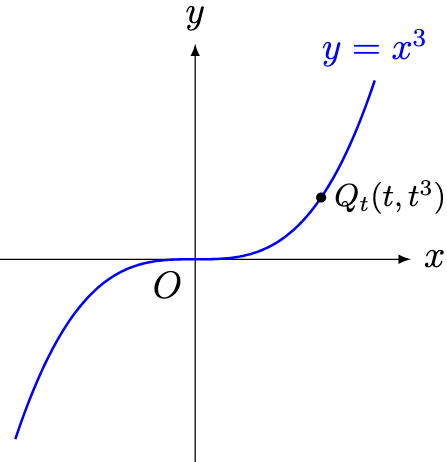
Define the point Q_t on the graph by (t, t^3).

For any t and h, evaluate the gradient of Q_t Q_{t+h} in terms of h.

(Click for Solution)

Solution. Using the same strategy as per Example 1, since Q_{t+h}(t+h, (t+h)^3), the gradient is given by

\begin{aligned} m_{P_tP_{t+h}} &= \frac{(t+h)^3-t^3}{(t+h)-t} = \frac{(t+h)^3-t^3}{ h }. \end{aligned}

We first expand (t+h)^3:

\begin{aligned}  (t+h)^3 &= (t+h)^2 \cdot (t+h) \\ &= (t^2 + 2th + h^2)(t + h) \\ &= t^3 + (2t^2 + t^2)h + (t+2t)h^2 + h^3 \\ &= t^3 + 3t^2h + 3th^2 + h^3.\end{aligned}

Therefore,

\begin{aligned} m_{P_tP_{t+h}} & = \frac{(t+h)^3-t^3}{ h } \\ & = \frac{3t^2h + 3th^2 + h^3}{ h } \\ & = \frac{(3t^2 + 3th + h^2)h}{ h } \\ &= 3t^2 + 3th + h^2. \end{aligned}

If we set h = 0 in the final result, we obtain the expression 3t^2. Intuitively, this expression describes the gradient of the tangent at (t, t^3).

Problem 6. Given that P_t lies on y = x^n, evaluate the gradient of the tangent to P_t. You may freely use the factorisation

x^n - t^n = (x-t)(x^{n-1} + x^{n-2}t + \cdots + xt^{n-2} + t^{n-1}).

without proof.

(Click for Solution)

Solution. Denote f(x) := x^n and

\varphi (x) := x^{n-1} + x^{n-2}t + \cdots + xt^{n-2} + t^{n-1}

so that f(x)- f(t) = (x-t) \cdot \varphi (x) for brevity (and possible generality).

We follow the approach in Problem 4. Denote the gradient of the tangent L_t to P_t by m. Then

L_t : y = m(x-t) + f(x).

When L_t intersects the curve y = f(x),

f(x) = m(x-t) + f(t).

Solving yields

\begin{aligned} f(x) - f(t) - m(x-t) &= 0 \\ (x-t)g(x) - m(x-t) &= 0 \\ (x-t)(\varphi (t) - m) &= 0. \end{aligned}

Hence, x = t or \varphi (x) = m. For L_t to be tangent to P_t, we must have \varphi (t) = m and vice versa. In particular,

m = \varphi (t) = n \cdot t^{n-1}.

Remark 1. Problem 6 generalises to other kinds of functions using Carathéodory’s theorem.

—Joel Kindiak, 7 Jan 26, 1542H

,

Published by


Response

  1. The Curvy Gradient – KindiakMath

    […] the point on the graph by . Using algebra, we can evaluate the gradient of the tangent at to […]

    Like

Leave a comment