Return to Circle Geometry

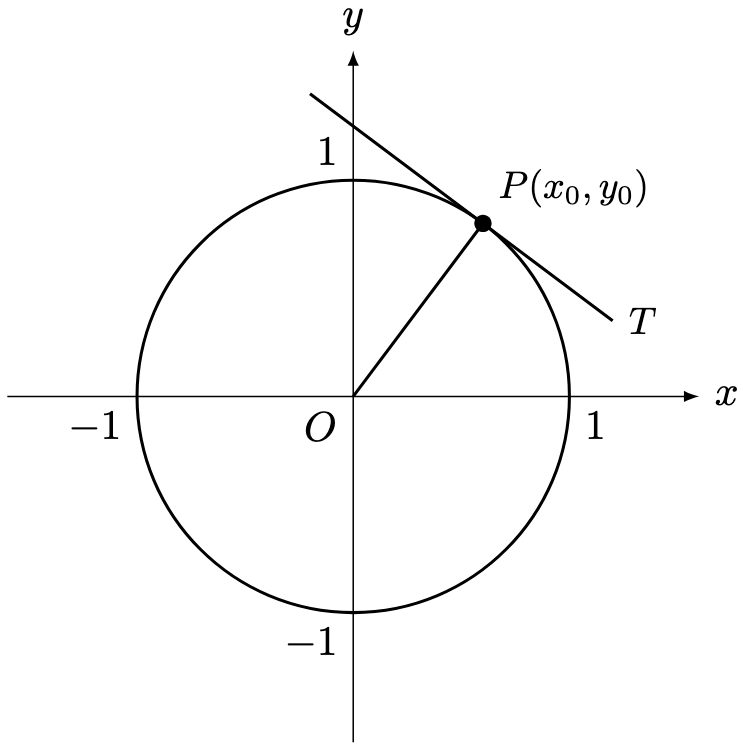
Problem 1. Consider the circle below with equation x^2 + y^2 = 1.

Given x_0 > 0 and y_0 > 0, calculate the gradient of the tangent T passing through the point P(x_0, y_0) lying on the circle. Deduce that OP \perp T.

(Click for Solution)

Solution. Since (x_0, y_0) lies on the circle,

x_0^2 + y_0^2 = 1.

For any line with gradient m passing through (x_0, y_0),

y = m(x-x_0) + y_0.

When the line intersects the circle,

x^2 + (m(x-x_0) + y_0)^2 = 1.

Expanding the left-hand side, since x_0^2 + y_0^2 = 1,

\begin{aligned} x^2 + m^2(x-x_0)^2 + 2m(x-x_0)y_0 + y_0^2 &= 1 \\ x^2 + m^2(x-x_0)^2 + 2m(x-x_0)y_0 -(1-y_0^2) &= 0 \\ x^2 + m^2(x-x_0)^2 + 2m(x-x_0)y_0 -x_0^2 &= 0 \\ x^2 -x_0^2 + m^2(x-x_0)^2 + 2m(x-x_0)y_0 &= 0 \\ (x-x_0)(x+x_0) + m^2(x-x_0)^2 + 2m(x-x_0)y_0 &= 0, \\ (x-x_0)(x+x_0 + m^2(x-x_0) + 2my_0) &= 0.\end{aligned}

Hence, x = x_0 or

x+x_0 + m^2(x-x_0) + 2my_0 = 0.

For T to be a tangent with gradient m_T, we require x_0 to be the only root. Hence, we must have

x_0+x_0 + m_T^2(x_0-x_0) + 2m_T \cdot y_0 = 0.

Solving for m_T,

\displaystyle 2x_0 + 2m_T \cdot y_0 = 0 \quad \Rightarrow \quad m_T = -\frac{x_0}{y_0}.

On the other hand, m_{OP} = y_0/x_0, so that

\displaystyle m_T  \cdot m_{OP} = -\frac{x_0}{y_0} \cdot \frac{y_0}{x_0} = -1.

Therefore, OP \perp T. We recover the tangent is perpendicular to radius property of circles.

Remark 1. The same argument holds for any general circle, with more careful book-keeping.

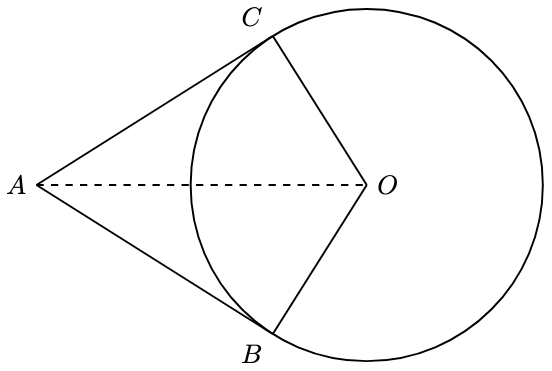
Problem 2. Given that AB and AC are tangents to the circle, show that AB = AC and AO bisects \angle BOC.

This result is described by the phrase tangent from external point.

(Click for Solution)

Solution. By Problem 1, AB \perp OB and AC \perp OC. As radii, OB = OC. As a common side, AO = AO. Therefore, by the RHS Criterion,

\Delta AOB \cong \Delta AOC.

In particular, AB = AC and \angle AOB = \angle AOC. Hence, AO bisects \angle BOC.

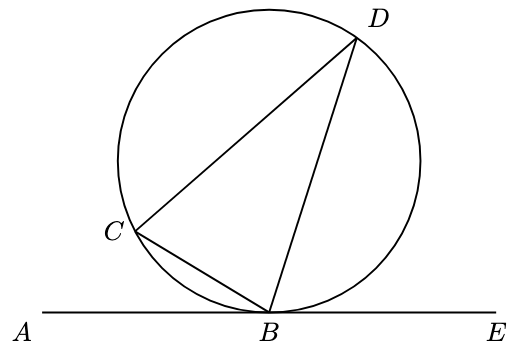
Problem 3. Given that ABE is tangent to the circle, show that \angle ABC = \angle BDC. Deduce that \angle EBD = \angle BCD. This result is known as the alternate segment theorem.

(Click for Solution)

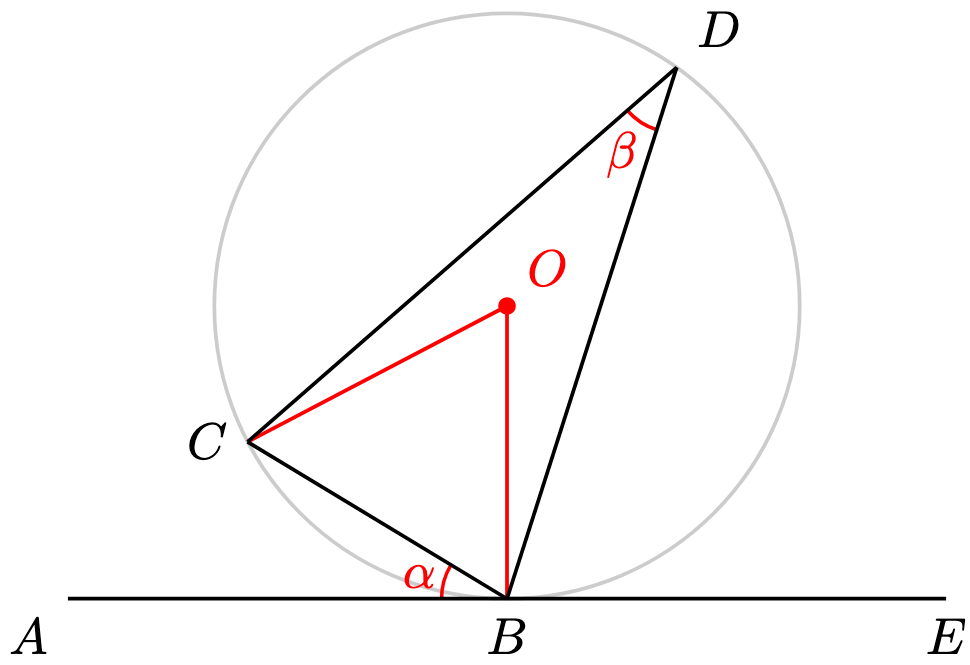
Solution. Make the following constructions, with O denoting the centre of the circle.

We aim to prove that \alpha = \beta. By Problem 1, \angle ABO = 90^\circ. Hence,

\angle OBC = 90^\circ - \alpha.

Since OB = OC as radii, \Delta BOC is isosceles. Hence,

\angle OCB  = \angle OBC = 90^\circ - \alpha.

Since the angle at the centre equals twice the angle at the circumference,

\angle BOC = 2 \cdot \angle BDC = 2 \beta.

Since angles in a triangle sum to 180^\circ,

\begin{aligned} \angle BOC + \angle OBC + \angle OCB &= 180^\circ. \end{aligned}

Substituting the displays,

\begin{aligned} 2\beta + (90^\circ - \alpha) + (90^\circ - \alpha) &= 180^\circ \\ 2 \beta + 180^\circ - 2\alpha &= 180^\circ \\ 2\beta - 2\alpha &= 0 \\ 2\beta &= 2\alpha \\ \beta &= \alpha. \end{aligned}

Therefore, \angle BDC = \alpha = \beta = \angle ABC, as required.

For the second result,

\begin{aligned} \angle EBD &= 180^\circ - \angle ABC - \angle ABC\quad &(\text{adj}\ \angle\ \text{on st. line}) \\ &= 180^\circ - \angle ABC - \angle BDC \quad &(\angle ABC = \angle BDC) \\ &= \angle BCD.\quad &(\angle\ \text{sum of}\ \Delta) \end{aligned}

—Joel Kindiak, 9 Jan 26, 1146H

,

Published by


Leave a comment