Having discussed a great deal about congruent triangles, we now turn our attention to a relaxation of congruence—similarities. Similarities are, no pun intended, similar ideas to congruence, but far more useful in helping us use small-scale items to represent large-scale items, such as maps and scale models.
Lemma 1. If 

Definition 1 (SSS Similarity Definition). We say that the triangles 


Therefore, congruence becomes a special case of similarity via the special case 
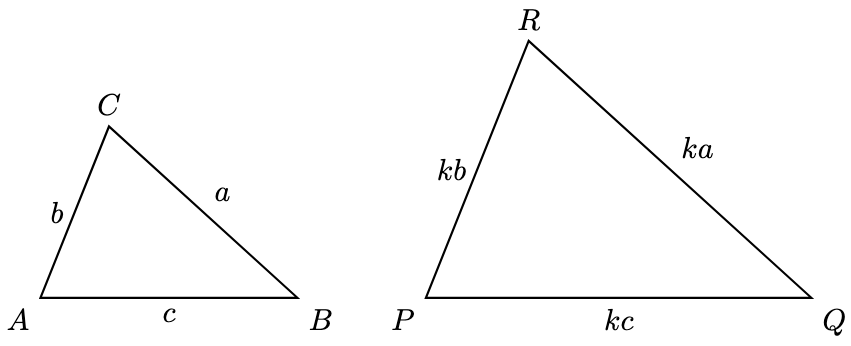
Since congruent triangles have angles that match, do similar triangles have angles match? Not only do they match, but that they have to match.
Lemma 2. We have

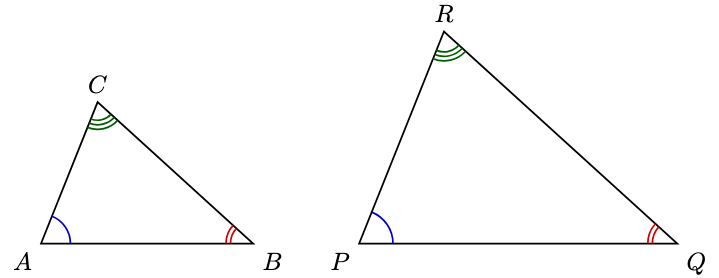
Proof Sketch. Suppose without loss of generality that 


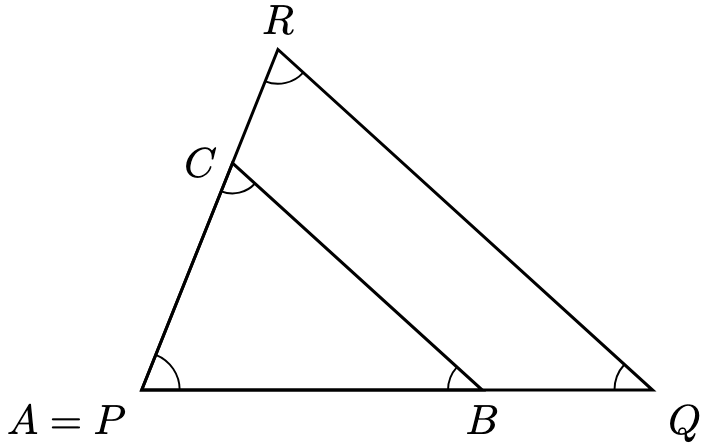
In the direction 

A technical proof by contradiction shows that 


Since the angles in a triangle sum to 

In the direction 

using corresponding angles,

yielding
Theorem 1 (AA Similarity Criterion). We have
Proof. It suffices to prove the direction
Theorem 2 (SAS Similarity Criterion). We have

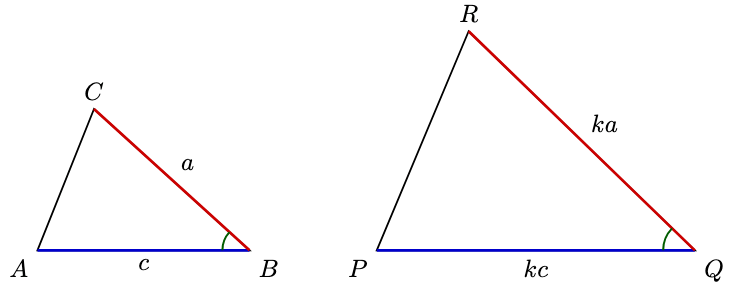
Proof Sketch. It suffices to prove the direction 


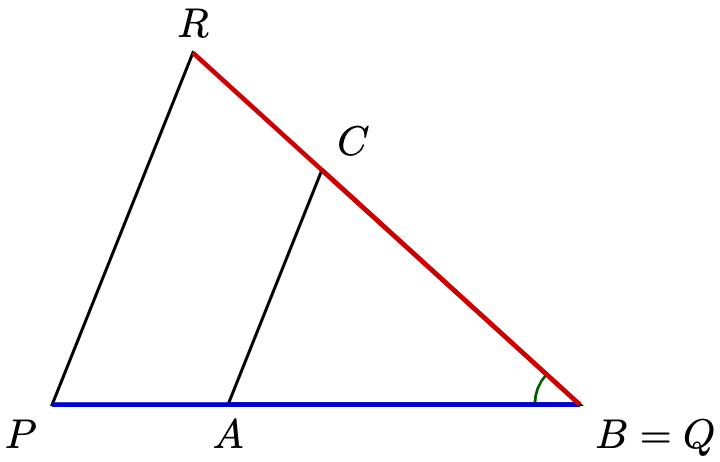
By the intercept theorem,

Using corresponding angles,
Similar triangles are used all the time in establishing interesting result in plane geometry.
Example 1 (Tangent-Secant Theorem). In the diagram below, 
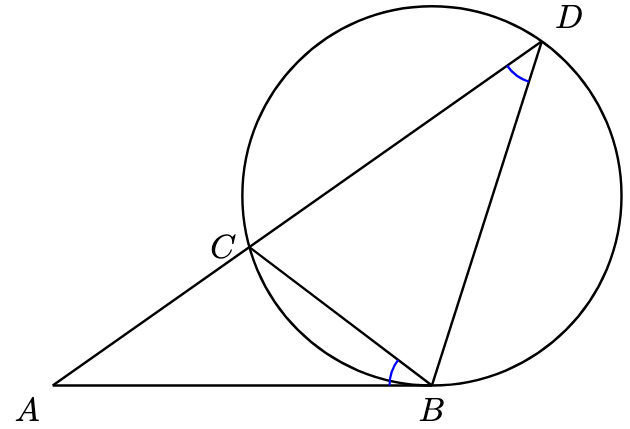
Show that 
Solution. Since 


Example 2. In the diagram below, 
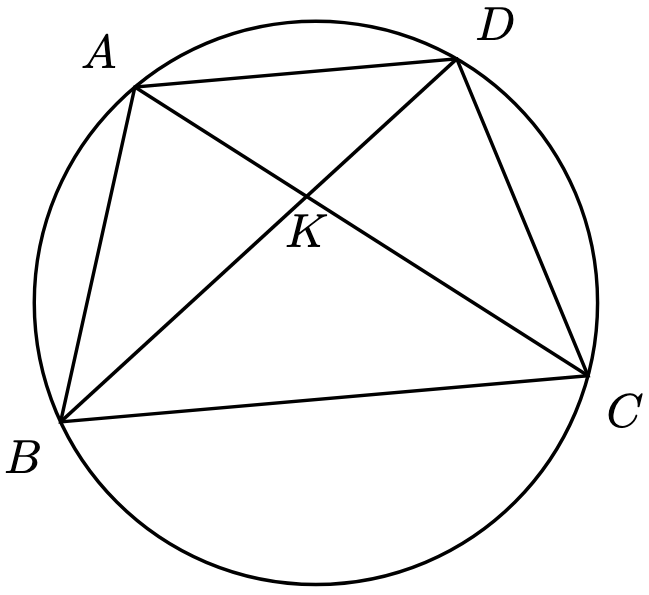
Given that 


Solution. For the first claim, since angles in the same segment are equal (i.e. the butterfly theorem), 


Okay, let’s return to earth one more time.
Definition 2. Denote the scale 


Example 3. Suppose 
Solution. Since 

Hence, the required scale is

Lemma 2. Suppose we have a scale of 

Proof Sketch. We can use the Riemann integration approach of approximating objects using a combination of squares. Since a square with length and height 
Lemma 3. Suppose we have a scale of 

Proof Sketch. Follow the idea in Lemma 2.
Likewise, using triangles to approximate shapes, two objects are similar if they share the same shape, and thus share some kind of similarity ratio in Definition 1. Therefore, the results following Definition 2 hold, allowing us to use scale models to represent real-life objects. From these ideas we obtain products like world globe maps and merchandise of varying sizes.
To further leverage these similarity properties, it helps for us to have simple formulas for well-known shapes. While we cannot prove them all in O-Level mathematics, we can state them and relegate their proofs to integral calculus. We explore these formulas in the next post.
—Joel Kindiak, 4 Nov 25, 1515H
 KindiakMath
Leave a comment