We start by considering the area of a rectangle. If a rectangle has base 


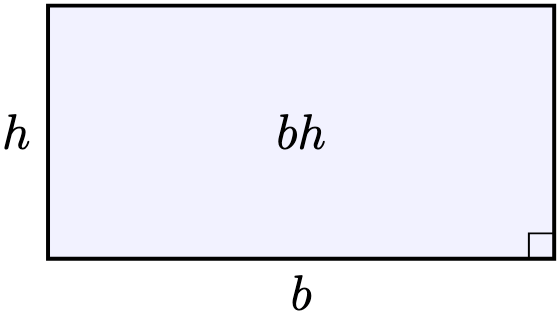
In fact, we used the rectangle intuition to list out the properties of real numbers, since we regarded 
Theorem 1. Any triangle with base 
Proof. We first suppose the triangle is right-angled:
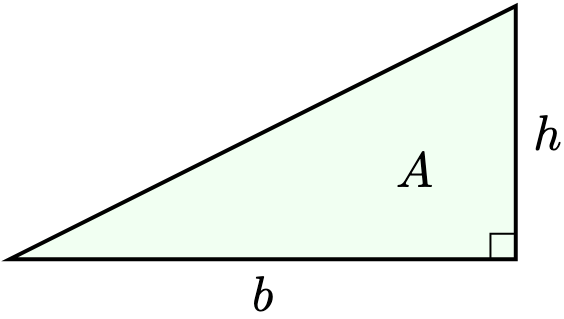
By duplicating the triangle and rotating it, we obtain a rectangle with base
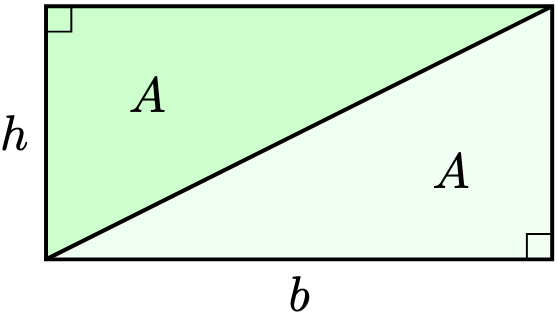
Denoting the area of the triangle by 

Now suppose the altitude lies inside the triangle:
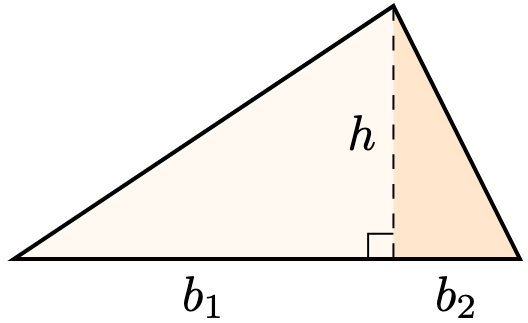
Adding the areas, we obtain a total area of

Now we consider the case when the altitude lies outside of the triangle:
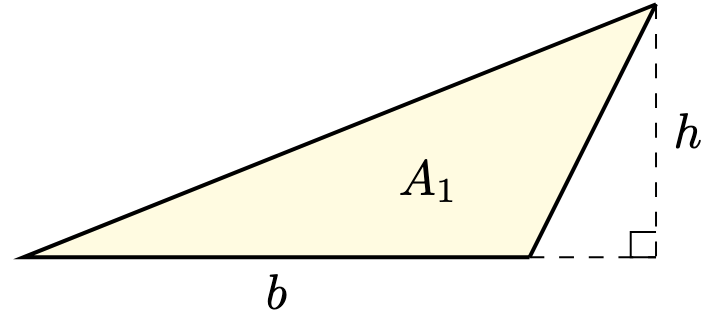
Denote the area of the original triangle by 

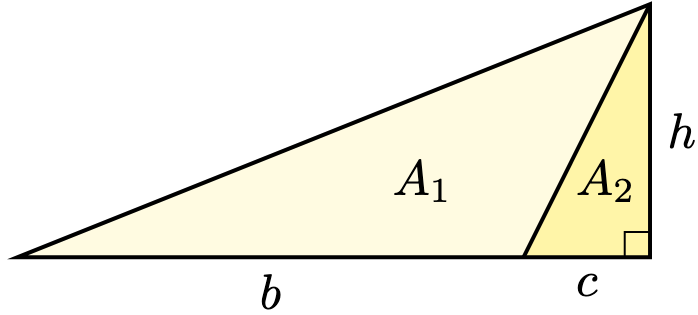
Since areas are additive, use the first case to obtain

Performing algebruh,

Theorem 2. Any trapezium with bases 

Proof. Consider the following trapezium without loss of generality:
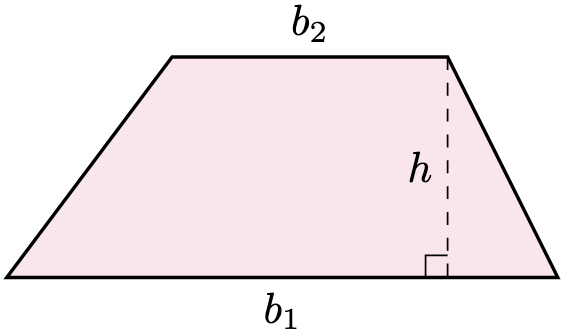
Split the trapezium into two identical triangles:
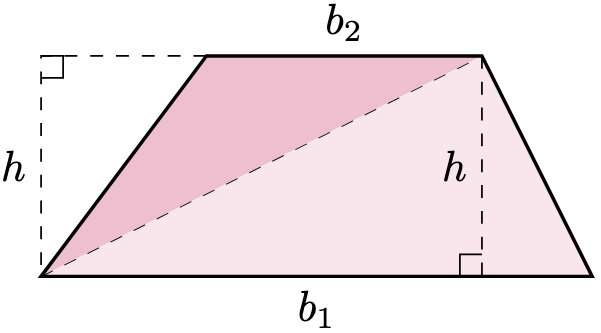
Using Theorem 1, the area of the trapezium is given by

Theorem 3. Any parallelogram with base 
Proof. Consider the parallelogram below without loss of generality:
Since this parallelogram is a trapezium with bases 

Most high school geometry problems boils down to applying these formulas one after another. However, they also include more “curvy” areas like circles. How do we compute such areas? We could memorise their formulas like 
Definition 1. Given a circle with circumference 


Equivalently, we recover the circumference formula 

Theorem 4. The area of a circle with radius
Proof Sketch. We will subdivide the circle into a collection of “curved triangles” or more technically, sectors:
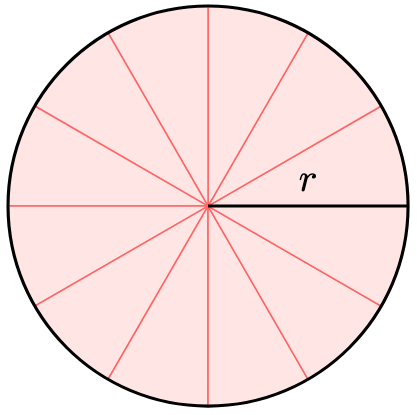
Here, we use 

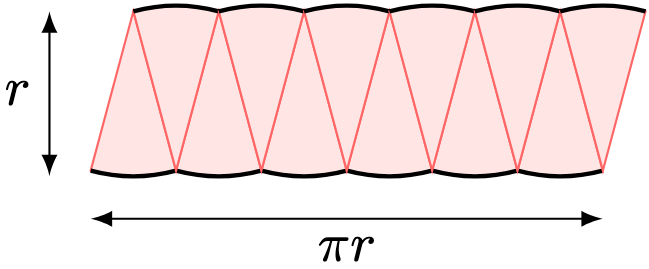
Therefore, using the area of a rectangle, the circle has approximate area 
Remark 1. A more complete construction can be formalised using integral calculus.
Finally, lets re-visit angles for completeness. Previously, we have usually used degrees—


Rather than use the convenience of 

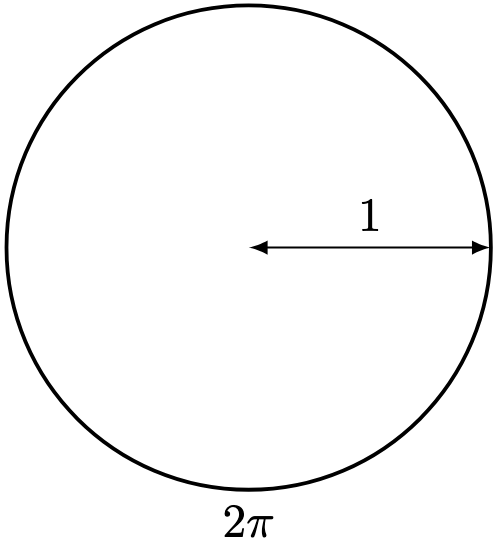
Here’s our intuition: an angle of 

Definition 2. An angle is said to be of 
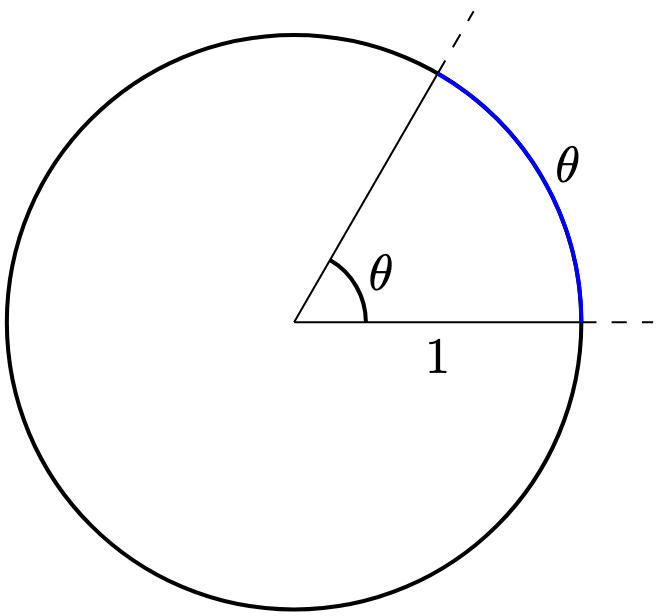
Therefore, an angle of
Lemma 1. Given any circle with radius 

Equivalently, 

Proof Sketch. Consider the diagram below.
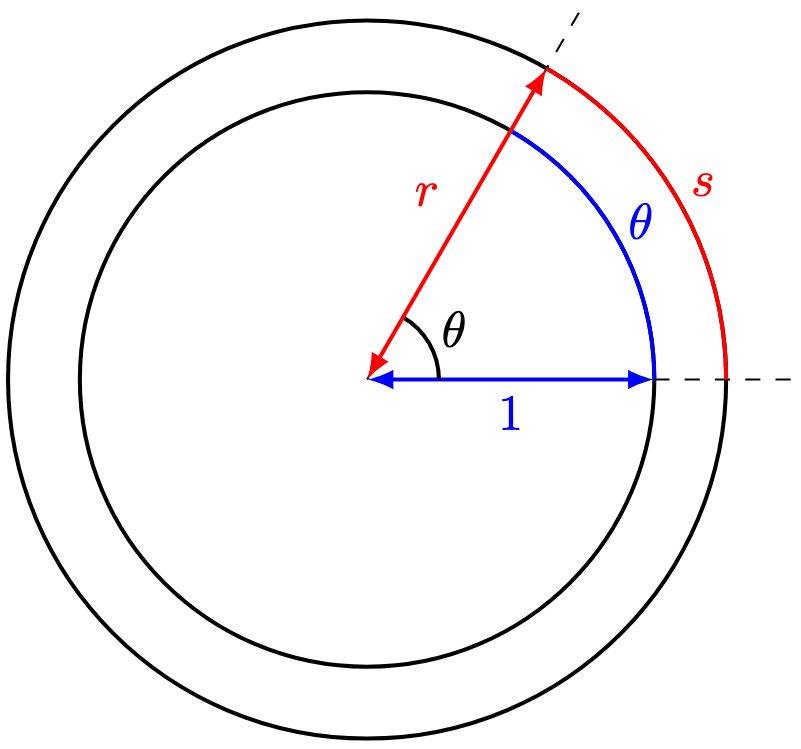
By regarding arcs as limits of straight lines, we can pass the intercept theorem for similar triangles to the limit and obtain

Therefore, radians work for angles regardless of radius size.
Lemma 2.

Here, of course, 
Theorem 5. A sector with radius 
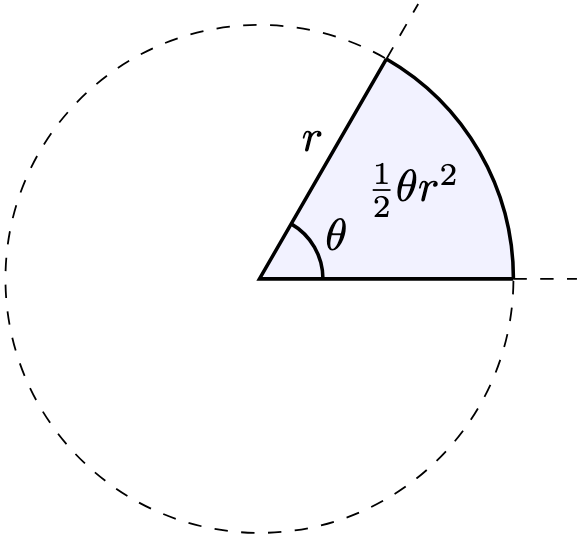
Proof. Since the sector sweeps 

For a full circle, set 

Having explored areas, we need to think deeper. Literally. Next time, we will look at volumes and surface areas, the three-dimensional version of areas and perimeters.
Oh, let’s just conclude with perimeters:
Definition 3. The perimeter of a shape is the total length of its boundary.
Example 1. A rectangle with base 
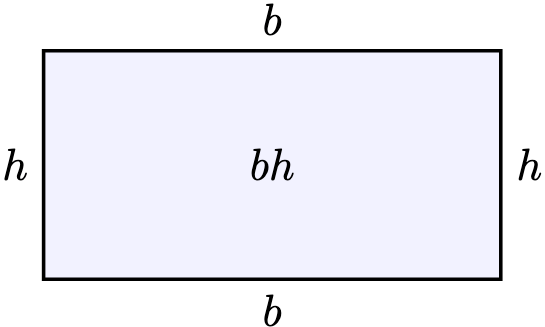
Example 2. A circle with radius 
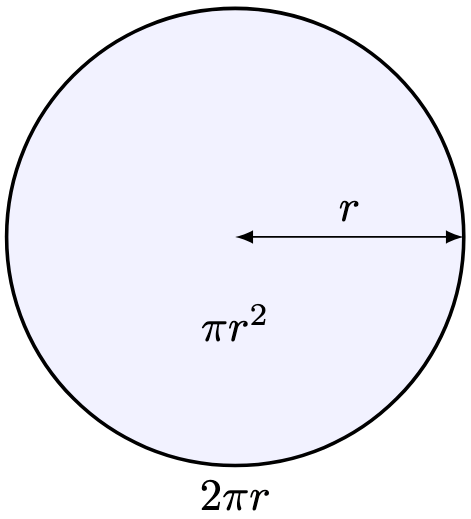
Indeed, the perimeter of a circle is simply its circumference.
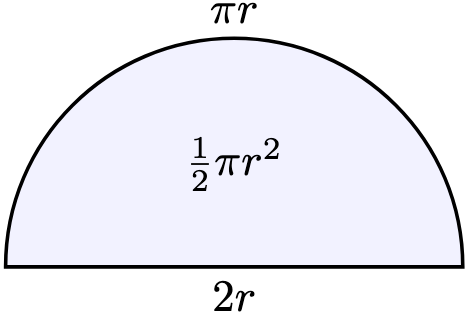
Example 3. A half-circle (i.e. a semicircle) with radius 
—Joel Kindiak, 21 Nov 25, 1715H
 KindiakMath
Leave a comment