The three-dimensional version of “area” and “perimeter” would be, rather unsurprisingly, “volume” and “surface area”.
We start with the simplest object: a prism.
Definition 1. A solid with height 
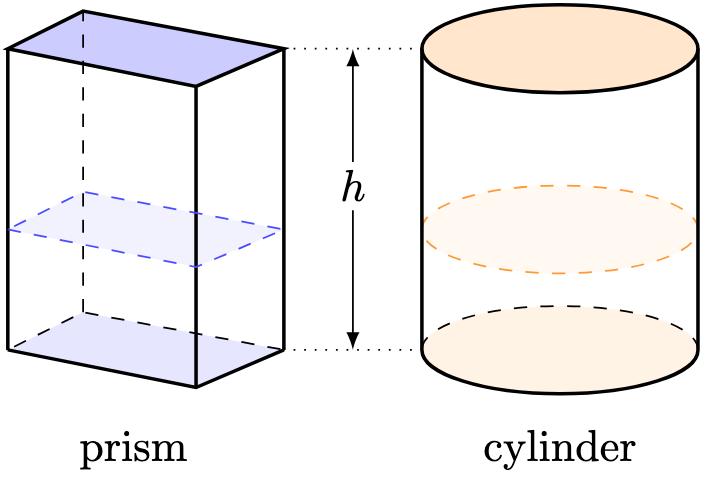
Just like how a rectangle has area 

In that sense, a prism is similar to a “three-dimensional” rectangle, with many possible shapes for its base.
Corollary 1. The volume of a cylinder with height 

If there’s a “three-dimensional” rectangle, is there a “three-dimensional” triangle? Yes, and it’s called a pyramid.
Definition 2. A solid with height
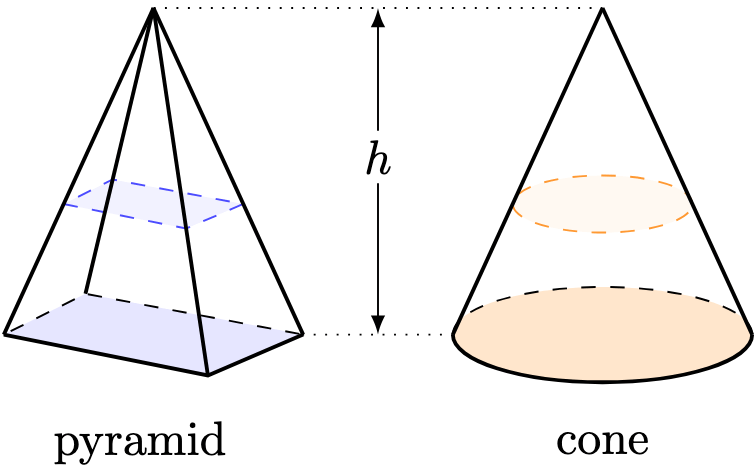
This description is similar to that of a triangle: the bases are similar to one another and “shrink” to a common point:
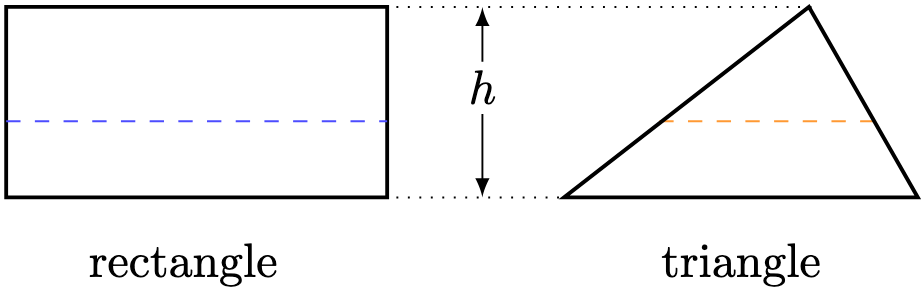
We have seen that a triangle has area 
Theorem 1. The volume of a prism is 
Proof. Omitted as it requires integral calculus. Nevertheless, the factor 

Corollary 2. The volume of a cone with height 
Proof. By Theorem 1, the cone has a volume of

Having discussed volumes, it’s worth looking into its partner, surface areas. As the name suggests, surface areas refer to the areas of the surfaces of a solid. But what happens when weird faces abound?
We can’t discuss them all, but there are some special cases.
Theorem 3. The curved surface area of a cylinder with height 
Proof. The curved surface area of a cylinder can be thought of as a “wrap” of a rectangle with base 
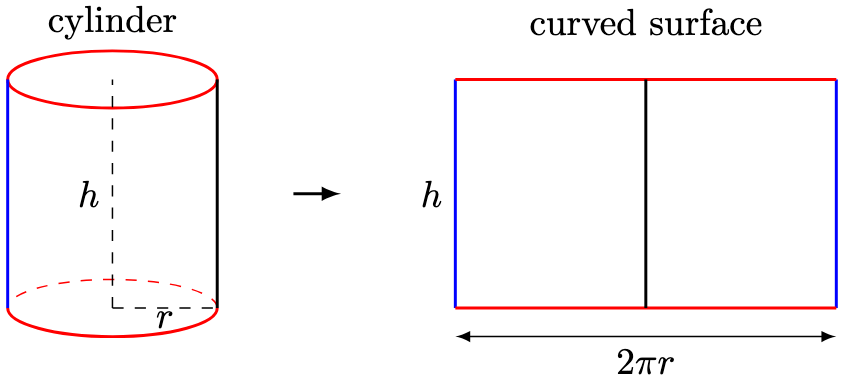
Hence, the curved surface area is 
Theorem 4. The curved surface area of a cone with height 
Proof. Let 
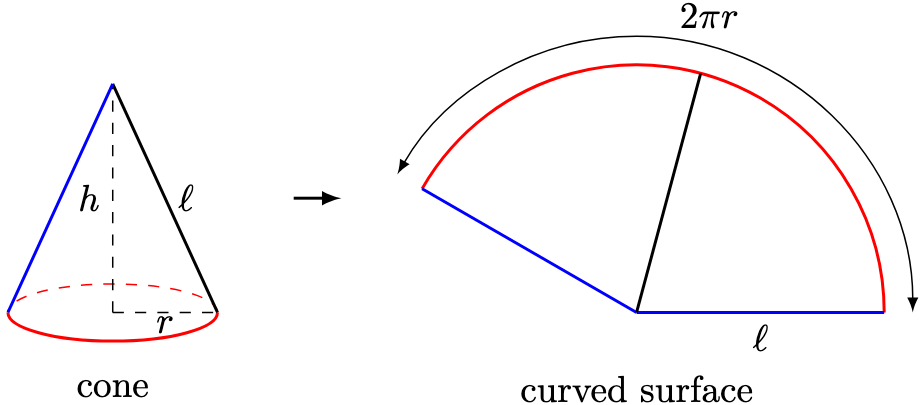
Now the length of the arc of the sector is the circumference of the original cone, namely,

Now by Pythagoras’ theorem,

Therefore, the curved surface area is
Finally we should discuss the geometry of the three-dimensional version of a circle: the sphere.
Definition 2. Define the sphere with centre and radius
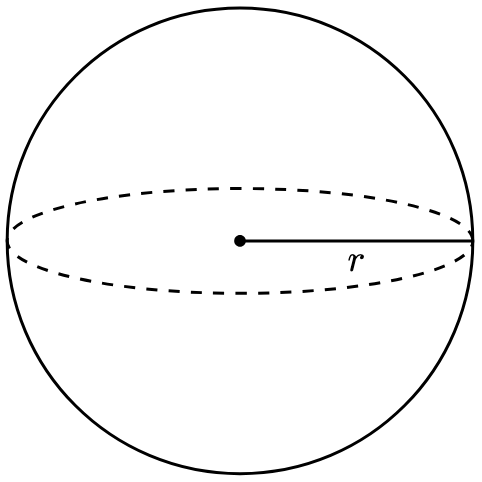
Example 1. The Earth can be modelled as a sphere.

Source: Wikipedia
Theorem 5. The volume of a sphere with radius 

Proof. Omitted as it requires integral (and arguably, differential) calculus.
Having developed the many commonly-used formulas in high school geometry, we cannot avoid the dreaded T-word: trigonometry. Contrary to popular anxiety, trigonometry is simply a new language to describe the relationship between straightedges and curves (i.e. angles). More on that in the next post.
—Joel Kindiak, 7 Dec 25, 1931H
 KindiakMath
_without_New_Guinea.svg)
Leave a comment