Now let’s discuss trigonometry, the bane of high school mathematics. In spite of its rather tragic reputation, the life goal of trigonometry is simple:
What is the relationship between line segments and angles?
An angle, at its heart, deals with circular motion. Angles take considerable effort to construct, but their main purpose is to quantify the “degree” (pun intended) of separation between two line segments.
Trigonometry aims to capture the precise effect angles have on line segments. The name trigono-metry itself suggests our starting point—the triangle. Furthermore, we should start with the simplest triangle—the right-angled triangle—then work our way up to more general triangles.
Definition 1. Consider the following right-angled triangle with acute angle 
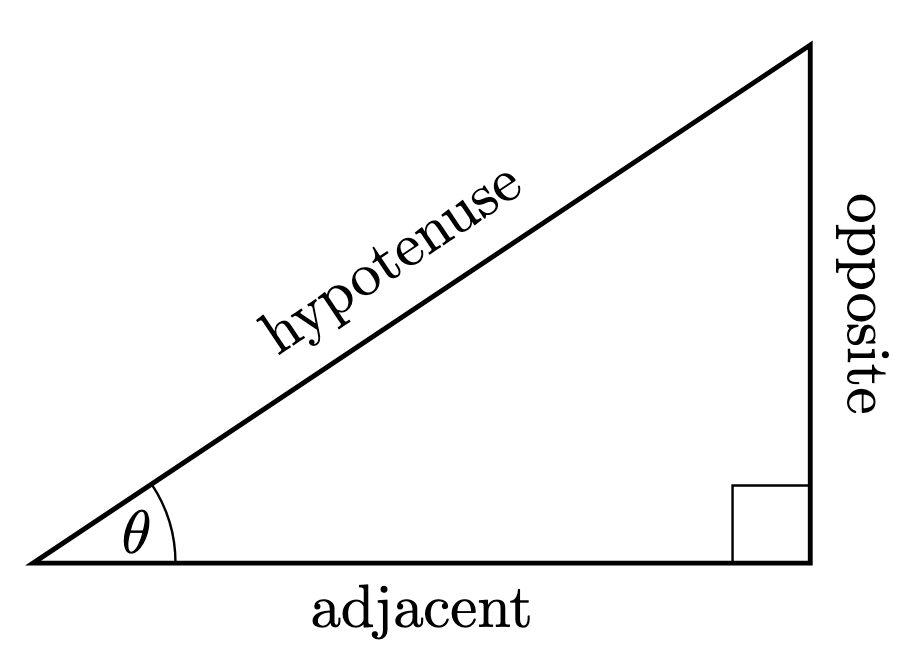
We abbreviate the words opposite, adjacent, and hypotenuse. We define the sine, cosine, and tangent of 

These definitions make sense thanks to similar triangles (i.e. right-angled triangles with the same shape will still give the same trigonometric ratios).
Example 1. Using a suitably-drawn triangle, evaluate the trigonometric ratios

Solution. We draw a right-angled isosceles triangle with side length 

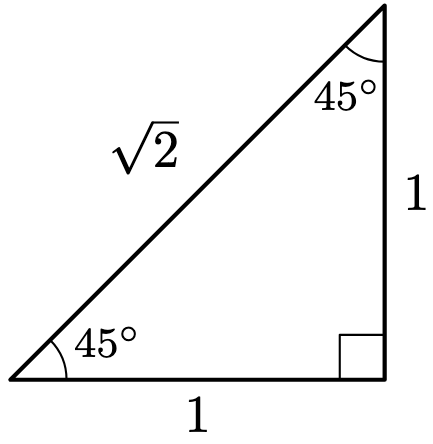
Using Pythagoras’ theorem, the triangle has hypotenuse

By Definition 1,

Example 2. Using a suitably-drawn triangle, evaluate the trigonometric ratios

Solution. We draw an equilateral triangle divided by its altitude:
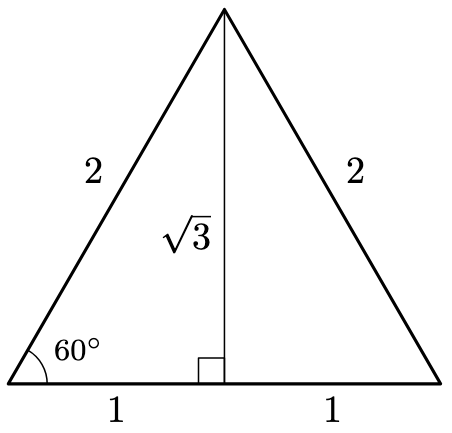
We leave it as an exercise to check that the two right-angled triangles are congruent. Hence, relative to 


By Definition 1,

Example 3. Use the same diagram in Example 2 to evaluate the trigonometric ratios

Solution. Since angles in a triangle sum to 

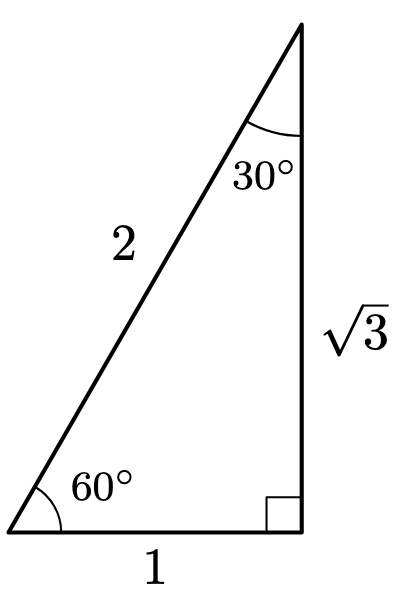
Relative to 


Now, if we scrutinise these results more carefully, we will notice that

These seeming coincidences are, in fact, not coincidences. We have several results that will always hold for any acute
Theorem 1. For any acute angle

Proof. Consider the triangle below:
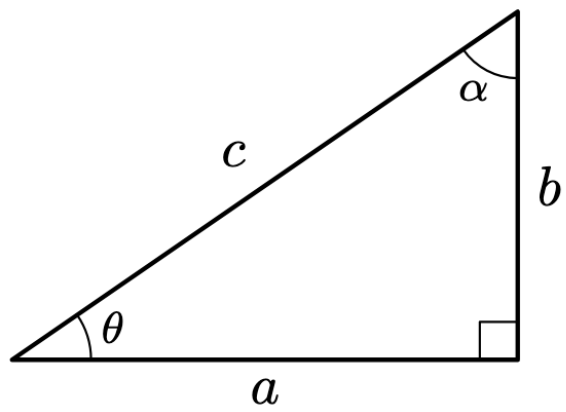
Using Definition 1,

and

Since angles in a triangle sum to

Substituting 
We call the acute angles 


Remark 1. To reduce the clunkiness of the expression, we make the (tragically ambiguous) notations

Theorem 2. For any acute angle

Proof. Consider the right-angled triangle below.
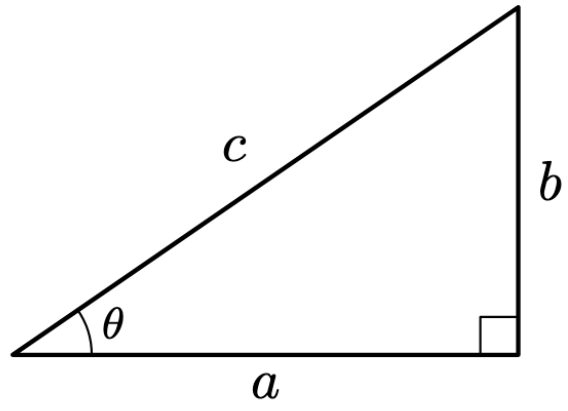
Using Definition 1 and Pythagoras’ theorem,

This result is simply the Pythagoras’ theorem with the special case hypotenuse equals
Strangely enough, together with geometry, we have everything we need to explore high school trigonometry. An alternate formulation of trigonometry, called rational trigonometry, captures more or less the same ideas but simplifies calculations.
Question 1. Given the following triangle with known side lengths 

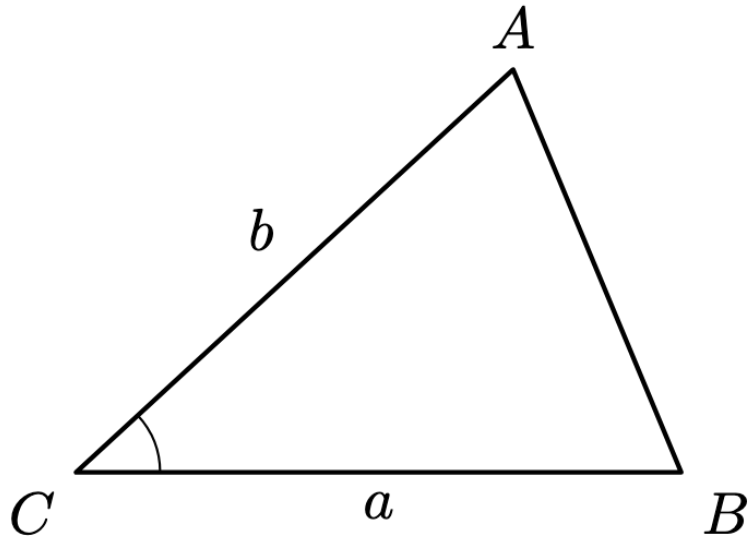
Solution. Let 
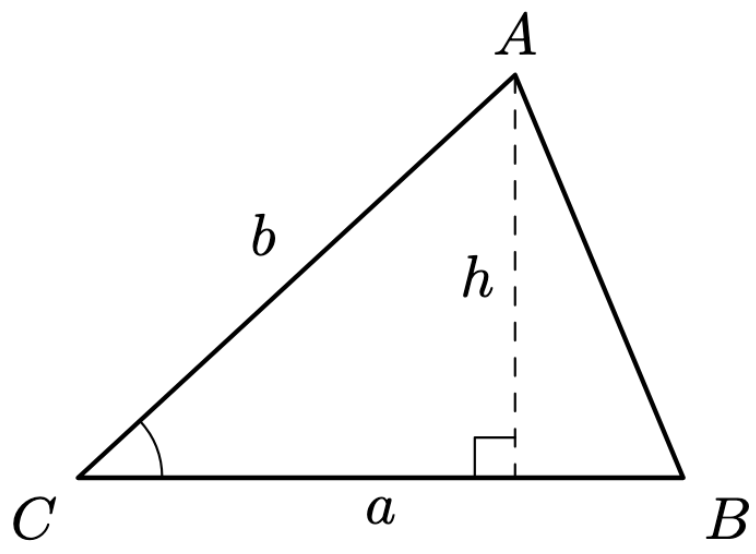
Then the triangle has area 

Therefore, 
Remark 2. The proof still holds if 
Question 2. If instead the angle
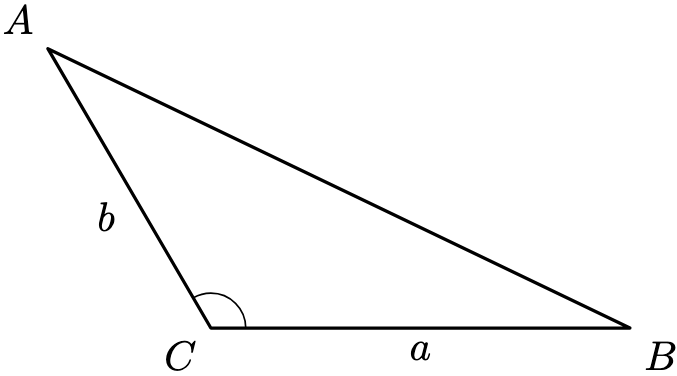
Solution. Extend the base of the triangle by 
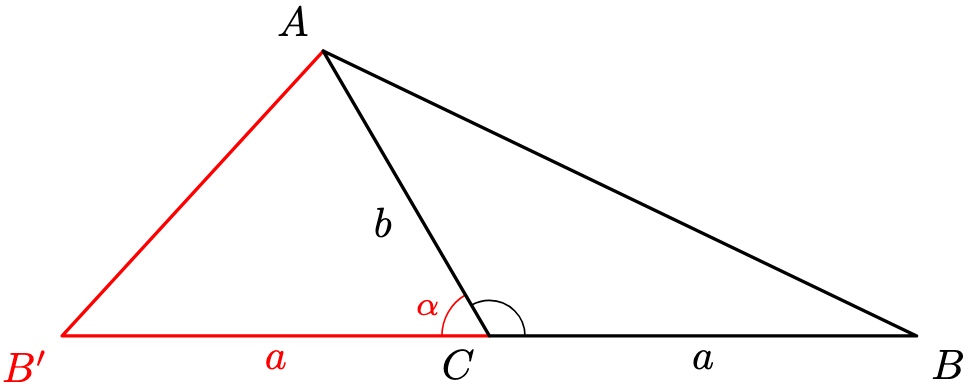
By Question 1, 


Since both triangles have the same base and height, they must have the same area 

If we insist that the formula

holds for obtuse

just as we have explored.
Question 3. Using the same reasoning, how should we define 
Solution. Consider the right-angled triangle below.
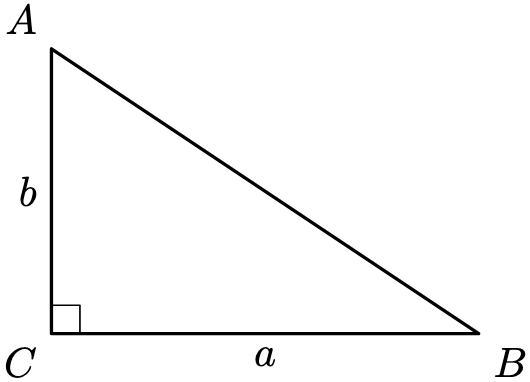
Assuming the desired area formula holds, we have

This result motivates our definition of 

Definition 2. Define 

Using this result, we obtain the beautiful law of sines.
Theorem 3 (Law of Sines). Given the triangle below,

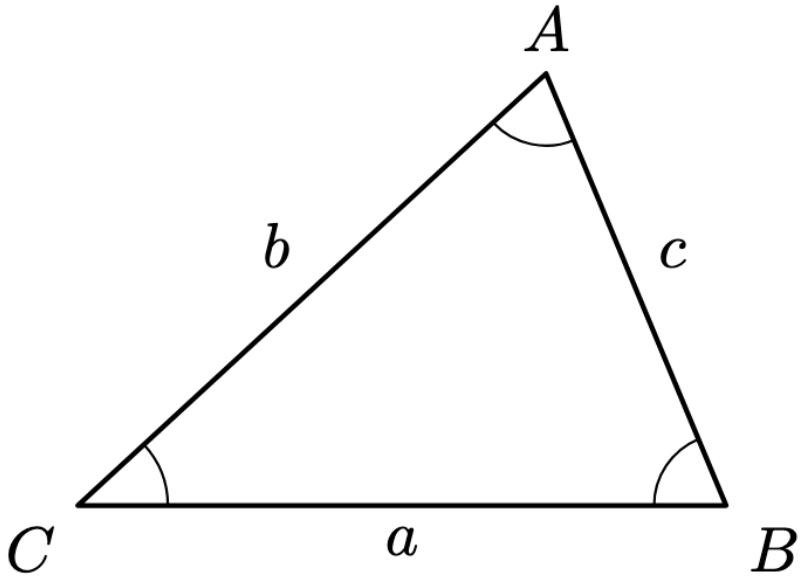
This result still holds even if some angle is right or obtuse.
Proof. Since the area formula holds in any type of angle (acute, right, obtuse),

Dividing by 
If there is a law of sines, would there be a law of cosines? Yes, and in fact we obtain it via Pythagoras’ theorem.
Lemma 1. Given the triangle below with all acute angles,

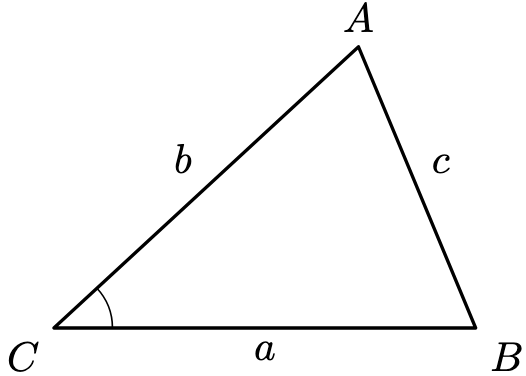
Proof. Sub-divide 
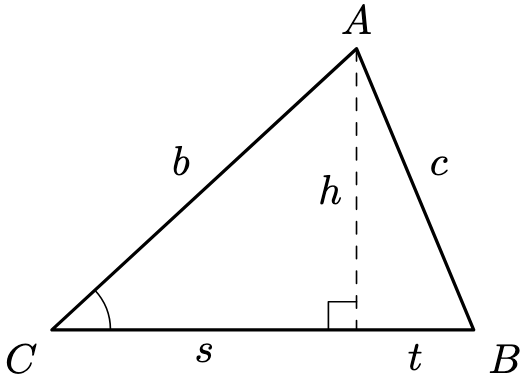
By Pythagoras’ theorem,

Using Definition 1,

Therefore, 
Lemma 2. Given the triangle below with obtuse angle

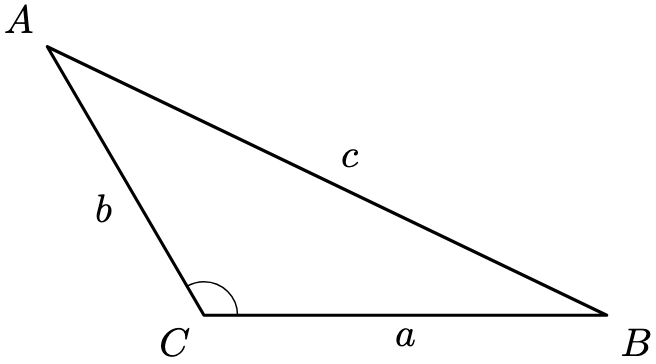
Proof. Draw the height of the triangle and extend 
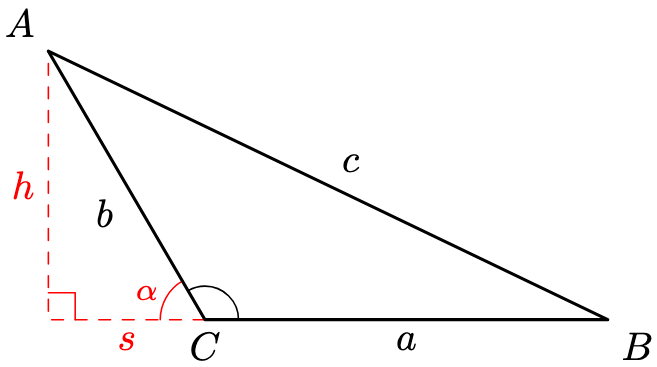
By Pythagoras’ theorem again,

Using Definition 1,

Therefore, 
Since angles on a straight line sum to
Hence,
Likewise, if we insist that the formula
holds for obtuse

Question 4. Using the same reasoning, how should we define 
Solution. We draw a right-angled triangle:
By Pythagoras’ theorem,

Therefore,

Definition 3. Define 

Using this result, we obtain the corresponding law of cosines.
Theorem 4 (Law of Cosines). Given the triangle below,

This result still holds even if
Proof. Apply Lemma 1, Lemma 2, and Question 4.
You would have noticed that we have neglected the tangent function. That is not too surprising, thanks to the following observation.
Theorem 5. For any acute 
Proof. We return to the very first triangle in this blog post.
By Definition 1,

Since, 


Definition 4. For obtuse

In particular, if

Corollary 1 (Obtuse Angle Identities). For any

whenever the right-hand side is well-defined.
You may explore more trigonometric identities in this exercise post, in which we used the extended definitions of 
Nevertheless, in the spirit of geometric reasoning, we will accomplish the same goal by revisiting an old friend—the unit circle.
—Joel Kindiak, 19 Dec 25, 1334H
 KindiakMath
Leave a comment