Applied Trigonometry

Now that we have motivated the definitions of \sin(\theta) and \cos(\theta) for 0^\circ < \theta < 180^\circ, can we extend this idea to 0^\circ \leq \theta \leq 360^\circ?

Lemma 1. For any 0^\circ < \theta < 180^\circ, \sin^2( \theta ) + \cos^2( \theta ) = 1.

Proof. The case 0^\circ < \theta < 90^\circ simply holds due to the vanilla Pythagoras’ theorem. For the case 90^\circ < \theta < 180^\circ, write

\theta = 180^\circ - \alpha \quad \iff \quad \alpha = 180^\circ - \theta,

so that \alpha is acute. By our definitions of \sin(\theta) and \cos(\theta),

\begin{aligned} \sin^2(\theta) + \cos^2(\theta) &= (\sin(\alpha) )^2 + (-{\cos(\alpha)})^2 \\ &= \sin^2(\alpha) + \cos^2(\alpha) = 1. \end{aligned}

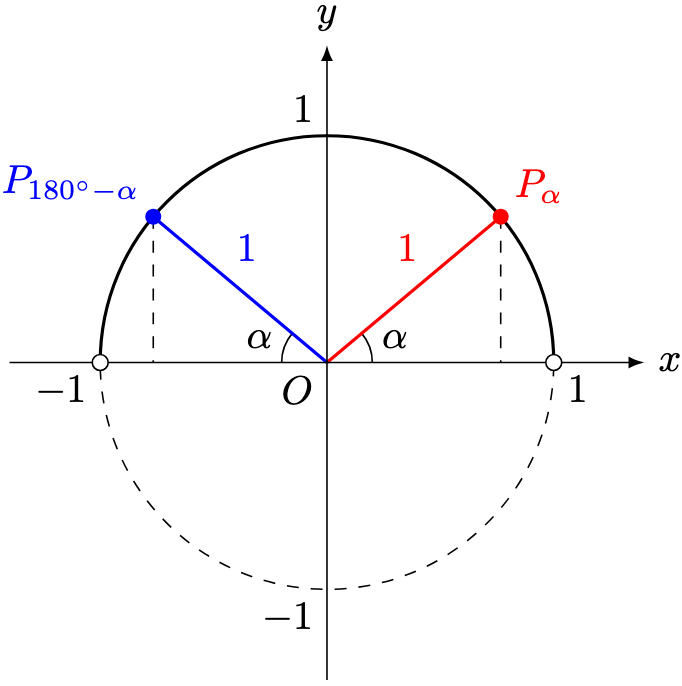
If you are thinking that the sum-of-squares formula feels like déjà-vu, you are not wrong. The equation x^2 + y^2 = 1 is the famous equation of a unit circle (i.e. a circle with centre (0, 0) and radius 1).

Furthermore, by measuring the clockwise angle relative to the positive x-axis and denoting P_\theta(x_\theta, y_\theta), we observe a remarkable discovery. For acute \alpha,

\displaystyle \frac{  x_\alpha }{ 1 } = \cos(\alpha),\quad \frac{ y_\alpha }{ 1 } = \sin(\alpha).

Hence, we generalise for any \theta:

\cos(\theta) := x_\theta, \quad \sin(\theta) := y_\theta.

When \theta is acute, the results hold as per vanilla trigonometry. When \theta = 180^\circ - \alpha is obtuse,

x_\theta = -{\cos(\alpha)} = \cos(\theta),\quad y = \sin(\alpha) = \sin(\theta).

Therefore, we can extend the definitions of \sin(\theta), \cos(\theta) to include 0^\circ \leq \theta \leq 360^\circ, though baby trigonometry suggests that the expressions \sin(0^\circ), \cos(0^\circ) seemed rather absurd!

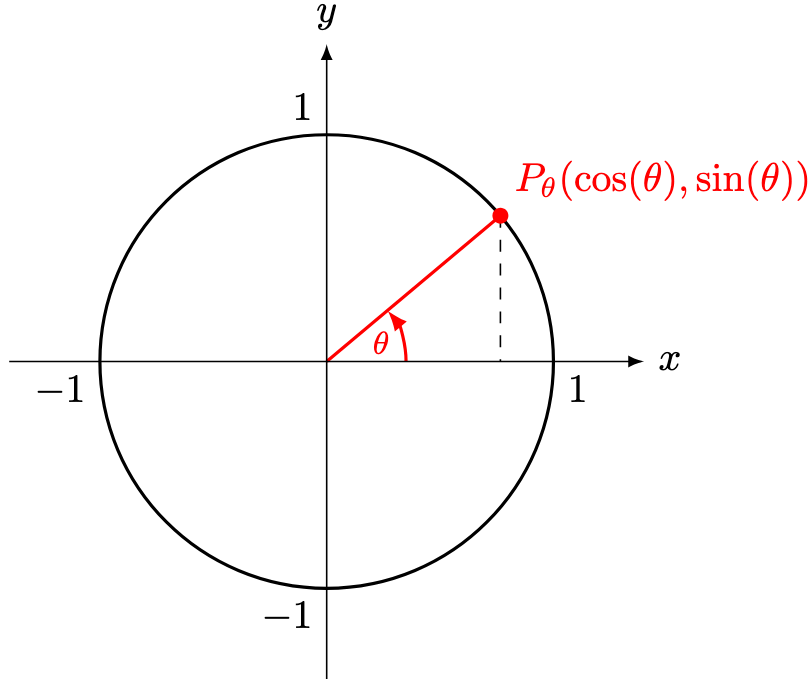
Definition 1. For any 0^\circ \leq \theta \leq 360^\circ, draw a line segment OP_\theta whose clockwise angle with the positive x-axis is \theta.

Define (\cos(\theta), \sin(\theta)) := P_\theta.

This definition agrees with the usual definitions of \cos(\theta), \sin(\theta) for 0^\circ < \theta < 180^\circ.

Example 1. Let \alpha be an acute angle. Use Definition 1 to evaluate \sin(\theta) and \cos(\theta) for

\theta = 180^\circ + \alpha,\quad \theta = 360^\circ - \alpha,

in terms of \alpha. Furthermore, evaluate \sin(\theta) and \cos(\theta) for

\theta = 0^\circ, \quad \theta = 180^\circ,\quad \theta = 270^\circ,\quad \theta = 360^\circ.

Solution. We annotate on the usual unit circle diagram.
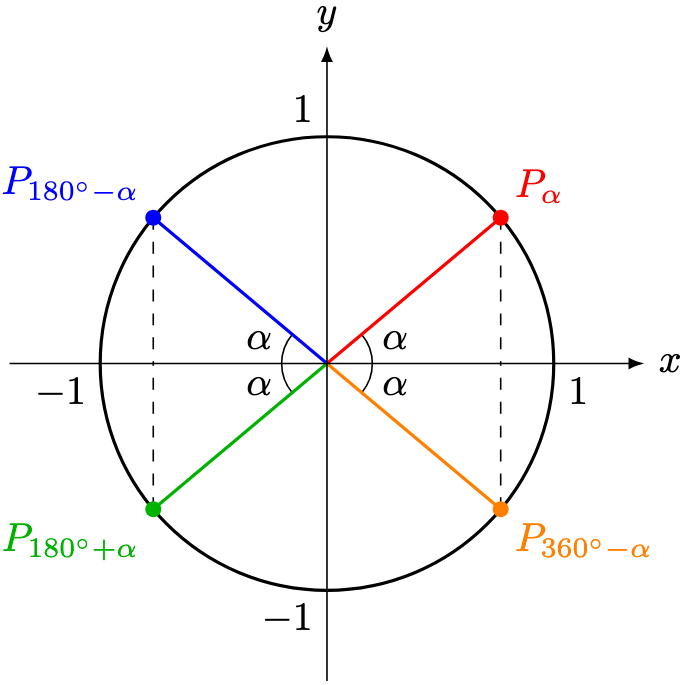
We can then deduce that

\begin{aligned} (\cos(180^\circ + \alpha), \sin(180^\circ + \alpha)) &= P_{180^\circ + \alpha} = (-{\cos(\alpha)}, -{\sin(\alpha)}), \\ (\cos(360^\circ - \alpha), \sin(360^\circ - \alpha)) &= P_{360^\circ - \alpha} = ({\cos(\alpha)}, -{\sin(\alpha)}). \end{aligned}

Similarly,

\begin{aligned} (\cos(0^\circ), \sin(0^\circ)) &= P_{0^\circ} = (1, 0), \\ (\cos(90^\circ), \sin(90^\circ)) &= P_{90^\circ}  = (0, 1), \\ (\cos(180^\circ), \sin(180^\circ)) &= P_{180^\circ}  = (-1, 0), \\ (\cos(270^\circ), \sin(270^\circ)) &= P_{270^\circ}  = (0, -1), \\ (\cos(360^\circ), \sin(360^\circ)) &= P_{360^\circ}  = (1, 0). \end{aligned}

Remark 1. From this point onward, we will switch our discussions to “radian mode”, given by the conversion 360^\circ = 2\pi:

\begin{aligned} (\cos (\pi - \alpha), \sin(\pi - \alpha)) &= (-{\cos(\alpha)}, \sin(\alpha)), \\ (\cos (\pi + \alpha), \sin(\pi + \alpha)) &= (-{\cos(\alpha)}, -{\sin(\alpha)}), \\ (\cos (2\pi - \alpha), \sin(2\pi - \alpha)) &= ({\cos(\alpha)}, -{\sin(\alpha)}). \end{aligned}

We will soon discuss calculus, which requires angles to be measured in radians.

Example 2. Evaluate \sin(7\pi/6), \cos(7\pi/4) exactly.

Solution. Using Remark 1,

\begin{aligned} \sin(7\pi/6) &= \sin(\pi +\pi/6) = -{\sin(\pi/6)} = -\frac{\sqrt 3}{2}, \\ \cos(7\pi/4) &= \cos(2\pi - \pi/4) = {\cos(\pi/4)} = \frac{1}{\sqrt 2}. \end{aligned}

Example 3. Derive the definition of \tan(\theta) for \pi/2 \leq \theta \leq 2\pi for the different possibilities of \theta.

Solution. Firstly, for 0 < \theta < \pi/2, we have the equivalent definition

\displaystyle \tan(\theta) = \frac{\sin(\theta)}{\cos(\theta)}.

Since \cos(\pi/2) = \cos(3\pi/2) = 0, \tan(\pi/2), \tan(3\pi/2) would not be well-defined. Therefore, suppose \theta \neq \pi/2, 3\pi/2. For any 0 < \alpha < \pi/2,

\begin{aligned} \tan(\pi - \alpha) &= \frac{\sin(\pi - \alpha)}{\cos(\pi - \alpha)} = \frac{\sin(\alpha)}{-{\cos(\alpha)}} = -{\tan(\alpha)}, \\ \tan(\pi + \alpha) &= \frac{\sin(\pi + \alpha)}{\cos(\pi + \alpha)} = \frac{-{\sin(\alpha)}}{-{\cos(\alpha)}} = \tan(\alpha), \\ \tan(2\pi - \alpha) &= \frac{\sin(2\pi - \alpha)}{2\cos(\pi - \alpha)} = \frac{-{\sin(\alpha)}}{\cos(\alpha)} = -{\tan(\alpha)}. \end{aligned}

Furthermore, we remark that \cos(k\pi) = (-1)^k \neq 0 for k = 0, 1, 2. Hence,

\displaystyle \tan(k\pi) = \frac{ \sin(k\pi) }{ \cos(k\pi) } = \frac{ 0 }{ (-1)^k } = 0.

This post is titled applied trigonometry, but so far, we haven’t applied it in any meaningful sense. Not yet, at least.

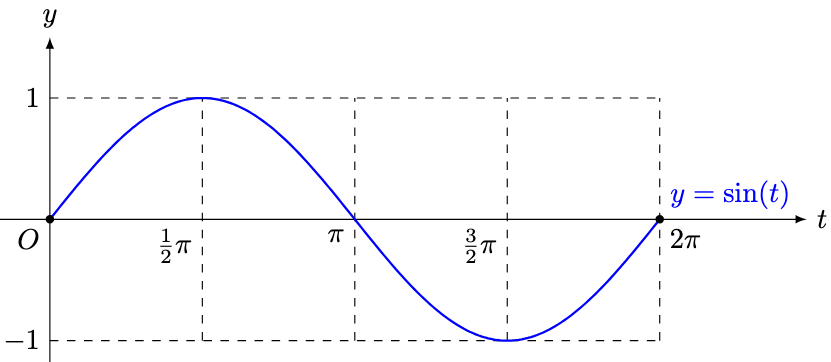
The key is that since we have already defined \sin(\theta) for 0 \leq \theta \leq 2\pi, we have enough information to sketch (at least approximately) the graph of one cycle of y = \sin(t). In fact, using the radians version of Example 1,

\begin{aligned}\sin(0) &= 0,\quad \sin(\pi/2) = 1, \\ \sin(\pi) &= 0,\quad \sin(3\pi/2) = -1,\quad \sin(2\pi) = 0. \end{aligned}

Hence, we can divvy-up the interval 0 \leq t \leq 2\pi into 5-1 = 4 regions, and these regions correspond to the 5 special values of t:

Returning to the unit circle, there is no reason to restrict our graph to 0 \leq x \leq 2\pi. Since one complete turn corresponds to an angle of 2\pi, the number \theta + 2\pi really just corresponds to an angle of \theta. In fact, by parsing Example 1 in radians,

\sin(0) = 0 = \sin(2\pi),\quad \cos(0) = 1 = \cos(2\pi).

Hence, we can extend the definitions of \sin(\theta) and \cos(\theta) accordingly.

Definition 2. For any integer k and 0 \leq \theta < 2\pi, define

\sin(\theta + 2k\pi) := \sin(\theta),\quad \cos(\theta + 2k\pi) := \cos(\theta).

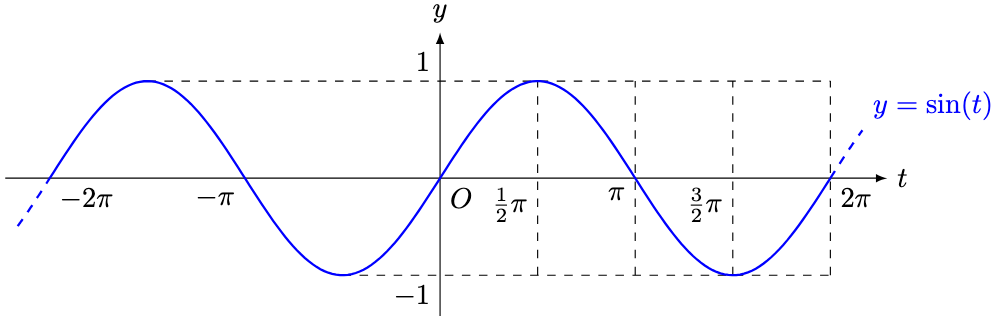
Now our complete graph for y = \sin(t) given real number inputs t looks like this:

If this shape looks familiar to the waves that you see on the seaside, once again, you’re not wrong! These wavy shapes are called sinusoids, or more informally, sine waves. We will call the graph of y = \sin(t) the standard sine wave.

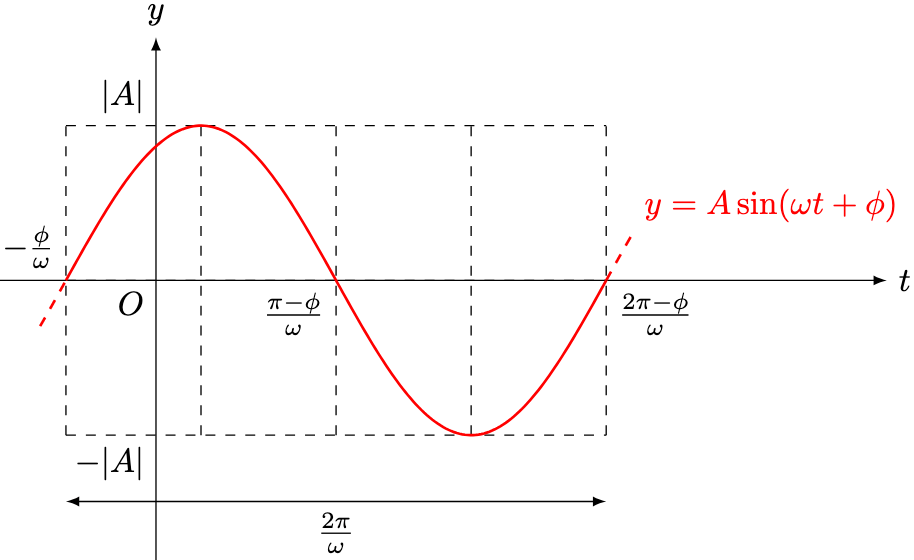
The most general form of a sine wave looks like f(t) = A \sin(\omega t + \phi), and has very natural visual meanings.

Theorem 1. Define the sine wave f(t) = A \sin(\omega t + \phi), where A \neq 0, \omega \neq 0, and \phi are real constants.

  • For any real t, -|A| \leq f(t) \leq |A|.
  • The sine wave first repeats itself after a time interval of 2\pi/\omega.
  • The roots of the sine wave are given by (k\pi - \phi)/\omega, where k is any integer.

In this case, we give the constants the following names:

  • |A| is the amplitude of the sine wave,
  • \omega is the angular frequency of the sine wave,
  • \phi/\omega is the leftward phase shift of the sine wave,
  • 2\pi/\omega is the period of the sine wave.

Proof Sketch. One cycle of the graph is obtained by the inequality

\displaystyle 0 \leq \omega t + \phi \leq 2\pi \quad \Rightarrow \quad -\frac{\phi}{\omega} \leq t \leq \frac{2\pi - \phi}{\omega}.

We calculated the special points using

\displaystyle \omega t + \phi = k\pi/2 \quad \iff \quad t = \frac{-\phi + k\pi/2}{\omega},

where k = 0,1,2,3,4. They match the transformed “four sections” of the standard sine wave.

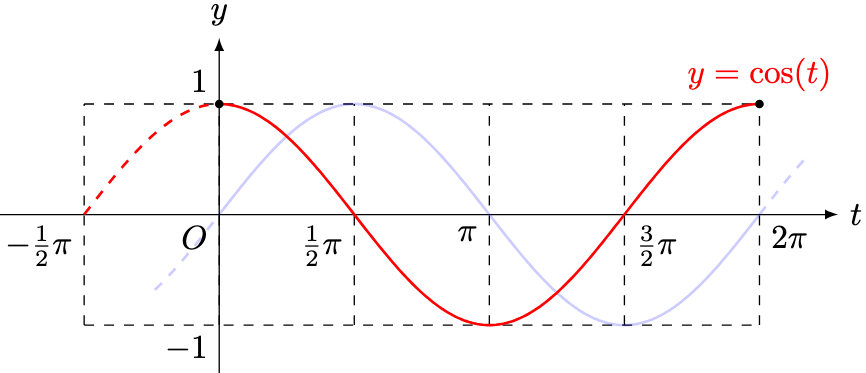
Example 4. Using Theorem 1, sketch the graph of y = \cos(t) for 0 \leq t \leq 2\pi.

Solution. Using the complementary and obtuse angle identities, if 0 < t < \pi/2, then

\begin{aligned} \cos(t) &= \sin(\pi/2 - t) \\ &= \sin( \pi - (\pi/2 - t) ) \\ &= \sin(t + \pi/2). \end{aligned}

It can be shown that this identity holds for any real t. Therefore, y = \cos(t) is a sine wave with:

  • amplitude 1,
  • period 2\pi,
  • leftward phase shift of \pi/2.

Hence, we sketch y = \cos(t) for 0 \leq t \leq 2\pi, and duplicate it for -2\pi \leq t \leq 0:

Therefore, for simplicity, we can just work with sine waves.

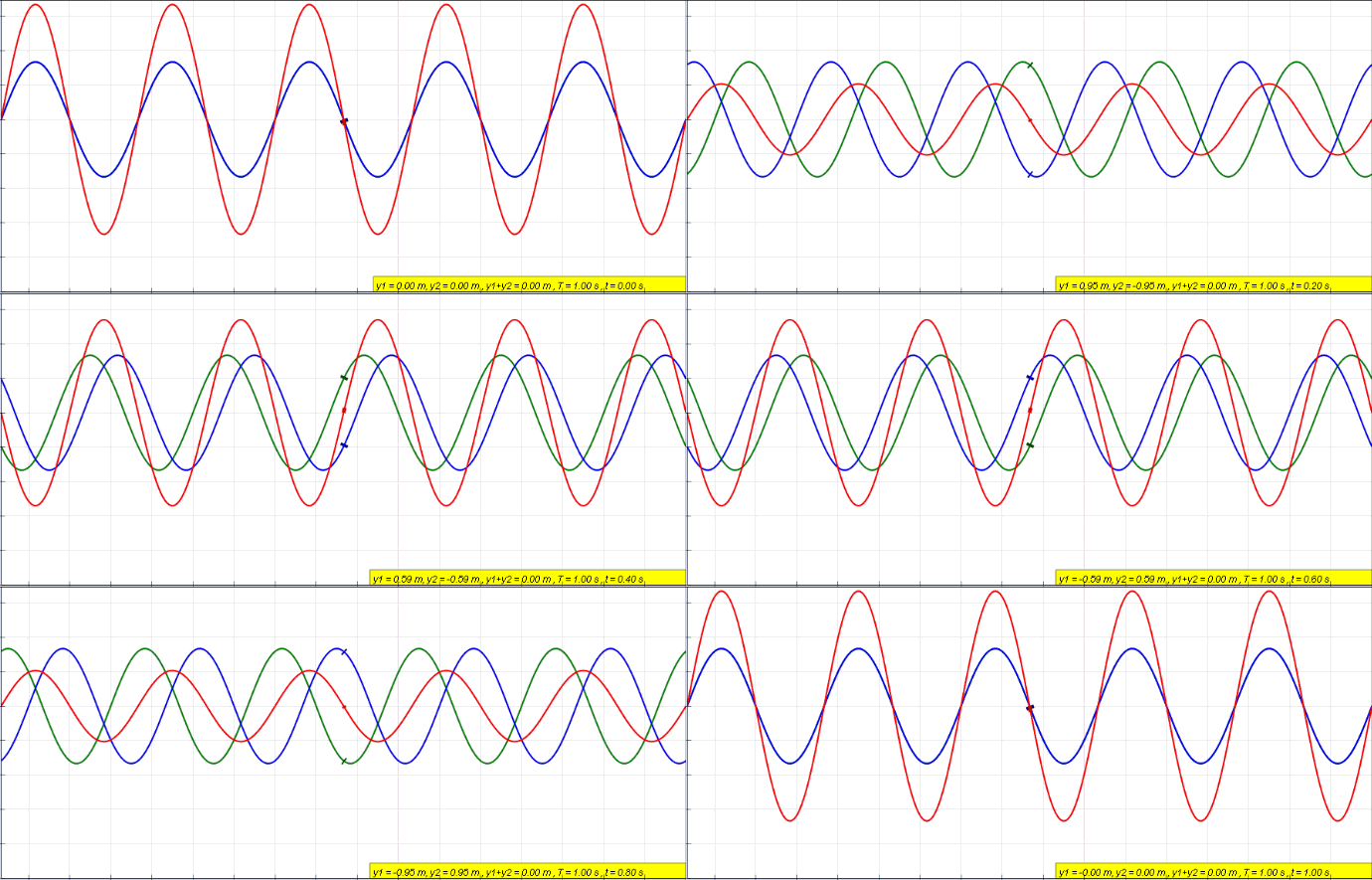
What happens when two waves f(t), g(t) meet each other? They combine by adding to give the resultant curve f(t) + g(t). This result is known as the principle of superposition, and the resulting wave is called an interference of waves.

Theorem 2. Let f(t), g(t) be sine waves with angular frequency \omega. Then their resultant curve f(t)+g(t) is a sine wave with angular frequency \omega.

In particular, given positive constants A, B, for any real t,

A \sin(t) \pm B \cos(t) = C \sin(t \pm \alpha), \quad 0 \leq \alpha \leq \pi/2

where C = \sqrt{A^2 + B^2} and \tan(\alpha) = B/A.

Proof. For the general case, see Problem 3 of this post. We will prove the special case directly. Expand the right-hand side using the addition formula:

C \sin(t \pm \alpha) = C \sin(t) \cos(\alpha) \pm C \cos(t) \sin(\alpha).

Setting A = C \cos(\alpha) and B = C \sin(\alpha),

C \sin(t \pm \alpha) = A \sin(t) \pm B \cos(t).

Using the Pythagorean identity,

\begin{aligned} A^2 + B^2 &= C^2 \cos^2(\alpha) + C^2 \sin^2(\alpha) \\ &= C^2 (\cos^2(\alpha) + \sin^2(\alpha)) \\ &= C^2 \cdot 1 = C^2. \end{aligned}

Furthermore,

\displaystyle \frac{B}{A} = \frac{C \sin(\alpha)}{C \cos(\alpha)} = \frac{\sin(\alpha)}{\cos(\alpha)} = \tan(\alpha).

A direct proof is possible but far more cumbersome, and not terribly helpful for our discussions.

Sine waves are responsible for Fourier series that make modern electronics possible in the first place, so if you intend to explore electronics, you will find them helpful.

What we have discussed up to this point covers much of pre-calculus. What lies ahead seems tricky for many but turns out to be one of the most versatile branches of high school mathematics with respect to further studies in college and university—calculus.

We will explore calculus from a computational point of view, rather than explore its rich underlying theory. That exploration can take us down a very, very deep rabbit hole called real analysis, which we shall relegate as an ambitious exercise for a select subset of students.

For now, we shall turn to the first idea of our consideration: differentiation.

—Joel Kindiak, 20 Dec 25, 1240H

,

Published by


Leave a comment