Differentiation finds one of its greatest powers in optimisation; that is maximising or minimising some constrained quantity.
Consider the graph of 

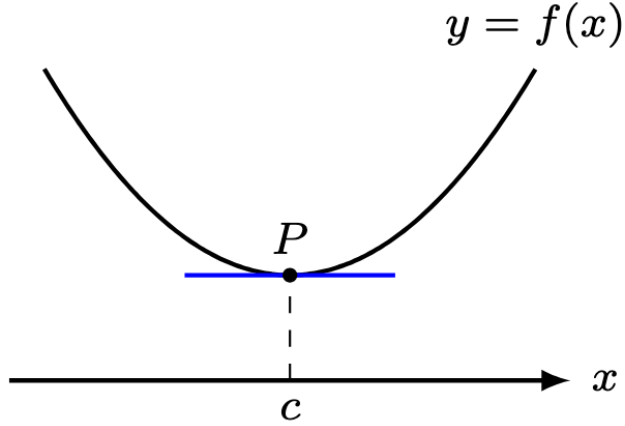
Since the tangent to the curve at 

Theorem 1 (Zero Derivative Condition). If 

Proof. We illustrate the proof for the local minimum case.
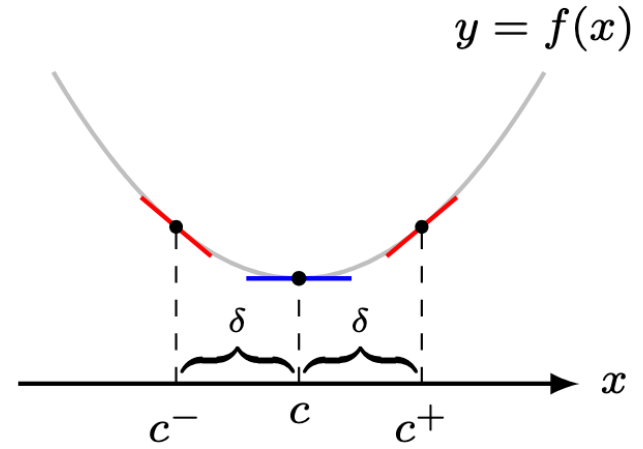
Denote 


so that by taking 

For more rigorous details, see this post.
Example 1. Calculate the turning points of the graph of 
Solution. To determine the turning points, we use the zero derivative condition:

We first evaluate the left-hand side:

Hence, we solve the equation

And we resolve two cases:
- At
,
.
- At
,
.
Therefore, the two turning points have coordinates 

Remark 1. Using software, the graph of
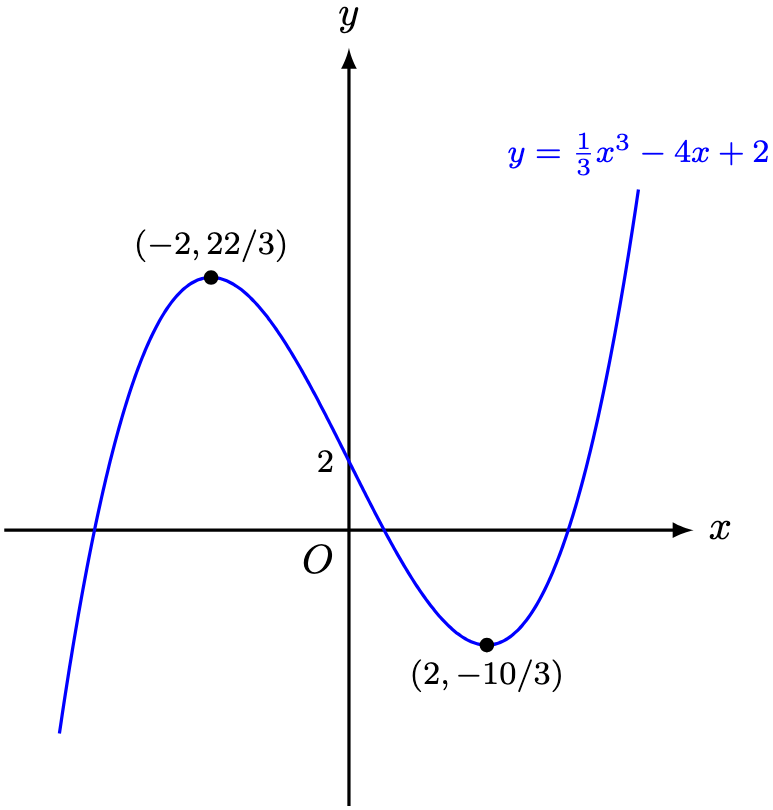
Hence, the power of calculus arises in calculating the turning points even without technology or visual intuition.
Example 2. Given constants 


has two distinct stationary points if and only if 
Solution. We take the first derivative:

By the zero derivative condition, the graph has two distinct stationary points if and only if the equation 

has two real and distinct roots if and only if its discriminant is positive:

Each step holds bi-directionally so the proof holds.
Suppose now we know that
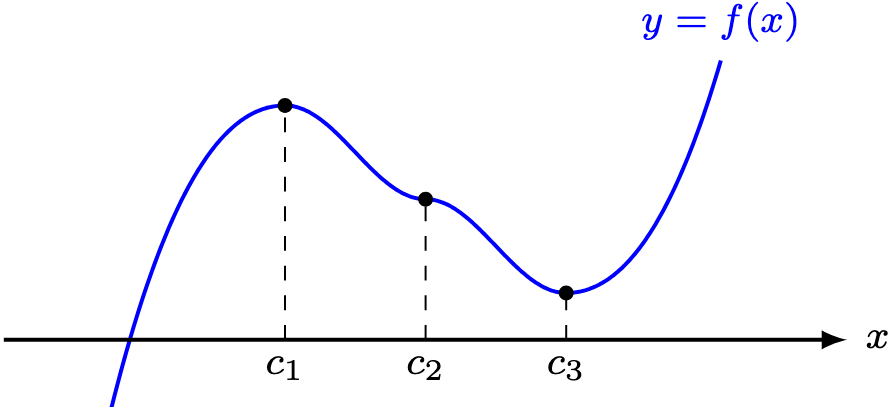
By considering the graph above, there are three instances in which
: at a local maximum,
: at a stationary point of inflection,
: at a local minimum.
How do we distinguish between these three types? Graphically, but expressed in equations.
Theorem 2 (First Derivative Test). Suppose 


- local minimum if
and
,
- local maximum if
and
,
- stationary point of inflection if
.
Proof. The diagram above illustrates all three scenarios. For details, see this post.
Example 3. Determine the nature of the turning points calculated in Example 1.
It turns out that we can take a short-cut to Theorem 1 by considering the second derivative, defined by the derivative of the first derivative:

For alternate notation, suppose

In turn, we have

Theorem 3 (Second Derivative Test). Suppose
- local minimum if
,
- local maximum if
.
If 
Proof Sketch. In the case of a local minimum,

Since 


Example 4. Calculate the stationary points of the graph 

Solution. To obtain the stationary points of the graph, we use the zero derivative condition

Evaluating the left-hand side,

Therefore, we solve the equation

Now 


To determine their nature, we use the second derivative test:

Using the second derivative test,

Therefore,
Example 5. The diagram below shows the graphs of

respectively.
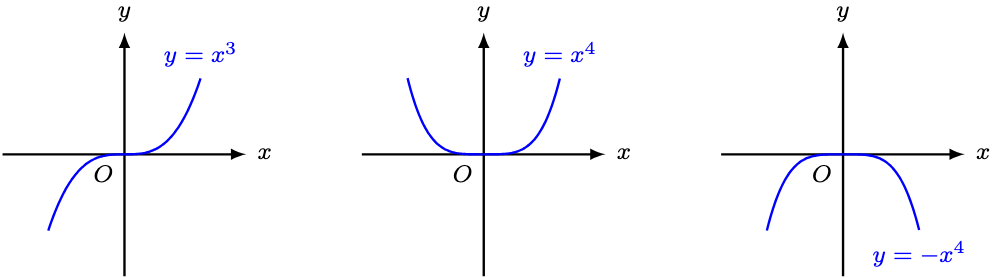
For each graph, compute 


Solution. For the first graph,

Therefore,

For the first graph,

Therefore,

Similarly, in the case 

Remark 2. The point of this exercise is to demonstrate that 
Now, we can talk about constrained optimisation.
Example 6. Determine the smallest perimeter for a rectangle with area 
Solution. Sketch the rectangle as follows.
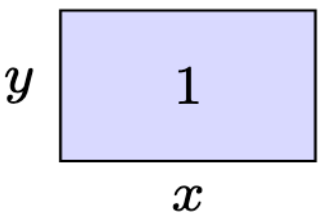
Since 


Since 


In particular, the smallest perimeter achieved is 

Remark 3. Strictly speaking, we need to do more work to show that 
Example 7. Determine the smallest surface area for a closed cylinder with volume 
Solution. Sketch the cylinder as follows.
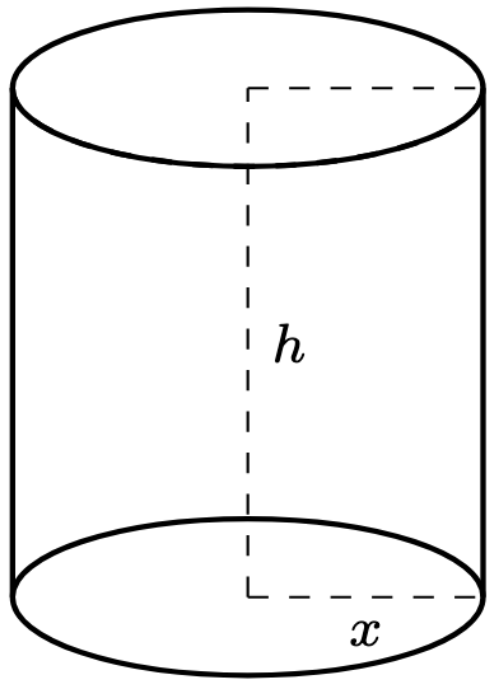
Here,

The surface area 


To use the zero derivative condition, we first calculate 

Hence, we set 

Therefore, ![x = \sqrt[3]{5/\pi} \approx 1.17](https://s0.wp.com/latex.php?latex=x+%3D+%5Csqrt%5B3%5D%7B5%2F%5Cpi%7D+%5Capprox+1.17&bg=ffffff&fg=000&s=0&c=20201002)

whenever ![x = \sqrt[3]{5/\pi}](https://s0.wp.com/latex.php?latex=x+%3D+%5Csqrt%5B3%5D%7B5%2F%5Cpi%7D&bg=ffffff&fg=000&s=0&c=20201002)
![\begin{aligned} A &= 20 \pi x^2 + \frac{ 20 }{ x } \\ &= \frac 1{x} (2 \pi x^3 + 20 ) \\ &= \frac{ \sqrt[3]{\pi} }{ \sqrt[3]{5} } \left( 2\pi \cdot \frac 5{\pi} + 20\right) \\ &= \frac{ 30 \sqrt[3]{\pi} }{ \sqrt[3]{5} } \approx 25.7\, \text{units}^2. \end{aligned}](https://s0.wp.com/latex.php?latex=%5Cbegin%7Baligned%7D+A+%26%3D+20+%5Cpi+x%5E2+%2B+%5Cfrac%7B+20+%7D%7B+x+%7D+%5C%5C+%26%3D+%5Cfrac+1%7Bx%7D+%282+%5Cpi+x%5E3+%2B+20+%29+%5C%5C+%26%3D+%5Cfrac%7B+%5Csqrt%5B3%5D%7B%5Cpi%7D+%7D%7B+%5Csqrt%5B3%5D%7B5%7D+%7D+%5Cleft%28+2%5Cpi+%5Ccdot+%5Cfrac+5%7B%5Cpi%7D+%2B+20%5Cright%29++%5C%5C+%26%3D+%5Cfrac%7B+30+%5Csqrt%5B3%5D%7B%5Cpi%7D+%7D%7B+%5Csqrt%5B3%5D%7B5%7D+%7D+%5Capprox+25.7%5C%2C+%5Ctext%7Bunits%7D%5E2.+%5Cend%7Baligned%7D&bg=ffffff&fg=000&s=0&c=20201002)
While there are many possible applications of optimisation, especially in profit-maximisation, we want to switch gears and discuss differentiation’s shadow brother—integration. This we will computationally discuss next time.
For now, let’s resolve an interesting generalisation of the questions we solved just now.
Example 8. For positive constants 

with equality if and only if 
Solution. Define the function 

By the zero derivative condition,

Since 


In particular, at 

Dividing by 

Equality holds if and only if 
Remark 4. The left-hand side 


Remark 5. An alternative proof from just algebra arises from expanding the left-hand side of the not-so-trivial inequality

—Joel Kindiak, 16 Jan 26, 1215H
 KindiakMath
Leave a comment