The Parabolic Reflector

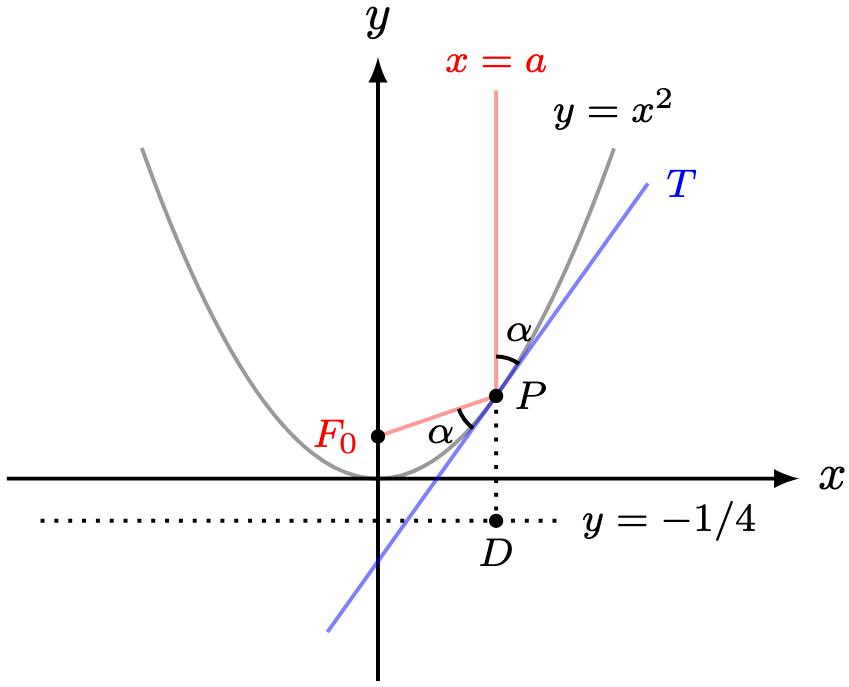
The diagram below shows a parabola with equation y =x^2. Recall that its directrix has equation y = -1/4.

A light ray traveling downward along x = a reflects off the tangent T to the curve at P(a, a^2) at an angle of \alpha, and intersects the y-axis at F_0.

Problem 1. Calculate the y-intercept H of T in terms of a.

(Click for Solution)

Solution. Recall that T has gradient 2a and hence equation

y = 2a(x-a) + a^2.

At the y-intercept, x = 0, so that y = -a^2. Hence, T has a y-intercept of (0, -a^2).

Problem 2. Show that F_0 P H D is a rhombus.

(Click for Solution)

Solution. Denote H below as per Problem 1.
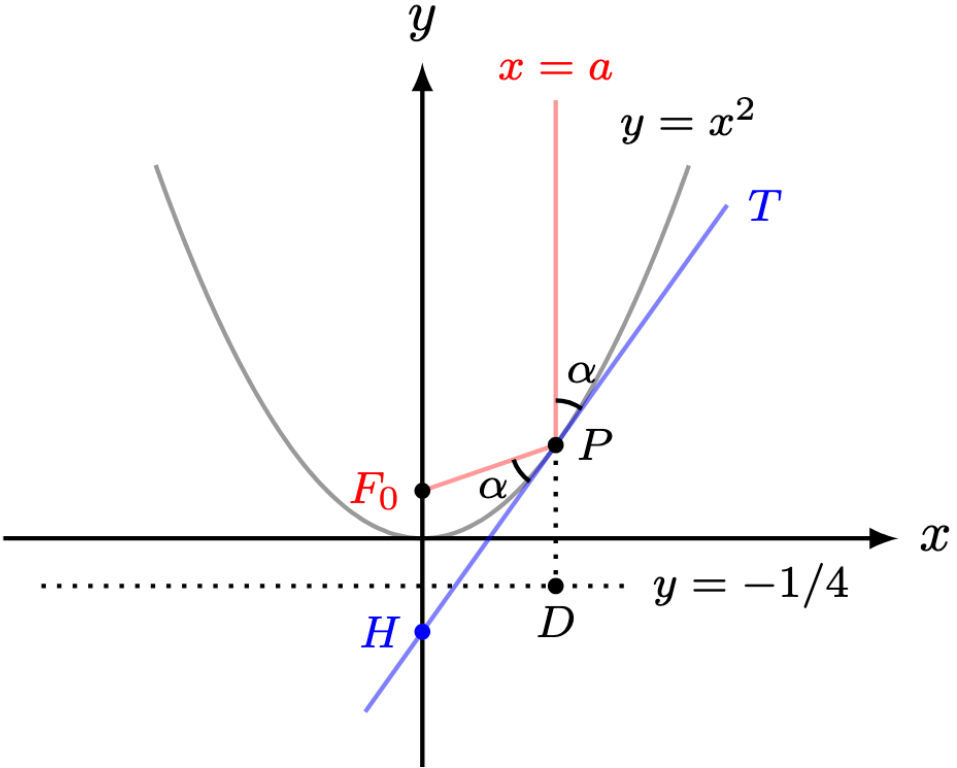
By vertically opposite angles, \angle HPD = \alpha.

Since PD \parallel F_0H, the alternate angles equal:

\angle F_0 H P = \angle HPD = \alpha = \angle F_0 PH.

Since the base angles of \Delta F_0 HP are equal, \Delta F_0 H P is isosceles, so that

F_0 H = F_0 P.

By direct computation,

PD^2 = (a^2 + 1/4)^2 = a^4 + a^2/2 + 1/16

and

\begin{aligned} HD^2 &= a^2 + (a^2 - 1/4)^2 \\ &= a^2 + (a^4 - a^2/2 + 1/16) \\ &= a^4 + a^2/2 + 1/16 = PD^2, \end{aligned}

so that HD = PD. Hence, \Delta DPH is isosceles and

\angle DHP = \angle DPH = \alpha = \angle F_0 PH = \angle F_0HP.

With the common side PH, \angle DPH = \angle F_0PH, and \angle DHP = \angle F_0 HP, the ASA Criterion yields

\Delta DPH \equiv \Delta F_0 PH.

Therefore,

DP = PF_0 = F_0 H = HD,

implying that F_0 PHD is a rhombus.

Problem 3. Deduce that F_0 coincides with the focus of the parabola.

(Click for Solution)

Solution. Since F_0 H = PD = a^2 + 1/4, the y-coordinate of F_0 is

-a^2 + (a^2+1/4) = 1/4.

Hence, F_0(0, 1/4), coinciding with the focus of y = x^2.

Remark 1. Our arguments generalise to other parabolas, requiring extra book-keeping.

Remark 2. A similar calculation can establish the converse: given that light starts at F_0 and reflects off T at P, the resulting light ray travels upward, and parallel to the y-axis.

—Joel Kindiak, 10 Jan 26, 2026H

,

Published by


Leave a comment