Definition 1. A rhombus is a shape made up of four straight line segments whose side lengths are all equal.
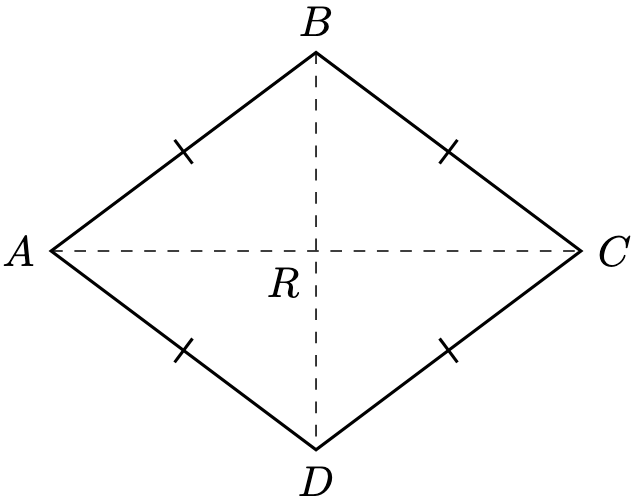
In the rhombus ABCD above, we call AC and BD the diagonals of the rhombus that intersect at R.
Problem 1. Show that the diagonals of a rhombus are perpendicular bisectors of each other.
(Click for Solution)
Solution. Since angles in a triangle are supplementary,

Since

summing the equations yields

Since 


Therefore,

Similarly, 

Since the interior angles sum to 


Using previous data, we have 

By the ASA Criterion, 

Therefore, 


so that 

Therefore, 

Problem 2. Let AB be the line segment below, and let r > 0 be a length such that
AB/2 < r ≤ AB.
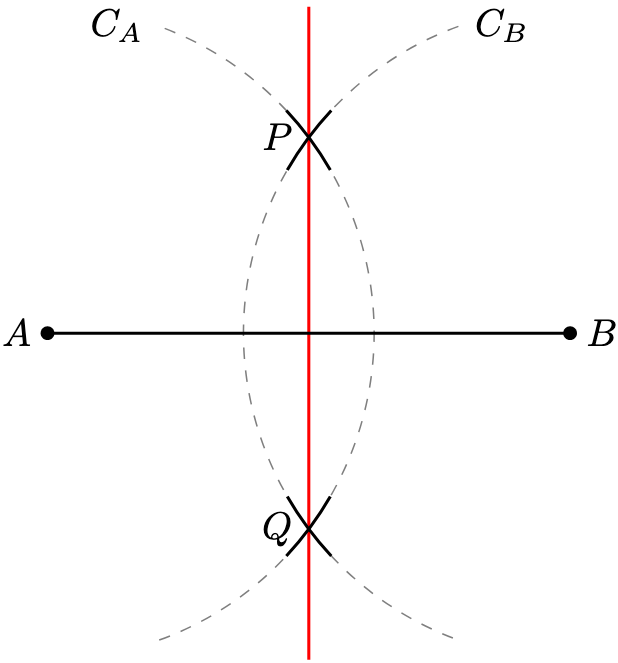
Here, CA is a circle with centre A and radius r. Define CB likewise. Let P, Q denote the intersections between CA, CB.
Show that the line passing through P, Q is the perpendicular bisector of AB.
(Click for Solution)
Solution. As radii of the same circle,

Therefore, 


Problem 3. Let OA, OB be the line segments below, and let r > 0 be any length.
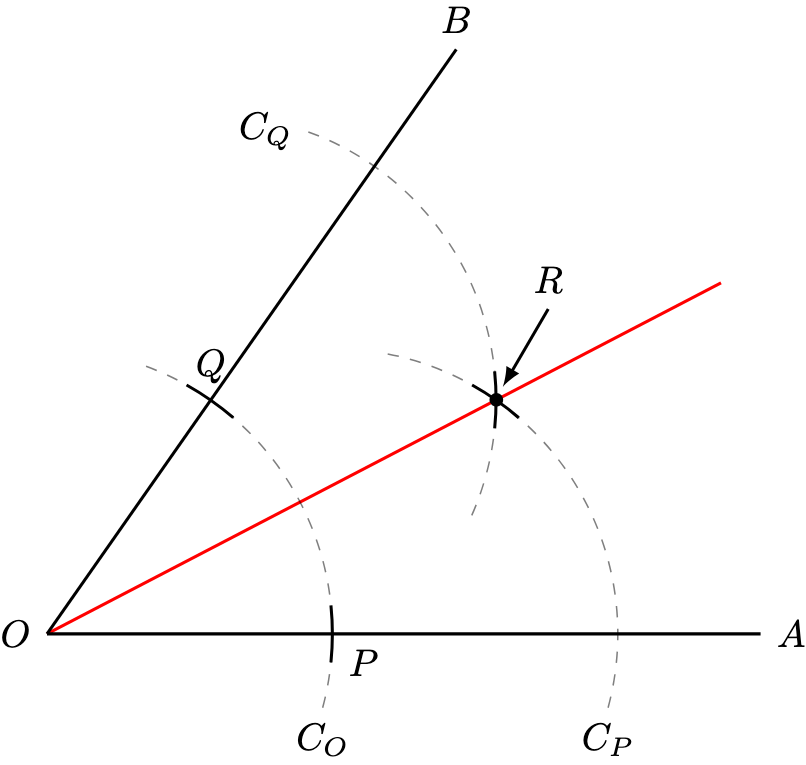
Here, CO denotes the circle with centre O and radius r. Suppose CO intersects OA at P and OB at Q. Define CA, CB similarly, and denote their intersection by R.
Show that ∠AOR = ∠BOR. In this case, we call the line passing through O, R the angle bisector of ∠AOB.
(Click for Solution)
Solution. As radii of the same circle,

Therefore, 

Denote their intersection by 


as required.
—Joel Kindiak, 19 Jan 26, 1400H
 KindiakMath
Leave a comment