What was the point of integration? To compute areas. Which sounds strange. Don’t we already have meaningful formulas for common areas?
Example 1. Consider the graph 

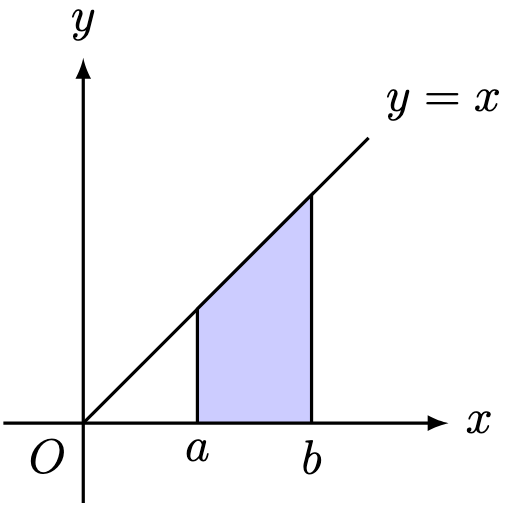
Define 

Solution. Using integration,

In particular,

Since the shaded region is a trapezium, it has an area given by

Example 2. Consider the graph 

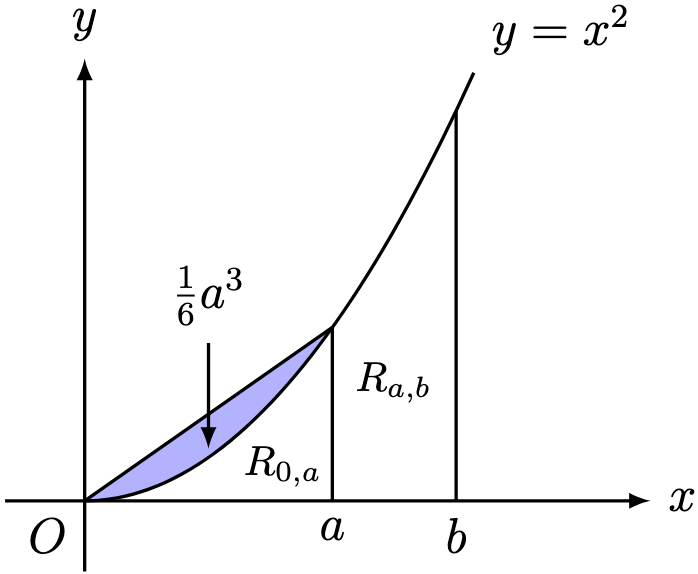
Define 


Deduce that the area of 

Solution. Using integration,

In particular, 
On the other hand,

The region 

This pattern turns out to be true in more general settings. We will simply state this general pattern, and omit its proof (referencing it for more a more advanced study of calculus).
Theorem 1. Consider the graph 

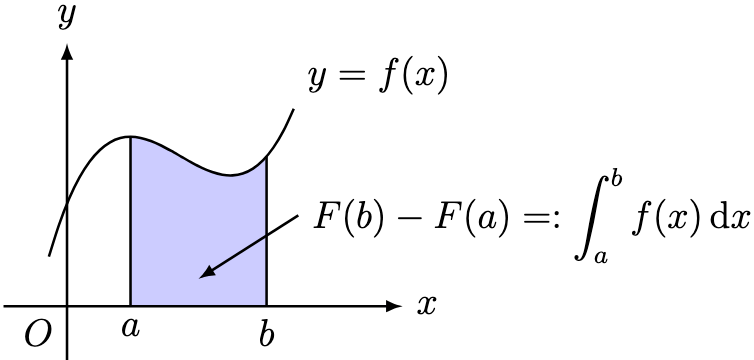
Define 

Proof. This result is known as the famous fundamental theorem of calculus, which is rigorously proven elsewhere in the blog.
Definition 1. Given any function 
![[G(x)]_a^b := G(b) - G(a).](https://s0.wp.com/latex.php?latex=%5BG%28x%29%5D_a%5Eb+%3A%3D+G%28b%29+-+G%28a%29.&bg=ffffff&fg=000&s=0&c=20201002)
Suppose we know the functions 

Then we define the definite integral of 


![\displaystyle \int_a^b f(x)\, \mathrm dx := [F(x)]_a^b \equiv F(b) - F(a).](https://s0.wp.com/latex.php?latex=%5Cdisplaystyle+%5Cint_a%5Eb+f%28x%29%5C%2C+%5Cmathrm+dx+%3A%3D+%5BF%28x%29%5D_a%5Eb+%5Cequiv+F%28b%29+-+F%28a%29.&bg=ffffff&fg=000&s=0&c=20201002)
In particular, if

denotes the area of the region in Theorem 1.
Example 3. For 

Solution. Using integration,

Hence,
![\displaystyle \int_0^1 x^n\, \mathrm dx = \left[ \frac{x^{n+1}}{n+1} \right]_0^1 = \frac{1^{n+1}}{n+1} - \frac{0^{n+1}}{n+1} = \frac 1{n+1}.](https://s0.wp.com/latex.php?latex=%5Cdisplaystyle+%5Cint_0%5E1+x%5En%5C%2C+%5Cmathrm+dx+%3D+%5Cleft%5B+%5Cfrac%7Bx%5E%7Bn%2B1%7D%7D%7Bn%2B1%7D+%5Cright%5D_0%5E1+%3D+%5Cfrac%7B1%5E%7Bn%2B1%7D%7D%7Bn%2B1%7D+-+%5Cfrac%7B0%5E%7Bn%2B1%7D%7D%7Bn%2B1%7D+%3D+%5Cfrac+1%7Bn%2B1%7D.&bg=ffffff&fg=000&s=0&c=20201002)
More generally, for any real 

Using the definition of the definite integral, we can recover several important integration properties.
Theorem 2. Let 


Proof. We will prove just the third result and relegate the rest of the results as exercises. Suppose 

Then
![\begin{aligned} \int_a^b f(x) \, \mathrm dx + \int_b^c f(x) \, \mathrm dx &= [F(x)]_a^b + [F(x)]_b^c \\ &= (F(b) - F(a)) + (F(c) - F(b)) \\ &= F(c) - F(a) \\ &= \int_a^c f(x) \, \mathrm dx. \end{aligned}](https://s0.wp.com/latex.php?latex=%5Cbegin%7Baligned%7D+%5Cint_a%5Eb+f%28x%29+%5C%2C+%5Cmathrm+dx+%2B+%5Cint_b%5Ec+f%28x%29+%5C%2C+%5Cmathrm+dx+%26%3D+%5BF%28x%29%5D_a%5Eb+%2B+%5BF%28x%29%5D_b%5Ec+%5C%5C+%26%3D+%28F%28b%29+-+F%28a%29%29+%2B+%28F%28c%29+-+F%28b%29%29+%5C%5C+%26%3D+F%28c%29+-+F%28a%29+%5C%5C+%26%3D+%5Cint_a%5Ec+f%28x%29+%5C%2C+%5Cmathrm+dx.++%5Cend%7Baligned%7D&bg=ffffff&fg=000&s=0&c=20201002)
Example 4. Evaluate the exact area of the following region.
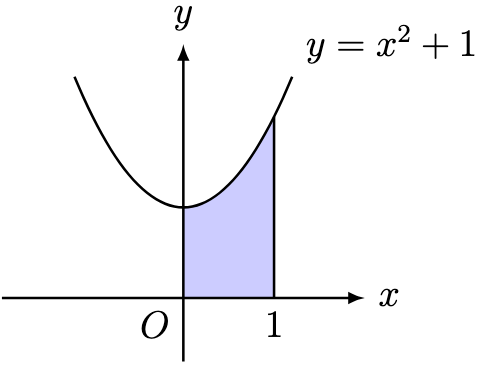
Solution. Since the area under the graph is calculated using an integral,

Remark 1. Paradoxically, a rigorous treatment of calculus first proves Theorem 2 using a more fundamental definition of integration, then uses Theorem 2 and other real-analytic tools to prove Theorem 1.
Remark 2. The theory of integration is an incredibly deep rabbit hole, arguably deeper than that of differentiation. Its uses are deep and far-reaching due to its connections with probability (which influences basically almost every area of life). However, to keep things simple, we will restrict our attention to simple computations of integrals.
The rest of this post could evolve into a mere hodge-podge of integration drills, but perhaps we can think about Theorem 1 a little more closely.
Example 5. Consider the graph of 
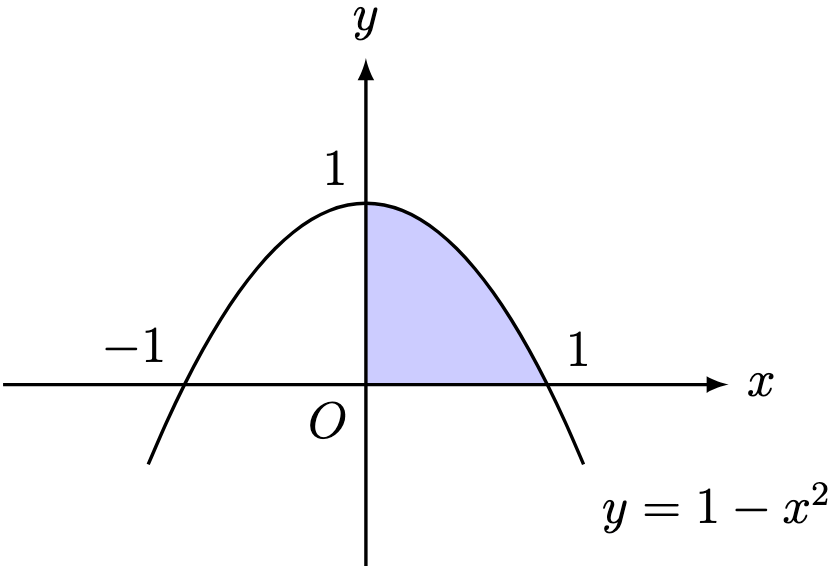
Evaluate 

Solution. Using the linearity of integration

By Theorem 2,

If, instead, we graphed 
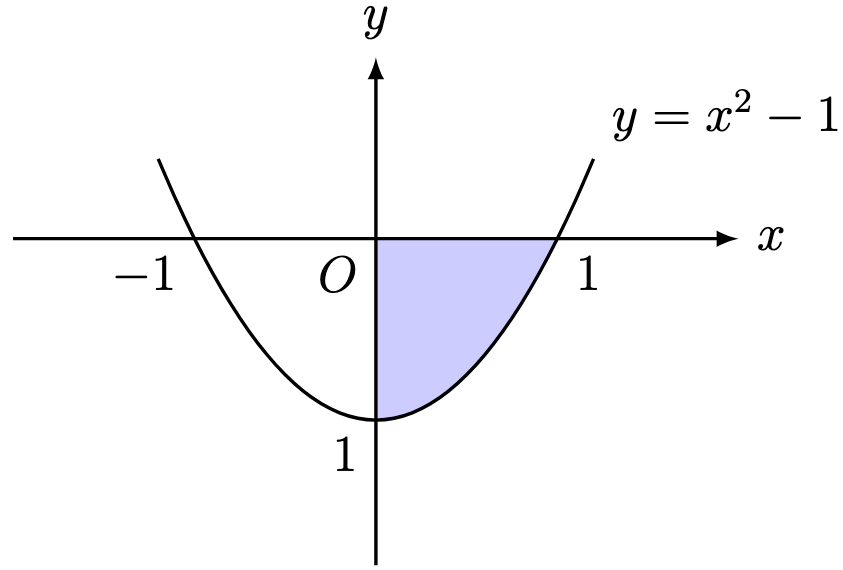
Furthermore, it would have an area of 
Hence, strictly speaking, the integral only accounts for the signed area, which is positive if
In many ways, integration was formulated to answer problems in physics.
Definition 2. Sir Isaac Newton used calculus to formulate the connections between displacement 


We remark that these definitions agree with the usual velocity-time graph (for displacement) and the acceleration-time graph (for velocity), where we calculate the desired quantities by evaluating the areas under the graphs (hence, corresponding with the integral formulation)
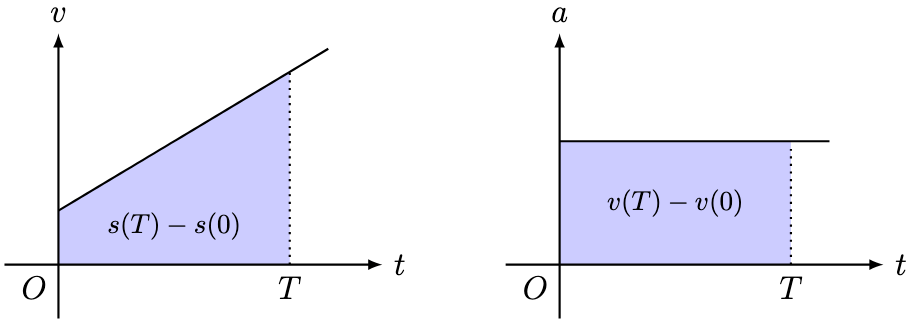
He was interested in the special case when 

Theorem 3. Given constants 

Then

Furthermore, 
Proof. Integrating

Therefore,
![\begin{aligned} v(T) &= v(0) + \int_0^T a(t)\, \mathrm dt \\ &= v_0 + [a_0x]_0^T \\ &= v_0 + (a_0 T - a_0 \cdot 0) \\ &= v_0 + a_0T. \end{aligned}](https://s0.wp.com/latex.php?latex=%5Cbegin%7Baligned%7D+v%28T%29+%26%3D+v%280%29+%2B+%5Cint_0%5ET+a%28t%29%5C%2C+%5Cmathrm+dt+%5C%5C+%26%3D+v_0+%2B+%5Ba_0x%5D_0%5ET+%5C%5C+%26%3D+v_0+%2B+%28a_0+T+-+a_0+%5Ccdot+0%29+%5C%5C+%26%3D+v_0+%2B+a_0T.+%5Cend%7Baligned%7D&bg=ffffff&fg=000&s=0&c=20201002)
Similarly,

where 
![\begin{aligned} s(T) &= s(0) + \int_0^T v(t)\, \mathrm dt \\ &= \textstyle s_0 + \left[ v_0t + \frac 12 a_0t^2 \right]_0^T \\ &= \textstyle s_0 + \left( v_0T + \frac 12 a_0T^2 \right) - \left( v_0\cdot 0 + \frac 12 a_0 \cdot 0^2 \right) \\ &= \textstyle s_0 + v_0T + \frac 12 a_0T^2 . \end{aligned}](https://s0.wp.com/latex.php?latex=%5Cbegin%7Baligned%7D+s%28T%29+%26%3D+s%280%29+%2B+%5Cint_0%5ET+v%28t%29%5C%2C+%5Cmathrm+dt+%5C%5C+%26%3D+%5Ctextstyle+s_0+%2B+%5Cleft%5B+v_0t+%2B+%5Cfrac+12+a_0t%5E2+%5Cright%5D_0%5ET+%5C%5C+%26%3D+%5Ctextstyle+s_0+%2B+%5Cleft%28+v_0T+%2B+%5Cfrac+12+a_0T%5E2+%5Cright%29+-+%5Cleft%28+v_0%5Ccdot+0+%2B+%5Cfrac+12+a_0+%5Ccdot+0%5E2+%5Cright%29+%5C%5C+%26%3D+%5Ctextstyle+s_0+%2B+v_0T+%2B+%5Cfrac+12+a_0T%5E2+.+%5Cend%7Baligned%7D&bg=ffffff&fg=000&s=0&c=20201002)
In particular,

Theorem 3 lists out several common laws of kinematics, in particular, for an object moving in a straight line at constant acceleration. If instead we started by knowing the displacement 
Theorem 4. The displacement 

In particular, 
Proof. Write 


Differentiating on both sides,

The argument holds similarly for
Similarly, these connections agree with the usual displacement-time graph (for velocity) and the velocity-time graph (for acceleration), where we calculate the desired quantities at a specific time by evaluating the gradient of the tangent at that point.
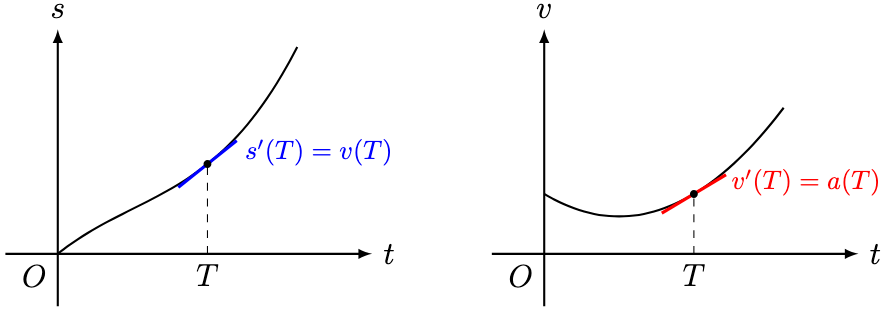
We have only scratched the surface regarding applied calculus, and you can explore even more in adjacent STEM fields like physics and economics.
For now, we need to answer a crucial question. So far, we have only discussed calculus regarding the simple-enough polynomials. But can we discuss calculus on the trigonometric functions like 


The answer is yes, sort of. A rigorous treatment takes a lot more effort into the nuts and bolts of calculus. Nevertheless, we can still appreciate these formulas from a visually intuitive perspective, and I think there is still a lot to enjoy from viewing it that way.
—Joel Kindiak, 23 Jan 26, 1937H
 KindiakMath
Leave a comment