If you won’t further your studies into a STEM discipline, then the tools and techniques in this post would not be terribly relevant for you. But for the aspiring STEM student, we are now going to do calculus with trigonometric functions and exponential functions.
The derivative of 
Denote 


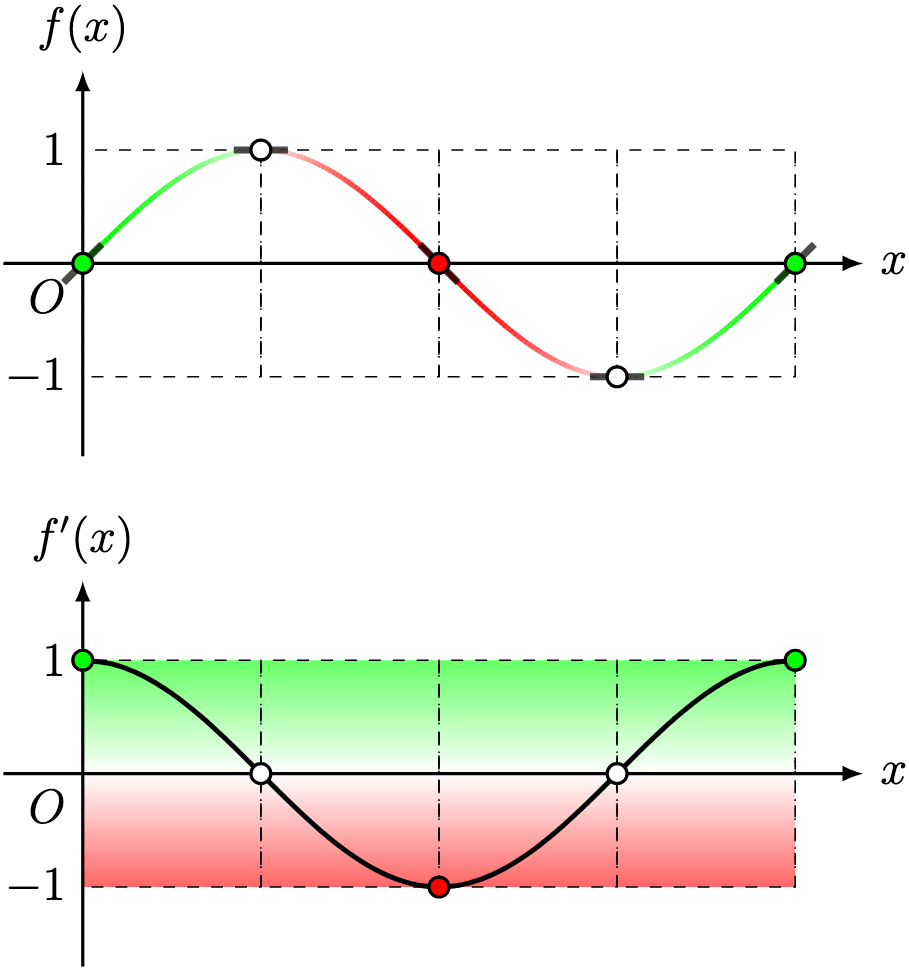
If now we plot the points of the new graph 
Recalling our discussions on trigonometric graphs, 

Theorem 1. 
Proof. Omitted. Or relegated to a study in more advanced calculus. In the language of limits, we need to use the limit definition of the derivative to show that

Then the core result is proven using the limit

Remark 1. Strictly speaking, we have put the cart before the horse—I couldn’t colour the sine graph unless I already knew that the derivative of 

You might wonder—in that case, why not obtain all other derivatives in this manner? Other than the fact that I need to slave-drive ChatGPT harder than I already do, it turns out that the existing differentiation technology, if we accept them to remain true for non-polynomials, empowers us to obtain (almost) all of these other derivatives.
For instance, the chain rule helps us compute the derivative of

Example 1. Show that 
Solution. Using the complementary angle identities, the chain rule, and Theorem 1,

These two results, coupled with the quotient rule, help us compute the derivative of 

Example 2. Show that 
Solution. Using the quotient rule and previous theorems,

There are many more commonly-used derivatives in this exercise here. We now state the integral versions of these three results.
Theorem 4. The following integrals hold:

Proof. We prove the first result to illustrate the power of thinking of integration as reverse differentiation. Using Theorem 2 and linearity,

Therefore dividing by

where 
We have to discuss the exponential family too. Once again, just like with the derivative of 
Let’s first ask ourselves: how can we experimentally compute the gradient 


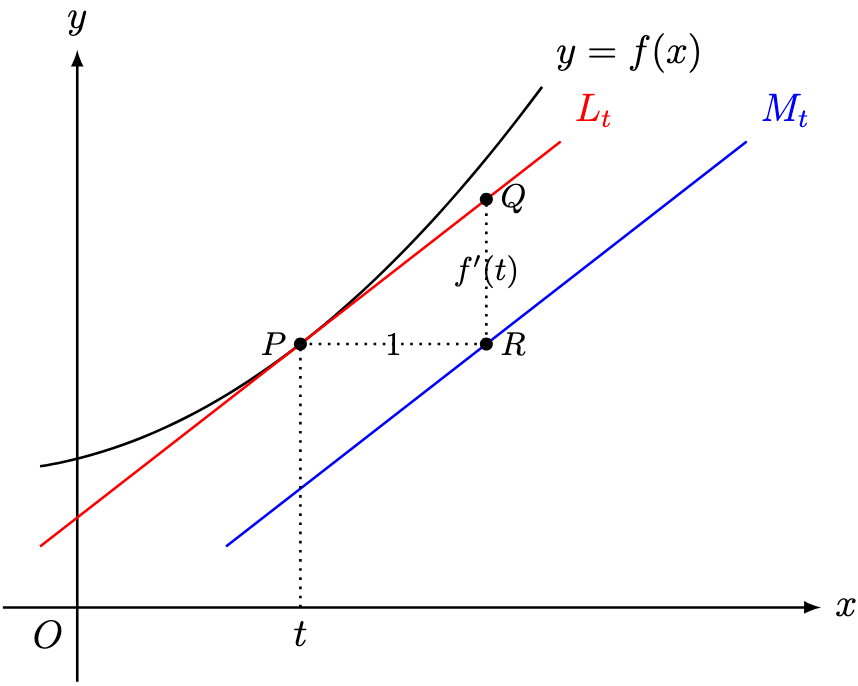
Draw a line 


In particular, if we know that

Now particularise to 
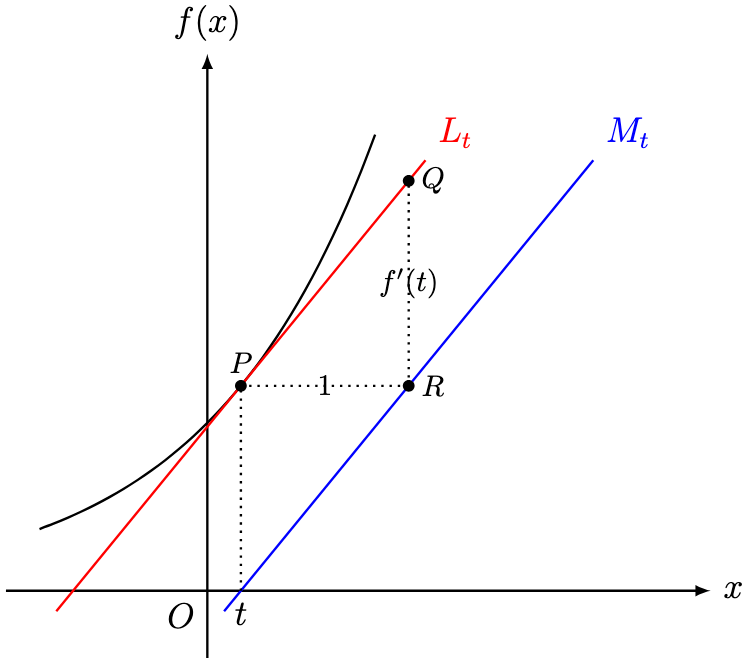
Notice that the 


This result is a consequence of the famous differentiation result for exponentials.
Theorem 2. 
Proof. Omitted.
Remark 2. Once again, we have assumed Theorem 2 in our illustration. A complete proof requires a rigorous definition of the real exponential, then deducing its various properties, and concluding by using the limit definition of the derivative. In the language of limits, the heart of the proof is the limit result

Recall that

Example 3. Show that 


Solution. Using the chain rule and Theorem 2,

Remark 1. For 


Therefore, the integral version of these results are given by

Since the absolute value is defined by

we can abbreviate the integral result as follows:

In particular, the absolute value symbol 
Definition 1. Define 


Similarly, define 

Likewise, define 

In particular,

The domain restrictions allow the expressions 


Example 4. Show that 
Solution. For the first result, use the chain rule and Theorem 1:

Since 


By the Pythagorean identity,

Therefore,

By definition,

Example 5. Show that 
Solution. Follow the strategy in Example 4 by using the chain rule and Example 2:

Using the Pythagorean identity,

Therefore,

By definition,

We conclude with one rather peculiar result regarding
Example 6. Given that

Solution. By the complementary angle identities,

Differentiating on both sides,

We have barely scratched the surface of calculus. There is much more that can be explored in many depths. At a high level, the area interpretation of integration allows mathematicians and statisticians to model probabilities—our conceived notions of randomness. We explore a special sub-branch of this topic next time.
—Joel Kindiak, 23 Jan 26, 2045H
 KindiakMath
Leave a comment