Problem 1. Consider the triangle below.
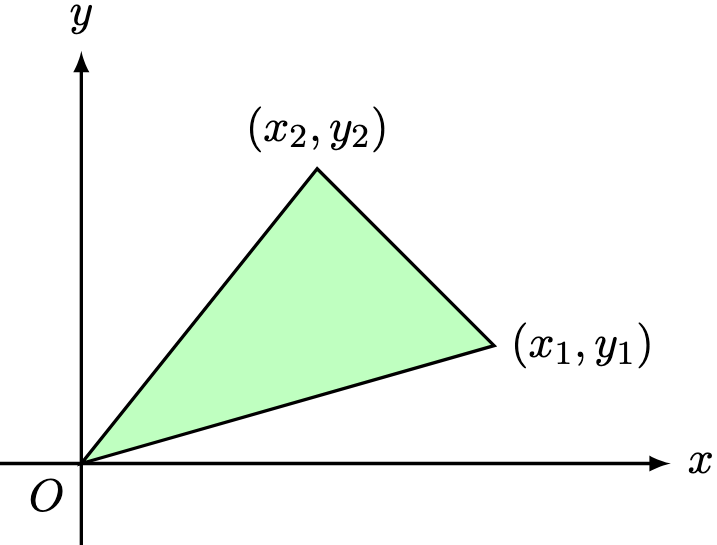
Show that the triangle has area 
(Click for Solution)
Solution. Add dashed lines to draw in “phantom” triangles.
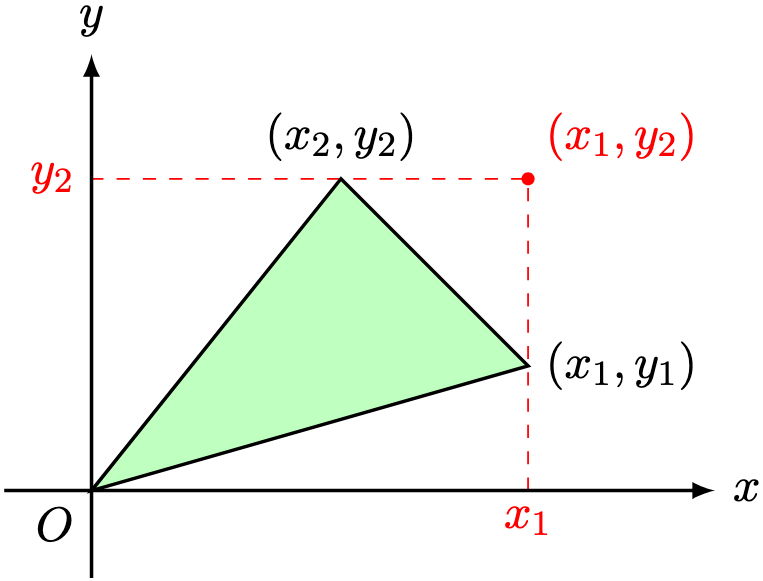
We subtract the area of the three smaller triangles from the larger rectangle:

Remark 1. There are many other kinds of triangles, but with enough patience, they can all be shown to yield the same area formula.
Definition 1. Define

In particular, the area of the triangle in Problem 1 can be written as 
Problem 2. Show that 

(Click for Solution)
Solution. By definition,

Remark 1. In particular, a polygon is said to have positive orientation if its coordinates are traversed in anti-clockwise direction, and have negative orientation if its coordinates are traversed in clock-wise direction.
Problem 3. Consider the triangle below with positive orientation.
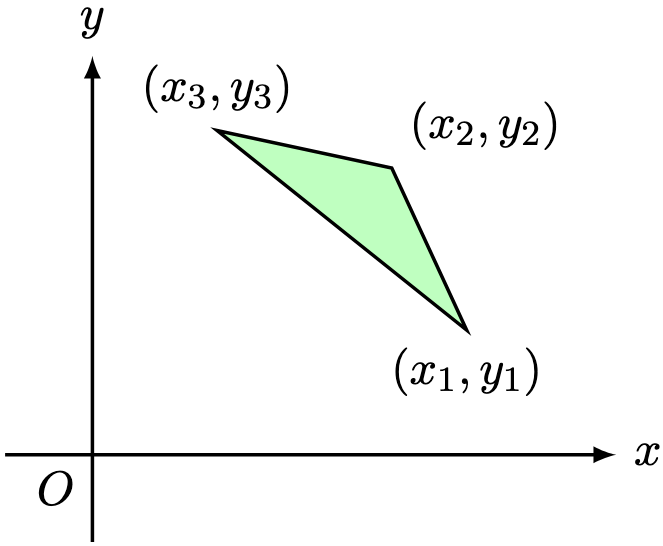
Show that the triangle has area

(Click for Solution)
Solution. Draw some “phantom” triangles:
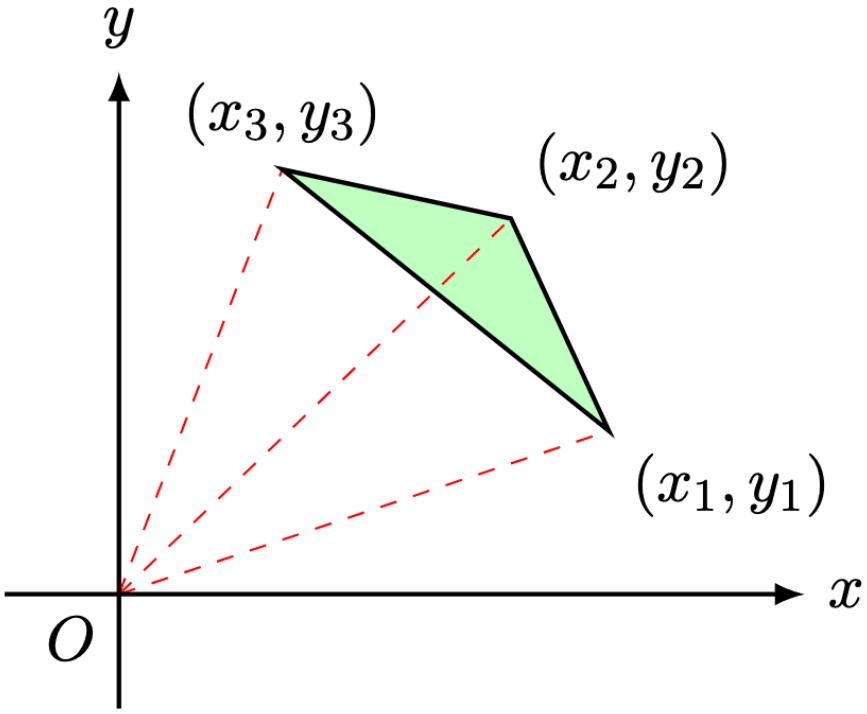
Denote the area of the triangle by 

By Problem 2,

Remark 2. In a similar manner, for triangles with other orientations, as long as the vertices are traversed in an anti-clockwise direction, we still recover the same formula as in Problem 3.
Definition 2. Make the notation

This notation is commonly referred to as the shoelace formula. In particular, the area in Problem 3 can be expressed as

Problem 4. Show that

(Click for Solution)
Solution. Patiently expand the right-hand side:

Problem 5. Consider the quadrilateral below.
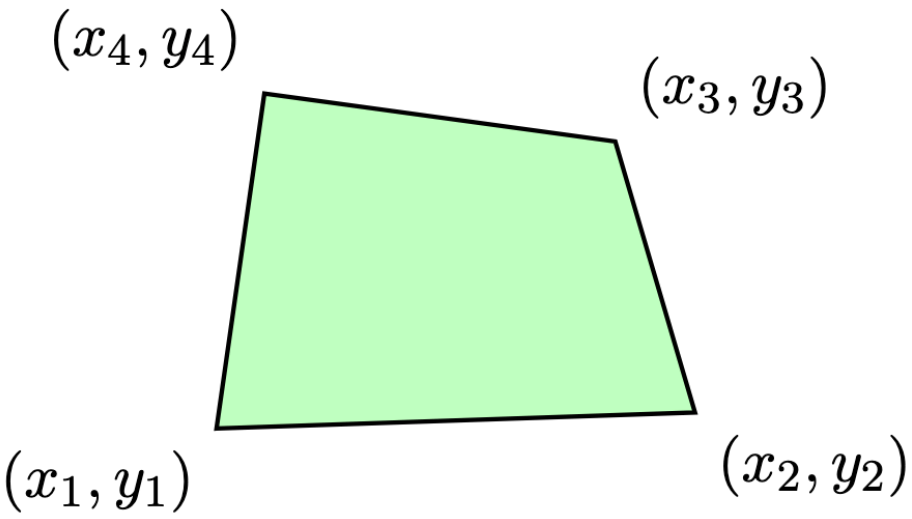
Show that the quadrilateral has area

(Click for Solution)
Solution. Connect 

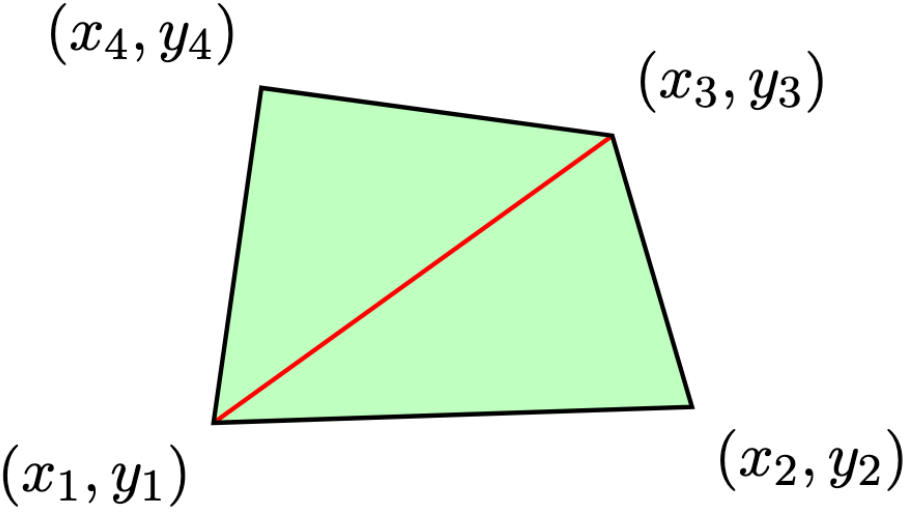
The quadrilateral consists of two triangles, and therefore its area is given by the sum of both triangles, whose formulas are given by Problem 4:

where the 

Remark 2. Using mathematical induction and the same strategy in Problem 5, the signed area of an 

can be shown to equal

Furthermore, this quantity is positive if the vertices are traversed in an anti-clockwise direction and negative if the vertices are traversed in a clockwise direction.
—Joel Kindiak, 24 Jan 26, 1722H


Leave a Reply