Gamma Symmetries

Problem 1. Using the fact that the Beta distribution \mathrm{Beta}(\alpha, \beta) has a p.d.f. given by

\displaystyle \frac{ \Gamma(\alpha + \beta) }{ \Gamma(\alpha) \cdot \Gamma(\beta) } \cdot t^{\alpha - 1} (1-t)^{\beta - 1} \cdot \mathbb I_{[0,1]}(t),

show that for any real number z \notin \mathbb Z_{\leq 0},

\displaystyle \Gamma(z) \cdot \Gamma(z+1/2) = 2^{1-2z} \sqrt{\pi} \cdot \Gamma(2z).

Deduce that

\displaystyle \Gamma( 1 - z/2 ) \cdot \Gamma((1-z)/2) = 2^z \cdot \sqrt{\pi} \cdot \Gamma(1-z).

(Click for Solution)

Solution. Since the given function is a p.d.f., its integral over \mathbb R is 1:

\displaystyle \frac{ \Gamma(\alpha + \beta) }{ \Gamma(\alpha) \cdot \Gamma(\beta) } \int_0^1 t^{\alpha - 1} (1-t)^{\beta - 1}\, \mathrm dt = 1.

Setting \alpha = \beta = z,

\begin{aligned} \frac{ \Gamma(z)^2 }{ \Gamma(2z) } &= \int_0^1 t^{z - 1} (1-t)^{z - 1}\, \mathrm dt. \end{aligned}

Making the substitution t = (1+u)/2 so that u = 2t-1,

\begin{aligned} \frac{ \Gamma(z)^2 }{ \Gamma(2z) } &= \int_{-1}^1 \left( \frac {1+u}{2} \right)^{z - 1} \left( \frac {1-u}{2} \right)^{z - 1} \cdot \frac 12 \, \mathrm du \\ &= \frac 1{4^{z-1}} \int_{-1}^1 (1-u^2)^{z - 1} \cdot \frac 12 \, \mathrm du \\ &= \frac 1{4^{z-1}} \int_0^1 (1-u^2)^{z - 1}\, \mathrm du. \end{aligned}

Making the substitution x = u^2,

\begin{aligned} \frac{ \Gamma(z)^2 }{ \Gamma(2z) } &= \frac 1{4^{z-1}} \int_0^1 (1-x)^{z - 1} \cdot \frac{1}{2\sqrt x} \, \mathrm dx \\ &= \frac 1{2 \cdot 4^{z-1}} \int_0^1 x^{1/2-1} (1-x)^{z - 1} \, \mathrm dx \\ &= \frac 1{2 \cdot 4^{z-1}}  \cdot \frac{ \Gamma(1/2) \cdot \Gamma(z) }{ \Gamma(1/2 + z) }. \end{aligned}

Since \Gamma(z) \neq 0,

\begin{aligned} \Gamma(z) \cdot \Gamma(1/2 + z) &= \frac 1{2 \cdot 4^{z-1}}  \cdot \Gamma(1/2) \cdot \Gamma(2z)\\ &= \frac 1{2 \cdot 2^{2z-2}}  \cdot \sqrt{\pi} \cdot \Gamma(2z) \\ &= 2^{1-2z} \cdot \sqrt{\pi} \cdot \Gamma(2z). \end{aligned}

The final result follows by replacing z with (1-z)/2.

Remark 1. Extend these results to \mathbb C \backslash \mathbb Z_{\leq 0} by analytic continuation.

Problem 2. Given 0 < \alpha < 1, Cauchy’s residue theorem to evaluate the integral

\displaystyle I(\alpha) := \int_0^\infty \frac{v^{\alpha-1}}{1+v}  \, \mathrm dv

in terms of \alpha.

(Click for Solution)

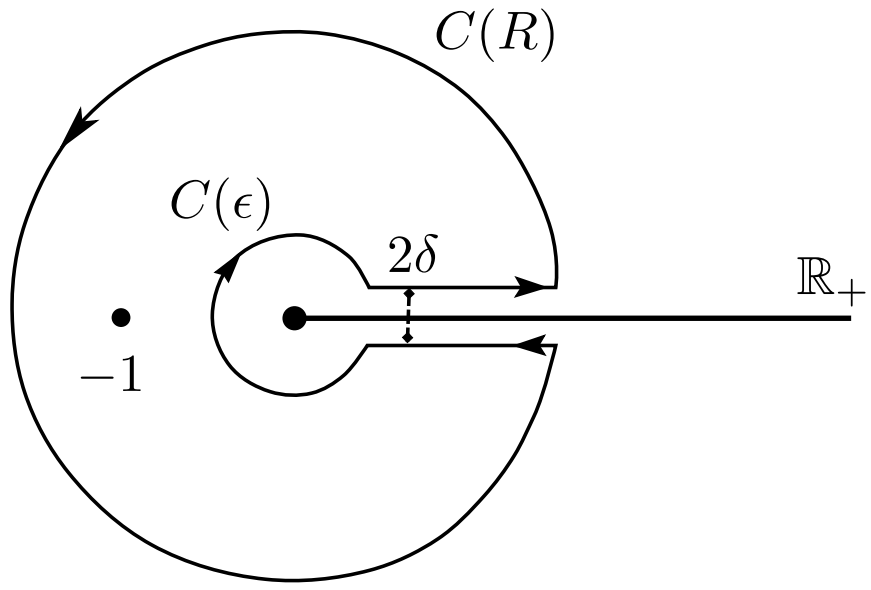
Solution. We follow this post on ‘keyhole contour integration’. Fix the positive constants 0 < \delta < \epsilon < R, where we eventually set \epsilon \to 0^+ and R \to \infty. Consider the following contour

\Gamma = \gamma_1 + C(\epsilon) + \gamma_2 + C(R)

oriented anti-clockwise.

Consider the analytic continuation of v^\alpha given by f(z) = \exp(\alpha \log(z) ) with branch cut 0< \arg(z) < 2\pi, which analytically continues v^\alpha for \mathrm{Im}(z) < 0. By Cauchy’s residue theorem,

\begin{aligned} \left( \int_{\gamma_1} + \int_{C(\epsilon)} + \int_{\gamma_2} + \int_{C(R)}\right) \frac{f(z)}{z(z+1)}\, \mathrm dz &= 2 \pi i \cdot \underset{z=-1}{\mathrm{Res}} \frac{f(z)}{z(z+1)} \\ &= -2\pi i \cdot f(-1) \\ &= -2\pi i \cdot e^{i \alpha \pi}. \end{aligned}

For z \in C(R) and sufficiently large R, |z(z+1)| \geq R(R-1) and |f(z)| \leq R^\alpha, so that by the ML-inequality,

\displaystyle \left| \int_{C(R)} \frac{f(z)}{z(z+1)}\, \mathrm dz \right| \leq 2 \pi \cdot \frac{R^\alpha}{R-1} \to 0

as R \to \infty. Similarly,

\displaystyle \left| \int_{C(\epsilon)} \frac{f(z)}{z(z+1)}\, \mathrm dz \right| \leq 2 \epsilon \cdot \frac{\epsilon^\alpha}{1-\epsilon} \to 0

as \epsilon \to 0^+. With these limits

\displaystyle \int_{\gamma_1} \frac{f(z)}{z(z+1)}\, \mathrm dz  \to I(\alpha).

Using the branch cut 0 < \arg(z) < 2\pi,

\displaystyle \int_{\gamma_2} \frac{f(z)}{z(z+1)}\, \mathrm dz  \to -e^{2\pi i \alpha} \cdot I(\alpha).

Summing all integrals and taking limits,

\displaystyle (1 - e^{2 i \alpha \pi}) \cdot I(\alpha) = -2 \pi i \cdot e^{i\alpha \pi}.

Therefore,

\begin{aligned} I(\alpha) &= -2\pi i \cdot \frac{e^{i\alpha \pi}}{1 - e^{2 i \alpha \pi}} \\ &= 2\pi i \cdot \frac{1}{ e^{ i \alpha \pi} - e^{-i\alpha \pi} } \\ &= 2\pi i \cdot \frac{1}{ 2 i \cdot \sin(\alpha \pi) } \\ &= \frac{\pi}{\sin (\alpha \pi)}. \end{aligned}

Problem 3. Show that for 0 < \mathrm{Re}(z) < 1,

\Gamma(z) \cdot \Gamma(1-z) = \displaystyle \frac{\pi}{\sin(\pi z)}.

(Click for Solution)

Solution. By definition of the gamma function,

\displaystyle \Gamma(z) = \int_0^\infty t^{z-1} e^{-t}\, \mathrm dt.

By Fubini’s theorem,

\begin{aligned} \Gamma(z) \cdot \Gamma(1-z) &= \int_0^\infty t^{z-1} e^{-t}\, \mathrm dt \cdot \int_0^\infty s^{(1-z)-1} e^{-s}\, \mathrm ds \\ &= \int_0^\infty \int_0^\infty t^{z-1} \cdot s^{-z} \cdot e^{-(s+t)}\, \mathrm dt \, \mathrm ds \\ &= \int_0^\infty \int_0^\infty \left( \frac ts \right)^{z-1} \cdot s^{-1} \cdot e^{-(s+t)}\, \mathrm ds \, \mathrm dt.  \end{aligned}

Using the multivariable substitution (u, v) = (s+t, t/s), we have

\displaystyle (s, t) = \left(\frac{u}{1+v}, \frac{uv}{1+v}\right) =: \mathbf F(u, v)

whose Jacobian is given by

\displaystyle\begin{aligned}  |\mathbf J_{\mathbf F}| &=  \left| \begin{matrix} 1/(1+v) & -u/(1+v)^{2} \\ v/(1+v) & u/(1+v)^{2} \end{matrix} \right| \\ &= \frac{1}{(1+v)^3} \left| \begin{matrix} 1 & -u \\ v & u \end{matrix} \right| \\ &= \frac{u+uv}{(1+v)^3} = \frac{u}{(1+v)^2}. \end{aligned}

Therefore, using integration by substitution, Fubini’s theorem, and Problem 2,

\begin{aligned} \Gamma(z) \cdot \Gamma(1-z) &= \int_0^\infty \int_0^\infty \left( \frac ts \right)^{z-1} \cdot s^{-1} \cdot e^{-(s+t)}\, \mathrm ds \, \mathrm dt \\ &= \int_0^\infty \int_0^\infty v^{z-1} \cdot \left( \frac{u}{1+v} \right)^{-1} \cdot e^{-u} \cdot \frac{u}{(1+v)^2} \, \mathrm du \, \mathrm dv \\ &= \int_0^\infty \int_0^\infty \left( \frac ts \right)^{z-1} \cdot s^{-1} \cdot e^{-(s+t)}\, \mathrm ds \, \mathrm dt \\ &= \int_0^\infty \int_0^\infty  e^{-u} \cdot \frac{v^{z-1}}{1+v} \, \mathrm du \, \mathrm dv \\ &= \int_0^\infty \frac{v^{z-1}}{1+v}  \, \mathrm dv \cdot \underbrace{ \int_0^\infty  e^{-u} \, \mathrm du}_1 \\ &= \int_0^\infty \frac{v^{z-1}}{1+v}  \, \mathrm dv \\ &= \frac{\pi}{\sin(\pi z)}. \end{aligned}

Remark 2. Extend this result to \mathbb C \backslash \mathbb Z_{\leq 0} by analytic continuation.

Problem 4. Show that for z \notin \mathbb Z_{\geq 0},

\zeta(z) = 2^z \cdot \pi^{z-1} \cdot \sin(\pi z/2) \cdot  \Gamma(1-z) \cdot \zeta(1-z).

(Click for Solution)

Solution. Previously, we have shown that

\displaystyle \zeta(z) = \pi^{z-1} \cdot \frac{\Gamma((1-z)/2) \cdot \sqrt{\pi}}{ \Gamma(z/2) } \cdot \zeta(1-z).

Therefore, it suffices to prove that

\displaystyle \frac{\Gamma((1-z)/2) \cdot \sqrt{\pi}}{ \Gamma(z/2) } = 2^z \cdot \sin(\pi z/2) \cdot  \Gamma(1-z).

By Problem 3 and algebraic simplication, this equation is equivalent to

\displaystyle \Gamma( 1 - z/2 ) \cdot \Gamma((1-z)/2) = 2^z \cdot \sqrt{\pi} \cdot \Gamma(1-z),

which holds by Problem 1.

Problem 5. Evaluate \zeta(0).

(Click for Solution)

Solution. We cannot set z = 0 since there it is a pole of \zeta(1 - \cdot). But we have previously shown that (s-1) \cdot \zeta(s) \to 1 for any s \to 1. Therefore,

\begin{aligned} \zeta(z) &= -\frac{2^{z}}{2} \cdot \pi^{z} \cdot \frac{\sin(\pi z/2)}{\pi z/2} \cdot  \Gamma(1-z) \cdot -z \cdot \zeta(1-z) \\ &\to - \frac{2^0}{2} \cdot \pi^0 \cdot 1 \cdot \Gamma(1-0) \cdot 1 \\ &= -\frac 12 \cdot \Gamma(1) = -\frac 12 \cdot 1 = -\frac 12. \end{aligned}

Since \zeta is analytic at 0, \zeta(0) = -1/2.

Remark 1. In the sense of analytic continuation,

\displaystyle 1 + 1 + 1 + 1 + \cdots = \sum_{k=0}^\infty \frac 1{0^k} = \zeta(0) = -\frac 12.

—Joel Kindiak, 8 Mar 26, 1650H

,

Published by


Leave a comment