Questions are publicly available. Do comment if you spot any errors.
Question 1. Projectile Motion
(a) Observe that 


(b) Similarly,

(c) At time 


At the maximum height, 

(d) By symmetry, the total time the ball was in the air is 


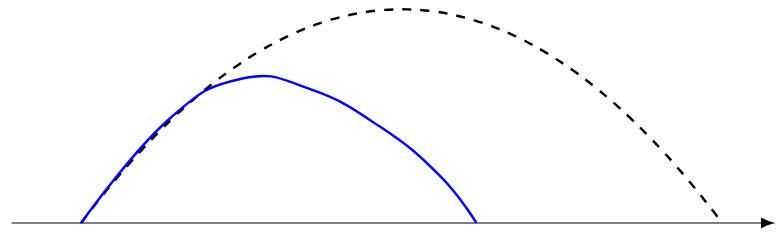
(e) We sketch as follows.
Question 2. Wind Turbines
(a) Since 


(b) Using uniform circular motion,

(c) Since 

Since 


Question 3. Charged Particles
(a) (i) Since 


(a) (ii) Therefore,

(b) (i) Whenever the helium-3 ion passes from one dee to the next, the polarity of the alternating potential difference reverses, so that the electric field in the gap always points in the direction that accelerates the (positive) ion. Thus, work is done on the ion, which is converted to kinetic energy, so that the total energy of the positive ion increases.
(b) (ii) Since 

Question 4. Magnetic Fields
(a) Since 


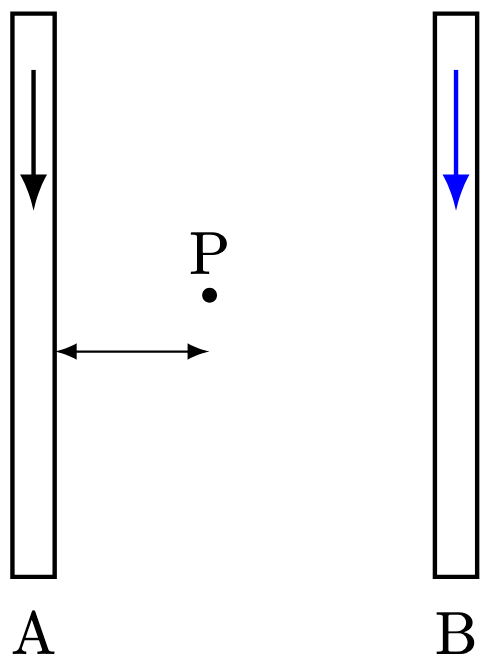
(b) We draw an arrow in the same direction for conductor B:
Question 5. Gravitation
Let 


Question 6. Electric Fields
(a) Since 


(b) Since 


(c) Since 


(d) Since 

Question 7. Momentum
Let 


Since xenon ions are being thrusted out, 


Since 

Question 8. Standard Model
Since 

Question 9. Fluorescent Lights
(a) Since 


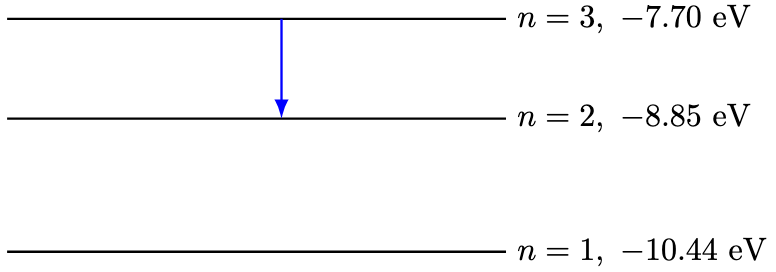
(b) (i) By comparing energy levels, the incident photon has energy

(b) (ii) Using 


(c) We sketch as follows:
Question 10. Electrostatic Precipitators
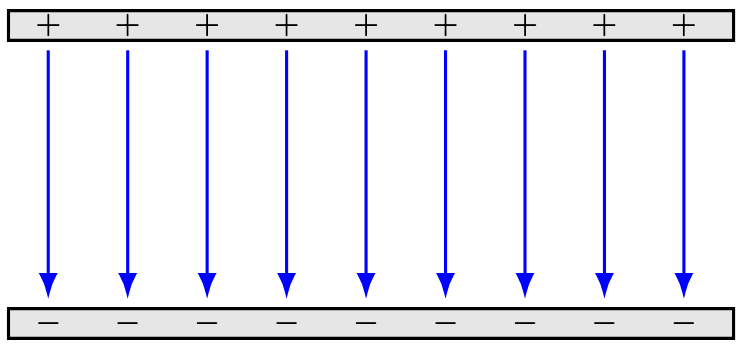
(a) We sketch as follows:
(b) Understanding and inquiry can enable scientists to develop solutions, but its use may also have beneficial or unexpected consequences, which requires monitoring, assessment and evaluation of risk, while also providing opportunities for innovation. This shows that applying scientific knowledge to solve one problem can both drive innovation and introduce new risks that must continually be assessed and managed, rather than providing a risk-free, finished solution.
Nanotechnology has produced genuine benefits, such as in medicine and energy production. The same nanoparticles have also been linked to harmful, unintended health effects, including neurodegenerative disease. Electrostatic precipitators are the innovative solution developed to manage this risk, but they can themselves produce harmful by-products if they are not operating effectively.
Question 11. Experiment Design
(a) Two variables that may affect the fall time include:
- the surface area (or diameter) of the parachute canopy;
- the mass of the toy (or the mass added to the toy).
(b) We hypothesise that a larger canopy area will increase the fall time: a larger canopy presents a greater surface area to the air, increasing the air-resistance (drag) force acting on the parachute, which reduces its (terminal) falling speed.
- Independent variable: canopy area.
Dependent variable: time taken to fall to the ground.
Controlled variables: mass of the toy, drop height, canopy material, string length, release method, and absence of wind (trial indoors). - Equipment/materials: the parachute toy, canopy material (e.g. plastic sheeting) cut into at least five different areas (e.g. by cutting circles of different diameters), scissors, a ruler or measuring tape (to measure canopy diameter and drop height), a stopwatch (or a smartphone/camera for video with frame-by-frame analysis, for greater precision), and a fixed drop point (e.g. a stairwell or balcony of known height, 2.00 m).
- Keeping the toy, strings, string length and drop height identical for every trial, attach the first canopy and release the parachute the same way each time (e.g. dropped rather than thrown, using a clamp/gate release to avoid an initial push), performing all trials indoors to minimise the effect of wind.
- For each canopy area, drop the parachute and use the stopwatch (or video) to measure the time taken to fall to the ground.
- Repeat each trial at least 3–5 times for each canopy area and calculate the mean fall time, to reduce the effect of random error.
- Record canopy area and mean fall time in a table, then plot a graph of fall time versus canopy area to identify the relationship between the two variables.
Question 12. Circular Motion and Gravitation
(a) Since 

(b) Likewise,

(c) Since 

Question 13. Double-Slit Experiment
(a) The laser light illuminating the two slits come from the same source and thus are coherent. Each slit acts as a new source of superposing waves that propagate toward the screen with wavelength 


(b) Since there are 


(c) Since 


(d) Since 


Question 14. Spectroscopy
(a) Each line in an emission spectrum corresponds to light of one specific, discrete frequency, and hence one specific photon energy given by
This light is emitted when an electron falls from a higher energy level to a lower one, releasing a photon whose energy equals the difference between those two levels. Because only a small number of discrete frequencies are observed, rather than a continuum, the energy differences between levels available to the electron must themselves be discrete, fixed values.
(b) In the absorption spectrum, white light of a continuous range of frequencies passes through a (cooler) gas. These missing frequencies appear as dark lines against the otherwise continuous spectrum.
Photons whose energy exactly matches the energy difference between two electron energy levels in the gas atoms are absorbed, exciting electrons from a lower to a higher energy level. The excited electrons then fall back down and re-emit photons of the same frequency, but in random directions rather than only in the original forward direction of the beam. This removes those specific frequencies from the light travelling straight through the gas, while other frequencies pass through unaffected.
Question 15. Photoelectric Effect
(a) Since 


(b) Increasing the intensity of the incident light increases the number of photons striking the target per second, and hence the number of photoelectrons emitted (the current). However, increasing intensity does not change the energy of each individual photon, since photon energy depends only on frequency given by 
Since 

Question 16. Diffractometers
(a) Since 

(b) Regarding the spacing between the ions as 


(c) Using 


Setting 

Question 17. Momentum
Denote the momentum vector of piece C by 

By the diagram,

Question 18. Relativity
(a) Using 

Therefore,

(b) In particular,

Question 19. Atomic Structure
(a) Since 


(b) (i) We sketch as follows:
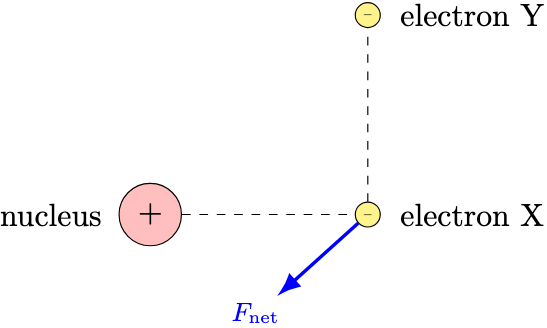
(b) (ii) By Pythagoras’ theorem,

Question 20. Charged Particles
(a) Since 

(b) Since 


(c) Since 

(d) A sigma particle with quark composition dds has charge 

Using 
Question 21. Electromagnetic Induction
(a) We sketch as follows:
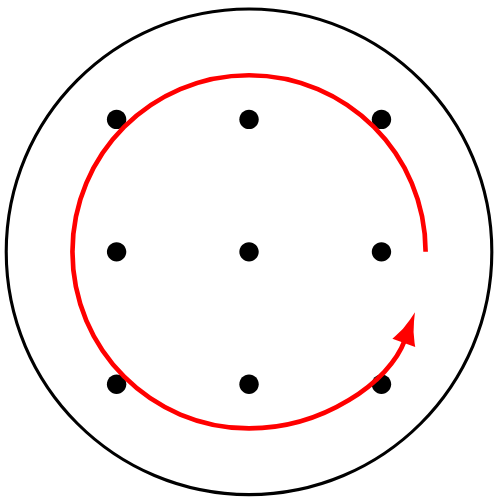
(b) By Lenz’s Law, the direction of an induced current is always such that it opposes the change in magnetic flux that produced it.
Applying the right-hand grip rule, a field out of the page inside the loop requires the current to circulate anticlockwise, which is why the eddy current shown in part (a) flows in that direction.
Here, the magnetic flux through the pan, which points out of the page, is decreasing. The induced current must therefore flow in the direction that creates its own magnetic field out of the page inside the loop, to oppose this decrease.
Remark 1. These suggested answers has been written with the help of Generative AI.
—Joel Kindiak, 5 Sept 26, 2316H


Leave a Reply