Questions are publicly available. Do comment if you spot any errors. Download the solutions here.
Remark 1. In SACE Stage 2 Specialist Maths, the following equivalent notation is used:

Furthermore, we use row vector notation for vectors:
![\displaystyle [x,y,z] \equiv \begin{bmatrix} x \\ y \\ z \end{bmatrix}.](https://s0.wp.com/latex.php?latex=%5Cdisplaystyle+%5Bx%2Cy%2Cz%5D+%5Cequiv+%5Cbegin%7Bbmatrix%7D+x+%5C%5C+y+%5C%5C+z+%5Cend%7Bbmatrix%7D.&bg=ffffff&fg=000&s=0&c=20201002)
Question 1. Lines and Planes
Solution. (a) Substituting the parametric equations of 


Setting 


(b) The direction vector ![[1, -2, -1]](https://s0.wp.com/latex.php?latex=%5B1%2C+-2%2C+-1%5D&bg=ffffff&fg=000&s=0&c=20201002)


Therefore, the required plane is 
Question 2. Related Rates of Change
Solution. (a) 
(b) (i) In the right-angled triangle with vertices 


(b) (ii) By the chain rule,

(c) Differentiating 

By (a) and (b) (ii),

Question 3. Complex Numbers
Solution. (a) (i) Since 

(a) (ii) Similarly, since 

(b) (i) Dividing moduli and subtracting arguments,

(b) (ii) By (b) (i), 
(c) Since 


Question 4. Mathematical Induction
Solution. (a) For the base case 


which is divisible by 


(b) By (a), 

which is divisible by 

Question 5. Systems of Linear Equations
Solution. (a) (i) The augmented matrix is
![\displaystyle \left[ \begin{array}{ccc|c} 1 & 1 & -3 & 4 \\ 1 & -1 & -a & 2 \\ 3 & a & -1 & 8 \end{array} \right].](https://s0.wp.com/latex.php?latex=%5Cdisplaystyle+%5Cleft%5B+%5Cbegin%7Barray%7D%7Bccc%7Cc%7D+1+%26+1+%26+-3+%26+4+%5C%5C+1+%26+-1+%26+-a+%26+2+%5C%5C+3+%26+a+%26+-1+%26+8+%5Cend%7Barray%7D+%5Cright%5D.&bg=ffffff&fg=000&s=0&c=20201002)
(a) (ii) Applying 

![\displaystyle \left[ \begin{array}{ccc|c} 1 & 1 & -3 & 4 \\ 0 & 2 & a - 3 & 2 \\ 0 & 3 - a & -8 & 4 \end{array} \right].](https://s0.wp.com/latex.php?latex=%5Cdisplaystyle+%5Cleft%5B+%5Cbegin%7Barray%7D%7Bccc%7Cc%7D+1+%26+1+%26+-3+%26+4+%5C%5C+0+%26+2+%26+a+-+3+%26+2+%5C%5C+0+%26+3+-+a+%26+-8+%26+4+%5Cend%7Barray%7D+%5Cright%5D.&bg=ffffff&fg=000&s=0&c=20201002)
Applying 
![\displaystyle \begin{aligned} &[\, 0,\ 2(3-a) - 2(3-a),\ -16 - (3-a)(a-3) \ :\ 8 - 2(3-a) \,] \\ = \ &[\, 0,\ 0,\ a^2 - 6a - 7 \ :\ 2a + 2 \,] \\ = \ &[\, 0,\ 0,\ (a-7)(a+1) \ :\ 2(a+1) \,], \end{aligned}](https://s0.wp.com/latex.php?latex=%5Cdisplaystyle+%5Cbegin%7Baligned%7D+%26%5B%5C%2C+0%2C%5C+2%283-a%29+-+2%283-a%29%2C%5C+-16+-+%283-a%29%28a-3%29+%5C+%3A%5C+8+-+2%283-a%29+%5C%2C%5D+%5C%5C+%3D+%5C+%26%5B%5C%2C+0%2C%5C+0%2C%5C+a%5E2+-+6a+-+7+%5C+%3A%5C+2a+%2B+2+%5C%2C%5D+%5C%5C+%3D+%5C+%26%5B%5C%2C+0%2C%5C+0%2C%5C+%28a-7%29%28a%2B1%29+%5C+%3A%5C+2%28a%2B1%29+%5C%2C%5D%2C+%5Cend%7Baligned%7D&bg=ffffff&fg=000&s=0&c=20201002)
as required.
(b) Figure 4 shows three planes, no two of which are parallel, with no common point of intersection. This corresponds to an inconsistent system, which occurs when 


![[1,1,-3]](https://s0.wp.com/latex.php?latex=%5B1%2C1%2C-3%5D&bg=ffffff&fg=000&s=0&c=20201002)
![[1,-1,-7]](https://s0.wp.com/latex.php?latex=%5B1%2C-1%2C-7%5D&bg=ffffff&fg=000&s=0&c=20201002)
![[3,7,-1]](https://s0.wp.com/latex.php?latex=%5B3%2C7%2C-1%5D&bg=ffffff&fg=000&s=0&c=20201002)
(c) For 


Therefore, the three planes intersect at the single point 
(d) (i) 
(d) (ii) For 


Therefore, the line is

or in vector form, ![\mathbf r = [3, 1, 0] + t[1, 2, 1]](https://s0.wp.com/latex.php?latex=%5Cmathbf+r+%3D+%5B3%2C+1%2C+0%5D+%2B+t%5B1%2C+2%2C+1%5D&bg=ffffff&fg=000&s=0&c=20201002)
Question 6. Logistic Differential Equations
Solution. (a) (i) Combining the fractions on the right-hand side,

(a) (ii) Rewriting the differential equation as

and separating variables, by (a) (i),

Therefore,

(b) The slope field shows horizontal segments at 


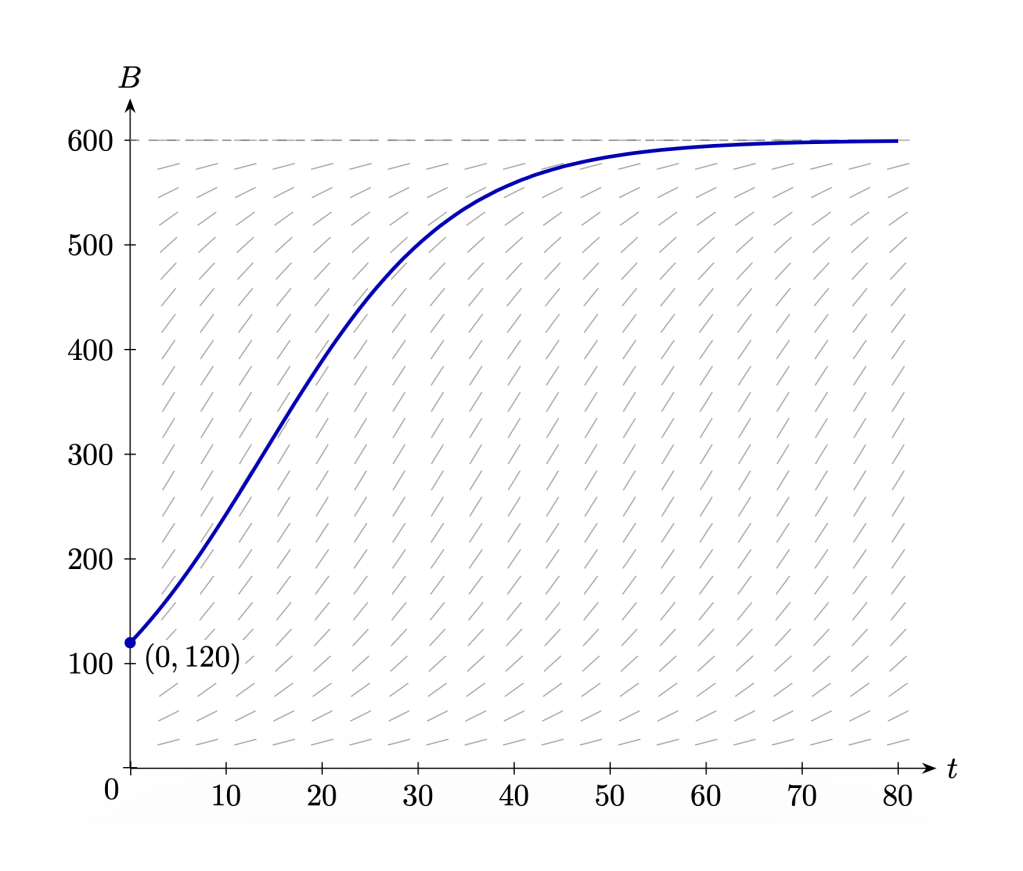
(c) (i) 
(c) (ii) Setting 


(c) (iii) Setting

Therefore, the population exceeds 

Question 7. Integration and Volumes of Revolution
Solution. (a) Integrating by parts with 


(b) (i) For 


(b) (ii) The curve meets the 


i.e. at 

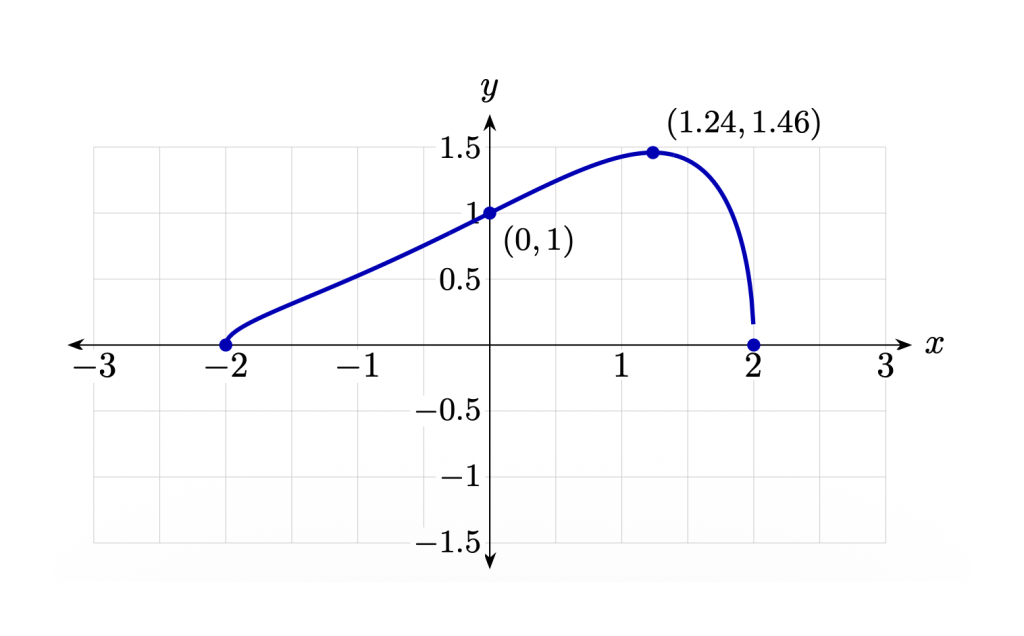
(c) (i) By the volume of revolution formula,

(c) (ii) By (a),

Therefore, by (c) (i),
![\displaystyle \begin{aligned} V &= \frac{\pi}{4} \left[ e^x(2 + 2x - x^2) \right]_{-2}^2 \\ &= \frac{\pi}{4} \left( e^2 (2 + 4 - 4) - e^{-2}(2 - 4 - 4) \right) \\ &= \frac{\pi}{4} (2e^2 + 6e^{-2}) \\ &= \frac{\pi}{2} (e^2 + 3e^{-2}). \end{aligned}](https://s0.wp.com/latex.php?latex=%5Cdisplaystyle+%5Cbegin%7Baligned%7D+V+%26%3D+%5Cfrac%7B%5Cpi%7D%7B4%7D+%5Cleft%5B+e%5Ex%282+%2B+2x+-+x%5E2%29+%5Cright%5D_%7B-2%7D%5E2+%5C%5C+%26%3D+%5Cfrac%7B%5Cpi%7D%7B4%7D+%5Cleft%28+e%5E2+%282+%2B+4+-+4%29+-+e%5E%7B-2%7D%282+-+4+-+4%29+%5Cright%29+%5C%5C+%26%3D+%5Cfrac%7B%5Cpi%7D%7B4%7D+%282e%5E2+%2B+6e%5E%7B-2%7D%29+%5C%5C+%26%3D+%5Cfrac%7B%5Cpi%7D%7B2%7D+%28e%5E2+%2B+3e%5E%7B-2%7D%29.+%5Cend%7Baligned%7D&bg=ffffff&fg=000&s=0&c=20201002)
Question 8. Vector Geometry
Solution. (a) In the right-angled triangle 


(b) ![\overrightarrow{BA} = [4, 0, 2] - [-1, -6, -2] = [5, 6, 4]](https://s0.wp.com/latex.php?latex=%5Coverrightarrow%7BBA%7D+%3D+%5B4%2C+0%2C+2%5D+-+%5B-1%2C+-6%2C+-2%5D+%3D+%5B5%2C+6%2C+4%5D&bg=ffffff&fg=000&s=0&c=20201002)
(c) (i) Computing the cross product,
![\displaystyle \overrightarrow{BA} \times \mathbf l = [5, 6, 4] \times [2, 2, -1] = [-6 - 8, 8 + 5, 10 - 12] = [-14, 13, -2],](https://s0.wp.com/latex.php?latex=%5Cdisplaystyle+%5Coverrightarrow%7BBA%7D+%5Ctimes+%5Cmathbf+l+%3D+%5B5%2C+6%2C+4%5D+%5Ctimes+%5B2%2C+2%2C+-1%5D+%3D+%5B-6+-+8%2C+8+%2B+5%2C+10+-+12%5D+%3D+%5B-14%2C+13%2C+-2%5D%2C&bg=ffffff&fg=000&s=0&c=20201002)
so that 
(c) (ii) Since 

(c) (iii) ![\mathbf r = [-1, -6, -2] + \lambda [2, 2, -1]](https://s0.wp.com/latex.php?latex=%5Cmathbf+r+%3D+%5B-1%2C+-6%2C+-2%5D+%2B+%5Clambda+%5B2%2C+2%2C+-1%5D&bg=ffffff&fg=000&s=0&c=20201002)

(c) (iv) Substituting ![[x, y, z] = [-1 + 2\lambda, -6 + 2\lambda, -2 - \lambda]](https://s0.wp.com/latex.php?latex=%5Bx%2C+y%2C+z%5D+%3D+%5B-1+%2B+2%5Clambda%2C+-6+%2B+2%5Clambda%2C+-2+-+%5Clambda%5D&bg=ffffff&fg=000&s=0&c=20201002)


Setting 

(d) Since 


since
![\displaystyle \overrightarrow{OC} = [4, 0, 2] + 5[-5, -6, -4] = [-21, -30, -18].](https://s0.wp.com/latex.php?latex=%5Cdisplaystyle+%5Coverrightarrow%7BOC%7D+%3D+%5B4%2C+0%2C+2%5D+%2B+5%5B-5%2C+-6%2C+-4%5D+%3D+%5B-21%2C+-30%2C+-18%5D.&bg=ffffff&fg=000&s=0&c=20201002)
Since 

Remark 2. As a check, the distances from 

respectively, as expected from the similar triangles.
Question 9. Complex Roots of Unity
Solution. (a) Let 


so that 


(b) (i) Since 


(b) (ii) 

(c) (i) Expanding,

where the final equality follows from the geometric series (or by expanding and cancelling).
(c) (ii) By (c) (i), the zeros of 


(d) (i) By De Moivre’s theorem, 

which is real.
(d) (ii) Using the double angle identity 

(d) (iii) Writing ![c = \cos\theta \in [-1, 1]](https://s0.wp.com/latex.php?latex=c+%3D+%5Ccos%5Ctheta+%5Cin+%5B-1%2C+1%5D&bg=ffffff&fg=000&s=0&c=20201002)

with equality when ![c = -\frac 14 \in [-1, 1]](https://s0.wp.com/latex.php?latex=c+%3D+-%5Cfrac+14+%5Cin+%5B-1%2C+1%5D&bg=ffffff&fg=000&s=0&c=20201002)


(d) (iv) The minimum occurs when 

We mark these as follows.
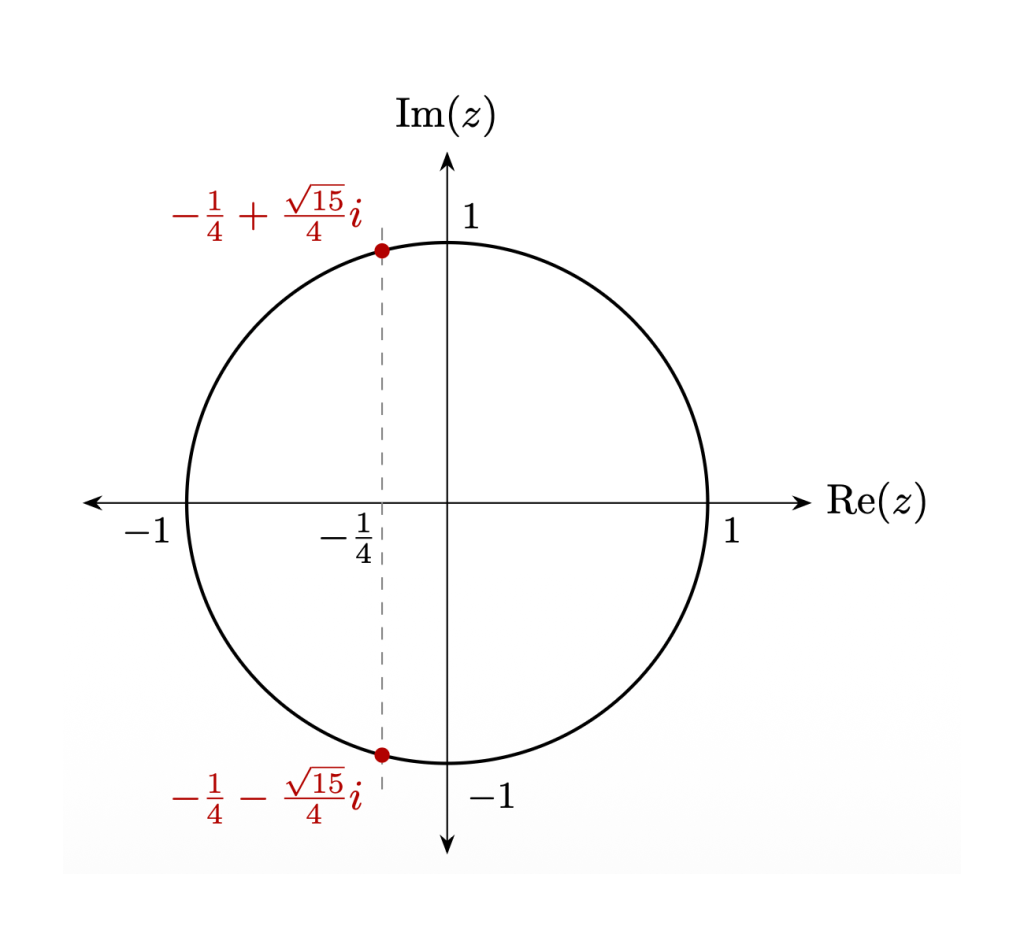
Question 10. Parametric Curves in 3D
Solution. (a) Using the double angle identity 

(b) The curve is a figure of eight through the origin, with 


We sketch as follows.
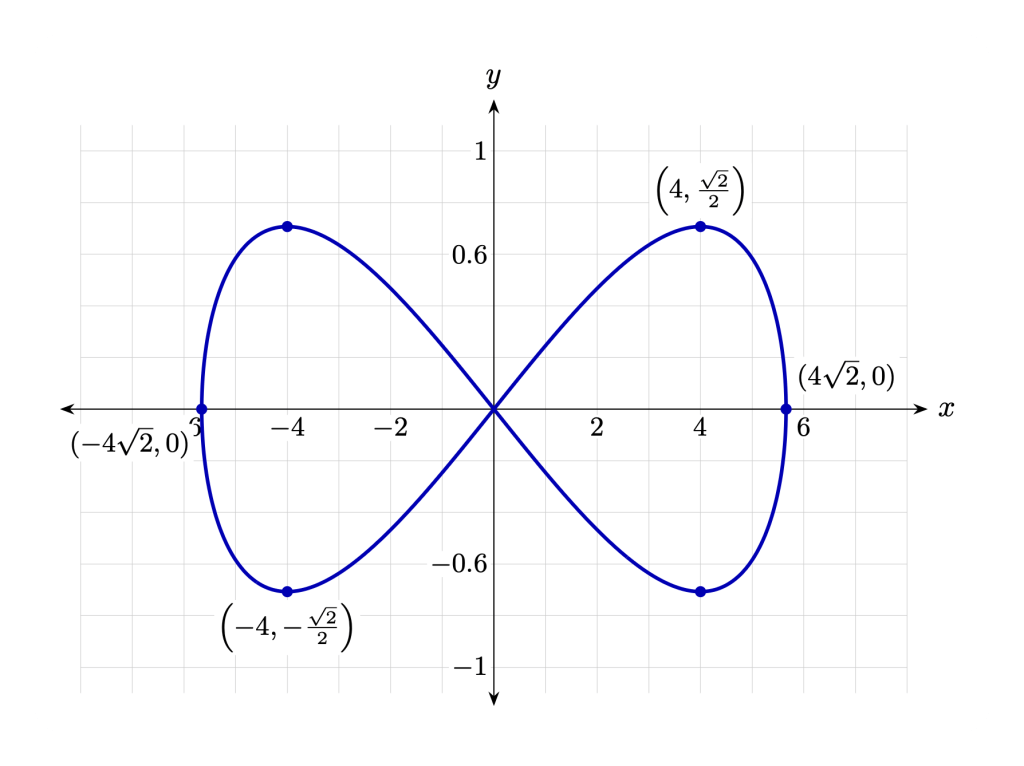
(c) (i) Differentiating each component with respect to 
![\displaystyle \mathbf v = \left[ 4\sqrt 2 \cos t,\ \sqrt 2 \cos 2t,\ 4 \right].](https://s0.wp.com/latex.php?latex=%5Cdisplaystyle+%5Cmathbf+v+%3D+%5Cleft%5B+4%5Csqrt+2+%5Ccos+t%2C%5C+%5Csqrt+2+%5Ccos+2t%2C%5C+4+%5Cright%5D.&bg=ffffff&fg=000&s=0&c=20201002)
(c) (ii) Writing 


Since 

(c) (iii) The distance travelled is the integral of the speed. By (a) and (c) (ii),
![\displaystyle \begin{aligned} \int_{\pi/4}^{3\pi/4} (2\sqrt 2 \cos^2 t + 3\sqrt 2)\, \mathrm dt &= 2\sqrt 2 \left[ \frac t2 + \frac 14 \sin 2t \right]_{\pi/4}^{3\pi/4} + 3\sqrt 2 \cdot \frac{\pi}{2} \\ &= 2\sqrt 2 \left( \left( \frac{3\pi}{8} - \frac 14 \right) - \left( \frac{\pi}{8} + \frac 14 \right) \right) + \frac{3\sqrt 2 \pi}{2} \\ &= 2\sqrt 2 \left( \frac{\pi}{4} - \frac 12 \right) + \frac{3\sqrt 2 \pi}{2} \\ &= \sqrt 2 \left( \frac{\pi}{2} - 1 + \frac{3\pi}{2} \right) \\ &= \sqrt 2 (2\pi - 1). \end{aligned}](https://s0.wp.com/latex.php?latex=%5Cdisplaystyle+%5Cbegin%7Baligned%7D+%5Cint_%7B%5Cpi%2F4%7D%5E%7B3%5Cpi%2F4%7D+%282%5Csqrt+2+%5Ccos%5E2+t+%2B+3%5Csqrt+2%29%5C%2C+%5Cmathrm+dt+%26%3D+2%5Csqrt+2+%5Cleft%5B+%5Cfrac+t2+%2B+%5Cfrac+14+%5Csin+2t+%5Cright%5D_%7B%5Cpi%2F4%7D%5E%7B3%5Cpi%2F4%7D+%2B+3%5Csqrt+2+%5Ccdot+%5Cfrac%7B%5Cpi%7D%7B2%7D+%5C%5C+%26%3D+2%5Csqrt+2+%5Cleft%28+%5Cleft%28+%5Cfrac%7B3%5Cpi%7D%7B8%7D+-+%5Cfrac+14+%5Cright%29+-+%5Cleft%28+%5Cfrac%7B%5Cpi%7D%7B8%7D+%2B+%5Cfrac+14+%5Cright%29+%5Cright%29+%2B+%5Cfrac%7B3%5Csqrt+2+%5Cpi%7D%7B2%7D+%5C%5C+%26%3D+2%5Csqrt+2+%5Cleft%28+%5Cfrac%7B%5Cpi%7D%7B4%7D+-+%5Cfrac+12+%5Cright%29+%2B+%5Cfrac%7B3%5Csqrt+2+%5Cpi%7D%7B2%7D+%5C%5C+%26%3D+%5Csqrt+2+%5Cleft%28+%5Cfrac%7B%5Cpi%7D%7B2%7D+-+1+%2B+%5Cfrac%7B3%5Cpi%7D%7B2%7D+%5Cright%29+%5C%5C+%26%3D+%5Csqrt+2+%282%5Cpi+-+1%29.+%5Cend%7Baligned%7D&bg=ffffff&fg=000&s=0&c=20201002)
Remark 3. The 

Remark 4. The diagrams have been drawn and the solutions have been verified with the help of Generative AI.
—Joel Kindiak, 17 Oct 26, 0022H
 is used for probability; we write
  instead.
 , by the chain rule,
 , by the product rule and the chain rule,

 and
and  minutes after placing it is approximately
  .
.
 from
from  , shaded below.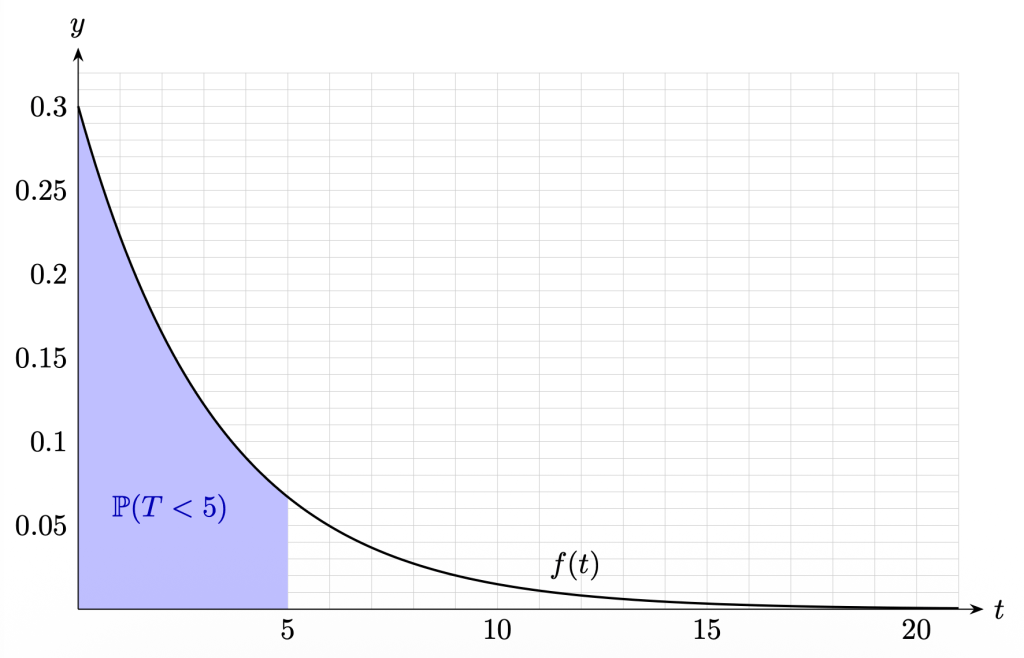

![\displaystyle 0.8 = \mathbb P(T < r) = \int_0^r 0.3e^{-0.3t}\, \mathrm dt = \left[ -e^{-0.3t} \right]_0^r = 1 - e^{-0.3r}.](https://s0.wp.com/latex.php?latex=%5Cdisplaystyle+0.8+%3D+%5Cmathbb+P%28T+%3C+r%29+%3D+%5Cint_0%5Er+0.3e%5E%7B-0.3t%7D%5C%2C+%5Cmathrm+dt+%3D+%5Cleft%5B+-e%5E%7B-0.3t%7D+%5Cright%5D_0%5Er+%3D+1+-+e%5E%7B-0.3r%7D.&bg=ffffff&fg=000&s=0&c=20201002)

 ,
,

 , and
, and  . Therefore, the tangent at
  is
is
 -coordinate of
  . Therefore,
  , so that
  .
. denote the number of gold cards in one randomly selected pack.
![\mathbb E[X] = 10 \cdot 0.035 = 0.35](https://s0.wp.com/latex.php?latex=%5Cmathbb+E%5BX%5D+%3D+10+%5Ccdot+0.035+%3D+0.35&bg=ffffff&fg=000&s=0&c=20201002) .
. .
.
 packs contain
  independent cards. Let
  denote the number of gold cards among them. Then
 , not
, not  .
. cards, so that
 confidence level,
  , so that the confidence interval is
 , but the confidence interval contains values above
  (indeed, most of the interval lies above
  , by the chain rule,
 . Since
  for
for  , we require
 , the
, the  ,
,  and
and  respectively.
 are
are  and
and  .
. , by the chain rule,
 and multiplying by
  ,
,
 . Therefore, for every constant
  , so the graph of
  units in the positive
  units in the positive
  , and decreases after
 . Since
  only at
  and
and  , and
, and  decreases until
  , where the curve is steepest on its decreasing part.
 and
and  , since
  for
for  , where
  is negative with a minimum at
  , has a positive maximum at
  , crosses zero at
  , and then decreases towards the horizontal asymptote
  from above. We sketch as follows.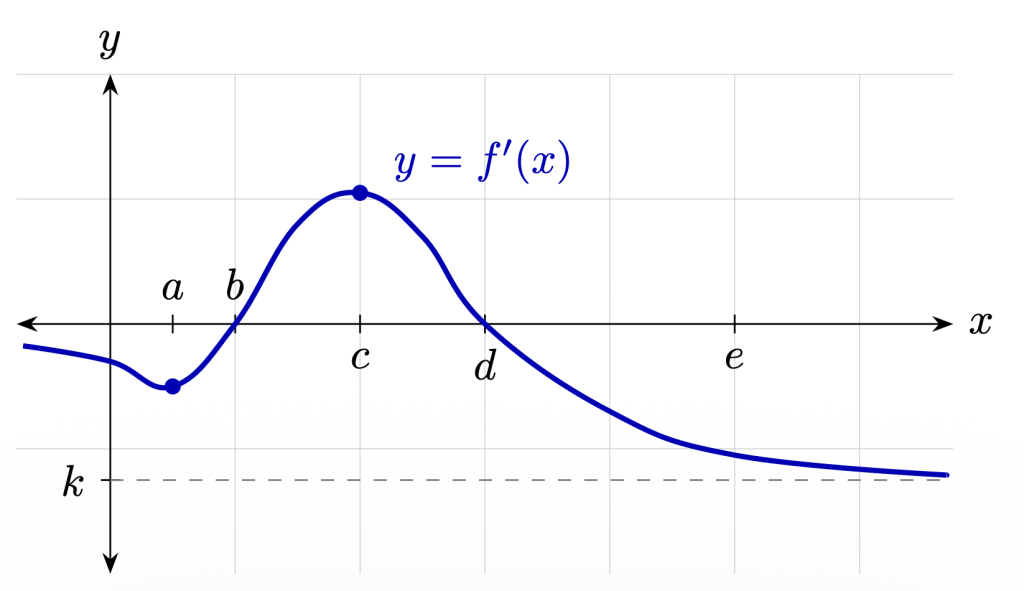
 denote the daily milk production of a randomly selected cow. Then
  .
. ,
,  . Using
 is normally distributed (for any
 ,
,  .
. .
. confidence level,
  , so that the confidence interval is
 litres, since
  . Hence, with
 litres (for instance
  ), since its lower bound
  is less than
  cows will have a mean total daily milk production of more than
  litres.
 , so the robot initially leans
  radians to the right.
 .
. seconds after release, the angle of lean of the robot is increasing (i.e. the robot is rotating towards the right) at a rate of approximately
  radians per second.
 attains its minimum. Using software, this occurs at
  seconds after release (where
  ).
).
 ,
,  if and only if
  . Since
  would force
  , we may divide by
  :
:
 , the exact values are
 exceeds
  .
. ,
,
 .
.


 and
and  , the values of
  within one standard deviation of the mean are
  . By (a), the required probability is
 .
.![[1,3]](https://s0.wp.com/latex.php?latex=%5B1%2C3%5D&bg=ffffff&fg=000&s=0&c=20201002) ,
, ![[3,5]](https://s0.wp.com/latex.php?latex=%5B3%2C5%5D&bg=ffffff&fg=000&s=0&c=20201002) and
and ![[5,7]](https://s0.wp.com/latex.php?latex=%5B5%2C7%5D&bg=ffffff&fg=000&s=0&c=20201002) . We draw the rectangles as follows.
. We draw the rectangles as follows.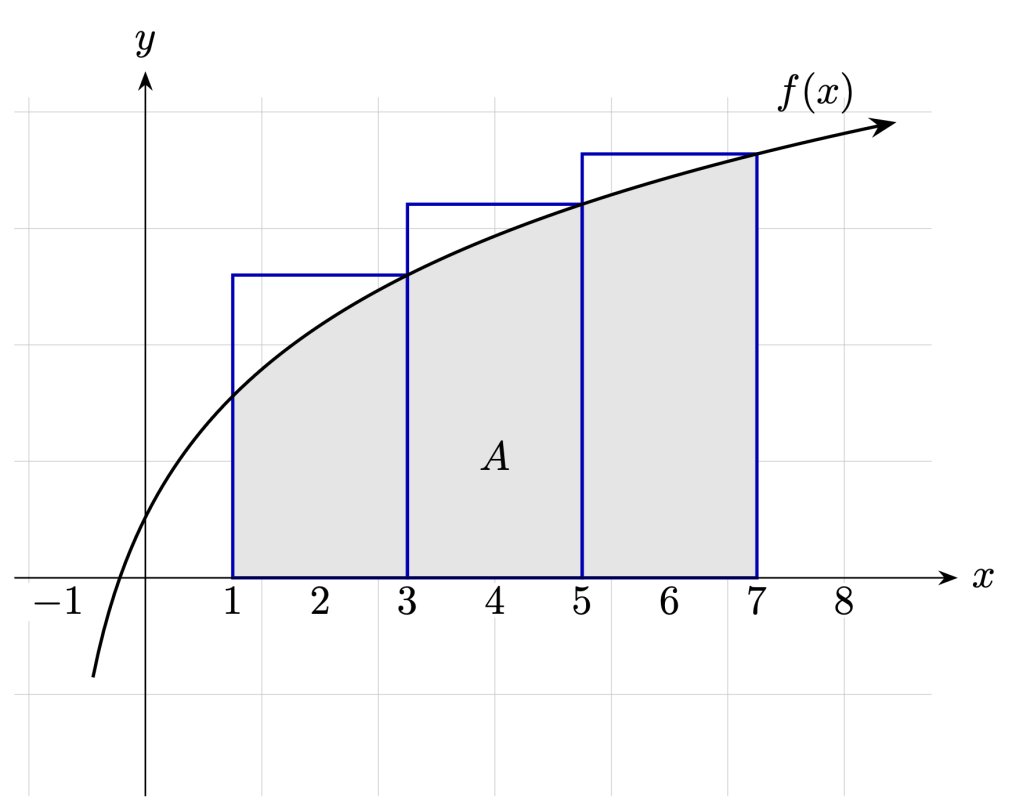


 ,
,  . Therefore,

 is the graph of
  translated
  to
to  is the translation of the region under
  . By (b) (ii),
![\displaystyle \begin{aligned} A = \int_2^8 \ln(2x^2)\, \mathrm dx &= \left[ x \left( \ln(2x^2) - 2 \right) \right]_2^8 \\ &= 8(\ln 128 - 2) - 2(\ln 8 - 2) \\ &= 56 \ln 2 - 16 - 6 \ln 2 + 4 \\ &= 50 \ln 2 - 12. \end{aligned}](https://s0.wp.com/latex.php?latex=%5Cdisplaystyle+%5Cbegin%7Baligned%7D+A+%3D+%5Cint_2%5E8+%5Cln%282x%5E2%29%5C%2C+%5Cmathrm+dx+%26%3D+%5Cleft%5B+x+%5Cleft%28+%5Cln%282x%5E2%29+-+2+%5Cright%29+%5Cright%5D_2%5E8+%5C%5C+%26%3D+8%28%5Cln+128+-+2%29+-+2%28%5Cln+8+-+2%29+%5C%5C+%26%3D+56+%5Cln+2+-+16+-+6+%5Cln+2+%2B+4+%5C%5C+%26%3D+50+%5Cln+2+-+12.+%5Cend%7Baligned%7D&bg=ffffff&fg=000&s=0&c=20201002)
 and
and  .
. , as expected for an upper estimate.
 , we denote its area by
  . Finally, we use row vector notation for vectors:
![[x,y,z] \equiv \begin{bmatrix} x \\ y \\ z \end{bmatrix}.](https://s0.wp.com/latex.php?latex=%5Bx%2Cy%2Cz%5D+%5Cequiv+%5Cbegin%7Bbmatrix%7D+x+%5C%5C+y+%5C%5C+z+%5Cend%7Bbmatrix%7D.&bg=ffffff&fg=000&s=0&c=20201002)
 is also a zero by the conjugate root theorem. Therefore, a real quadratic factor is
 :
:
 :
:
 and
and  .
.
 , where we compared constant terms. Comparing the coefficients of
  ,
,  so that
  . Therefore,
![[1,2,-3]](https://s0.wp.com/latex.php?latex=%5B1%2C2%2C-3%5D&bg=ffffff&fg=000&s=0&c=20201002) and
and ![[1,1,2]](https://s0.wp.com/latex.php?latex=%5B1%2C1%2C2%5D&bg=ffffff&fg=000&s=0&c=20201002) of
of  ,
,![\left[ \begin{array}{ccc|c} 1 & 2 & -3 & 9 \\ 1 & 1 & 2 & 5 \end{array} \right] \to \left[ \begin{array}{ccc|c} 1 & 2 & -3 & 9 \\ 0 & -1 & 5 & -4 \end{array} \right].](https://s0.wp.com/latex.php?latex=%5Cleft%5B+%5Cbegin%7Barray%7D%7Bccc%7Cc%7D+1+%26+2+%26+-3+%26+9+%5C%5C+1+%26+1+%26+2+%26+5+%5Cend%7Barray%7D+%5Cright%5D+%5Cto+%5Cleft%5B+%5Cbegin%7Barray%7D%7Bccc%7Cc%7D+1+%26+2+%26+-3+%26+9+%5C%5C+0+%26+-1+%26+5+%26+-4+%5Cend%7Barray%7D+%5Cright%5D.&bg=ffffff&fg=000&s=0&c=20201002)
 , so that
  . The first row then yields
 with parametric equations
 , we obtain
  ,
,  and
and  . Hence,
  lies on
 ![[-7, 5, 1]](https://s0.wp.com/latex.php?latex=%5B-7%2C+5%2C+1%5D&bg=ffffff&fg=000&s=0&c=20201002) of
of ![\overrightarrow{AQ} = [-10,12,0] - [-13,14,2] = [3, -2, -2].](https://s0.wp.com/latex.php?latex=%5Coverrightarrow%7BAQ%7D+%3D+%5B-10%2C12%2C0%5D+-+%5B-13%2C14%2C2%5D+%3D+%5B3%2C+-2%2C+-2%5D.&bg=ffffff&fg=000&s=0&c=20201002)
![\begin{aligned} [-7, 5, 1] \times [3, -2, -2] &= [5 \cdot (-2) - 1 \cdot (-2),\ 1 \cdot 3 - (-7) \cdot (-2),\ -7 \cdot (-2) - 5 \cdot 3] \\ &= [-8, -11, -1]. \end{aligned}](https://s0.wp.com/latex.php?latex=%5Cbegin%7Baligned%7D+%5B-7%2C+5%2C+1%5D+%5Ctimes+%5B3%2C+-2%2C+-2%5D+%26%3D+%5B5+%5Ccdot+%28-2%29+-+1+%5Ccdot+%28-2%29%2C%5C+1+%5Ccdot+3+-+%28-7%29+%5Ccdot+%28-2%29%2C%5C+-7+%5Ccdot+%28-2%29+-+5+%5Ccdot+3%5D+%5C%5C+%26%3D+%5B-8%2C+-11%2C+-1%5D.+%5Cend%7Baligned%7D&bg=ffffff&fg=000&s=0&c=20201002)
![[8, 11, 1]](https://s0.wp.com/latex.php?latex=%5B8%2C+11%2C+1%5D&bg=ffffff&fg=000&s=0&c=20201002) and the point
and the point 
 satisfies
 . Using
  ,
,
 , as required. Fix

 and
and  ,
,  and
and  . By (b),

 is the midpoint of
  ,
,  .
. .
. , their dot product is zero:
 .
. . By the cosine rule in triangle
  ,
,
 by definition.
 . Substituting into (c),
 : whenever two medians of a triangle are perpendicular, the squares of the two sides they bisect sum to five times the square of the third side.
 and increases slowly, e.g. through
  . We sketch it in blue below, together with
  in red for (b) (iii).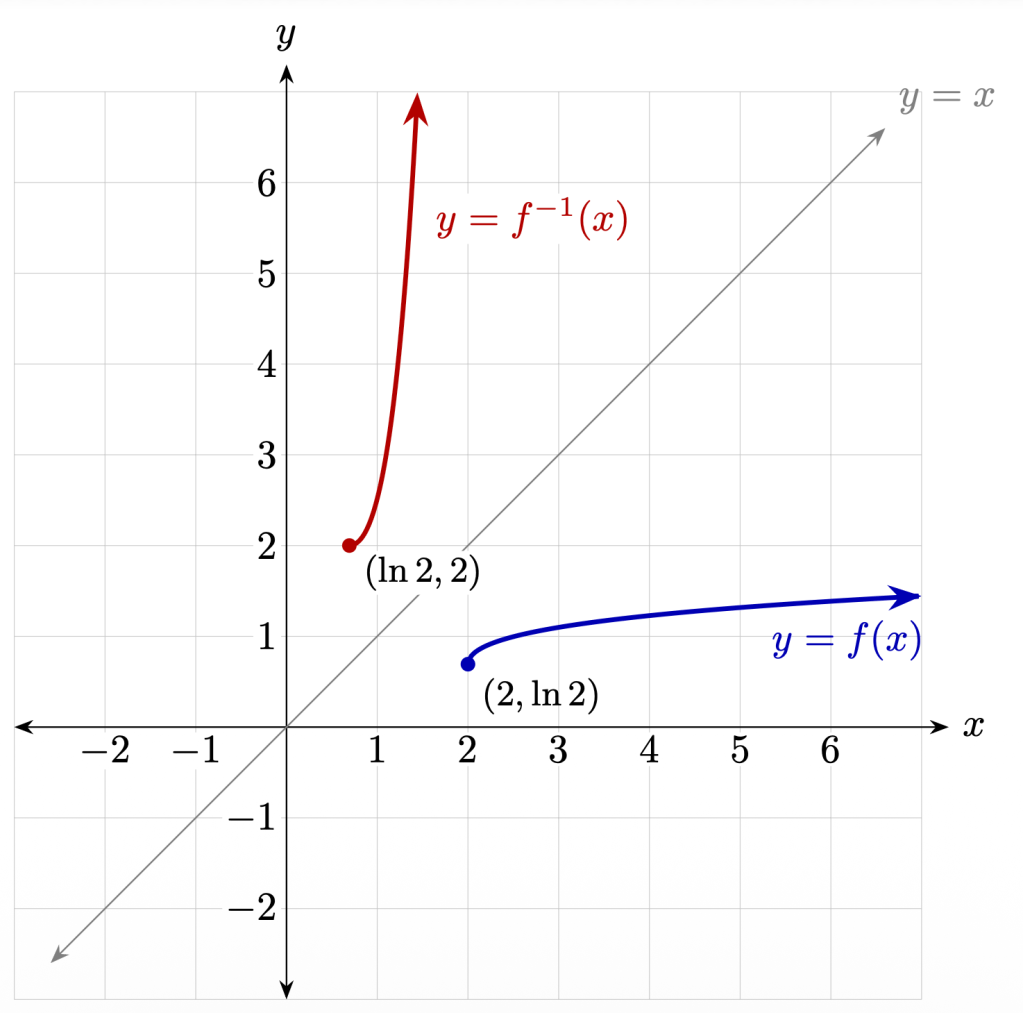
 . Then
 . Swapping
 is the range of
  and
and  as
as  , the domain of
  .
. . It starts at
  and increases steeply; see the red curve in the figure in (a).

 with
with  . By De Moivre’s theorem,
 and
and  . Matching the positions in Figure 4,
 is the conjugate of
 .
. has two sides of length
  with included angle
  . Hence,
 .
. lie on a circle of radius
  , spaced
  apart. As in (b), the hexagon has area
 works (and so does
  ).
).

![\begin{aligned} \int_0^{\pi/3} \sin x \ln(\cos x)\, \mathrm dx &= \left[ -\cos x \ln(\cos x) + \cos x \right]_0^{\pi/3} \\ &= \left( -\tfrac 12 \ln \tfrac 12 + \tfrac 12 \right) - (-1 \cdot \ln 1 + 1) \\ &= \tfrac 12 \ln 2 + \tfrac 12 - 1 \\ &= \tfrac 12 \ln 2 - \tfrac 12. \end{aligned}](https://s0.wp.com/latex.php?latex=%5Cbegin%7Baligned%7D+%5Cint_0%5E%7B%5Cpi%2F3%7D+%5Csin+x+%5Cln%28%5Ccos+x%29%5C%2C+%5Cmathrm+dx+%26%3D+%5Cleft%5B+-%5Ccos+x+%5Cln%28%5Ccos+x%29+%2B+%5Ccos+x+%5Cright%5D_0%5E%7B%5Cpi%2F3%7D+%5C%5C+%26%3D+%5Cleft%28+-%5Ctfrac+12+%5Cln+%5Ctfrac+12+%2B+%5Ctfrac+12+%5Cright%29+-+%28-1+%5Ccdot+%5Cln+1+%2B+1%29+%5C%5C+%26%3D+%5Ctfrac+12+%5Cln+2+%2B+%5Ctfrac+12+-+1+%5C%5C+%26%3D+%5Ctfrac+12+%5Cln+2+-+%5Ctfrac+12.+%5Cend%7Baligned%7D&bg=ffffff&fg=000&s=0&c=20201002)
 ,
,  . For
. For  , the graph of
  is the reflection of the right half of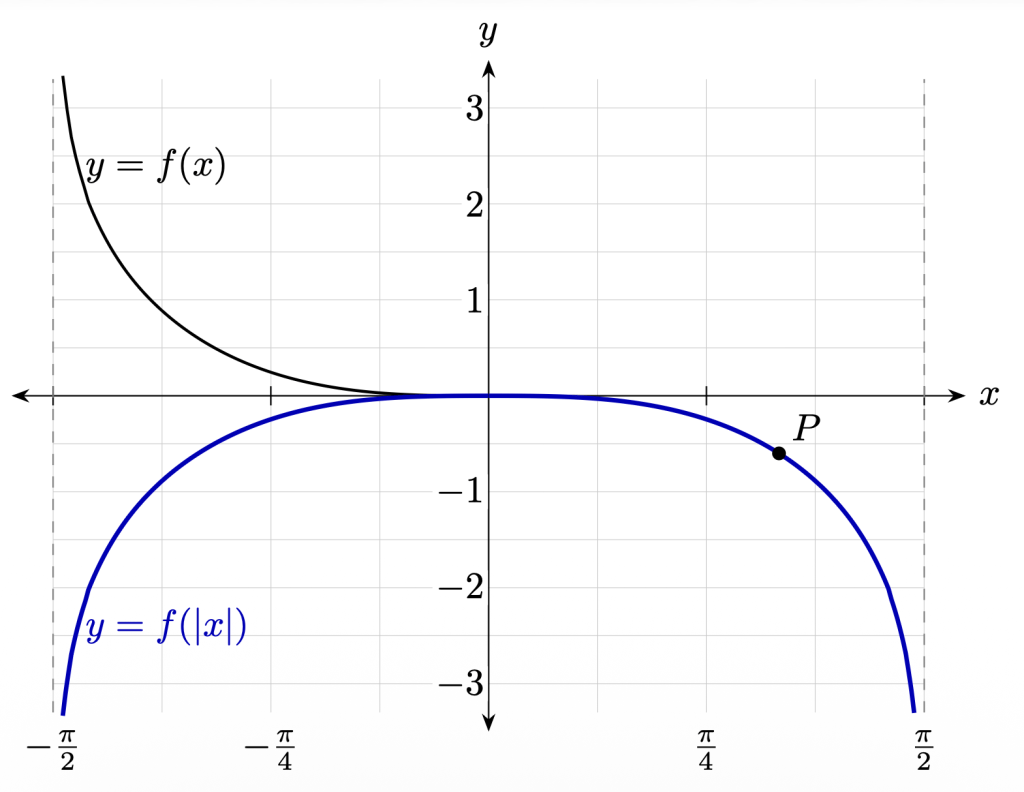

 , where

 together with
  .
. , rises to its maximum
  at
at  , and returns to
  at
at  . We sketch as follows.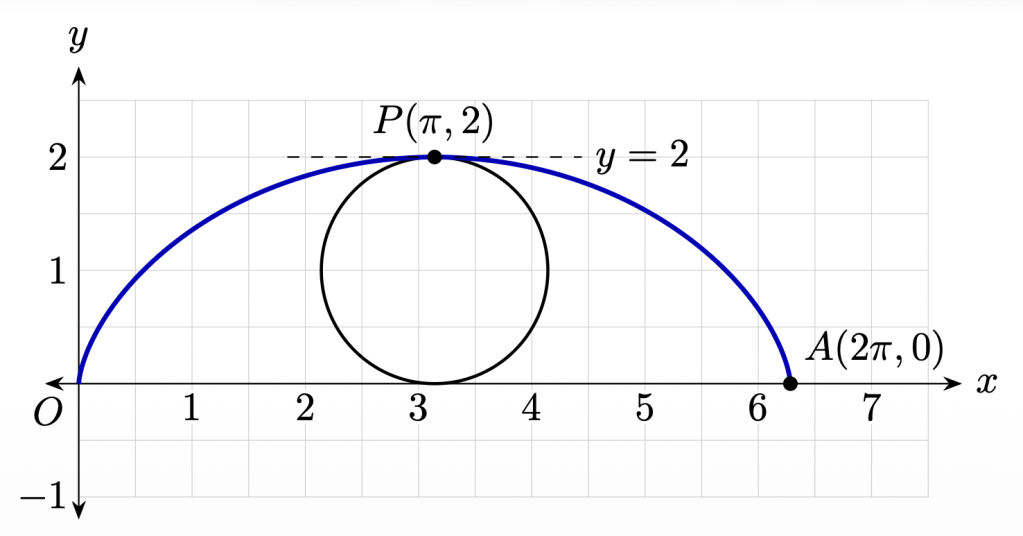
 implicitly with respect to

 lies on the circle since
  , and on the parametric curve with
  at
at 
 at
at  , the arc
  has the same length as the arc
  , and the length of each arc is greater than the length of the corresponding chord. By the triangle inequality in triangle
  ,
,
 . Hence, the length of the parametric curve is greater than the circumference of the circle.
 and
and  ,
,
 . For
. For  ,
,  , so that the length of the curve is
![\displaystyle \int_0^{2\pi} 2 \sin \left( \frac t2 \right) \mathrm dt = \left[ -4 \cos \frac t2 \right]_0^{2\pi} = -4(-1) + 4 = 8\ \text{units}.](https://s0.wp.com/latex.php?latex=%5Cdisplaystyle+%5Cint_0%5E%7B2%5Cpi%7D+2+%5Csin+%5Cleft%28+%5Cfrac+t2+%5Cright%29+%5Cmathrm+dt+%3D+%5Cleft%5B+-4+%5Ccos+%5Cfrac+t2+%5Cright%5D_0%5E%7B2%5Cpi%7D+%3D+-4%28-1%29+%2B+4+%3D+8%5C+%5Ctext%7Bunits%7D.&bg=ffffff&fg=000&s=0&c=20201002)
 . In fact, the bound in (d) is
  , since
  .
.
 .
. ,
,
 ,
,  , so that
 , decreases, and approaches
  from above. We sketch as follows.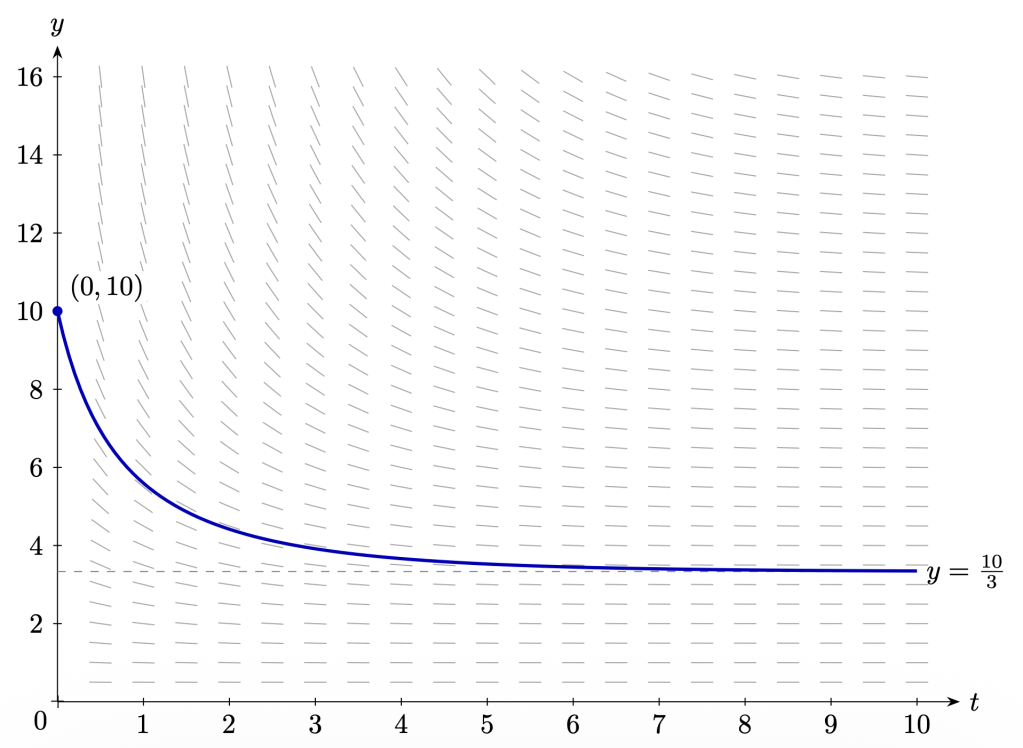
 with respect to
 (as
(as  ), by (c),
 . By (a) (ii),

 , so that
  .
. satisfies
  . Since
  ,
,  and half the argument of
  centred at
  is the closed half-plane on and to the right of the line
  , shaded in red below.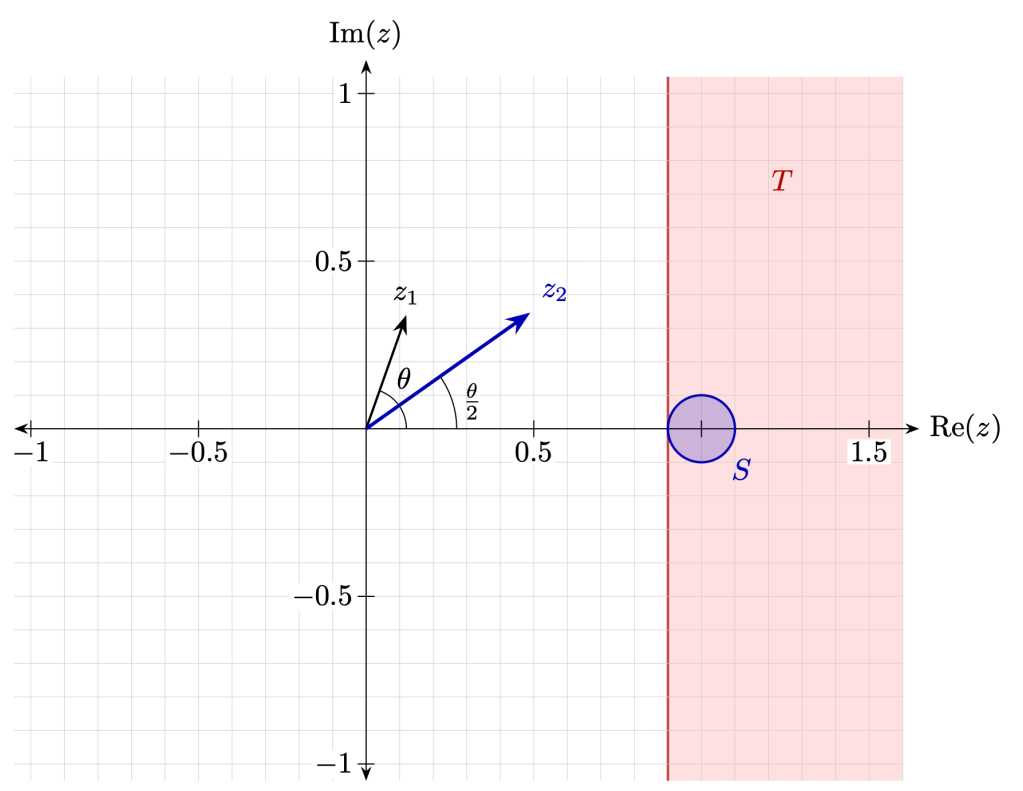
 ,
,
 . Therefore, the smallest such integer is
  .
. , which is in the first quadrant since
  .
. ,
,  . In cartesian form,
 ,
,  is in
is in  with
with  .)
.)
 : it is close enough to the real axis to satisfy
  , but its imaginary part is too large for it to lie within
  , the required probability is

 , we have
  . Using
 ,
,  and
and  .
.![\displaystyle \mathbb E[\bar X_4] = \mu = 54, \quad \sigma_{\bar X_4} = \frac{\sigma}{\sqrt 4} = \frac 62 = 3.](https://s0.wp.com/latex.php?latex=%5Cdisplaystyle+%5Cmathbb+E%5B%5Cbar+X_4%5D+%3D+%5Cmu+%3D+54%2C+%5Cquad+%5Csigma_%7B%5Cbar+X_4%7D+%3D+%5Cfrac%7B%5Csigma%7D%7B%5Csqrt+4%7D+%3D+%5Cfrac+62+%3D+3.&bg=ffffff&fg=000&s=0&c=20201002)
 has the same centre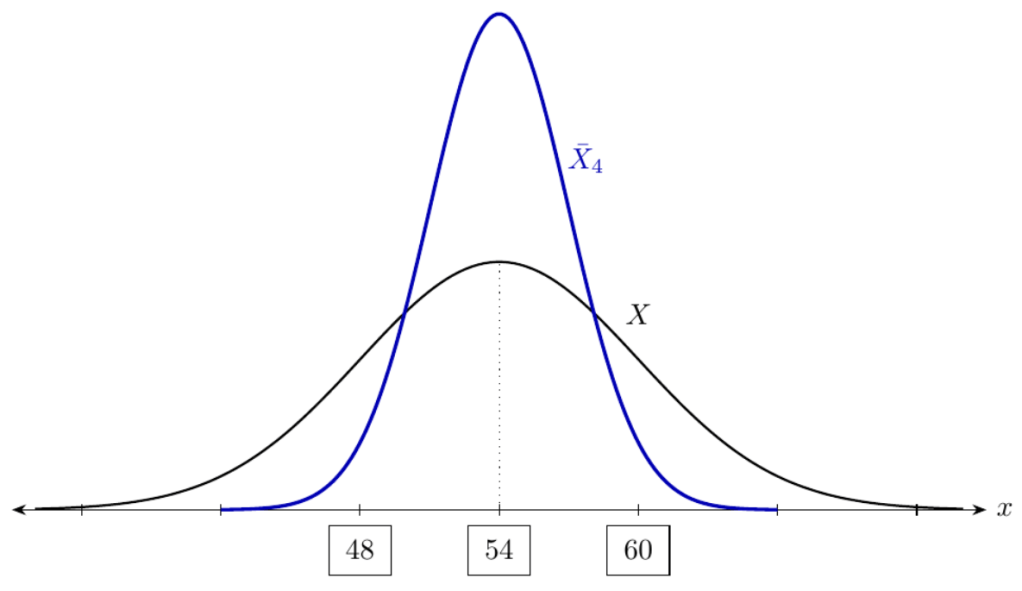
 ,
,

 , we have
  so that
  , hence
  , as required.
 ,
,  and
and  . We sketch as follows.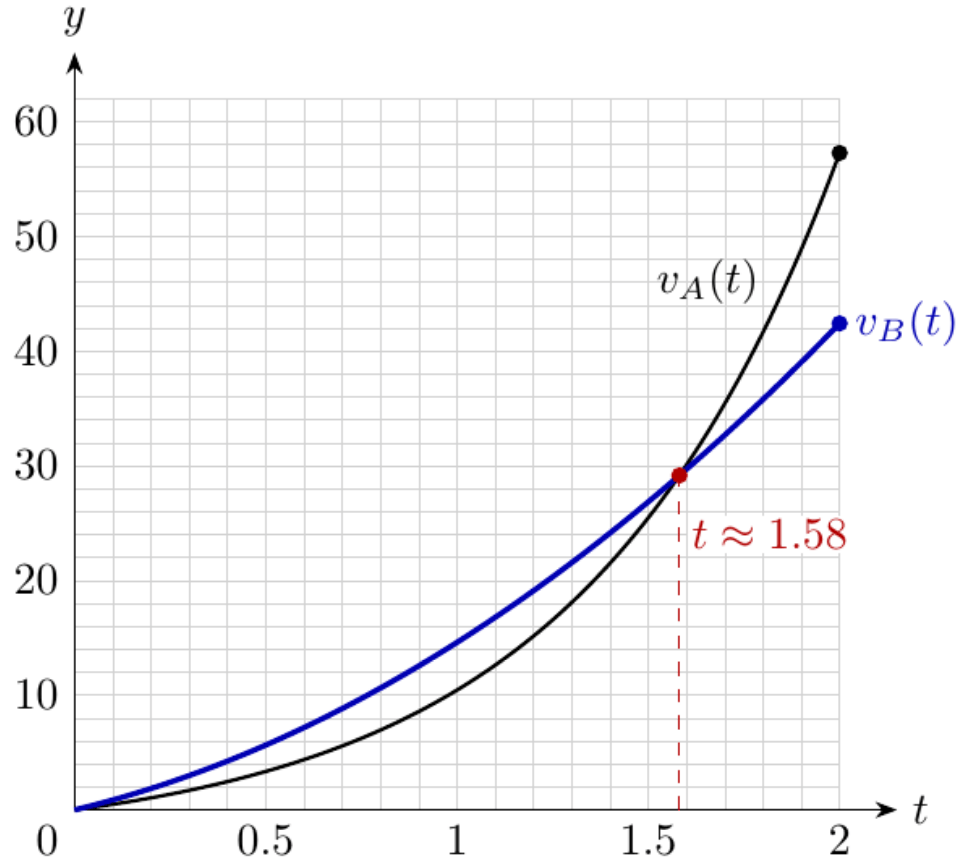
 using software yields
  . By (c), the velocity of Car A was greater than that of Car B for
  .
. with
with  ,
,![\displaystyle s_B(2) = \int_0^2 (6.6t^2 + 8t)\, \mathrm dt = \left[ 2.2t^3 + 4t^2 \right]_0^2 = 17.6 + 16 = 33.6\ \text{m}.](https://s0.wp.com/latex.php?latex=%5Cdisplaystyle+s_B%282%29+%3D+%5Cint_0%5E2+%286.6t%5E2+%2B+8t%29%5C%2C+%5Cmathrm+dt+%3D+%5Cleft%5B+2.2t%5E3+%2B+4t%5E2+%5Cright%5D_0%5E2+%3D+17.6+%2B+16+%3D+33.6%5C+%5Ctext%7Bm%7D.&bg=ffffff&fg=000&s=0&c=20201002)
 , the models suggest that Car B travelled the furthest.
 . This is why Car B is narrowly ahead.
 .
. .
. , so that
  and
and  . Since
 . Therefore,
  is obtained from
  by a dilation of factor
  parallel to the
  . Using a
 does not lie in the confidence interval, since
  .
. ,
,  and
and  do not contain
  .
. of the confidence intervals miss the population proportion, which is close to the
  that we expect from
  .
.

 denote the number of
 . Therefore, the minimum number is
  . As a check,
  while
while  .
. and small

 is
is  .
.![\displaystyle 1 = \int_{400}^{440} \frac kx\, \mathrm dx = k \left[ \ln x \right]_{400}^{440} = k \ln \left( \frac{440}{400} \right) = k \ln 1.1 \quad \Rightarrow \quad k = \frac{1}{\ln 1.1}.](https://s0.wp.com/latex.php?latex=%5Cdisplaystyle+1+%3D+%5Cint_%7B400%7D%5E%7B440%7D+%5Cfrac+kx%5C%2C+%5Cmathrm+dx+%3D+k+%5Cleft%5B+%5Cln+x+%5Cright%5D_%7B400%7D%5E%7B440%7D+%3D+k+%5Cln+%5Cleft%28+%5Cfrac%7B440%7D%7B400%7D+%5Cright%29+%3D+k+%5Cln+1.1+%5Cquad+%5CRightarrow+%5Cquad+k+%3D+%5Cfrac%7B1%7D%7B%5Cln+1.1%7D.&bg=ffffff&fg=000&s=0&c=20201002)

 and
and  grams of sand (i.e. at most
  grams of excess sand) is approximately
  .
.
 confidence level,
  , so that the confidence interval is
 grams, which lies inside the confidence interval. Hence, with
  , we have
  . Hence,
  and
and  , so that the tangent at
 ,
,  . The
. The  .
. . (This also agrees with (b), where
  .)
.) , by the chain rule,
 ,
,  , so that

 ,
,
 , which proves the conjecture.
 vehicles per hour.
 passes through
  , and its maximum occurs at
  hours after midnight.
 vehicles entered during the
  -hour period.
 , which is maximised when
  with
with  dropping below
  , i.e. at
  . Indeed,
  . Therefore, the maximum occurred
  hours after midnight.
 tonnes, and the proportion of non-EVs is
  .
.
 vehicles in Park-o-Rama at any point during the day. Let
  vehicles. By the central limit theorem,

 tonnes is even smaller. Therefore, the engineers would not be concerned.
 yields
  , so that
 yields
  , so that
 and
and  respectively.
 (since
  ) and
) and  . Since this equation has exactly one solution, this is the only stationary point.
 . By (b) (i),
  , so that

 . Hence, the
  . Since
  , i.e.
  .
. and
and  and
and  from (a).
 :
:
 ,
,  , so that for
  , the
, the  .
.
 and dividing by
 or
or  , so that
  .
. . By (b) (ii),
  . Hence,
  , so that the graphs of
  intersect at
  .
. (e.g.
(e.g.  ), while on region
  (e.g.
(e.g.  ). Therefore,
![\begin{aligned} A - B &= \int_{\pi/2}^{c} (f'(x) - f''(x))\, \mathrm dx - \int_c^{2\pi} (f''(x) - f'(x))\, \mathrm dx \\ &= \int_{\pi/2}^{2\pi} (f'(x) - f''(x))\, \mathrm dx \\ &= \left[ f(x) - f'(x) \right]_{\pi/2}^{2\pi} \\ &= (e^{-1} - 0) - (1 - 1) \\ &= \frac 1e. \end{aligned}](https://s0.wp.com/latex.php?latex=%5Cbegin%7Baligned%7D+A+-+B+%26%3D+%5Cint_%7B%5Cpi%2F2%7D%5E%7Bc%7D+%28f%27%28x%29+-+f%27%27%28x%29%29%5C%2C+%5Cmathrm+dx+-+%5Cint_c%5E%7B2%5Cpi%7D+%28f%27%27%28x%29+-+f%27%28x%29%29%5C%2C+%5Cmathrm+dx+%5C%5C+%26%3D+%5Cint_%7B%5Cpi%2F2%7D%5E%7B2%5Cpi%7D+%28f%27%28x%29+-+f%27%27%28x%29%29%5C%2C+%5Cmathrm+dx+%5C%5C+%26%3D+%5Cleft%5B+f%28x%29+-+f%27%28x%29+%5Cright%5D_%7B%5Cpi%2F2%7D%5E%7B2%5Cpi%7D+%5C%5C+%26%3D+%28e%5E%7B-1%7D+-+0%29+-+%281+-+1%29+%5C%5C+%26%3D+%5Cfrac+1e.+%5Cend%7Baligned%7D&bg=ffffff&fg=000&s=0&c=20201002)
 units
units .
. : it cancels when the two integrals are combined. Furthermore, the two graphs in Figure 9 touch at
  and, by (c),
 ![[x,y,z] \equiv \begin{bmatrix} x \\ y \\ z \end{bmatrix},](https://s0.wp.com/latex.php?latex=%5Bx%2Cy%2Cz%5D+%5Cequiv+%5Cbegin%7Bbmatrix%7D+x+%5C%5C+y+%5C%5C+z+%5Cend%7Bbmatrix%7D%2C&bg=ffffff&fg=000&s=0&c=20201002)
 .
. ,
,
 , we have
  .
. ,
,

 . By the question,
  . By (b),

 is given by
![\begin{aligned} V &= \pi \int_{-1}^0 (xe^x)^2\, \mathrm dx \\ &= \pi \int_{-1}^0 x^2 e^{2x}\, \mathrm dx \\ &= \pi \left[ \textstyle{\frac 12} x^2e^{2x} - \textstyle{\frac 12}xe^{2x} + \textstyle{\frac 14}e^{2x} \right]_{-1}^0 \\ &= \textstyle{\frac 14} \pi ( 1-e^{-2} )\, \text{units}^3. \end{aligned}](https://s0.wp.com/latex.php?latex=%5Cbegin%7Baligned%7D+V+%26%3D+%5Cpi+%5Cint_%7B-1%7D%5E0+%28xe%5Ex%29%5E2%5C%2C+%5Cmathrm+dx+%5C%5C+%26%3D+%5Cpi+%5Cint_%7B-1%7D%5E0+x%5E2+e%5E%7B2x%7D%5C%2C+%5Cmathrm+dx+%5C%5C+%26%3D+%5Cpi+%5Cleft%5B+%5Ctextstyle%7B%5Cfrac+12%7D+x%5E2e%5E%7B2x%7D+-+%5Ctextstyle%7B%5Cfrac+12%7Dxe%5E%7B2x%7D+%2B+%5Ctextstyle%7B%5Cfrac+14%7De%5E%7B2x%7D+%5Cright%5D_%7B-1%7D%5E0+%5C%5C+%26%3D+%5Ctextstyle%7B%5Cfrac+14%7D+%5Cpi+%28+1-e%5E%7B-2%7D+%29%5C%2C+%5Ctext%7Bunits%7D%5E3.+%5Cend%7Baligned%7D&bg=ffffff&fg=000&s=0&c=20201002)


 , where
 . Comparing arguments,
![\displaystyle \theta = \frac{2k+1}{5}\pi \in (-\pi, \pi].](https://s0.wp.com/latex.php?latex=%5Cdisplaystyle+%5Ctheta+%3D+%5Cfrac%7B2k%2B1%7D%7B5%7D%5Cpi+%5Cin+%28-%5Cpi%2C+%5Cpi%5D.&bg=ffffff&fg=000&s=0&c=20201002)

 . Therefore, we obtain the solutions
 respectively.
 , we obtain the solutions


 .
.


![\begin{aligned} \mathbf a \times \mathbf b &= [1,2,4] \times [3,1,-5] \\ &= [-10 - 4, -5-12, 1-6] \\ &= [-14, -17, -5] \\ &= -[14,17,5]. \end{aligned}](https://s0.wp.com/latex.php?latex=%5Cbegin%7Baligned%7D+%5Cmathbf+a+%5Ctimes+%5Cmathbf+b+%26%3D+%5B1%2C2%2C4%5D+%5Ctimes+%5B3%2C1%2C-5%5D+%5C%5C+%26%3D+%5B-10+-+4%2C+-5-12%2C+1-6%5D+%5C%5C+%26%3D+%5B-14%2C+-17%2C+-5%5D+%5C%5C+%26%3D+-%5B14%2C17%2C5%5D.+%5Cend%7Baligned%7D&bg=ffffff&fg=000&s=0&c=20201002)


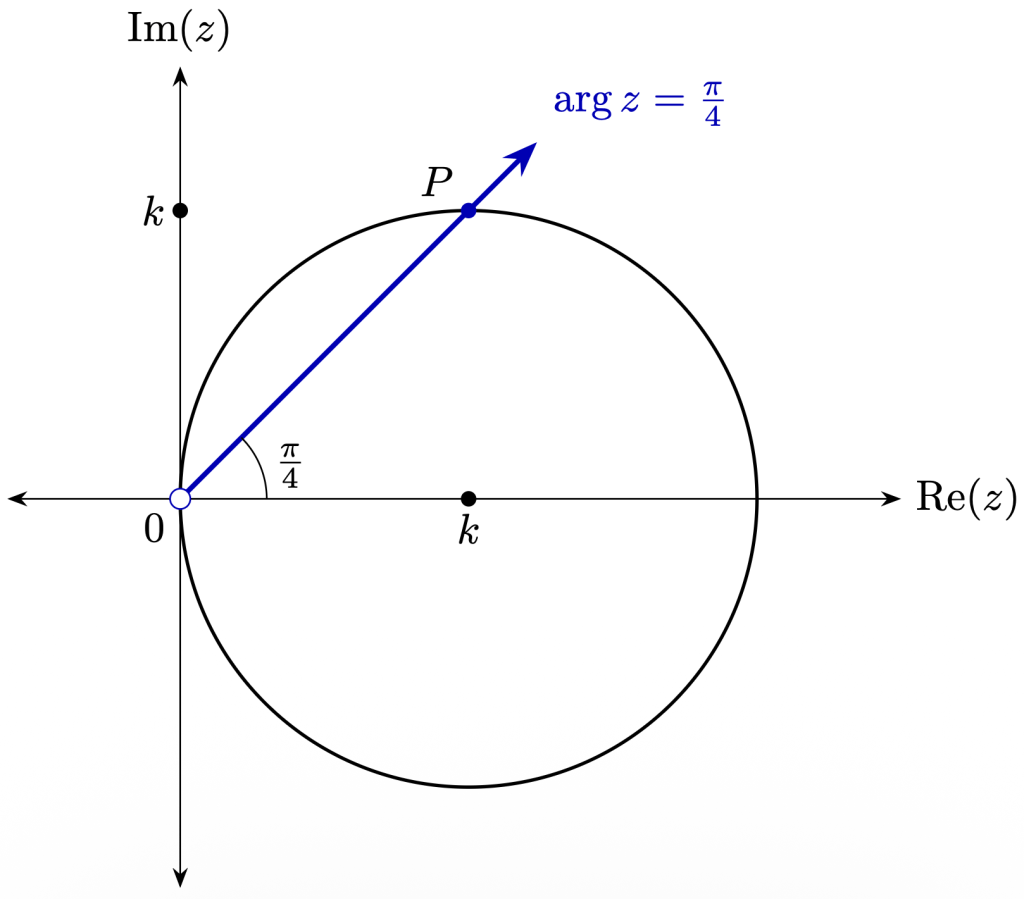
 .
. .
. .
.
 lies inside
  .
. it lies on the ray drawn in (a). For any point
  if and only if
  . Hence, we aim to find the smallest
 , taking logarithms yields
 .
.

![\begin{aligned} \int_0^{\pi/3} \sin^3 x\, \mathrm dx &= \left[ -\cos x + \textstyle{\frac 13} \cos^3 x \right]_0^{\pi/3} \\ &= \left( -\cos(\pi/3) + \textstyle{\frac 13} \cos^3(\pi/3) \right) - \left( -1 + \textstyle{\frac 13} \cdot 1 \right) \\ &= \left( - \frac 12 + \frac 13 \cdot \left( \frac 12 \right)^3 \right) + \frac 23 \\ &= \frac 5{24}. \end{aligned}](https://s0.wp.com/latex.php?latex=%5Cbegin%7Baligned%7D+%5Cint_0%5E%7B%5Cpi%2F3%7D+%5Csin%5E3+x%5C%2C+%5Cmathrm+dx+%26%3D+%5Cleft%5B+-%5Ccos+x+%2B+%5Ctextstyle%7B%5Cfrac+13%7D+%5Ccos%5E3+x+%5Cright%5D_0%5E%7B%5Cpi%2F3%7D+%5C%5C+%26%3D++%5Cleft%28+-%5Ccos%28%5Cpi%2F3%29+%2B+%5Ctextstyle%7B%5Cfrac+13%7D+%5Ccos%5E3%28%5Cpi%2F3%29+%5Cright%29+-+%5Cleft%28+-1+%2B+%5Ctextstyle%7B%5Cfrac+13%7D+%5Ccdot+1+%5Cright%29+%5C%5C+%26%3D+%5Cleft%28+-+%5Cfrac+12+%2B+%5Cfrac+13+%5Ccdot+%5Cleft%28+%5Cfrac+12+%5Cright%29%5E3+%5Cright%29+%2B+%5Cfrac+23+%5C%5C+%26%3D+%5Cfrac+5%7B24%7D.+%5Cend%7Baligned%7D&bg=ffffff&fg=000&s=0&c=20201002)
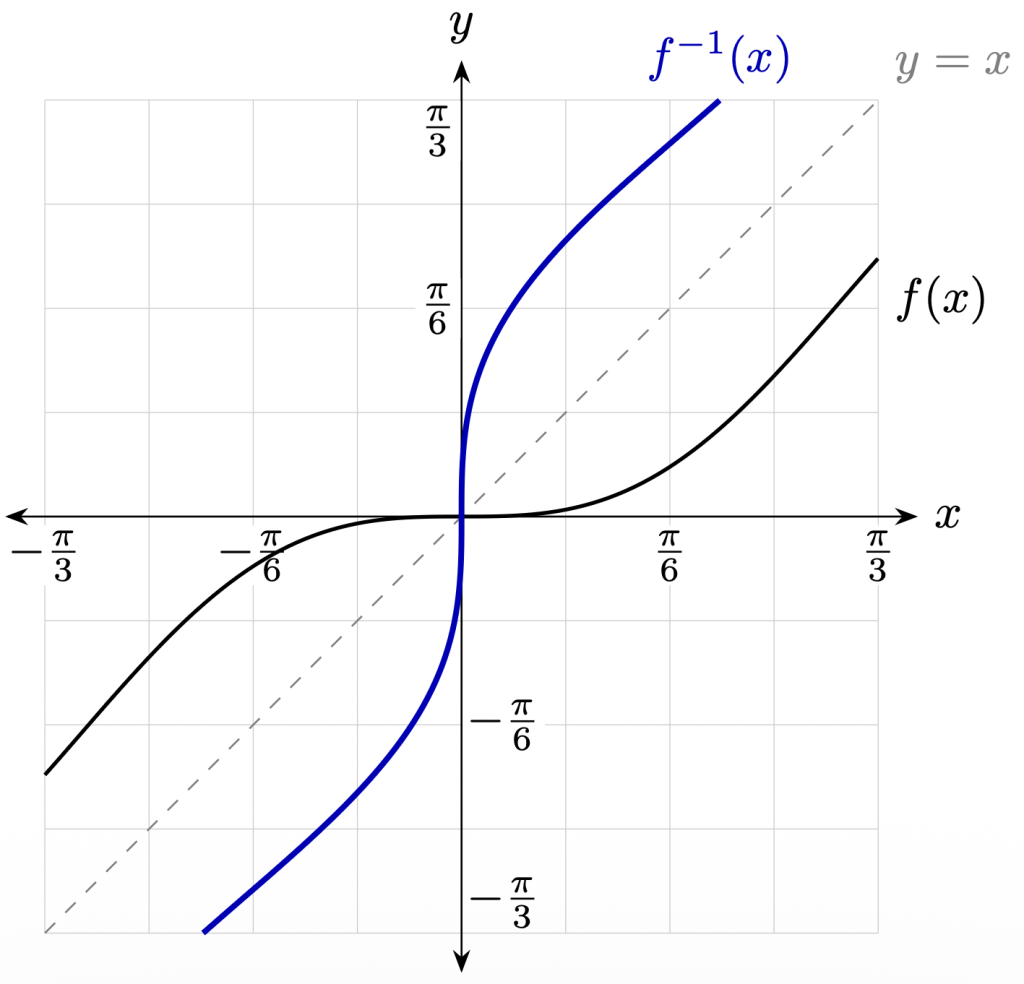
 .
. . By symmetry, the total area of the white space is
  . Since the square has an area of
  , the required area is what is left over:
 , we get
 lies on the plane
 to the second plane:
 , we obtain a distance of
![[2,-1,1]](https://s0.wp.com/latex.php?latex=%5B2%2C-1%2C1%5D&bg=ffffff&fg=000&s=0&c=20201002) , the normal is given by the line equation
, the normal is given by the line equation![[x,y,z] = [10,2,2] + t[2,-1,1],\quad t \in \mathbb R.](https://s0.wp.com/latex.php?latex=%5Bx%2Cy%2Cz%5D+%3D+%5B10%2C2%2C2%5D+%2B+t%5B2%2C-1%2C1%5D%2C%5Cquad+t+%5Cin+%5Cmathbb+R.&bg=ffffff&fg=000&s=0&c=20201002)
![\overrightarrow{OB} = [10+2t, 2-t, 2 + t]](https://s0.wp.com/latex.php?latex=%5Coverrightarrow%7BOB%7D+%3D+%5B10%2B2t%2C+2-t%2C+2+%2B+t%5D&bg=ffffff&fg=000&s=0&c=20201002)

![\overrightarrow{OB} = [10+2\cdot(-5), 2-(-5), 2 + (-5)] = [0, 7, -3],](https://s0.wp.com/latex.php?latex=%5Coverrightarrow%7BOB%7D+%3D+%5B10%2B2%5Ccdot%28-5%29%2C+2-%28-5%29%2C+2+%2B+%28-5%29%5D+%3D+%5B0%2C+7%2C+-3%5D%2C&bg=ffffff&fg=000&s=0&c=20201002)
 .
.
 to be determined. Just like in (a),
  lies on
  . Since
  . By the question,
  , so that
  . Therefore, by (a) (ii),
 . Therefore, by (a) (ii),
 , i.e.
  . Hence,
 , so that
  if
if  ),
),
 . Similarly,
  . Since
  are collinear,
 and
and  , which is the normal from (b) (ii). Since
 ![\displaystyle [x,y,z] = [10,2,2] + t[2,-1,1] = [10+2t, 2-t, 2+t],\quad t \in \mathbb R](https://s0.wp.com/latex.php?latex=%5Cdisplaystyle+%5Bx%2Cy%2Cz%5D+%3D++%5B10%2C2%2C2%5D+%2B+t%5B2%2C-1%2C1%5D+%3D+%5B10%2B2t%2C+2-t%2C+2%2Bt%5D%2C%5Cquad+t+%5Cin+%5Cmathbb+R&bg=ffffff&fg=000&s=0&c=20201002)
 . Intersecting the two objects,
![\overrightarrow{OC} = [10,2,2] + \frac 52 [2,-1,1] = [15, -1/2, 9/2].](https://s0.wp.com/latex.php?latex=%5Coverrightarrow%7BOC%7D+%3D+%5B10%2C2%2C2%5D+%2B+%5Cfrac+52+%5B2%2C-1%2C1%5D+%3D+%5B15%2C+-1%2F2%2C+9%2F2%5D.&bg=ffffff&fg=000&s=0&c=20201002)

 . Therefore,
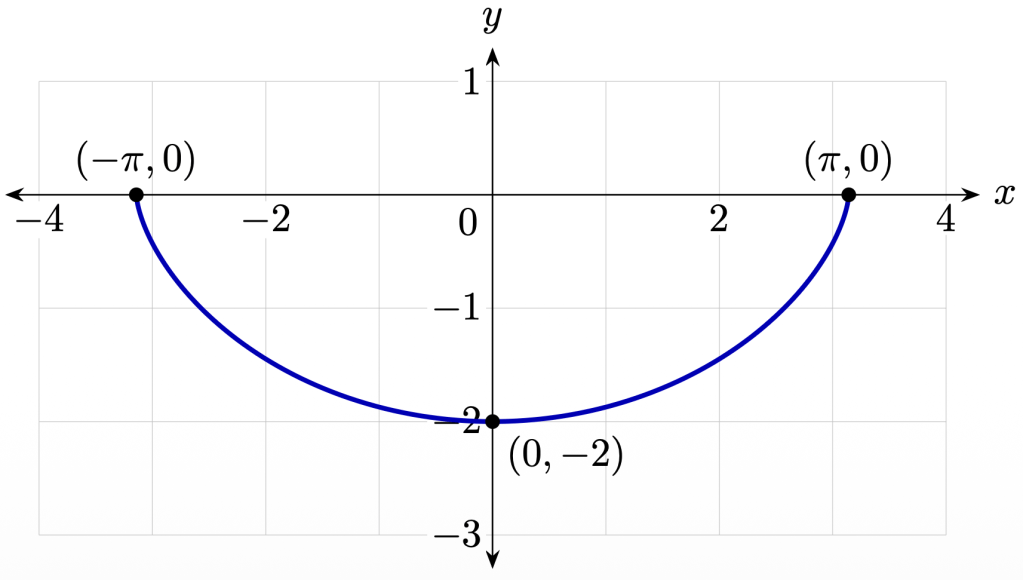


![\mathbf v = 2a[1 + \cos 2t, \sin 2t]](https://s0.wp.com/latex.php?latex=%5Cmathbf+v+%3D+2a%5B1+%2B+%5Ccos+2t%2C+%5Csin+2t%5D&bg=ffffff&fg=000&s=0&c=20201002) , so that
, so that


![\begin{aligned} I &= 2a\sqrt 2 \cdot \left[ \sqrt 2 \sin t \right]_{-\pi/2}^{\pi/2} \\ &= 2a\sqrt 2 \cdot \sqrt 2 \cdot (1-(-1)) \\ &= 8a. \end{aligned}](https://s0.wp.com/latex.php?latex=%5Cbegin%7Baligned%7D+I+%26%3D+2a%5Csqrt+2+%5Ccdot+%5Cleft%5B+%5Csqrt+2+%5Csin+t+%5Cright%5D_%7B-%5Cpi%2F2%7D%5E%7B%5Cpi%2F2%7D+%5C%5C+%26%3D++2a%5Csqrt+2+%5Ccdot+%5Csqrt+2++%5Ccdot+%281-%28-1%29%29+%5C%5C+%26%3D+8a.+%5Cend%7Baligned%7D&bg=ffffff&fg=000&s=0&c=20201002)
 .
. .
.

 , we have
  so that
  , hence

 such that

 yields
  , and setting
  yields
  , so that


 ,
,
 ,
,

 ,
,

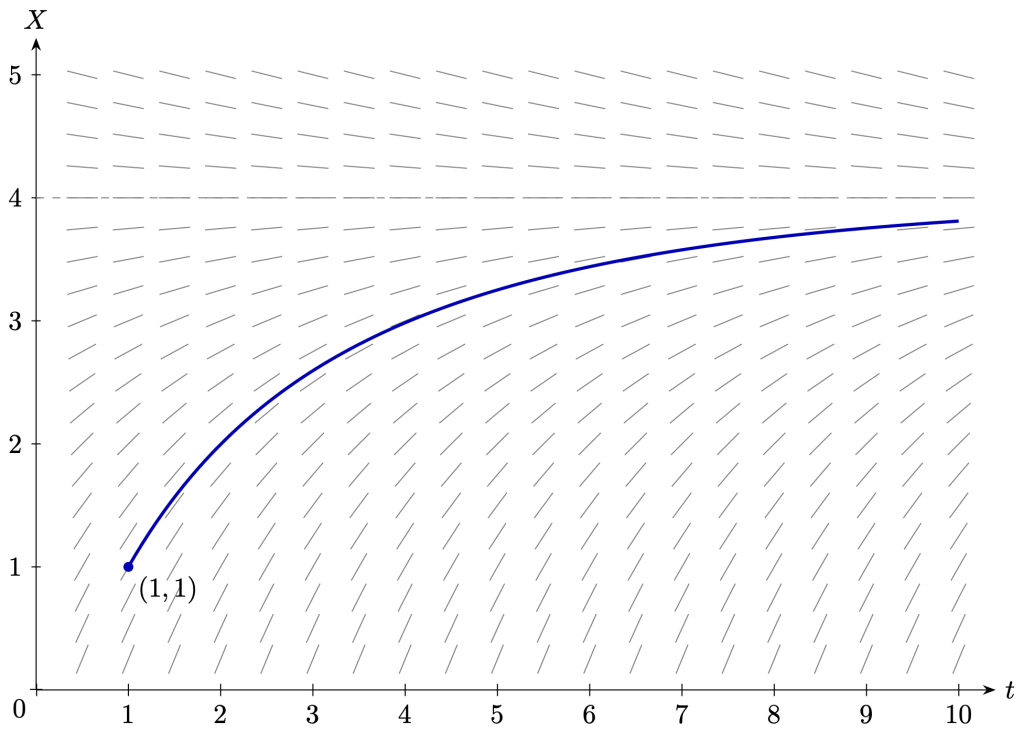
 .
. .
. .
. .
. , the required probability is
 , the required probability is
 so that
  .
. and
and  , so that the small block is more likely to weigh less than its labelled weight.
 , where
  are independent. Then
![\begin{aligned} \mathbb E[\tilde X] &= \sum_{i=1}^{25} \mathbb E[X_i] = \sum_{i=1}^{25} 408 = 25 \times 408 = 10\, 200, \\ \mathrm{Var}(\tilde X) &= \sum_{i=1}^{25}\mathrm{Var}(X_i) = \sum_{i=1}^{25} 6.9^2 = 25 \times 6.9^2 = 1190.25. \end{aligned}](https://s0.wp.com/latex.php?latex=%5Cbegin%7Baligned%7D+%5Cmathbb+E%5B%5Ctilde+X%5D+%26%3D+%5Csum_%7Bi%3D1%7D%5E%7B25%7D+%5Cmathbb+E%5BX_i%5D+%3D+%5Csum_%7Bi%3D1%7D%5E%7B25%7D+408+%3D+25+%5Ctimes+408+%3D+10%5C%2C+200%2C+%5C%5C+%5Cmathrm%7BVar%7D%28%5Ctilde+X%29+%26%3D+%5Csum_%7Bi%3D1%7D%5E%7B25%7D%5Cmathrm%7BVar%7D%28X_i%29+%3D+%5Csum_%7Bi%3D1%7D%5E%7B25%7D+6.9%5E2+%3D+25+%5Ctimes+6.9%5E2+%3D+1190.25.+%5Cend%7Baligned%7D&bg=ffffff&fg=000&s=0&c=20201002)

 , so that the required probability is
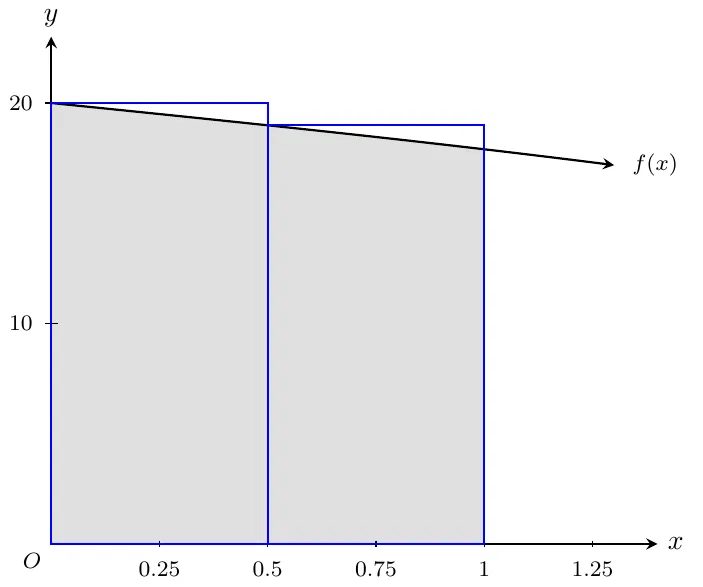


 for
for  .
.![[0,1]](https://s0.wp.com/latex.php?latex=%5B0%2C1%5D&bg=ffffff&fg=000&s=0&c=20201002) . Therefore,
. Therefore,

 is a better approximation for the area of the shaded region than
  .
.![\begin{aligned} \int_0^1 \left( -\frac 1{10}x^3 - 2x + 20 \right) \, \mathrm dx &= \left[-\frac 1{10} \cdot \frac{x^4}{4} - 2 \cdot \frac{x^2}{2} + 20x\right]_0^1 \\ &= \left( -\frac 1{10} \cdot \frac{1}{4} - 2 \cdot \frac{1}{2} + 20 \cdot 1 \right) - 0 \\ &= \textstyle 18\frac {39}{40}\ \text{units}^2.\end{aligned}](https://s0.wp.com/latex.php?latex=%5Cbegin%7Baligned%7D+%5Cint_0%5E1+%5Cleft%28+-%5Cfrac+1%7B10%7Dx%5E3+-+2x+%2B+20+%5Cright%29+%5C%2C+%5Cmathrm+dx+%26%3D+%5Cleft%5B-%5Cfrac+1%7B10%7D+%5Ccdot+%5Cfrac%7Bx%5E4%7D%7B4%7D+-+2+%5Ccdot+%5Cfrac%7Bx%5E2%7D%7B2%7D+%2B+20x%5Cright%5D_0%5E1+%5C%5C+%26%3D+%5Cleft%28+-%5Cfrac+1%7B10%7D+%5Ccdot+%5Cfrac%7B1%7D%7B4%7D+-+2+%5Ccdot+%5Cfrac%7B1%7D%7B2%7D+%2B+20+%5Ccdot+1+%5Cright%29+-+0+%5C%5C+%26%3D+%5Ctextstyle++18%5Cfrac+%7B39%7D%7B40%7D%5C+%5Ctext%7Bunits%7D%5E2.%5Cend%7Baligned%7D&bg=ffffff&fg=000&s=0&c=20201002)
 . Then
![\mathbb E[X] = 5 \cdot \frac 14 = 1.25.](https://s0.wp.com/latex.php?latex=%5Cmathbb+E%5BX%5D+%3D+5+%5Ccdot+%5Cfrac+14+%3D+1.25.&bg=ffffff&fg=000&s=0&c=20201002)

 . Therefore,
 .
. .
.

 .
. .
. ,
,  ,
,  .
. .
. .
.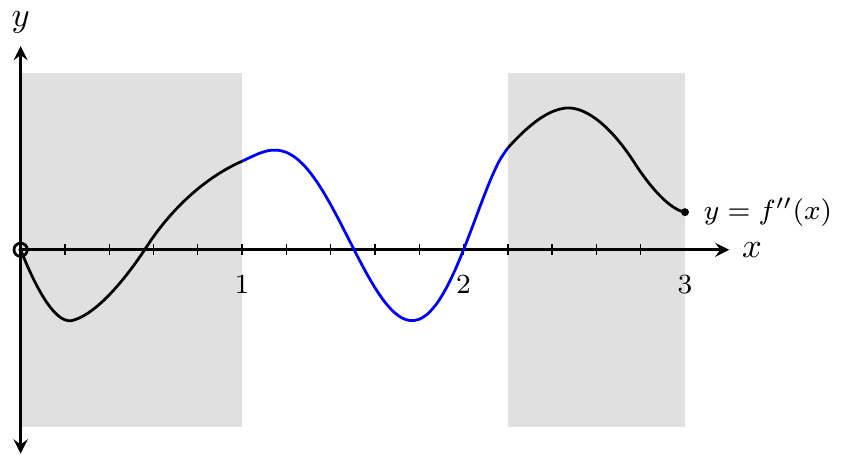
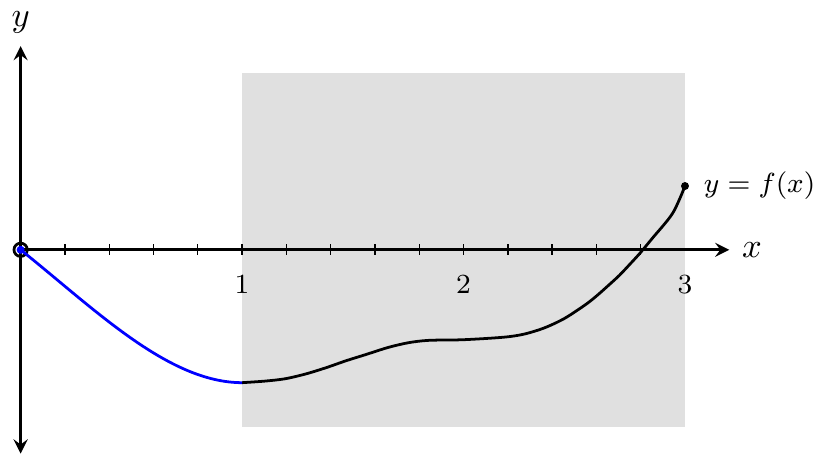
 , but we drew
  for simplicity.
 . Differentiating with respect to
 ,
,
 changes sign from negative to positive at
  , which lies between
  and
and  , this is where
 equals
  :
:
 , dividing by
  and multiplying by
  ,
,
 , we conclude that
  .
.
 .
.![\mathbb E[X] \approx 2100](https://s0.wp.com/latex.php?latex=%5Cmathbb+E%5BX%5D+%5Capprox+2100&bg=ffffff&fg=000&s=0&c=20201002) , the required probability would be approximately
, the required probability would be approximately
 calories.
 denote the number of points that a player receives. If
  for some

 . That is, the set of dice throw outcomes such that
  is empty, and thus impossible.
 respectively,


 or
or  . Since
  .
. .
.![\begin{aligned}A+B+C &= \int_0^{\pi} \sin x\, \mathrm dx \\ 1 + B + 0.566 &= \left[ - \cos x \right]_0^{\pi} \\ 1.566 + B &= 2 \\ B &= 0.434\, \text{units}^2. \end{aligned}](https://s0.wp.com/latex.php?latex=%5Cbegin%7Baligned%7DA%2BB%2BC+%26%3D+%5Cint_0%5E%7B%5Cpi%7D+%5Csin+x%5C%2C+%5Cmathrm+dx+%5C%5C+1+%2B+B+%2B+0.566+%26%3D+%5Cleft%5B+-+%5Ccos+x+%5Cright%5D_0%5E%7B%5Cpi%7D+%5C%5C+1.566+%2B+B+%26%3D+2+%5C%5C+B+%26%3D+0.434%5C%2C+%5Ctext%7Bunits%7D%5E2.+%5Cend%7Baligned%7D&bg=ffffff&fg=000&s=0&c=20201002)
 . Therefore,
 .
. .
. :
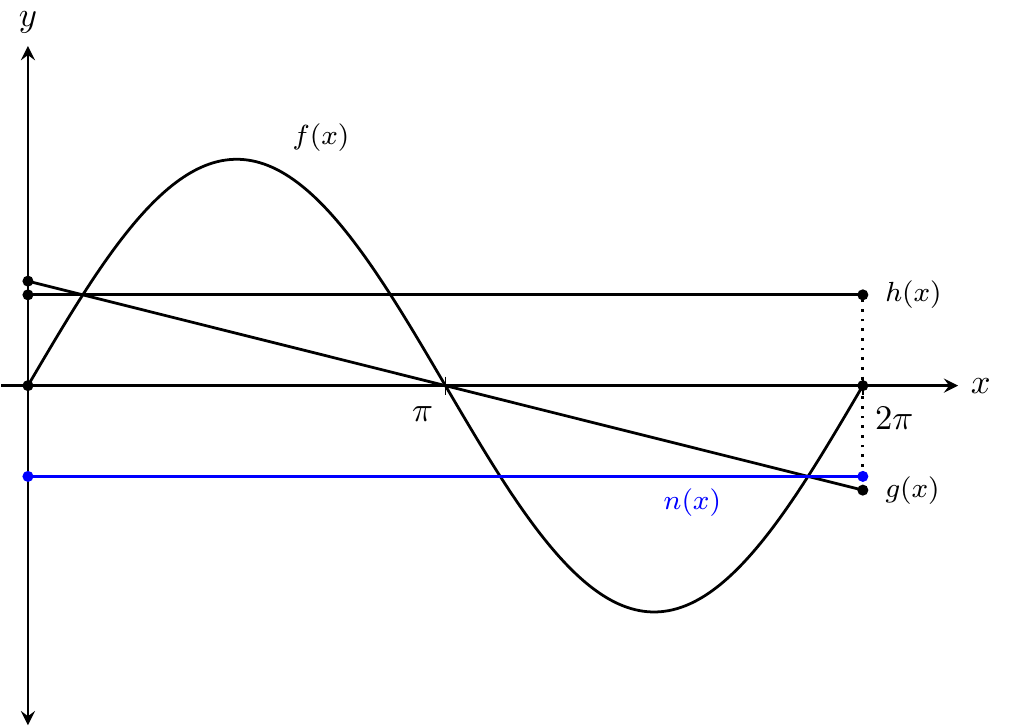
:


 , so that the denominator is nonzero. Therefore,
 is
is  .
. for each
 . By Pythagoras’ theorem,
 decreases as
  . Setting
  ,
,
 . As a check,
  while
while  .
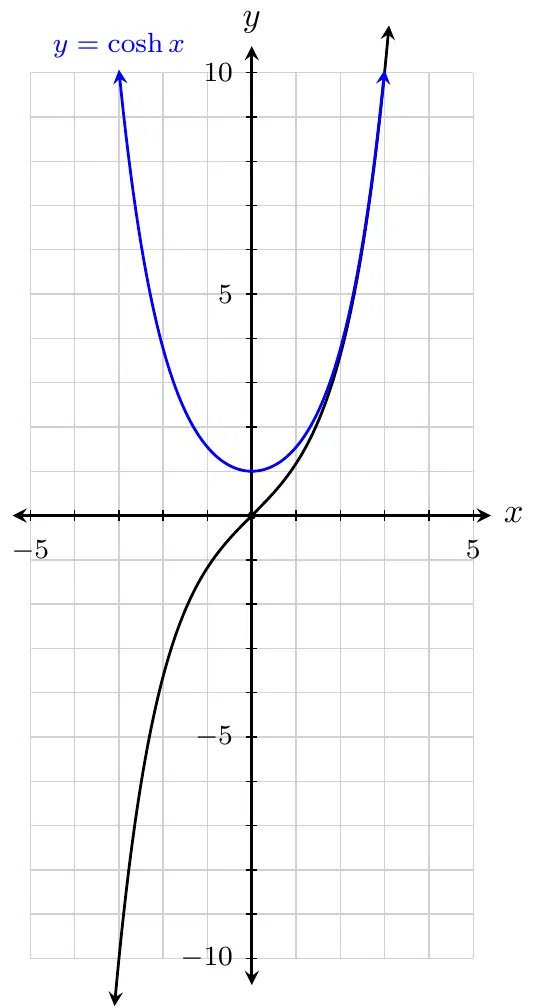
.


 for any real

 .
. points but more than Quentin’s
  points, i.e.
  points. Let
  denote the number of car, train, and boat tokens respectively that Sam has. Hence,
 , so that
 for simplicity, we must have
  . Similarly,
  and
and  .
. ,
,  works, with
  distinct and
  . Since there is only one solution, Sam had
 and
and  are collinear, we have


 :
:


 ,
,
 , where
  .
. (these values correspond with
  ).
).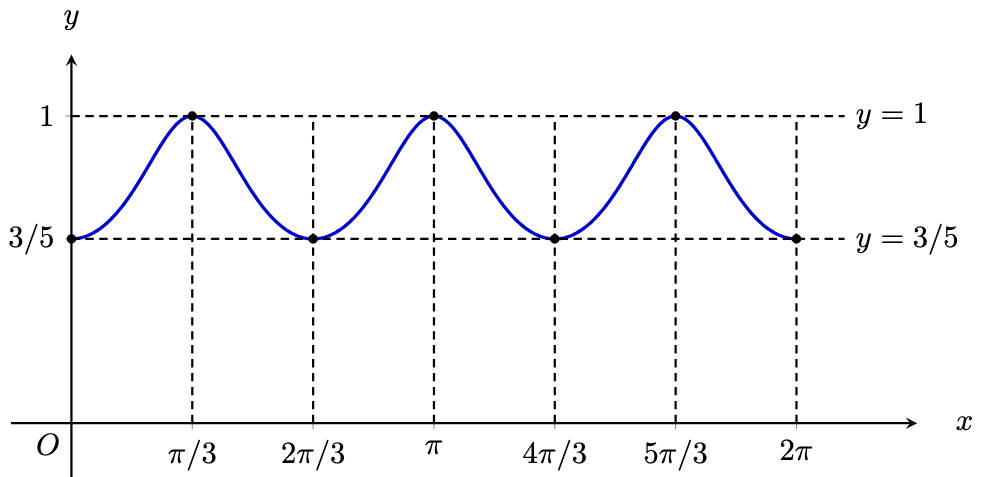
 , not just the domain
 ![[0, 2\pi]](https://s0.wp.com/latex.php?latex=%5B0%2C+2%5Cpi%5D&bg=ffffff&fg=000&s=0&c=20201002) . By considering reflections about vertical lines, we observe that the lines of symmetry of
. By considering reflections about vertical lines, we observe that the lines of symmetry of  , where
  .
. is
is 


 .
. 

 ,
,

 , the required time taken is given by solving the equation:
 ,
,
 . Since
 ![h \in [0, 15]](https://s0.wp.com/latex.php?latex=h+%5Cin+%5B0%2C+15%5D&bg=ffffff&fg=000&s=0&c=20201002) , we reject the first and last option and conclude
, we reject the first and last option and conclude  . By (c), this occurs at time
  s, when water is being poured at the rate
  .
.
 . The probability that the counters are of the same colours is given by
 .
. counters are all non-red (there are


 yields
  or
or  . Since at most
  , so that
 , we have


 ,
,


 by (c),
  .
.

 ) is
) is  . Hence, the required total is


 , there is a weak positive linear correlation between the best performances of the athletes in the high jump and long jump events. This is consistent with the scatter diagram, where the points do not lie close to a straight line.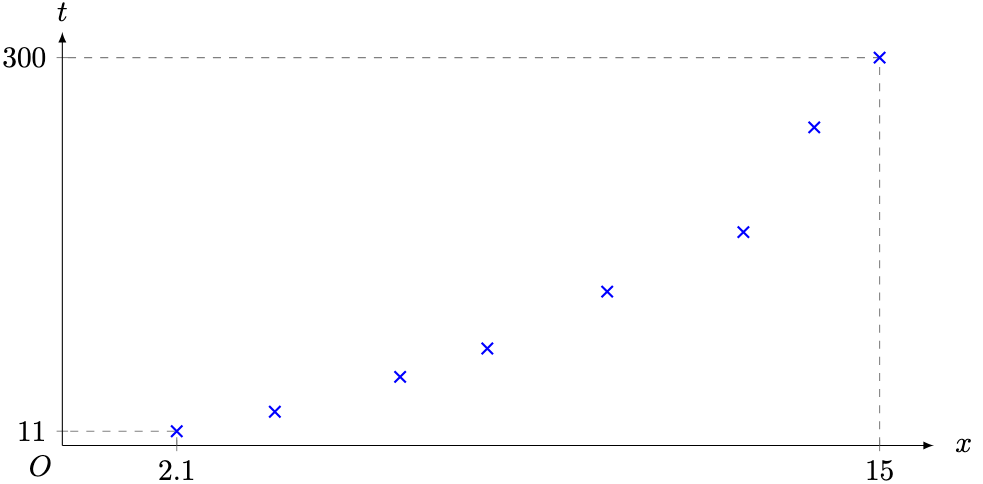
 , we obtain a correlation coefficient of
  , and for the model
  we obtain a correlation coefficient of
  . Since
  (i.e.
(i.e.  is closer to
  ), the model
 ,
,
 is strongly positive. Secondly,
  lies within the range of the data, so the estimate is an interpolation. Hence, the estimate is reliable.
 , the required probability is
 denote the number of days in a
 , let
, let  denote the number of faulty refrigerators that Alan finds in total, in a
 are independent, the required probability is given by three cases:
 denotes the mass, in kg, of packets produced by Machine
  are independent.
 denote the mass of a randomly chosen packet of flour produced by Machine
  denote the mass of a randomly chosen packet of flour produced by Machine
 ![\begin{aligned} \mathbb E[X - Y] &= 2.2 - 2.1 = 0.1, \\ \mathrm{Var}(X - Y) &= 0.1^2 + 0.05^2 = 0.0125, \\ X- Y &\sim \mathcal N(0.1, 0.0125). \end{aligned}](https://s0.wp.com/latex.php?latex=%5Cbegin%7Baligned%7D+%5Cmathbb+E%5BX+-+Y%5D+%26%3D+2.2+-+2.1+%3D+0.1%2C+%5C%5C+%5Cmathrm%7BVar%7D%28X+-+Y%29+%26%3D+0.1%5E2+%2B+0.05%5E2+%3D+0.0125%2C+%5C%5C+X-+Y+%26%5Csim+%5Cmathcal+N%280.1%2C+0.0125%29.+%5Cend%7Baligned%7D&bg=ffffff&fg=000&s=0&c=20201002)

 ,
,![\begin{aligned} \mathbb E[W] &= 3 \cdot 2.2 + 5 \cdot 2.1 = 17.1, \\ \mathrm{Var} (W) &= 3 \cdot 0.1^2 + 5 \cdot 0.05^2 = 0.0425. \end{aligned}](https://s0.wp.com/latex.php?latex=%5Cbegin%7Baligned%7D+%5Cmathbb+E%5BW%5D+%26%3D+3+%5Ccdot+2.2+%2B+5+%5Ccdot+2.1+%3D+17.1%2C+%5C%5C+%5Cmathrm%7BVar%7D+%28W%29+%26%3D+3+%5Ccdot+0.1%5E2+%2B+5+%5Ccdot+0.05%5E2+%3D+0.0425.+%5Cend%7Baligned%7D&bg=ffffff&fg=000&s=0&c=20201002)
 , so that the required probability is
 denote the mean mass of a packet of flour, in kg, produced by the adjusted Machine
  and the alternative hypothesis
  are given as follows:
 and
and  denote the unbiased estimates of the population mean and variance of the relevant masses. Then

 is sufficiently large, by the central limit theorem,
 . Since we are conducting a two-tailed test, the required
 , there is sufficient evidence to reject
  kg.
kg. packets, the sample may be too small for the central limit theorem to apply, so
  may not be approximately normal and the
  ,
,

 .
. denote the
  . By considering the sum of the first
  terms, we have first term
  so that
 terms, we have first term
  and last term
  so that
 and
and  .
.
 is a geometric sequence.
 :
:

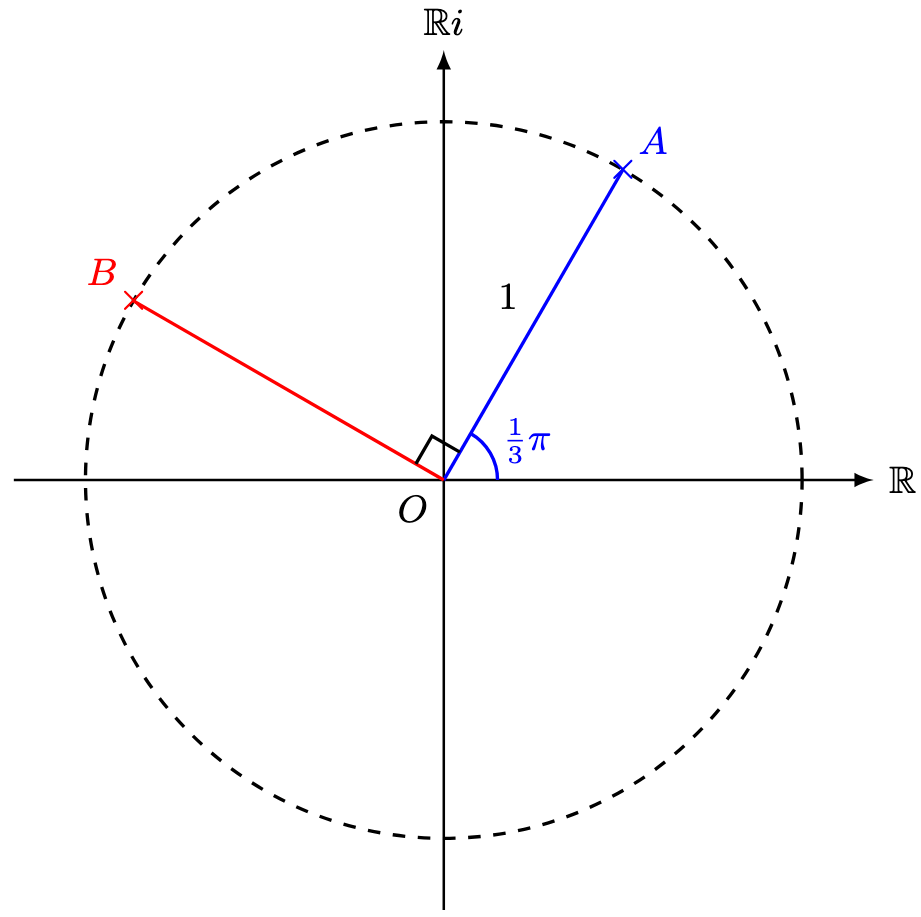
 . Indeed, since
  , we have
  and
and  , so multiplying by
  rotates
  about
about  . Using the product rule,
 so that

 yields
 , so that we solve the inequality
 (which we reject since
  ) or
) or


 , we split the integral into two parts:


 when
when  :
:

 years ago, to the nearest 100 years.

 . Therefore, the required volume of revolution
  is
is![\begin{aligned}V_1 &= \pi \int_1^e (\ln x)^2\, \mathrm dx \\ &= \pi \left( \left[\underbrace{ (x \ln x - x) }_{\mathrm I} \cdot \underbrace{ \ln x }_{\mathrm S}\right]_1^e - \int_1^e \underbrace{ (x \ln x - x) }_{\mathrm I} \cdot \underbrace{ \frac 1x }_{\mathrm D}\, \mathrm dx \right) \\ &= \pi \left( (0 - 0) - \int_1^e (\ln x - 1)\, \mathrm dx \right) \\ &= \pi \int_1^e (1 - \ln x )\, \mathrm dx \\ &= \pi [ x - (x \ln x - x)]_1^e \\ &= \pi [ 2x - x \ln x ]_1^e \\ &= \pi \cdot ( (2e - e) - (2 - 0) ) \\ &= \pi (e-2)\, \text{units}^3.\end{aligned}](https://s0.wp.com/latex.php?latex=%5Cbegin%7Baligned%7DV_1+%26%3D+%5Cpi+%5Cint_1%5Ee+%28%5Cln+x%29%5E2%5C%2C+%5Cmathrm+dx+%5C%5C+%26%3D+%5Cpi+%5Cleft%28+%5Cleft%5B%5Cunderbrace%7B+%28x+%5Cln+x+-+x%29+%7D_%7B%5Cmathrm+I%7D+%5Ccdot+%5Cunderbrace%7B+%5Cln+x+%7D_%7B%5Cmathrm+S%7D%5Cright%5D_1%5Ee+-+%5Cint_1%5Ee+%5Cunderbrace%7B+%28x+%5Cln+x+-+x%29+%7D_%7B%5Cmathrm+I%7D+%5Ccdot+%5Cunderbrace%7B+%5Cfrac+1x+%7D_%7B%5Cmathrm+D%7D%5C%2C+%5Cmathrm+dx+%5Cright%29+%5C%5C+%26%3D+%5Cpi+%5Cleft%28+%280+-+0%29+-+%5Cint_1%5Ee+%28%5Cln+x+-+1%29%5C%2C+%5Cmathrm+dx+%5Cright%29+%5C%5C+%26%3D+%5Cpi+%5Cint_1%5Ee+%281+-+%5Cln+x+%29%5C%2C+%5Cmathrm+dx+%5C%5C+%26%3D+%5Cpi+%5B+x+-+%28x+%5Cln+x+-+x%29%5D_1%5Ee+%5C%5C+%26%3D+%5Cpi+%5B+2x+-+x+%5Cln+x+%5D_1%5Ee+%5C%5C+%26%3D+%5Cpi+%5Ccdot+%28+%282e+-+e%29+-+%282+-+0%29+%29+%5C%5C+%26%3D+%5Cpi+%28e-2%29%5C%2C+%5Ctext%7Bunits%7D%5E3.%5Cend%7Baligned%7D&bg=ffffff&fg=000&s=0&c=20201002)
 is equivalently given by
  . Therefore, the required volume of revolution
  is
is
 , left as a simple exercise in integration.
 in scalar product form:
 perpendicular to
 is given by the intersection of


 is given by the cross product:
 between
  is given by the dot product between their normal vectors:


 is given by

 (so that
  ) yields the series expansion
 ,
,  and axial intercepts
  ,
,  .
.

 parallel to the
  units in the positive
  so that
 .
. ,
,
 ,
,


 is
is 
 . Since
  , we have
  at
at  at
at  are
are  and
and  respectively. Hence,

 or
or  . By substituting into expression for
 at
at  .
.
 . Since
 is given by

 .
. , we evaluate
  and
and 


 .
.

 is not a root (as
  ), we may divide by
  on both sides:
 . For
. For 
 ,
,
 . Therefore, the three roots are
  and
and  .
.
