SACE Maths Methods 2025 Suggested Answers

Questions are publicly available. Do comment if you spot any errors.

Question 1. Calculus Techniques

Solution. (a) (i) \displaystyle \frac{\mathrm dy}{\mathrm dx} = \frac 1x - \frac 2{\sqrt x}.

(a) (ii) \displaystyle \frac{\mathrm dy}{\mathrm dx} = -5\left( \frac 2x + \cos x \right)^4 \left(\frac 2x + \sin x\right).

(a) (iii) \displaystyle \frac{\mathrm dy}{\mathrm dx} = 6x^2 \cdot (3+e^{6x}) + (2x^3+7) \cdot 6e^{6x}.

(b) \displaystyle \int \left( \frac{7x+4}{x} \right) \mathrm dx = \int \left( 7 + \frac{4}{x} \right) \mathrm dx = 7x + 4 \ln |x| + C.

Question 2. Normal Distribution

Solution. (a) Denoting the weight of an individual small block by X \sim \mathcal N(408,6.9^2), the required probability is

\mathbb P(X > 400) \approx 0.877.

(b) Denoting the weight of an individual small block by Y \sim \mathcal N(624, \sigma^2), the required probability is

\begin{aligned} \mathbb P(Y > 600) &= 0.987\\ \mathbb P\left( \frac{Y-624}{\sigma} > \frac{600-624}{\sigma} \right) &= 0.987 \\ \mathbb P\left( Z > -\frac{24}{\sigma} \right) &= 0.987 \\ \mathbb P\left( Z \leq -\frac{24}{\sigma} \right) &= 0.013. \end{aligned}

Hence, -24/\sigma = -2.2262 so that \sigma = 10.780 \approx 10.8.

(c) We have \mathbb P(X < 400) \approx 0.123 and \mathbb P(Y < 600) = 0.013, so that the small block is more likely to weigh less than its labelled weight.

(d) (i) Denote \displaystyle \tilde X := \sum_{i=1}^{25} X_i, where X_1,\dots, X_{25} \sim \mathcal N(408, 6.9^2) are independent. Then

\begin{aligned} \mathbb E[\tilde X] &= \sum_{i=1}^{25} \mathbb E[X_i] = \sum_{i=1}^{25} 408 = 25 \times 408 = 10\, 200, \\ \mathrm{Var}(\tilde X) &= \sum_{i=1}^{25}\mathrm{Var}(X_i) = \sum_{i=1}^{25} 6.9^2 = 25 \times 6.9^2 = 1190.25. \end{aligned}

In particular,

\sigma_{\tilde{X}} = \sqrt{\mathrm{Var}(\tilde X)} = \sqrt{1190.25} = 34.5.

(d) (ii) We remark that \tilde X \sim \mathcal N(10\, 200, 1190.25), so that the required probability is

\mathbb P(\tilde X < 10\, 000) \approx 3.38 \times 10^{-9}.

Question 3. Riemann Sum

Solution. (a) We sketch as follows.
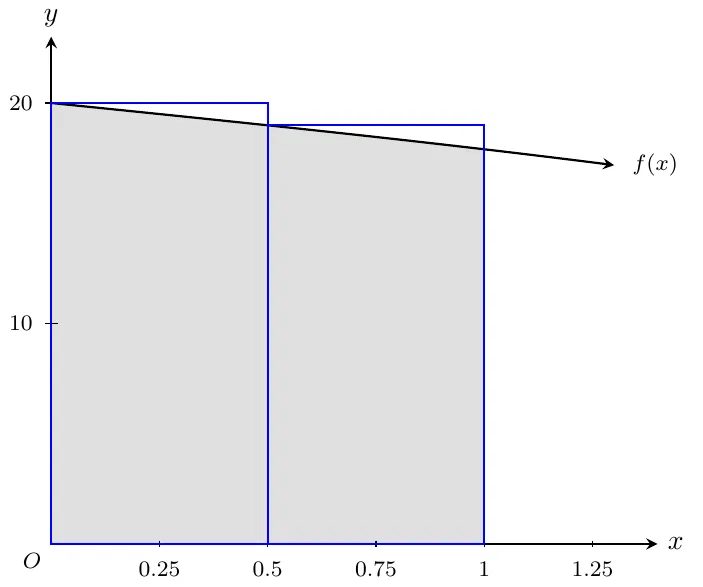
(b) Using part (a),

\begin{aligned} U_2 &= f(0) \times 0.5 + f(0.5) \times 0.5 \\ &= 20 \times 0.5 + 18.9875 \times 0.5 \\ &= 19.49375. \end{aligned}

(c) Differentiating with respect to x twice,

f'(x) = -\frac 3{10}x^2 - 2, \quad f''(x) = - \frac 35x.

(d) (i) f''(x) \leq 0 for 0 \leq x \leq 1.

(d) (ii) By part (d) (i), f is concave down on [0,1]. Therefore,

\displaystyle L_2 < \frac{L_2+U_2}{2} < \int_0^1 f(x)\, \mathrm dx < U_2.

Therefore,

\begin{aligned} \left|  \int_0^{1} f(x)\, \mathrm dx - U_2 \right| &= U_{2} - \int_0^{1} f(x)\, \mathrm dx \\ &< U_2 - \frac{L_2+U_2}{2} \\ &= \frac{U_2-L_2}{2} \\ &= \frac{L_2+U_2}{2} - L_2 \\ &< \int_0^{1} f(x)\, \mathrm dx - L_{2} \\ &= \left| \int_0^{1} f(x)\, \mathrm dx - L_{2} \right|. \end{aligned}

Hence, U_2 is a better approximation for the area of the shaded region than L_2.

(e) Taking integrals, the required area is

\begin{aligned} \int_0^1 \left( -\frac 1{10}x^3 - 2x + 20 \right) \, \mathrm dx &= \left[-\frac 1{10} \cdot \frac{x^4}{4} - 2 \cdot \frac{x^2}{2} + 20x\right]_0^1 \\ &= \left( -\frac 1{10} \cdot \frac{1}{4} - 2 \cdot \frac{1}{2} + 20 \cdot 1 \right) - 0 \\ &= \textstyle  18\frac {39}{40}\ \text{units}^2.\end{aligned}

Question 4. Binomial Distribution

Solution. (a) (i) Write X \sim \mathrm{B}(5, 1/4). Then

\mathbb E[X] = 5 \cdot \frac 14 = 1.25.

(a) (ii) The required probability is

\left(1 - \frac 15\right)^5 = \frac{1024}{3125} = 0.32768.

(a) (iii) By hypothesis, \mathbb P(X > k) = 0.1035. Therefore,

\mathbb P(X \leq k) = 0.8965.

By trial and error, k = 2.

(b) (i) The sample proportion is \hat p =80/1000 = 0.08.

(b) (ii) We compute

\hat p(1-\hat p) = 0.08 \cdot 0.92 = 0.0736.

Using a confidence interval of 95\%, z \approx 1.96. Therefore, the confidence interval is given by

\displaystyle 0.08 - 1.96 \cdot \sqrt{\frac{0.0736}{1000}} < p <  0.08 + 1.96 \cdot \sqrt{\frac{0.0736}{1000}}.

Evaluating to 3 significant figures, 0.0632 \leq p \leq 0.0968.

(b) (iii) Yes; the upper bound of the confidence interval is less than 0.1035.

Question 5. Graphing Techniques

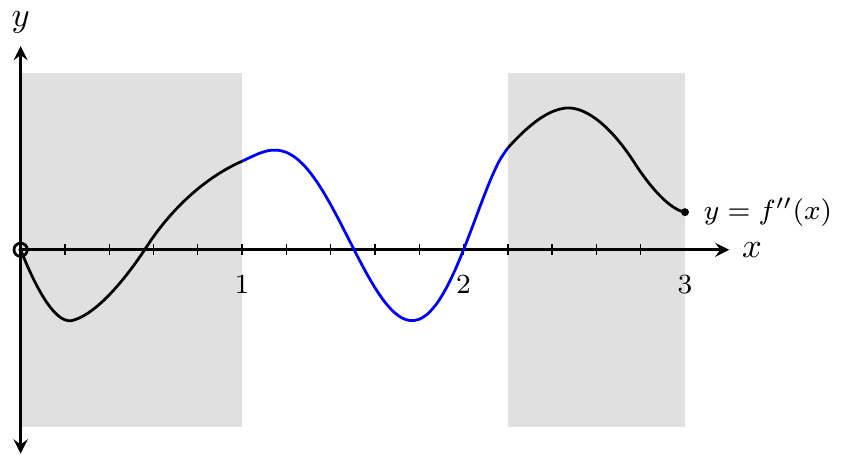
Solution. (a) -, +, +.

(b) 1 \leq x \leq 3.

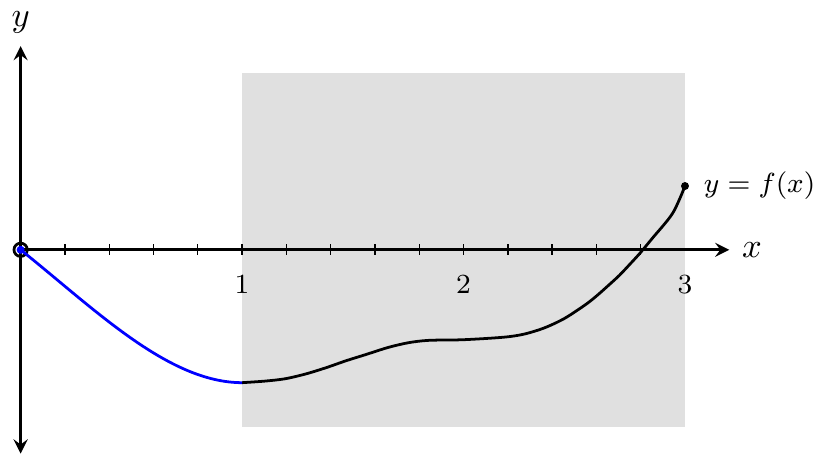
(c) f(0) > f(1).

(d) We sketch as follows, noting that f''(2) = 0.

(e) We sketch as follows.

It is possible that f(0) \neq 0, but we drew f(0) = 0 for simplicity.

Question 6. Differentiation Applications

Solution. (a) By the quotient rule,

\begin{aligned} \frac{\mathrm dy}{\mathrm dx} &= \frac{16x \cdot (x^2 + 20) - 8x^2 \cdot (2x)}{(x^2 + 20)^2} \\ &= \frac{(16x^3 + 320x) - 16x^3}{(x^2 + 20)^2} \\  &= \frac{320x}{(x^2 + 20)^2}. \end{aligned}

(b) Denote \displaystyle w := \frac{\mathrm dy}{\mathrm dx}. Differentiating with respect to x:

\begin{aligned} \frac{\mathrm dw}{\mathrm dx} &= \frac{ 320 \cdot (x^2 + 20) - 320 x \cdot 2x }{ (x^2+20)^4 } \\ &= \frac{ 6400 - 320x^2 }{ (x^2+20)^4 }. \end{aligned}

Setting \displaystyle \frac{\mathrm dw}{\mathrm dx} = 0,

6400 - 320x^2 = 0 \quad \Rightarrow \quad x^2 = 20 \quad \Rightarrow \quad x = \pm 2\sqrt{5}.

Substituting into w,

\displaystyle w(-2\sqrt 5) = \frac{320 \cdot (-2\sqrt{5})}{(20 + 20)^2} = -\frac{2}{5} \sqrt 5 \approx -0.894 < -1.

Therefore, Haz Finder cannot drive to (-2\sqrt 5, y(-2\sqrt 5)), and thus from H to O.

(c) Solving \displaystyle \frac{\mathrm dy}{\mathrm dx} = -1,

\displaystyle \frac{320x}{(x^2 + 20)^2} = -1 \quad \Rightarrow \quad x^4 + 40x^2+ 320x + 400  = 0.

Using software, x \approx -1.58 or x \approx -3.94.

Question 7. Probability Theory

Solution. (a) (i) Using the approximation,

\begin{aligned} p := \mathbb P(X \leq 2000) &\approx \int_0^{2000} f(x)\, \mathrm dx \\ &= \int_0^{2000} 0.006e^{12-0.006x-e^{12-0.006x}}\, \mathrm dx \\ &\approx 0.368. \end{aligned}

(a) (ii) No, since by (a) (i), p \approx 0.368 > 0.25.

(b) Since \mathbb E[X] \approx 2100, the required probability would be approximately

\begin{aligned} \mathbb P(X \leq 2100) &\approx \int_0^{2100} f(x)\, \mathrm dx \\ &= \int_0^{2100} 0.006e^{12-0.006x-e^{12-0.006x}}\, \mathrm dx \\ &\approx 0.578. \end{aligned}

(c) (i) 2110 calories.

(c) (ii) The sample mean is given by

\displaystyle \bar x = 2110+\frac{168}{2} = 2194\ \text{calories}.

Question 8. Discrete Random Variables

Solution. (a) (i) Let X_6 denote the number of points that a player receives. If X_6 \sim \mathrm{B}(n,p) for some n and p, then

\mathbb P(X_6 = n+1) = 0,

a contradiction, since the dice throw outcome

(6,6,\dots,6,1)

occurs with positive probability. Furthermore, every player must throw a die at least once, so that X_6 \geq 1 > 0. That is, the set of dice throw outcomes such that X_6 = 0 is empty, and thus impossible.

(a) (ii) Setting x = 2,

\displaystyle \mathbb P(X_6=2) = \left( \frac 56 \right)^{2-1} \cdot \frac 16 = \frac 5{36}.

Setting x = 5,6 respectively,

\displaystyle \mathbb P(X_6=5) = \left( \frac 56 \right)^4 \cdot \frac 16,\quad \mathbb P(X_6 = 6) = \left( \frac 56 \right)^5 \cdot \frac 16.

Taking the disjoint union,

\begin{aligned} \mathbb P(X_6 = 5\ \text{or}\ 6) &=  \left( \frac 56 \right)^4 \cdot \frac 16 + \left( \frac 56 \right)^5 \cdot \frac 16 \\ &= \left( \frac 56 \right)^4 \cdot \frac 16 \cdot \left( 1 + \frac 56 \right) \\ &= \frac{ 6875 }{ 46\, 656 }.  \end{aligned}

(b) (i) Taking the disjoint union like before,

\begin{aligned} \mathbb P(X_n \leq 2) &= \mathbb P(X_n = 1) + \mathbb P(X_n = 2) \\ &= \frac 1n + \left(1 - \frac 1n\right) \left(\frac 1n \right) \\ &= \left(2 - \frac 1n\right) \cdot \frac 1n. \end{aligned}

Setting n = 10,

\displaystyle \mathbb P(X_{10} \leq 2) = \left(2 - \frac 1{10}\right) \cdot \frac 1{10} = \frac {19}{100}.

(b) (ii) By hypothesis,

\begin{aligned} \left(2 - \frac 1n\right) \cdot \frac 1n &= \frac{39}{400} \\ 400 \cdot (2n-1) &= 39n^2 \\ 800n - 400 &= 39n^2 \\ 39n^2 - 800n + 400 &= 0. \end{aligned}

Solving for n yields n = 20/39 or n = 20. Since n is a positive integer, we must conclude that n = 20.

Question 9. Integration Applications

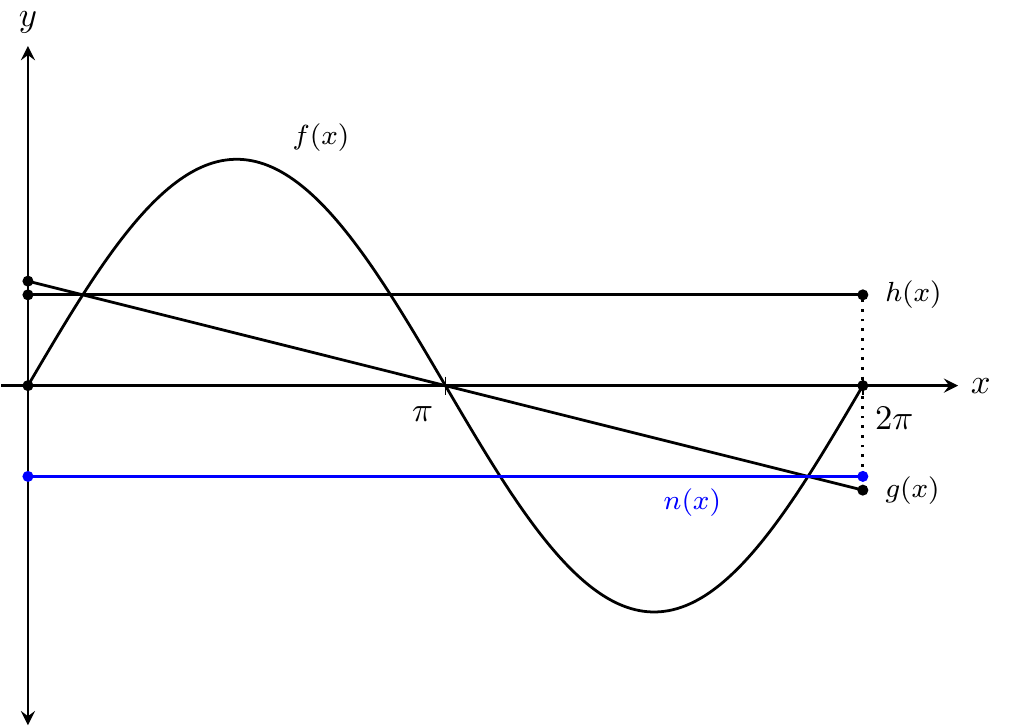
Solution. (a) 0.

(b) a = \pi.

(c) By considering the area under a curve,

\begin{aligned}A+B+C &= \int_0^{\pi} \sin x\, \mathrm dx \\ 1 + B + 0.566 &= \left[ - \cos x \right]_0^{\pi} \\ 1.566 + B &= 2 \\ B &= 0.434\, \text{units}^2. \end{aligned}

(d) By symmetry, E+F = 2. Therefore,

\begin{aligned} \int_{p_2}^{2\pi} (h(x) - f(x))\, \mathrm dx &= D + E+F \\ &= 1.20 + 2 \\ &= 3.20.\end{aligned}

(e) \displaystyle \int_{\pi}^{p_3} (g(x) - f(x))\, \mathrm dx.

(f) \displaystyle \int_{0}^{2\pi} (f(x) - h(x))\, \mathrm dx < 0.

(g) We sketch as follows, since n(x) = -h(x):

Question 10. Differentiation Applications

Solution. (a) By the chain rule,

\begin{aligned} f'(x) &= 100 \cdot \frac{1}{2x - \sin 2x} \cdot (2 - 2 \cos 2x) \\ &=  \frac{ 200 \cdot(1 -  \cos 2x) }{2x - \sin 2x}.  \end{aligned}

(b) (i) By (a), the stationary points are given by f'(x) = 0:

\displaystyle \frac{ 200 \cdot(1 -  \cos 2x) }{2x - \sin 2x} = 0.

For x > 0, \sin 2x < 2x, so that the denominator is nonzero. Therefore,

1 - \cos 2x = 0 \quad \Rightarrow \quad 2x = 2 k\pi, \quad k \in \mathbb Z^+.

In particular, x_k = k \pi, so that \sin 2x_k = 0. Therefore,

\begin{aligned} v_k &= f(x_{k+1}) - f(x_k) \\ &= 100 \ln (2x_{k+1} - \sin 2x_{k+1}) - 100 \ln (2x_{k} - \sin 2x_{k}) \\ &= 100 \ln \left( \frac{ 2x_{k+1} - \sin 2x_{k+1} }{  2x_{k} - \sin 2x_{k} } \right) \\ &= 100 \ln \left( \frac{  2(k+1)\pi - 0}{  2k\pi - 0 } \right) \\ &= 100 \ln \left( \frac{k+1}{k} \right). \end{aligned}

(b) (ii) By construction, h_k = x_{k+1} - x_k = \pi. By Pythagoras’ theorem,

\begin{aligned} d_k &= \sqrt{h_k^2 + v_k^2} \\ &= \sqrt{\pi^2 + \left( 100 \ln \left( \frac{k+1}{k} \right) \right)^2 } \\  &= \sqrt{\pi^2 + 10\, 000 \left(  \ln \left( \frac{k+1}{k} \right) \right)^2 }. \end{aligned}

Question 11. Differentiation Techniques

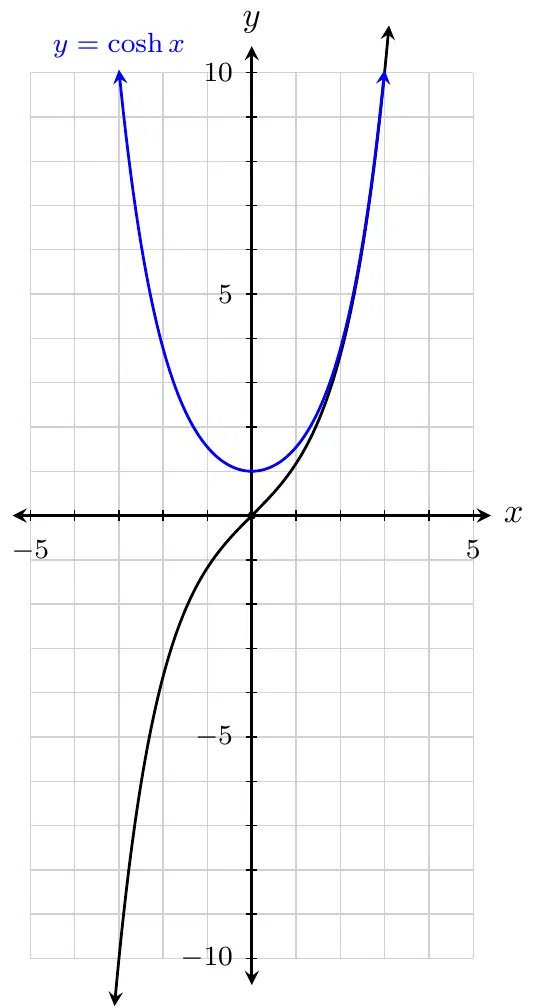
Solution. (a) We sketch as follows.
(b) Using the quotient rule,

\begin{aligned} \frac{\mathrm dy}{\mathrm dx} &= \frac{\mathrm d}{\mathrm dx} \left( \frac{\sinh x}{\cosh x} \right) \\ &= \frac{\cosh x \cdot \cosh x - \sinh x \cdot \sinh x}{(\cosh x)^2} \\ &= \frac{(\cosh x)^2 - ( \sinh x)^2}{(\cosh x)^2} \\ &= \frac{ (\cosh x + \sinh x) (\cosh x - \sinh x) }{ (\cosh x)^2 } \\ &= \frac{e^x \cdot e^{-x}}{ (\cosh x)^2 } \\ &= \frac 1{(\cosh x)^2}. \end{aligned}

(c) (i) Using the chain rule,

\begin{aligned} f'(x) &= \frac{13}{(\cosh x)^2} + \frac{10}{\cosh x} \cdot \sinh x \\ &= 13 (\cosh x)^{-2} + 10 \tanh x. \end{aligned}

Differentiating a second time,

\begin{aligned} f''(x) &= 13 \cdot (-2)(\cosh x)^{-3} \cdot \sinh x + \frac{10}{(\cosh x)^2} \\ &= -\frac{26 \sinh x}{(\cosh x)^3} + \frac{10}{(\cosh x)^2} \\ &= \frac{ 10 \cosh x - 26 \sinh x }{ (\cosh x)^3 }. \end{aligned}

(c) (ii) For this point of inflection, f''(x) = 0:

\displaystyle \frac{ 10 \cosh x - 26 \sinh x }{ (\cosh x)^3 } = 0.

Since \cosh x > 0 for any real x,

\begin{aligned} 10 \cosh x - 26 \sinh x &= 0 \\ \tanh x &= \frac{5}{13} \\ \frac{e^x - e^{-x}}{e^x + e^{-x}} &= \frac 5{13} \\ 13 e^x - 13 e^{-x} &= 5e^x + 5e^{-x} \\ 8e^x &=  18e^{-x} \\ e^{2x} &= \frac 94 \\ e^x &= \frac 32 \\ x &= \ln\left(\frac 32 \right). \end{aligned}

—Joel Kindiak, 22 Aug 26, 1904H

,

Published by


Leave a comment