Basic Probabilistic Events

Previously, we looked at evaluating and summarising data. Data is mostly randomly generated, though not necessarily in a purely unpredictable manner, by chance. It is of our interest, therefore, to now turn to games of chance.

Consider a fair 6-sided die with possible values 1,2,3,4,5,6 (plural: dice). We collect these outcomes into a set, defined \{ 1,2,3,4,5,6 \}, and collect sub-collections of these outcomes also as sets.

Example 1. Write down the sub-collection of even-numbered outcomes of the die.

Solution. Since the even-numbered outcomes of the die are 2,4,6, the required subset is \{ 2,4,6\}.

Definition 1. Let K, L be sets. We write:

  • K = L if the two sets have exactly the same elements,
  • K \subseteq L and call K a subset of L if K is a sub-collection of L,
  • K \not\subseteq L if K is not a subset of L.

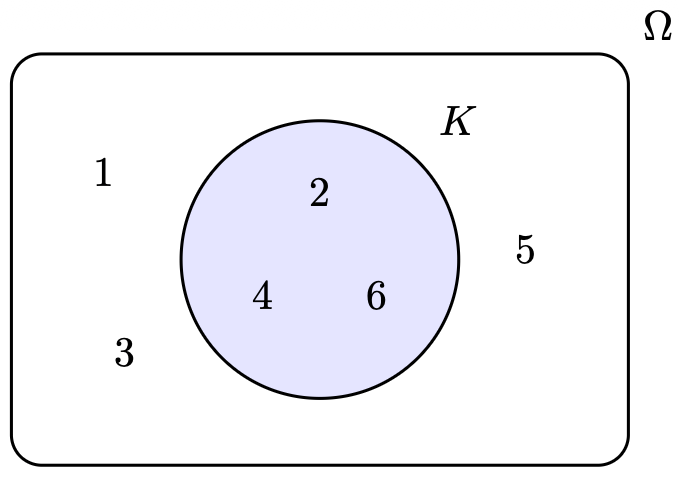
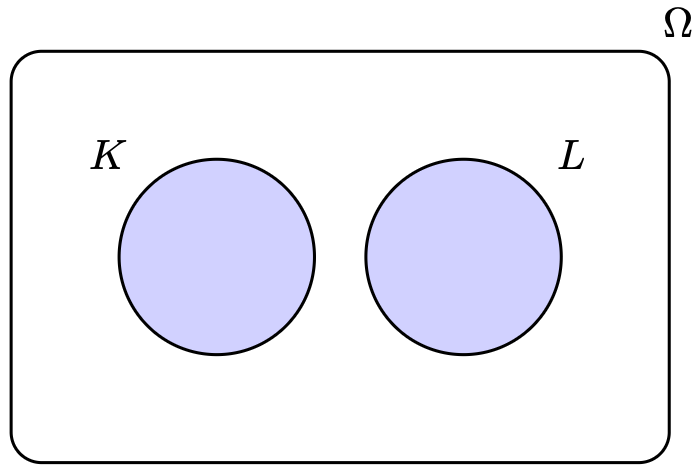
For instance, in Example 1, we have \{2,4,6\} \subseteq \{1,2,3,4,5,6\}. We can illustrate this relationship using a Venn diagram.

Therefore, we will use sets in order to model chance. However, sets alone don’t get at the full picture. We also need to quantify certainty. Intuitively, since there are 3 even numbers in the set \{ 1,2,3,4,5,6 \}, then the probability that we roll an even number on the die should be 3/6 = 1/2. We formalise this idea using sets.

For any (finite) set K, let |K| denote the number of elements in the set. For instance, |\{ 1,2,3,4,5,6 \}| = 6 and |\{2,4,6\}| = 3.

Definition 2. Let \Omega be a set, which we usually call the universal set of discourse. Given K \subseteq \Omega, define the uniform probability of K by

\displaystyle \mathbb P(K) = \frac{|K|}{|\Omega|}.

Using the language of Definition 2, the probability of rolling an even number on the die is displayed as

\displaystyle \mathbb P(\{2,4,6\}) = \frac{|\{2,4,6\}|}{|\{1,2,3,4,5,6\}|} = \frac 36 = \frac 12.

Denote \Omega := \{1,2,3,4,5,6\} for simplicity, because we are lazy. Recall that |\Omega| = 6.

Remark 1. Observe that \Omega \subseteq \Omega, and \displaystyle \mathbb P(\Omega) = \frac{|\Omega|}{|\Omega|} = 1. Furthermore, some education systems denote the universal set by the following alternate notation and use them in their assessments: U, \varepsilon, \mathcal{E}, \xi, \mathscr{E}. In the spirit of learning set-formulated probability theory, we will not follow such practice in these blog posts.

Example 2. What is the probability that we would roll a multiple of 3?

Solution. The multiples of 3 are described by the subset \{3,6\} \subseteq \Omega. Therefore, the required probability is

\displaystyle \mathbb P(\{3,6\}) = \frac{ |\{3,6\}| }{ |\Omega| } = \frac 26 = \frac 13.

Example 3. What is the probability that we would roll an even multiple of 3?

Solution. The even numbers are given by the subset \{2,4,6\}, and the multiples of 3 are given by the subset \{3,6\}. The common number is 6, and therefore the subset of \Omega that contains all even multiples of 3 is \{6\}. Therefore, the required probability is

\displaystyle \mathbb P(\{6\}) = \frac{|\{6\}|}{|\Omega|} = \frac 16.

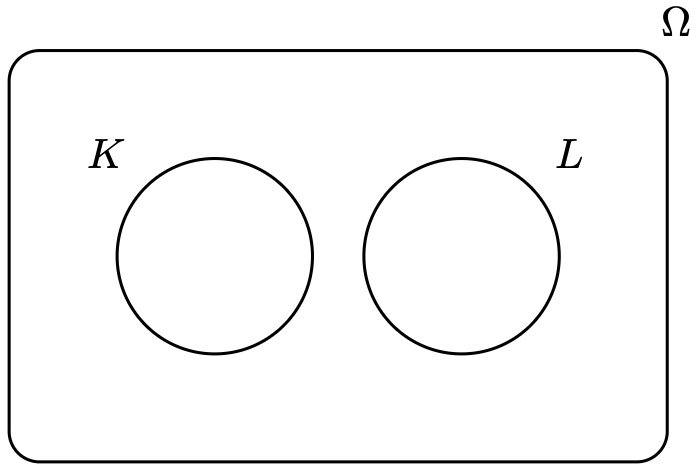
To capture the idea of “common elements”, we use the notion of the intersection. We can illustrate this common-ness using another Venn diagram.
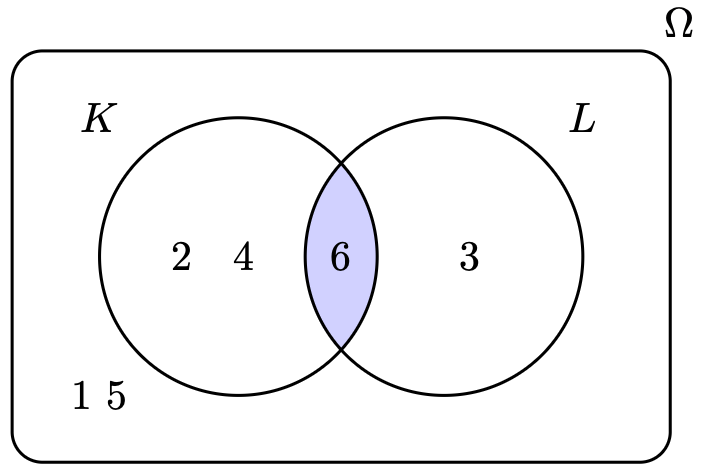
In order to do that, we need to introduce the idea of “membership”.

Definition 3. Let K be a set. We write x \in K to mean that x belongs to K. In this case, we say that x is an element of K. We write x \notin K to mean that x does not belong to K.

For instance, if K = \{2,4,6\}, then 2 \in K and 3 \notin K. Furthermore, we can write K in set-builder notation:

K = \{x \in \{1,2,3,4,5,6\} : x\ \text{is even}\}.

Definition 4. Let K, L be subsets of \Omega. We call the sub-collection K \cap L of common elements the intersection of K and L. Formally, we define this intersection by

K \cap L := \{x \in \Omega : x \in K\ \text{and}\ x \in L\}.

For example \{2,4,6\} \cap \{3,6\} = \{6\}.

Example 4. What is the probability that we would roll a number that is both odd and even?

Solution. The subset of odd numbers is \{1,3,5\} and the subset of even numbers is \{2,4,6\}. There…are no numbers in 1,2,3,4,5,6 that belong to both subsets. The required subset is empty: \{\}. In the language of Definition 4,

\{1,3,5\} \cap \{2,4,6\} = \{\ \}.

Therefore, the required probability is

\displaystyle \mathbb P(\{\ \}) = \frac{|\{\ \}|}{|\Omega|} = \frac 06 = 0.

Remark 2. We denote \emptyset := \{\ \}, motivated by the observation |\{\ \}| = 0. Furthermore, we say that K, L are mutually disjoint since K \cap L = \emptyset.

Example 5. What is the probability that we would roll a number that is either even or a multiple of 3?

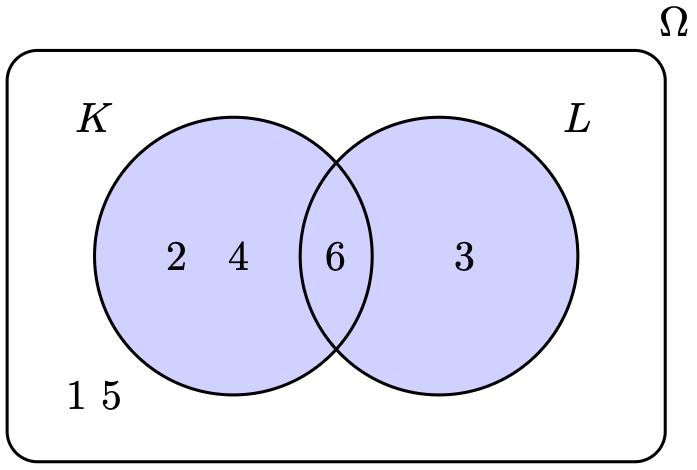
Solution. If we require a number to be at least one of these criterion, we allow it to be taken from either of the subsets \{2,4,6\} or \{3,6\}, then the desired subset would be \{2,3,4,6\}. We can illustrate this “collaboration” using another Venn diagram.

Therefore, the required probability is

\displaystyle \mathbb P(\{2,3,4,6\}) = \frac{|\{2,3,4,6\}|}{|\Omega|} = \frac 46 = \frac 23.

Definition 5. Let K, L be subsets of \Omega. We call the sub-collection K \cap L of “collaborated” elements the union of K and L. Formally, we define this union by

K \cup L := \{x \in \Omega : x \in K\ \text{or}\ x \in L\}.

For example \{2,4,6\} \cup \{3,6\} = \{2,3,4,6\}.

Example 6. What is the probability that we would roll a number that is not a multiple of 3?

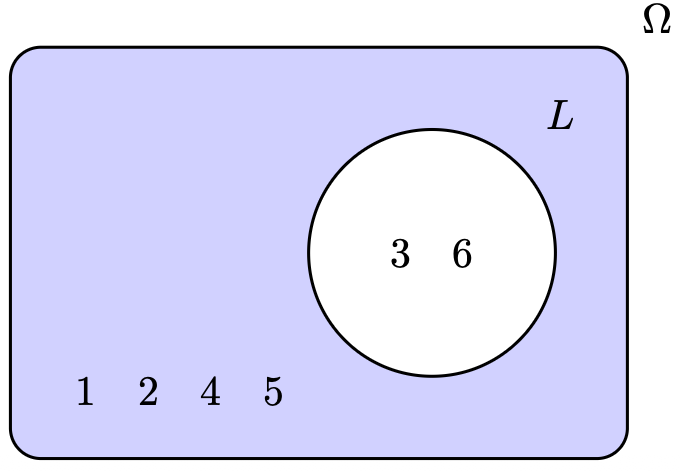
Solution. By accepting all elements of \{1,2,3,4,5,6\} that are not multiples of 3, the desired subset is \{1,2,4,5\}. We can visualise this subset, once again, using a Venn diagram.

Therefore, the required probability is

\displaystyle \mathbb P(\{1,2,4,5\}) = \frac{|\{1,2,4,5\}|}{|\Omega|} = \frac 46 = \frac 23.

Definition 6. For any K \subseteq \Omega, define the complement of K by

K' := \Omega \backslash K := \{x \in \Omega : x \notin K\}.

For example, \{1,2,4,5\} = \{3,6\}'.

At this point, alarm bells should ring, since by Remark 1 and Example 2,

\displaystyle \mathbb P(\{1,2,4,5\}) + \mathbb P(\{3,6\}) = \frac 23 + \frac 13 = \mathbb P(\{1,2,3,4,5,6\}).

Furthermore, we notice that

\begin{aligned} \{1,2,4,5\} \cup \{3,6\} &= \{1,2,3,4,5,6\}, \\ \{1,2,4,5\} \cap \{3,6\} &= \emptyset. \end{aligned}

That is, we can add probabilities of unions of mutually exclusive subsets.

Theorem 1. Let K, L be mutually disjoint subsets of \Omega. Then

\mathbb P(K \cup L) = \mathbb P(K) + \mathbb P(L).

Proof. Since K, L are mutually disjoint, every element in K \cup L belongs either to K and not L, or L and not K.

Therefore, |K \cup L| must equal |K| + |L|, and hence,

\begin{aligned} \mathbb P(K \cup L) &= \frac{|K \cup L|}{|\Omega|} \\ &= \frac{|K| + |L|}{|\Omega|} \\ &= \frac{|K|}{|\Omega|} + \frac{|L|}{|\Omega|} \\ &= \mathbb P(K) + \mathbb P(L). \end{aligned}

Remark 3. This property holds for any number of mutually disjoint subsets:

\mathbb P(K_1 \cup \cdots \cup K_n) = \mathbb P(K_1) + \cdots + \mathbb P(K_n)

whenever each K_i \cap K_j = \emptyset whenever i \neq j. This result is called the (finite or countable) additivity property of probability.

Corollary 1. Given K \subseteq \Omega,

\mathbb P(K') = 1 - \mathbb P(K).

Proof. By definition, K \cap K' = \emptyset and K \cup K' = \Omega. By Remark 1 and Theorem 1,

\mathbb P(K) + \mathbb P(K') = \mathbb P(K \cup K') = \mathbb P(\Omega) = 1.

Therefore, \mathbb P(K') = 1 - \mathbb P(K).

Remark 4. In particular, \emptyset = \Omega' so that

\mathbb P(\emptyset) = \mathbb P(\Omega') = 1 - \mathbb P(\Omega) = 1-1 = 0.

Example 7. Given subsets K, L, not necessarily disjoint, show that

\mathbb P(K \cup L) = \mathbb P(K) + \mathbb P(L) - \mathbb P(K \cap L).

Solution. Consider the Venn diagram below for illustrative purposes.
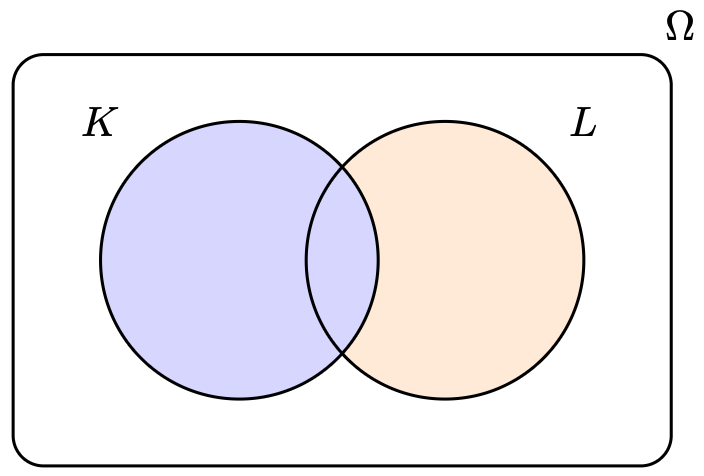
Given x \in K \cup L, there are two non-overlapping cases:

  • x \in K
  • x \in L and x \notin K.

Denoting L\backslash K := L \cap K' for brevity,

\begin{aligned} K \cup (L \backslash K)&= K \cup L , \\ K \cap (L \backslash K) &= \emptyset. \end{aligned}

By Theorem 1,

\mathbb P(K \cup L) = \mathbb P(K) + \mathbb P(L \backslash K).

On the other hand, we observe that given x \in L, either x \in K or x \notin K. Refer to the zoomed-in Venn diagram below.
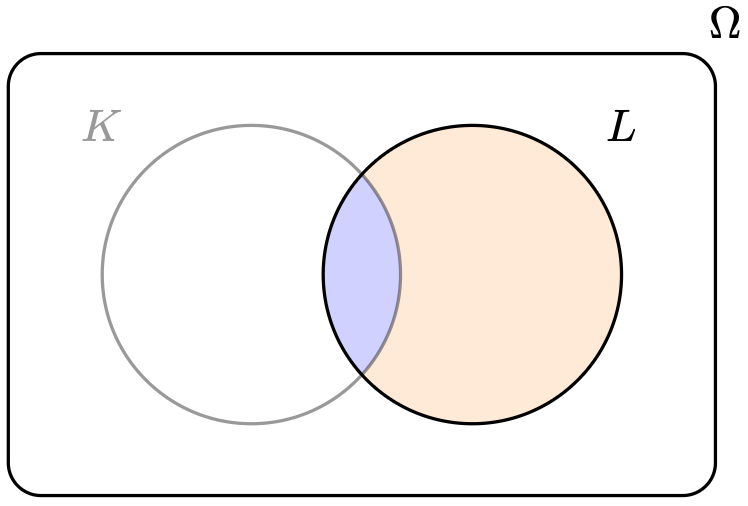
Therefore,

\begin{aligned} (K \cap L) \cup (L \backslash K)&= L , \\ (K \cap L) \cap (L \backslash K) &= \emptyset. \end{aligned}

By Theorem 1 again,

\mathbb P(K \cap L) + \mathbb P(L\backslash K) = \mathbb P(L).

Making \mathbb P(L\backslash K) the subject of the equation,

\mathbb P(K \cup L) = \mathbb P(K) + \mathbb P(L) - \mathbb P(K \cap L).

Therefore, we use set notation to describe our intuitive notions of probability. We can formalise these ideas with far more advanced tools, but we shall relegate that rabbit hole as an exercise for the keen reader. We keep these ideas simple for now.

Next time, we solve some simple problems involving probability.

—Joel Kindiak, 18 Mar 26, 1509H

,

Published by


Leave a comment