Definition 1. Define the rate of change of a quantity x with respect to time t by 
Problem 1. A latter of length 10 m rests with its foot on horizontal ground and its top against a smooth vertical wall. The foot of the ladder slides away from the wall at a constant rate of 0.2 m/s.
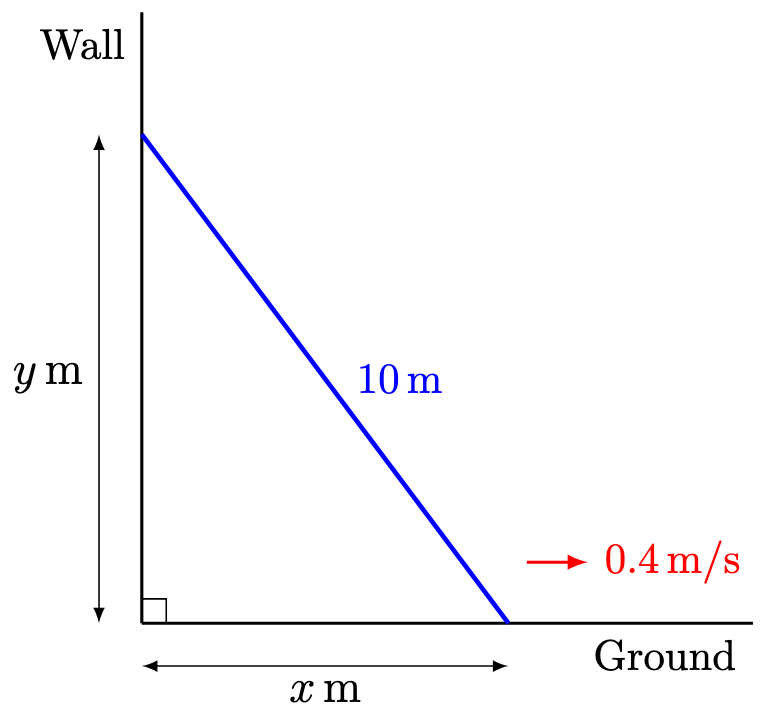
Let x m denote the distance of the foot from the wall and y m denote the height of the ladder above the ground.
Show that

Deduce the rate at which the ladder is falling down along the wall at x = 6.
(Click for Solution)
Solution. By Pythagoras’ theorem,

Differentiating all sides with respect to 

On the left-hand side, the chain rule yields

On the right-hand side, 

At 

Since 

Therefore, the ladder is falling down along the wall at a rate of 0.3 m/s.
Problem 2. Car A travels south toward a junction, and Car B travels east away from the junction. Let s km denote the distance between Car A and Car B.
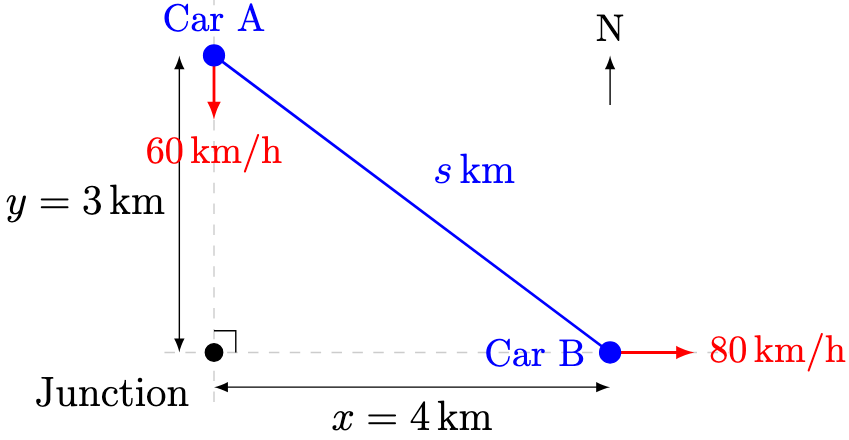
Given that Car A travels at a speed of 60 km/h and Car B travels at a speed of 80 km/h, determine the rate of change of s at the point in time where Car A is located 3 km north of the junction, while Car B is located 4 km east of the junction.
(Click for Solution)
Solution. By Pythagoras’ theorem,

Differentiating on both sides similar to Problem 1,

At 


Solving the equation yields 
Problem 3. A cup of coffee is placed in a room where the ambient temperature is 20°C. According to Newton’s law of cooling, the temperature T°C of the coffee at time t minutes after it is placed in the room satisfies the equation
T = 20 + 80e –0.05t .
Show that the rate of change of T is directly proportional to (T – 20).
(Click for Solution)
Solution. Differentiating with respect to time,

On the other hand,

Substituting the display,

Therefore, 
Problem 4. The displacement x cm from a fixed point O at time t seconds of an object moving in a straight line is given by
x = 3 sin(2t).
Define
- the velocity, v cm/s, of the object as the rate of change of the displacement of the object,
- the acceleration, a cm/s2, of the object as the rate of change of the velocity of the object.
Show that a is directly proportional to x.
(Click for Solution)
Solution. Differentiating twice with respect to time,

Since 


—Joel Kindiak, 7 Apr 26, 2159H


Leave a Reply