SACE Stage 2 Specialist Maths 2025 Suggested Answers

Questions are publicly available. Do comment if you spot any errors.

Remark 1. In SACE Stage 2 Specialist Maths, the following equivalent notation is used:

\mathrm{cis}\, \theta \equiv \mathrm{cis}(\theta) \equiv \cos \theta + i \sin \theta.

Furthermore, for any planar shape S, we denote its area by \mathcal A(S). Finally, we use row vector notation for vectors:

[x,y,z] \equiv \begin{bmatrix} x \\ y \\ z \end{bmatrix},

and denote vector norms by |\mathbf v| \equiv \| \mathbf v \|.

Question 1. Related Rates of Change

Solution. (a) Setting V = \displaystyle \frac{200}3 \pi,

\displaystyle \frac{11\pi}2 h^2 - \frac{\pi}3 h^3 = \frac{200\pi}{3} \quad \Rightarrow \quad 2h^3-33h^2 +400 = 0.

Solving for 0 \leq h \leq 5, we have h = 4.

(b) Differentiating with respect to h,

\begin{aligned} \frac{\mathrm dV}{\mathrm dh} &= \frac{\mathrm d}{\mathrm dh} \left( \frac{11\pi}2 h^2 - \frac{\pi}3 h^3 \right) \\ &= \frac{11\pi}2\frac{\mathrm d}{\mathrm dh} \cdot (  h^2  )- \frac{\pi}3 \cdot \frac{\mathrm d}{\mathrm dh} (  h^3 ) \\ &= \frac{11 \pi}{2} \cdot 2h - \frac{\pi}3 \cdot 3h^2 \\ &= \pi h ( 11 - h).  \end{aligned}

By the chain rule,

\begin{aligned} \frac{\mathrm dV}{\mathrm dt} = \pi h ( 11 - h) \cdot \frac{\mathrm dh}{\mathrm dt} \quad \Rightarrow \quad \frac{\mathrm dh}{\mathrm dt} &= \frac 1{\pi h ( 11 - h)} \frac{\mathrm dV}{\mathrm dt}. \end{aligned}

(c) By (a), h = 4 when V =  \displaystyle \frac{200}3 \pi. By the question, \displaystyle \frac{\mathrm dV}{\mathrm dt} = 2. By (b),

\displaystyle \frac{\mathrm dh}{\mathrm dt} = \frac 1{\pi \cdot 4 \cdot (11-4)} \cdot 2 = \frac 1{14\pi} \approx 0.0227\, \text{cm}/\text s.

Question 2. Integral Calculus

Solution. (a) Integrating by parts and using the assumed integral,

\begin{aligned} \int x^2 e^{2x}\, \mathrm dx &= \int x \cdot xe^{2x}\, \mathrm dx \\ &= \underbrace{\phantom. x \phantom.}_{u} \cdot \underbrace{\phantom. \left(\textstyle{\frac 12} xe^{2x} - \textstyle{\frac 14}e^{2x} \right)\phantom.}_{v} - \int \underbrace{\phantom.\left( \textstyle{\frac 12} xe^{2x} - \textstyle{\frac 14}e^{2x} \right) \phantom.}_{v} \cdot \underbrace{\phantom. 1\, \mathrm dx\phantom.}_{\mathrm du} \\ &= \textstyle{\frac 12} x^2e^{2x} - \textstyle{\frac 14}xe^{2x} - \left( \textstyle{\frac 12} \displaystyle \int xe^{2x}\, \mathrm dx - \textstyle{\frac 14} \displaystyle \int e^{2x}\, \mathrm dx \right) \\ &= \textstyle{\frac 12} x^2e^{2x} - \textstyle{\frac 14}xe^{2x} - \textstyle{\frac 12} \displaystyle \int xe^{2x}\, \mathrm dx + \textstyle{\frac 14} \displaystyle \int e^{2x}\, \mathrm dx  \\ &= \textstyle{\frac 12} x^2e^{2x} - \textstyle{\frac 14}xe^{2x} - \textstyle{\frac 12} \cdot \left( \textstyle{\frac 12} xe^{2x} - \textstyle{\frac 14}e^{2x} \right) +   \textstyle{\frac 14} \cdot \textstyle{\frac 12} e^{2x}   + C \\ &= \textstyle{\frac 12} x^2e^{2x} - \textstyle{\frac 12}xe^{2x} + \textstyle{\frac 14}e^{2x}  + C. \end{aligned}

(b) Using the volume of revolution formula, the required volume V is given by

\begin{aligned} V &= \pi \int_{-1}^0 (xe^x)^2\, \mathrm dx \\ &= \pi \int_{-1}^0 x^2 e^{2x}\, \mathrm dx \\ &= \pi \left[ \textstyle{\frac 12} x^2e^{2x} - \textstyle{\frac 12}xe^{2x} + \textstyle{\frac 14}e^{2x} \right]_{-1}^0 \\ &= \textstyle{\frac 14} \pi ( 1-e^{-2} )\, \text{units}^3. \end{aligned}

Question 3. Complex Number Algebra

Solution. (a) (i) By Euler’s identity and the 2\pi-periodicity of cosine and sine,

\mathrm{cis}\, 3\pi = \mathrm{cis}\, \pi = -1.

By De Moivre’s theorem,

\begin{aligned} \left(2\, \mathrm{cis}\, \frac{3\pi}{5} \right)^5 &= 2^5\, \mathrm{cis} \left( 5 \cdot \frac{3\pi}5 \right) \\ &= 32\, \mathrm{cis}\,  3\pi \\ &= 32 \cdot (-1) \\ &= -32. \end{aligned}

(a) (ii) Let z = r\, \mathrm{cis}\, \theta denote a solution to z^5 = -32, where r > 0 and -\pi < \theta \leq \pi. By De Moivre’s theorem,

r^5\, \mathrm{cis}\, 5\theta = z^5 = -32 = 32\, \mathrm{cis}((2k+1)\pi).

Comparing moduli, r^5 = 32 \Rightarrow r = 2. Comparing arguments,

\displaystyle \theta = \frac{2k+1}{5}\pi \in (-\pi, \pi].

Solving for k, we get

-5 < 2k+1 \leq 5,

so that k=-2,-1,0,1,2. Therefore, we obtain the solutions

\displaystyle -2, \quad 2\, \mathrm{cis}\, \frac{\pi}{5}, \quad 2\, \mathrm{cis}\, \frac{3\pi}{5}, \quad 2\, \mathrm{cis}\, \left(-\frac{3\pi}{5}\right), \quad 2\, \mathrm{cis}\, \left(-\frac{\pi}{5}\right)

from k=2,0,1,-2,-1 respectively.

(b) (i) We take advantage of the geometric series:

\begin{aligned} \frac{z^5 + 32}{z+2} &= \frac {-32}{-2}  \cdot \frac{(-z/2)^5 - 1}{(-z/2)-1} \\ &= 16 \cdot (1 + (-z/2) + (-z/2)^2 + (-z/2)^3 + (-z/2)^4) \\ &= 16 \cdot \left( 1 -\frac z2 + \frac{z^2}4 - \frac{z^3}8 + \frac{z^4}{16} \right) \\ &= 16 - 8z + 4z^2 - 2z^3 + z^4, \end{aligned}

as required, where the final result follows from the commutativity of addition.

(b) (ii) Using (a) (ii), since z \neq -2, we obtain the solutions

\displaystyle  2\, \mathrm{cis}\, \frac{\pi}{5}, \quad 2\, \mathrm{cis}\, \frac{3\pi}{5}, \quad 2\, \mathrm{cis}\, \left(-\frac{3\pi}{5}\right), \quad 2\, \mathrm{cis}\, \left(-\frac{\pi}{5}\right).

(c) (i) Using the formula for the area of a triangle,

\displaystyle \mathcal A(\Delta AOD) = \frac 12 \cdot 2 \cdot 2 \sin \frac{2\pi}{5} = 2 \sin \frac{2\pi}5.

(c) (ii) Similarly,

\displaystyle \mathcal A(\Delta BOC) = \frac 12 \cdot 2 \cdot 2 \sin \frac{4\pi}{5} = 2 \sin \frac{4\pi}5.

By symmetry,

\displaystyle \mathcal A(ABCD) = 6 \sin \frac{2\pi}5 + 2 \sin \frac{4\pi}5.

Therefore, (a,b) = (6,2).

Question 4. Mathematical Induction

Solution. (a) By the product rule,

\begin{aligned} \frac{\mathrm dy}{\mathrm dx} &= \frac{\mathrm d}{\mathrm dx} ((2x+1)e^x ) \\ &= 2e^x + (2x+1) e^x \\ &= (2+2x+1)e^x \\ &= (2x+3)e^x.\end{aligned}

(b) For the base case n = 1, part (a) yields

\displaystyle \frac{\mathrm dy}{\mathrm dx} = (2x+3)e^x = (2x + (2 \cdot 1 + 1))e^x,

as required. Fix k \in \mathbb N^+ such that

\displaystyle \frac{\mathrm d^k y}{\mathrm dx^k} = (2x + (2k + 1))e^x.

By the product rule,

\begin{aligned} \frac{\mathrm d^{k+1} y}{\mathrm dx^{k+1}} &= \frac{\mathrm d}{\mathrm dx} ((2x + (2k + 1))e^x ) \\ &= 2e^x + (2x + (2k + 1)) e^x \\ &= (2+2x + (2k + 1))e^x \\ &= (2x + 2k+3)e^x \\ &= (2x + 2(k+1)+1)e^x. \end{aligned}

Since the identity holds for n = 1 and it holds for n = k+1 whenever n = k, the identity holds for n \in \mathbb N^+ by mathematical induction.

Question 5. Vector Algebra

Solution. (a) Using cross product properties,

\begin{aligned} (2\mathbf a + 3\mathbf b) \times (\mathbf a + 5\mathbf b) &= 2 \mathbf a \times \mathbf a + 10 \mathbf a \times \mathbf b + 3 \mathbf b \times \mathbf a + 15 \mathbf b \times \mathbf b \\ &= \mathbf 0 + 10 \mathbf a \times \mathbf b - 3 \mathbf a \times \mathbf b + \mathbf 0 \\ &= 7 \mathbf a \times \mathbf b. \end{aligned}

(b) (i) Using vector addition,

\begin{aligned} \overrightarrow{OE} &= \overrightarrow{OC} + \overrightarrow{CD} + \overrightarrow{DE} \\ &= \mathbf a + \mathbf a + 3\mathbf b \\ &= 2\mathbf a + 3\mathbf b.  \end{aligned}

(b) (ii) Similarly,

\overrightarrow{OF} = \mathbf a + 5\mathbf b.

By (a),

\begin{aligned} \mathcal A(\Delta OEF) &= \frac 12 | \overrightarrow{OE} \times \overrightarrow{OF} | \\ &= \frac 12 | (2\mathbf a + 3\mathbf b) \times (\mathbf a + 5\mathbf b) | \\ &= \frac 12 | 7 \mathbf a \times \mathbf b | \\ &= \frac 72 | \mathbf a \times \mathbf b | . \end{aligned}

(b) (iii) Similarly,

\begin{aligned} \mathcal A(\Delta ODE) &= \frac 12 |\overrightarrow{OD} \times \overrightarrow{DE}| \\ &= \frac 12 |2\mathbf a \times 3\mathbf b| \\ &= \frac 12 \cdot 2 \cdot 3 \cdot |\mathbf a \times \mathbf b| \\  &= 3|\mathbf a \times \mathbf b|. \end{aligned}

Therefore,

\begin{aligned} \mathcal A(ODEF) &= \mathcal A(\Delta OEF) + \mathcal A(\Delta ODE) \\ &= \frac 72 | \mathbf a \times \mathbf b | + 3|\mathbf a \times \mathbf b| \\ &= \frac{13}{2} |\mathbf a \times \mathbf b|. \end{aligned}

(c) Computing the cross product,

\begin{aligned} \mathbf a \times \mathbf b &= [1,2,4] \times [3,1,-5] \\ &= [-10 - 4, -5-12, 1-6] \\ &= [-14, -17, -5] \\ &= -[14,17,5]. \end{aligned}

Computing the vector norm,

|\mathbf a \times \mathbf b| = \sqrt{14^2 + 17^2 + 5^2} = \sqrt{510}.

By (b) (iii),

\mathcal A(ODEF) = \frac{13}2 \sqrt{510} \approx 147\, \text{units}^2.

Question 6. Complex Number Geometry

Solution. (a) We draw the ray as follows.
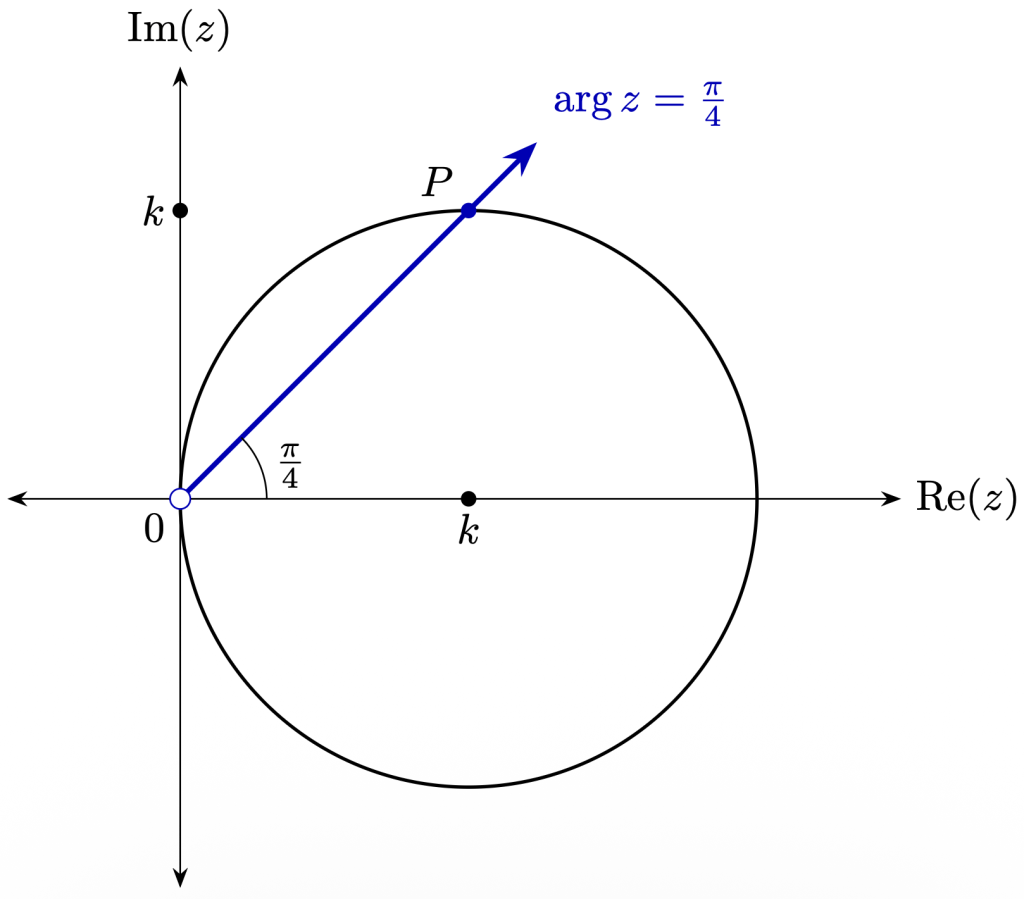
(b) (i) In Cartesian form, P = k+ki.

(ii) In polar form, P = k\sqrt 2\, \mathrm{cis}\, \frac{1}{4}\pi.

(c) C_n : |z - 2^{n}| = 2^{n}.

(d) We have

|v - 2^2| = |1+3i| = \sqrt{10} < \sqrt{16} = 2^2,

so that v lies inside C_2.

(e) Since w has argument \pi/4 it lies on the ray drawn in (a). For any point z on the ray, z lies on C_n if and only if |z| = 2^{n+1/2}. Hence, we aim to find the smallest n such that

|w| < 2^{n+1/2}

Since |w| = 10, taking logarithms yields

\displaystyle n > \frac{\ln 10}{\ln 2}-1/2 \approx 2.82.

Therefore, n = 3.

Question 7. Functions

Solution. (a) (i) Using the Pythagorean identity,

\begin{aligned} \sin^3 x &= \sin x \cdot \sin^2 x \\ &= \sin x \cdot (1-\cos^2 x) \\ &= \sin x - \sin x \cos^2 x. \end{aligned}

(a) (ii) Using linearity and the reverse chain rule,

\begin{aligned} \int \sin^3 x\, \mathrm dx &= \int \sin x\, \mathrm dx + \int(-\sin x) (\cos x)^2\, \mathrm dx \\ &= -\cos x + \frac{(\cos x)^3}{3} + C \\ &= -\cos x + \textstyle{\frac 13} \cos^3 x + C. \end{aligned}

Substituting the limits of the definite integral,

\begin{aligned} \int_0^{\pi/3} \sin^3 x\, \mathrm dx &= \left[ -\cos x + \textstyle{\frac 13} \cos^3 x \right]_0^{\pi/3} \\ &=  \left( -\cos(\pi/3) + \textstyle{\frac 13} \cos^3(\pi/3) \right) - \left( -1 + \textstyle{\frac 13} \cdot 1 \right) \\ &= \left( - \frac 12 + \frac 13 \cdot \left( \frac 12 \right)^3 \right) + \frac 23 \\ &= \frac 5{24}. \end{aligned}

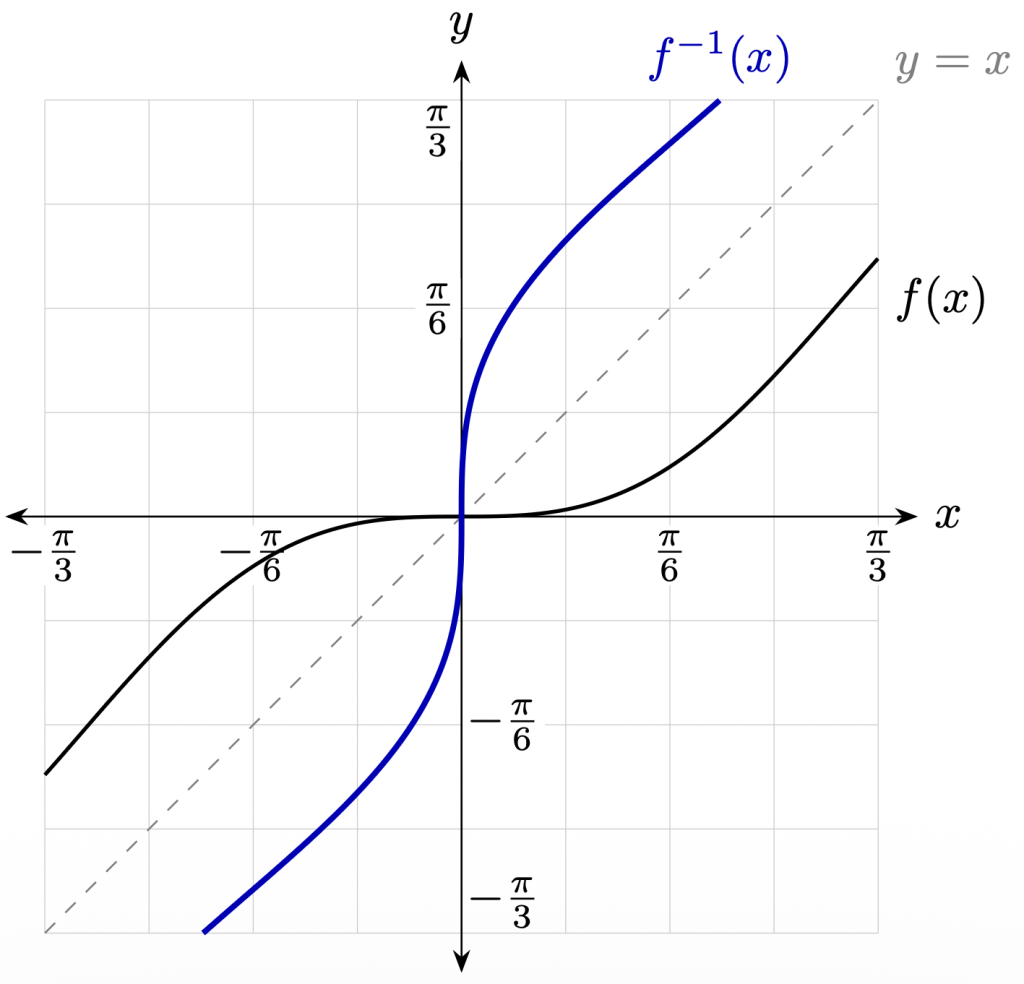
(b) We sketch as follows.

(c) g(x) = f(|x|).

(d) The area of the white space, by (a) (ii), is 5/24. By symmetry, the total area of the white space is 8 \times 5/24 = 5/3. Since the square has an area of (2\pi/3)^2 = 4\pi^2 /9, the required area is what is left over:

\displaystyle \left( \frac{4\pi^2}9 - \frac 53\right)\, \text{units}^2.

Question 8. Vector Geometry

Solution. (a) (i) Substituting x = d_1/a, y = 0, z = 0, we get

\displaystyle a \cdot \frac{d_1}a + b \cdot 0 + c \cdot 0 = d_1,

as required.

(a) (ii) Similarly, the point (d_2/a, 0, 0) lies on the plane

ax + by + cz - d_2 = 0.

By (a) (i), the distance between the planes is the distance from (d_1/a,0,0) to the second plane:

\displaystyle \frac{ |a \cdot d_1/a + b\cdot 0 + c \cdot 0 - d_2| }{\sqrt{a^2+b^2+c^2}} = \frac{ |d_1 - d_2| }{\sqrt{a^2+b^2+c^2}}.

(b) (i) Particularising (a) (ii) to (a,b,c,d_1,d_2) = (2,-1,1,20,-10), we obtain a distance of

\displaystyle \frac{ |20 - (-10)| }{\sqrt{2^2+(-1)^2+1^2}} = \frac{30}{\sqrt 6} = 5\sqrt{6} \approx 12.2\, \text{units}.

(b) (ii) Since the normal vector of P_1 is given by [2,-1,1], the normal is given by the line equation

[x,y,z] = [10,2,2] + t[2,-1,1],\quad t \in \mathbb R.

(b) (iii) Writing in parametric form,

\overrightarrow{OB} = [10+2t, 2-t, 2 + t]

for some t. When the normal intersects P_2 at B,

2(10+2t) - (2-t) + (2+t) = -10 \quad \Rightarrow \quad t = -5.

Therefore,

\overrightarrow{OB} = [10+2\cdot(-5), 2-(-5), 2 + (-5)] = [0, 7, -3],

so that B(0,7, -3).

(c) Since P_3 is parallel to P_1, it has equation

P_3 : 2x - y + z = d_3

for some d_3 to be determined. Just like in (a), (d_3/2, 0, 0) lies on P_3. Denote the distance between P_1 and P_3 by \delta. Since P_1 lies between P_2 and P_3, by (b) (i) the distance between P_2 and P_3 is 30/\sqrt 6 + \delta. By the question, 30/\sqrt 6 + \delta = 3\delta, so that \delta = 15/\sqrt 6. Therefore, by (a) (ii),

\displaystyle \frac{|20 - d_3|}{\sqrt 6} = \frac{15}{\sqrt 6} \quad \Rightarrow \quad d_3 \in \{5, 35\}.

Likewise, the distance between P_2 and P_3 is 3\delta = 45/\sqrt 6. Therefore, by (a) (ii),

\displaystyle \frac{| {-10 - d_3} |}{\sqrt 6} = \frac{45}{\sqrt 6} \quad \Rightarrow \quad d_3 \in \{-55, 35\}.

Therefore, d_3 \in \{5,35\} \cap \{-55,35\} = \{35\}, i.e. d_3 = 35. Hence,

P_3 : 2x - y + z = 35.

(d) (i) Let Q denote the foot of perpendicular from A to the line BC, so that Q = A if A lies on BC. By Pythagoras’ theorem (trivially if Q \in \{A, B\}),

\begin{aligned} |BA|^2 = |BQ|^2 + |QA|^2 \geq |BQ|^2. \end{aligned}

Taking square roots, |QB| \leq |AB|. Similarly, |QC| \leq |AC|. Since B, Q, C are collinear,

|BC| \leq |QB| + |QC| \leq |AB| + |AC|.

Remark 2. This is simply the triangle inequality.

(d) (ii) By (d) (i), equality holds if and only if |QA| = 0 and Q lies between B and C, i.e. A lies on the line segment BC. In that case, C lies on the line AB, which is the normal from (b) (ii). Since C also lies on P_3, it is the intersection of the normal with P_3. The normal has equation

\displaystyle [x,y,z] =  [10,2,2] + t[2,-1,1] = [10+2t, 2-t, 2+t],\quad t \in \mathbb R

while P_3 : 2x - y +z = 35. Intersecting the two objects,

2(10+2t) - (2-t) + (2+t) = 35 \quad \Rightarrow \quad t = 5/2.

Therefore,

\overrightarrow{OC} = [10,2,2] + \frac 52 [2,-1,1] = [15, -1/2, 9/2].

Question 9. Parametric Equations

Solution. (a) Using the double angle identity,

\sqrt{1+ \cos 2x} = \sqrt{2 \cos^2 x} = \sqrt 2 |{\cos x}| = \sqrt 2 \cos x,

for -\pi/2 \leq x \leq \pi/2. Therefore,

\displaystyle \int \sqrt{1 + \cos 2x}\, \mathrm dx = \sqrt 2 \int \cos x\, \mathrm dx = \sqrt 2 \sin x + C.

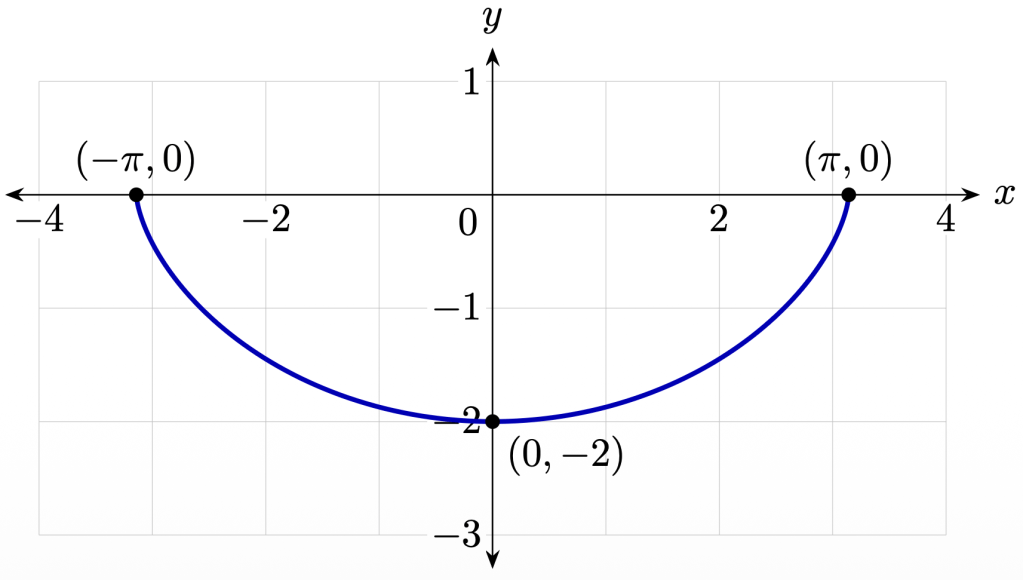
(b) We sketch as follows

(c) (i) Taking derivatives,

\begin{aligned} x'(t) &= a((2t)' + (\sin 2t)') \\ &= a(2 + \cos 2t \cdot 2) \\ &= 2a + 2a \cos 2t. \end{aligned}

Using the double angle identity again,

\begin{aligned} y'(t) &= (-2a \cos^2 t)' \\ &= -2a \cdot ((\cos t)^2)' \\ &= -2a \cdot 2\cos t \cdot (-\sin t) \\ &= 2a \cdot 2 \sin t \cos t \\ &= 2a \sin 2t. \end{aligned}

(c) (ii) Using (c) (i), \mathbf v = 2a[1 + \cos 2t, \sin 2t], so that

\begin{aligned} \mathbf v \cdot \mathbf v &= (2a)^2 \cdot ((1+\cos 2t)^2 + \sin^2 2t) \\ &= 4a^2 \cdot (1 + 2 \cos 2t + \cos^2 2t + \sin^2 2t) \\ &= 4a^2 \cdot (2 + 2 \cos 2t) \\ &= 8a^2 \cdot (1+ \cos 2t). \end{aligned}

Taking square roots,

\sqrt{\mathbf v \cdot \mathbf v} = 2a\sqrt 2 \cdot \sqrt{1+\cos 2t}.

By linearity, the required arc length is given by

\begin{aligned} I = \int_{-\pi/2}^{\pi/2} 2a\sqrt 2 \cdot \sqrt{1+\cos 2t}\, \mathrm dt &=  2a\sqrt 2 \int_{-\pi/2}^{\pi/2} \sqrt{1+\cos 2t}\, \mathrm dt. \end{aligned}

(d) (i) By (a) and (c) (ii),

\begin{aligned} I &= 2a\sqrt 2 \cdot \left[ \sqrt 2 \sin t \right]_{-\pi/2}^{\pi/2} \\ &=  2a\sqrt 2 \cdot \sqrt 2  \cdot (1-(-1)) \\ &= 8a. \end{aligned}

Since a = 1 and the string length is 4 units, we have 8\cdot 1 = 4k \Rightarrow k = 2.

(d) (ii) The arc length is given by I = 8.

Question 10. Differential Equations

Solution. (a) By the chain rule,

\displaystyle \frac{\mathrm dA}{\mathrm dX} \cdot \frac{\mathrm dX}{\mathrm dt} = \frac{\mathrm dA}{\mathrm dt} = -\frac 14 \frac{\mathrm dX}{\mathrm dt}.

Therefore,

\displaystyle \frac{\mathrm dA}{\mathrm dX} = -\frac 14 \quad \Rightarrow \quad A = \int -\frac 14\, \mathrm dX = -\frac 14 X + C.

Since A(0) = 2, we have 2 = 0 + C so that C = 2, hence

A = -\frac 14 X + 2.

(b) Substituting the expressions for A and B,

\begin{aligned} \frac{\mathrm dX}{\mathrm dt} &= \frac 13 \left( -\frac 14 X + 2 \right) \left( -\frac 34X + 3 \right) \\ &= \frac 13 \cdot \frac 14 \cdot \frac 34 \cdot (-X + 8) \cdot (-X + 4) \\ &= \frac 1{16} \cdot (-1) \cdot (X-8) \cdot (-1) \cdot (X-4) \\ &= \frac 1{16} (X-8)(X-4). \end{aligned}

(c) Using partial fraction decomposition, there exists constants A,B such that

\displaystyle \frac 1{(X-8)(X-4)} = \frac A{X-8} + \frac B{X-4}.

Clearing denominators,

1 = A(X-4) + B(X-8).

Setting X = 8 yields A = 1/4, and setting X = 4 yields B = -1/4, so that

\displaystyle \frac 1{(X-8)(X-4)} = \frac {1/4}{X-8} + \frac {-1/4}{X-4} = \frac 14 \left( \frac 1{X-8} - \frac 1{X-4} \right).

(d) (i) By the method of separable variables,

\displaystyle \int \frac {1}{(X-8)(X-4)}\, \mathrm dX = \int \frac 1{16}\, \mathrm dt = \frac 1{16}t + C_1.

To evaluate the left-hand side, we use (c) and linearity:

\begin{aligned} \int \frac {1}{(X-8)(X-4)}\, \mathrm dX &= \frac 14 \int \left( \frac 1{X-8} - \frac 1{X-4} \right)\, \mathrm dX \\ &= \frac 14 \left( \ln|X-8| - \ln |X-4| \right) +C_2\\ &= \frac 14 \ln \left| \frac{X-8}{X-4} \right| + C_2. \end{aligned}

Abbreviating C := C_1 - C_2,

\begin{aligned} \frac 14 \ln \left| \frac{X-8}{X-4} \right| &= \frac 1{16}t + C \\ \left| \frac{X-8}{X-4} \right| &= e^{\frac 1{4}t + 4C} \\ \frac{X-8}{X-4} &= \pm e^{4C} e^{\frac 14 t} =: Ae^{\frac 14 t} \\ X(1- Ae^{\frac 14 t}) &= 4(2 - Ae^{\frac 14 t}) \\ X &= \frac{ 4(2 - Ae^{\frac 14 t}) }{ 1 - Ae^{\frac 14 t} }. \end{aligned}

Using X(1) = 1,

\displaystyle \frac{1-8}{1-4} = Ae^{\frac 14} \quad \Rightarrow \quad A = \frac{7}{3}e^{-\frac 14}.

Therefore,

\begin{aligned} X &= \frac{ 4\left(2 - \frac{7}{3}e^{-\frac 14} \cdot e^{\frac 14 t}\right) }{ 1 - \frac{7}{3}e^{-\frac 14} \cdot e^{\frac 14 t} } \\ &= \frac{  4\left(6 - 7 e^{\frac 14 (t-1)}\right) }{  3 - 7\cdot e^{\frac 14 (t-1)} } \\ &= \frac{  24 - 28 e^{\frac 14 (t-1)} }{  3 - 7e^{\frac 14 (t-1)} }. \end{aligned}

(d) (ii) Writing 24 = 12 + 12,

\begin{aligned} X &= \frac{  12 - 28 e^{\frac 14 (t-1)} + 12 }{  3 - 7e^{\frac 14 (t-1)} }\\ &= \frac{ 4(3 - 7 e^{\frac 14 (t-1)}) + 12 }{ 3 - 7e^{\frac 14 (t-1)} } \\ &= 4 + \frac{ 12 }{ 3 - 7e^{\frac 14 (t-1)} }. \end{aligned}

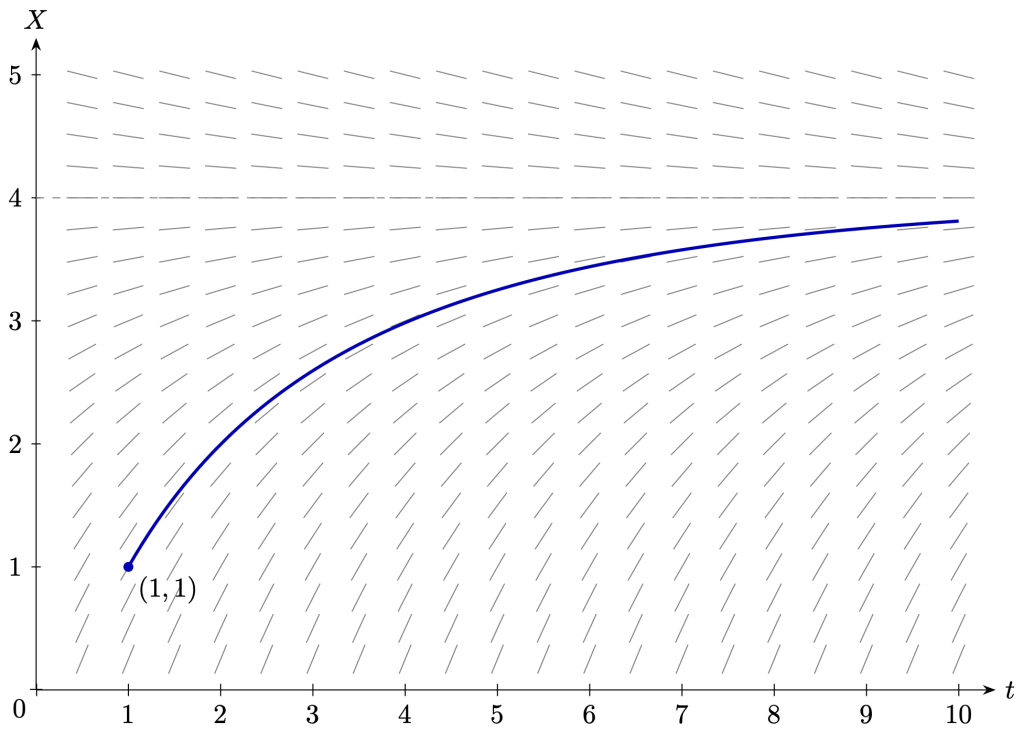
(d) (iii) We note that as t \to \infty, we have

\displaystyle X \to 4 + 0 = 4.

(e) We draw as follows.

Remark 3. The diagrams have been drawn and the solutions have been verified with the help of Generative AI.

—Joel Kindiak, 15 Oct 26, 1234H

,

Published by


Leave a Reply