Questions are publicly available. Do comment if you spot any errors. Download the solutions here.
Remark 1. In SACE Stage 2 Mathematical Methods, is used for probability; we write instead.
Question 1. Normal Distribution
Solution. (a) (i) Since , the required probability is
(a) (ii) Similarly,
(b) Since , we have . Using -scores,
(c) Since the dashes are one standard deviation apart and the dotted line marks the mean, the three boxes (from left to right) are labelled , and .
(d) (i) The sample mean of independent observations has
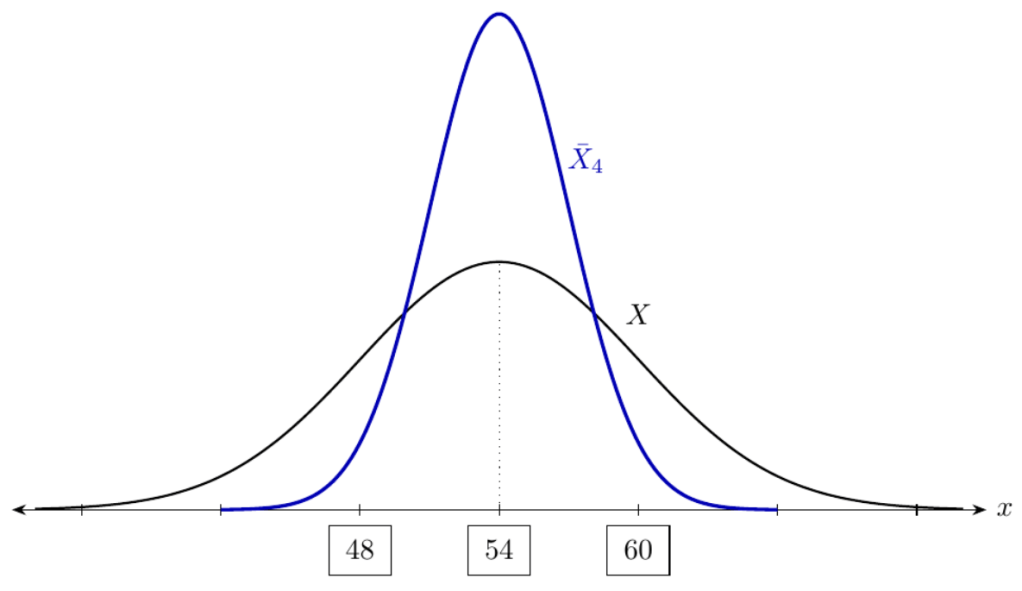
(d) (ii) The probability density function of has the same centre , half the spread, and hence twice the maximum height. We sketch as follows.
Remark 2. Since the area under every probability density function is , halving the standard deviation must double the maximum height of the curve.
Question 2. Kinematics
Solution. (a) Substituting ,
(b) (i) Integrating with respect to ,
Since , we have so that , hence , as required.
(b) (ii) By (b) (i),
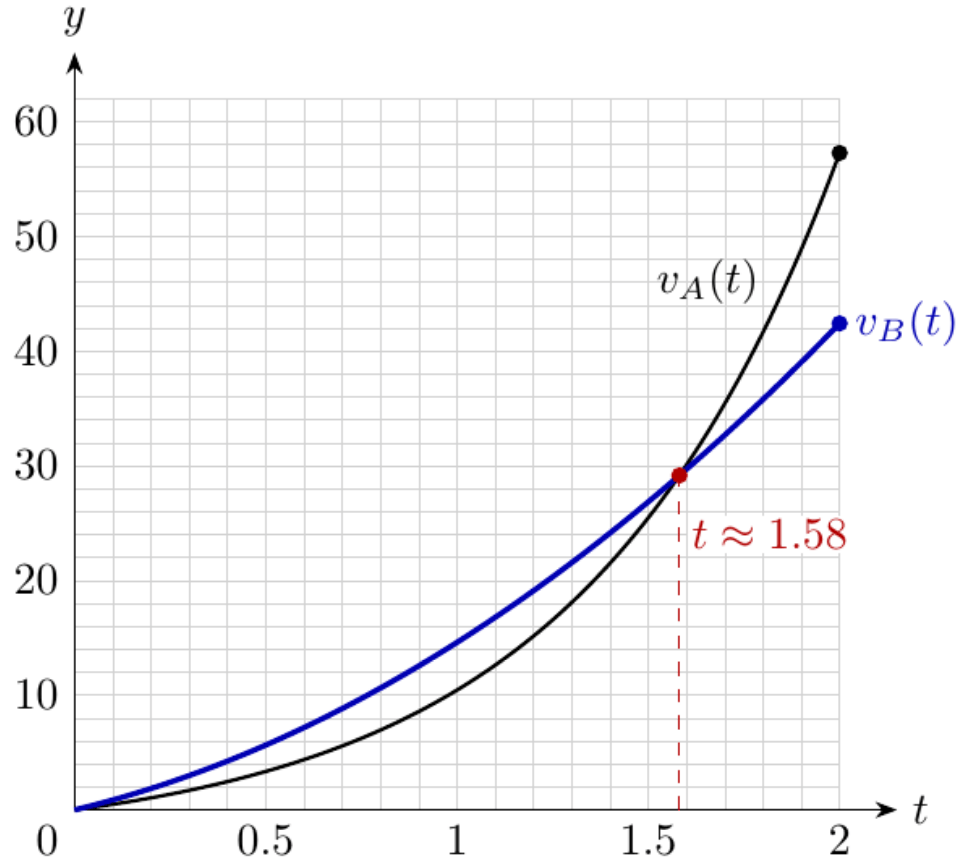
(c) We note that , and . We sketch as follows.
(d) Solving using software yields or . By (c), the velocity of Car A was greater than that of Car B for .
(e) Integrating with ,
Since both cars only travel forwards, the distance each car travels equals its displacement. Since , the models suggest that Car B travelled the furthest.
Remark 3. Although Car A ends the seconds much faster, Car B was faster for most of the interval, namely . This is why Car B is narrowly ahead.
Question 3. Logarithmic Functions
Solution. (a) By the chain rule, .
(b) By (a), .
(c) Similarly, , so that and . Since lies above ,
(d) By (c), . Therefore, is obtained from by a dilation of factor parallel to the -axis (i.e. from the -axis).
Question 4. Confidence Intervals
Solution. (a) (i) The sample proportion is . Using a confidence level, , so that the confidence interval is
(a) (ii) Yes.
(a) (iii) The value does not lie in the confidence interval, since .
(b) (i) The confidence intervals labelled , and do not contain .
(b) (ii) Only the confidence interval labelled lies entirely above .
Remark 4. Here of the confidence intervals miss the population proportion, which is close to the that we expect from confidence intervals.
(c) (i) .
(c) (ii) (1) The required probability is
(c) (ii) (2) Using complements,
(d) Let denote the number of independent confidence intervals that will not contain the population proportion. We require
where the inequality flips since . Therefore, the minimum number is . As a check, while .
Question 5. Differentiation from First Principles
Solution. (a) For and small ,
Therefore,
(b) By (a), the slope of the tangent at is .
Question 6. Continuous Random Variables
Solution. (a) Since is a probability density function,
(b) (i) Similarly,
(b) (ii) The probability that a randomly chosen bag contains between and grams of sand (i.e. at most grams of excess sand) is approximately .
(c) By the definition of the mean,
(d) (i) Using a confidence level, , so that the confidence interval is
(d) (ii) No. By (c), the mean net weight before the alteration is grams, which lies inside the confidence interval. Hence, with confidence, the confidence interval does not rule out that the mean net weight is unchanged.
Question 7. Tangents and Conjectures
Solution. (a) Writing , we have . Hence, and , so that the tangent at is
(b) Setting , . The -intercept is .
(c) The -intercept of the tangent to at is . (This also agrees with (b), where .)
(d) We prove the conjecture. Writing , by the chain rule,
Since , , so that
Therefore, the tangent to at has equation
Setting and multiplying both sides by ,
Hence, the -intercept is for every non-negative constant , which proves the conjecture.
Question 8. Integration Applications
Solution. (a) (i) At :00 am ( hours after midnight), vehicles were entering Park-o-Rama at a rate of vehicles per hour.
(a) (ii) (1) The graph of passes through and , and its maximum occurs at . Therefore, vehicles were leaving at the maximum rate hours after midnight.
(a) (ii) (2) By Table 2, vehicles entered during the -hour period.
(a) (ii) (3) By Table 2, the number of vehicles that left during the final hours is
(a) (iii) The number of vehicles in Park-o-Rama at time is , which is maximised when with dropping below , i.e. at . Indeed, . Therefore, the maximum occurred hours after midnight.
(b) (i) EVs weigh tonnes, and the proportion of non-EVs is .
(b) (ii) By (b) (i),
(b) (iii) By (a) (iii), there are at most vehicles in Park-o-Rama at any point during the day. Let denote the total weight of these vehicles. By the central limit theorem,
Hence,
At any other time, there are fewer vehicles in Park-o-Rama, so the probability that their total weight exceeds tonnes is even smaller. Therefore, the engineers would not be concerned.
Question 9. Exponential Functions
Solution. (a) For , yields , so that
For , yields , so that
Therefore, the -coordinates of and are and respectively.
(b) (i) Differentiating, the stationary points satisfy
where we used (since ) and . Since this equation has exactly one solution, this is the only stationary point.
(b) (ii) (1) Denote the stationary point by . By (b) (i), , so that
Therefore,
(b) (ii) (2) Since , . Hence, the -coordinate is positive if and only if . Since , this holds if and only if , i.e. .
Remark 5. As a check, setting and in (b) (ii) (1) recovers the -coordinates and from (a).
Question 10. Calculus of Exponential and Trigonometric Functions
Solution. (a) At , :
Since , , so that for , the -coordinate of is .
(b) (i) By the product rule and the chain rule,
(b) (ii) Setting and dividing by ,
Therefore, or , so that .
(c) By (a), . By (b) (ii), . Hence, , so that the graphs of and intersect at . This is the intersection labelled in Figure 10, so that .
(d) Let denote the other intersection point. On region , (e.g. ), while on region , (e.g. ). Therefore,
Therefore, the area of region exceeds the area of region by exactly units.
Remark 6. We never needed the value of : it cancels when the two integrals are combined. Furthermore, the two graphs in Figure 9 touch at because both their values and their gradients agree there: and, by (c), .
Remark 7. The diagrams have been drawn and the solutions have been verified with the help of Generative AI.


![\displaystyle \mathbb E[\bar X_4] = \mu = 54, \quad \sigma_{\bar X_4} = \frac{\sigma}{\sqrt 4} = \frac 62 = 3.](https://s0.wp.com/latex.php?latex=%5Cdisplaystyle+%5Cmathbb+E%5B%5Cbar+X_4%5D+%3D+%5Cmu+%3D+54%2C+%5Cquad+%5Csigma_%7B%5Cbar+X_4%7D+%3D+%5Cfrac%7B%5Csigma%7D%7B%5Csqrt+4%7D+%3D+%5Cfrac+62+%3D+3.&bg=ffffff&fg=000&s=0&c=20201002)





![\displaystyle s_B(2) = \int_0^2 (6.6t^2 + 8t)\, \mathrm dt = \left[ 2.2t^3 + 4t^2 \right]_0^2 = 17.6 + 16 = 33.6\ \text{m}.](https://s0.wp.com/latex.php?latex=%5Cdisplaystyle+s_B%282%29+%3D+%5Cint_0%5E2+%286.6t%5E2+%2B+8t%29%5C%2C+%5Cmathrm+dt+%3D+%5Cleft%5B+2.2t%5E3+%2B+4t%5E2+%5Cright%5D_0%5E2+%3D+17.6+%2B+16+%3D+33.6%5C+%5Ctext%7Bm%7D.&bg=ffffff&fg=000&s=0&c=20201002)


![\displaystyle 1 = \int_{400}^{440} \frac kx\, \mathrm dx = k \left[ \ln x \right]_{400}^{440} = k \ln \left( \frac{440}{400} \right) = k \ln 1.1 \quad \Rightarrow \quad k = \frac{1}{\ln 1.1}.](https://s0.wp.com/latex.php?latex=%5Cdisplaystyle+1+%3D+%5Cint_%7B400%7D%5E%7B440%7D+%5Cfrac+kx%5C%2C+%5Cmathrm+dx+%3D+k+%5Cleft%5B+%5Cln+x+%5Cright%5D_%7B400%7D%5E%7B440%7D+%3D+k+%5Cln+%5Cleft%28+%5Cfrac%7B440%7D%7B400%7D+%5Cright%29+%3D+k+%5Cln+1.1+%5Cquad+%5CRightarrow+%5Cquad+k+%3D+%5Cfrac%7B1%7D%7B%5Cln+1.1%7D.&bg=ffffff&fg=000&s=0&c=20201002)


![\begin{aligned} A - B &= \int_{\pi/2}^{c} (f'(x) - f''(x))\, \mathrm dx - \int_c^{2\pi} (f''(x) - f'(x))\, \mathrm dx \\ &= \int_{\pi/2}^{2\pi} (f'(x) - f''(x))\, \mathrm dx \\ &= \left[ f(x) - f'(x) \right]_{\pi/2}^{2\pi} \\ &= (e^{-1} - 0) - (1 - 1) \\ &= \frac 1e. \end{aligned}](https://s0.wp.com/latex.php?latex=%5Cbegin%7Baligned%7D+A+-+B+%26%3D+%5Cint_%7B%5Cpi%2F2%7D%5E%7Bc%7D+%28f%27%28x%29+-+f%27%27%28x%29%29%5C%2C+%5Cmathrm+dx+-+%5Cint_c%5E%7B2%5Cpi%7D+%28f%27%27%28x%29+-+f%27%28x%29%29%5C%2C+%5Cmathrm+dx+%5C%5C+%26%3D+%5Cint_%7B%5Cpi%2F2%7D%5E%7B2%5Cpi%7D+%28f%27%28x%29+-+f%27%27%28x%29%29%5C%2C+%5Cmathrm+dx+%5C%5C+%26%3D+%5Cleft%5B+f%28x%29+-+f%27%28x%29+%5Cright%5D_%7B%5Cpi%2F2%7D%5E%7B2%5Cpi%7D+%5C%5C+%26%3D+%28e%5E%7B-1%7D+-+0%29+-+%281+-+1%29+%5C%5C+%26%3D+%5Cfrac+1e.+%5Cend%7Baligned%7D&bg=ffffff&fg=000&s=0&c=20201002)


Leave a Reply