Questions are publicly available. Do comment if you spot any errors. Download the solutions here.
Remark 1. In SACE Stage 2 Mathematical Methods, is used for probability; we write instead.
Question 1. Differentiation Techniques
Solution. (a) By the chain rule,
(b) Writing , by the chain rule,
(c) Writing , by the product rule and the chain rule,
Question 2. Continuous Random Variables
Solution. (a) (i) Using software (or (c)),
(a) (ii) The probability that a randomly chosen customer receives their order between and minutes after placing it is approximately .
(b) (i) The required probability is
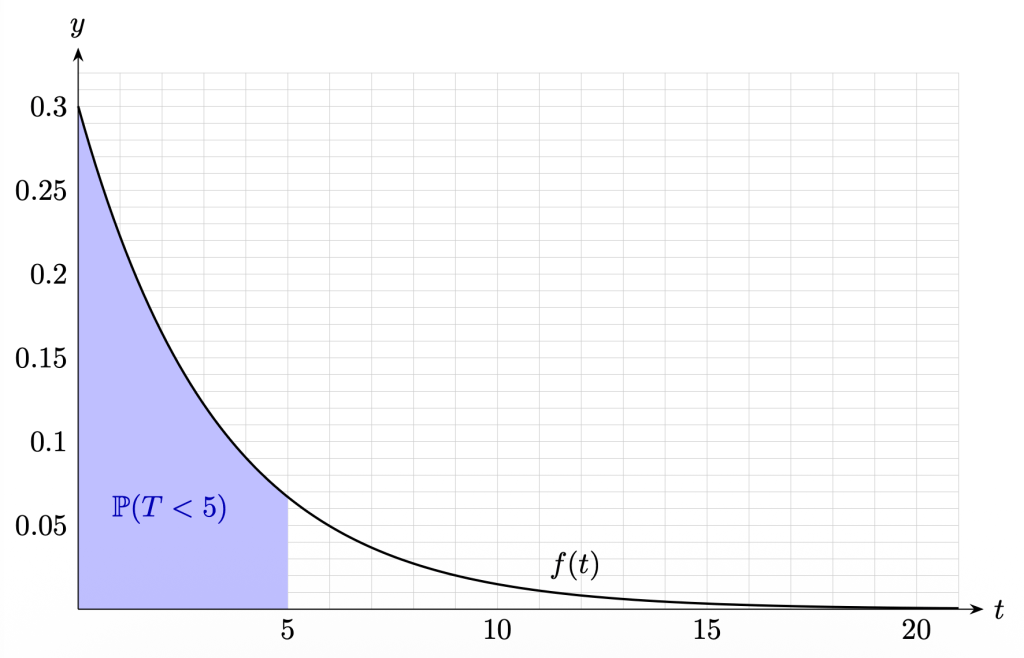
(b) (ii) The probability is the area under from to , shaded below.
(c) By the reverse chain rule,
(d) By (c),
Therefore,
Question 3. Differentiation from First Principles
Solution. (a) For ,
Therefore,
(b) By (a), , and . Therefore, the tangent at is
(c) Setting , the -coordinate of is . Therefore, , so that .
Question 4. Binomial Distribution and Confidence Intervals
Solution. (a) (i) Let denote the number of gold cards in one randomly selected pack.
(a) (i) (1) .
(a) (i) (2) .
(a) (i) (3) Using complements,
(a) (ii) The packs contain independent cards. Let denote the number of gold cards among them. Then
so the chance of finding at least one gold card is about , not .
(b) (i) The sample contains cards, so that
(b) (ii) Using a confidence level, , so that the confidence interval is
(b) (iii) No. The claim is that , but the confidence interval contains values above (indeed, most of the interval lies above ). Hence, we cannot be confident that , so the interval does not support the claim. (It does not refute the claim either, since it also contains values below .)
Question 5. Stationary Points and Conjectures
Solution. (a) (i) Writing , by the chain rule,
(a) (ii) The stationary points satisfy . Since for , we require
Both values satisfy , so has exactly two stationary points, at and .
(b) (i) For , the -coordinates of the stationary points are , and respectively.
(b) (ii) The -coordinates of the two stationary points of are and .
(b) (iii) We prove the conjecture. Writing , by the chain rule,
Setting and multiplying by ,
Both values satisfy . Therefore, for every constant , has exactly two stationary points, at and .
Remark 2. Equivalently, , so the graph of is a translation of the graph of by units in the positive -direction (and units in the positive -direction). Translations move stationary points without changing their number.
Question 6. Graphing Techniques
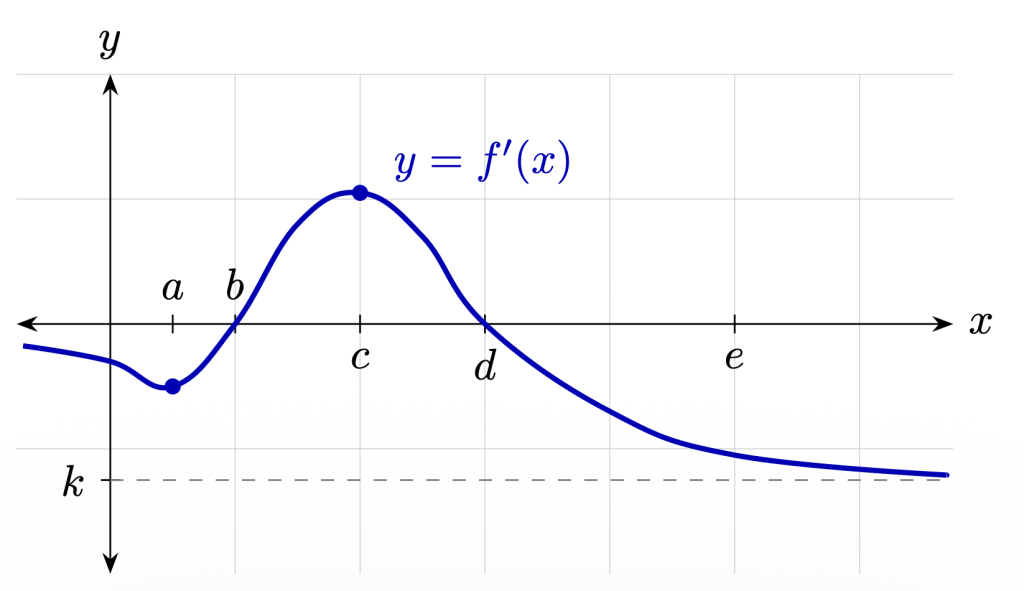
Solution. (a) The function decreases until , increases from to , and decreases after . We complete the sign diagram as follows.
(b) (i) . Since only at and , and is concave down to the left of , the gradient decreases until , where the curve is steepest on its decreasing part.
(b) (ii) and , since is a local maximum above the -axis.
(c) for , where is concave up.
(d) The graph of is negative with a minimum at , crosses zero at , has a positive maximum at , crosses zero at , and then decreases towards the horizontal asymptote from above. We sketch as follows.
Question 7. Normal Distribution and Confidence Intervals
Solution. (a) (i) Let denote the daily milk production of a randomly selected cow. Then .
(a) (ii) Since , . Using -scores,
(b) The daily milk productions of the randomly chosen cows are independent and each normally distributed. Since a sum of independent normally distributed random variables is normally distributed, is normally distributed (for any , without needing the central limit theorem).
(c) (i) By the properties of sums of independent random variables,
(c) (ii) (1) Since , .
(c) (ii) (2) Similarly, .
(d) Using a confidence level, , so that the confidence interval is
(e) Yes. The entire confidence interval lies above the original mean of litres, since . Hence, with confidence, the new feeding plan has increased the mean daily milk production per cow.
(f) (i) The mean daily milk production per cow would be
(f) (ii) No. The confidence interval contains values below litres (for instance ), since its lower bound is less than . Hence, we cannot be confident that the cows will have a mean total daily milk production of more than litres.
Question 8. Derivatives of Trigonometric Functions
Solution. (a) (i) , so the robot initially leans radians to the right.
(a) (ii) By the product rule and the chain rule,
so that .
(a) (iii) At seconds after release, the angle of lean of the robot is increasing (i.e. the robot is rotating towards the right) at a rate of approximately radians per second.
(a) (iv) The robot leans to the left with its maximum angle when attains its minimum. Using software, this occurs at seconds after release (where ).
(b) (i) By the product rule,
(b) (ii) Since , if and only if . Since would force , we may divide by :
For , the exact values are
since the next solution exceeds .
Question 9. Discrete Random Variables
Solution. (a) Substituting and ,
As a check, the seven probabilities in the table sum to .
(b) By the chain rule,
Therefore,
(c) (i) By the product rule and (b),
(c) (ii) By (c) (i) and (b),
(d) Since and , the values of within one standard deviation of the mean are . By (a), the required probability is
Remark 3. The random variable follows a Poisson distribution with parameter , whose mean and variance both equal . The exact answer to (d) is .
Question 10. Integration Applications
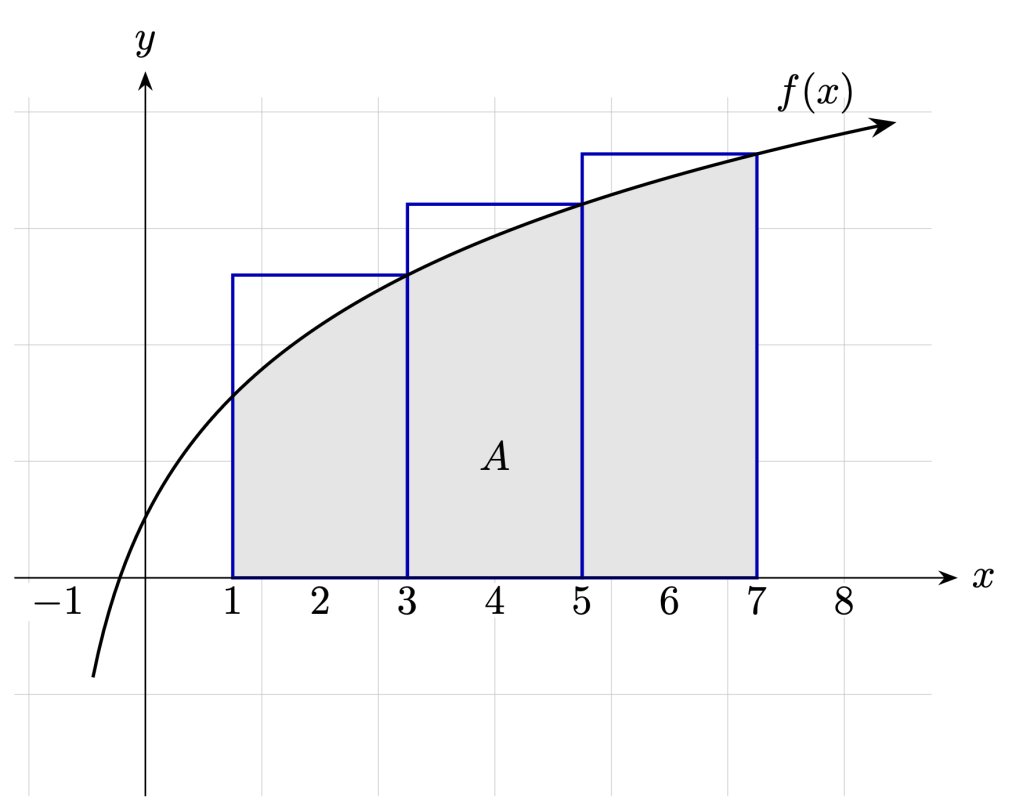
Solution. (a) (i) Since is increasing, the upper estimate uses the right endpoints of the subintervals , and . We draw the rectangles as follows.
(a) (ii) Each rectangle has width , so that
(a) (iii) The exact value of is
(b) (i) By the product rule,
(b) (ii) By (b) (i),
For , . Therefore,
(c) Since
the graph of is the graph of translated unit in the negative -direction.
(d) By (c), the region under from to is the translation of the region under from to . By (b) (ii),
Therefore, and .
Remark 4. As a check, , as expected for an upper estimate.
Remark 5. The diagrams have been drawn and the solutions have been verified with the help of Generative AI.



![\displaystyle 0.8 = \mathbb P(T < r) = \int_0^r 0.3e^{-0.3t}\, \mathrm dt = \left[ -e^{-0.3t} \right]_0^r = 1 - e^{-0.3r}.](https://s0.wp.com/latex.php?latex=%5Cdisplaystyle+0.8+%3D+%5Cmathbb+P%28T+%3C+r%29+%3D+%5Cint_0%5Er+0.3e%5E%7B-0.3t%7D%5C%2C+%5Cmathrm+dt+%3D+%5Cleft%5B+-e%5E%7B-0.3t%7D+%5Cright%5D_0%5Er+%3D+1+-+e%5E%7B-0.3r%7D.&bg=ffffff&fg=000&s=0&c=20201002)


![\mathbb E[X] = 10 \cdot 0.035 = 0.35](https://s0.wp.com/latex.php?latex=%5Cmathbb+E%5BX%5D+%3D+10+%5Ccdot+0.035+%3D+0.35&bg=ffffff&fg=000&s=0&c=20201002)







![[1,3]](https://s0.wp.com/latex.php?latex=%5B1%2C3%5D&bg=ffffff&fg=000&s=0&c=20201002)
![[3,5]](https://s0.wp.com/latex.php?latex=%5B3%2C5%5D&bg=ffffff&fg=000&s=0&c=20201002)
![[5,7]](https://s0.wp.com/latex.php?latex=%5B5%2C7%5D&bg=ffffff&fg=000&s=0&c=20201002)


![\displaystyle \begin{aligned} A = \int_2^8 \ln(2x^2)\, \mathrm dx &= \left[ x \left( \ln(2x^2) - 2 \right) \right]_2^8 \\ &= 8(\ln 128 - 2) - 2(\ln 8 - 2) \\ &= 56 \ln 2 - 16 - 6 \ln 2 + 4 \\ &= 50 \ln 2 - 12. \end{aligned}](https://s0.wp.com/latex.php?latex=%5Cdisplaystyle+%5Cbegin%7Baligned%7D+A+%3D+%5Cint_2%5E8+%5Cln%282x%5E2%29%5C%2C+%5Cmathrm+dx+%26%3D+%5Cleft%5B+x+%5Cleft%28+%5Cln%282x%5E2%29+-+2+%5Cright%29+%5Cright%5D_2%5E8+%5C%5C+%26%3D+8%28%5Cln+128+-+2%29+-+2%28%5Cln+8+-+2%29+%5C%5C+%26%3D+56+%5Cln+2+-+16+-+6+%5Cln+2+%2B+4+%5C%5C+%26%3D+50+%5Cln+2+-+12.+%5Cend%7Baligned%7D&bg=ffffff&fg=000&s=0&c=20201002)


Leave a Reply