Questions are publicly available. Do comment if you spot any errors. Download the solutions here.
Remark 1. In SACE Stage 2 Specialist Maths, the following equivalent notation is used:

Furthermore, we use row vector notation for vectors:
![\displaystyle [x,y,z] \equiv \begin{bmatrix} x \\ y \\ z \end{bmatrix}.](https://s0.wp.com/latex.php?latex=%5Cdisplaystyle+%5Bx%2Cy%2Cz%5D+%5Cequiv+%5Cbegin%7Bbmatrix%7D+x+%5C%5C+y+%5C%5C+z+%5Cend%7Bbmatrix%7D.&bg=ffffff&fg=000&s=0&c=20201002)
Question 1. Lines and Planes
Solution. (a) Substituting the parametric equations of 


Setting 


(b) The direction vector ![[1, -2, -1]](https://s0.wp.com/latex.php?latex=%5B1%2C+-2%2C+-1%5D&bg=ffffff&fg=000&s=0&c=20201002)


Therefore, the required plane is 
Question 2. Related Rates of Change
Solution. (a) 
(b) (i) In the right-angled triangle with vertices 


(b) (ii) By the chain rule,

(c) Differentiating 

By (a) and (b) (ii),

Question 3. Complex Numbers
Solution. (a) (i) Since 

(a) (ii) Similarly, since 

(b) (i) Dividing moduli and subtracting arguments,

(b) (ii) By (b) (i), 
(c) Since 


Question 4. Mathematical Induction
Solution. (a) For the base case 


which is divisible by 


(b) By (a), 

which is divisible by 

Question 5. Systems of Linear Equations
Solution. (a) (i) The augmented matrix is
![\displaystyle \left[ \begin{array}{ccc|c} 1 & 1 & -3 & 4 \\ 1 & -1 & -a & 2 \\ 3 & a & -1 & 8 \end{array} \right].](https://s0.wp.com/latex.php?latex=%5Cdisplaystyle+%5Cleft%5B+%5Cbegin%7Barray%7D%7Bccc%7Cc%7D+1+%26+1+%26+-3+%26+4+%5C%5C+1+%26+-1+%26+-a+%26+2+%5C%5C+3+%26+a+%26+-1+%26+8+%5Cend%7Barray%7D+%5Cright%5D.&bg=ffffff&fg=000&s=0&c=20201002)
(a) (ii) Applying 

![\displaystyle \left[ \begin{array}{ccc|c} 1 & 1 & -3 & 4 \\ 0 & 2 & a - 3 & 2 \\ 0 & 3 - a & -8 & 4 \end{array} \right].](https://s0.wp.com/latex.php?latex=%5Cdisplaystyle+%5Cleft%5B+%5Cbegin%7Barray%7D%7Bccc%7Cc%7D+1+%26+1+%26+-3+%26+4+%5C%5C+0+%26+2+%26+a+-+3+%26+2+%5C%5C+0+%26+3+-+a+%26+-8+%26+4+%5Cend%7Barray%7D+%5Cright%5D.&bg=ffffff&fg=000&s=0&c=20201002)
Applying 
![\displaystyle \begin{aligned} &[\, 0,\ 2(3-a) - 2(3-a),\ -16 - (3-a)(a-3) \ :\ 8 - 2(3-a) \,] \\ = \ &[\, 0,\ 0,\ a^2 - 6a - 7 \ :\ 2a + 2 \,] \\ = \ &[\, 0,\ 0,\ (a-7)(a+1) \ :\ 2(a+1) \,], \end{aligned}](https://s0.wp.com/latex.php?latex=%5Cdisplaystyle+%5Cbegin%7Baligned%7D+%26%5B%5C%2C+0%2C%5C+2%283-a%29+-+2%283-a%29%2C%5C+-16+-+%283-a%29%28a-3%29+%5C+%3A%5C+8+-+2%283-a%29+%5C%2C%5D+%5C%5C+%3D+%5C+%26%5B%5C%2C+0%2C%5C+0%2C%5C+a%5E2+-+6a+-+7+%5C+%3A%5C+2a+%2B+2+%5C%2C%5D+%5C%5C+%3D+%5C+%26%5B%5C%2C+0%2C%5C+0%2C%5C+%28a-7%29%28a%2B1%29+%5C+%3A%5C+2%28a%2B1%29+%5C%2C%5D%2C+%5Cend%7Baligned%7D&bg=ffffff&fg=000&s=0&c=20201002)
as required.
(b) Figure 4 shows three planes, no two of which are parallel, with no common point of intersection. This corresponds to an inconsistent system, which occurs when 


![[1,1,-3]](https://s0.wp.com/latex.php?latex=%5B1%2C1%2C-3%5D&bg=ffffff&fg=000&s=0&c=20201002)
![[1,-1,-7]](https://s0.wp.com/latex.php?latex=%5B1%2C-1%2C-7%5D&bg=ffffff&fg=000&s=0&c=20201002)
![[3,7,-1]](https://s0.wp.com/latex.php?latex=%5B3%2C7%2C-1%5D&bg=ffffff&fg=000&s=0&c=20201002)
(c) For 


Therefore, the three planes intersect at the single point 
(d) (i) 
(d) (ii) For 


Therefore, the line is

or in vector form, ![\mathbf r = [3, 1, 0] + t[1, 2, 1]](https://s0.wp.com/latex.php?latex=%5Cmathbf+r+%3D+%5B3%2C+1%2C+0%5D+%2B+t%5B1%2C+2%2C+1%5D&bg=ffffff&fg=000&s=0&c=20201002)
Question 6. Logistic Differential Equations
Solution. (a) (i) Combining the fractions on the right-hand side,

(a) (ii) Rewriting the differential equation as

and separating variables, by (a) (i),

Therefore,

(b) The slope field shows horizontal segments at 


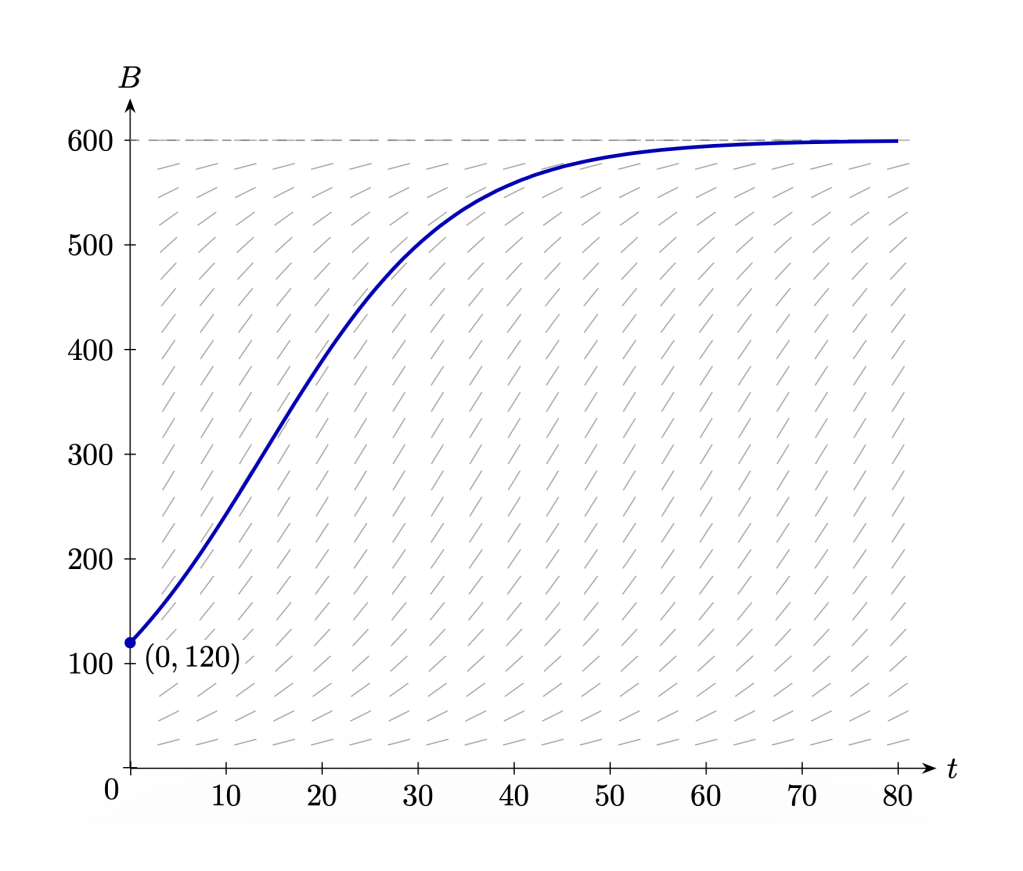
(c) (i) 
(c) (ii) Setting 


(c) (iii) Setting

Therefore, the population exceeds 

Question 7. Integration and Volumes of Revolution
Solution. (a) Integrating by parts with 


(b) (i) For 


(b) (ii) The curve meets the 


i.e. at 

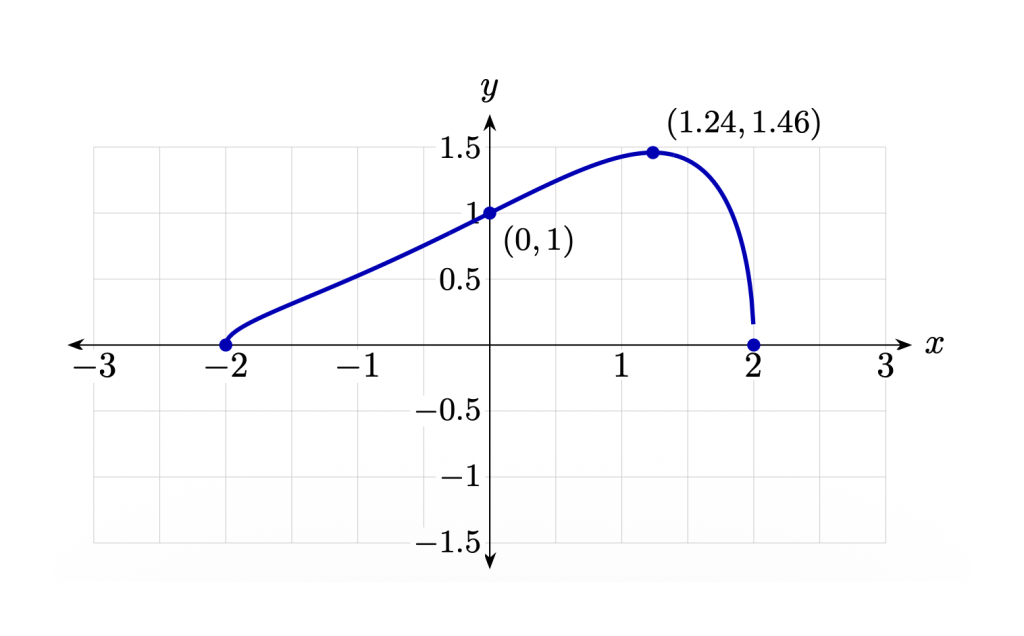
(c) (i) By the volume of revolution formula,

(c) (ii) By (a),

Therefore, by (c) (i),
![\displaystyle \begin{aligned} V &= \frac{\pi}{4} \left[ e^x(2 + 2x - x^2) \right]_{-2}^2 \\ &= \frac{\pi}{4} \left( e^2 (2 + 4 - 4) - e^{-2}(2 - 4 - 4) \right) \\ &= \frac{\pi}{4} (2e^2 + 6e^{-2}) \\ &= \frac{\pi}{2} (e^2 + 3e^{-2}). \end{aligned}](https://s0.wp.com/latex.php?latex=%5Cdisplaystyle+%5Cbegin%7Baligned%7D+V+%26%3D+%5Cfrac%7B%5Cpi%7D%7B4%7D+%5Cleft%5B+e%5Ex%282+%2B+2x+-+x%5E2%29+%5Cright%5D_%7B-2%7D%5E2+%5C%5C+%26%3D+%5Cfrac%7B%5Cpi%7D%7B4%7D+%5Cleft%28+e%5E2+%282+%2B+4+-+4%29+-+e%5E%7B-2%7D%282+-+4+-+4%29+%5Cright%29+%5C%5C+%26%3D+%5Cfrac%7B%5Cpi%7D%7B4%7D+%282e%5E2+%2B+6e%5E%7B-2%7D%29+%5C%5C+%26%3D+%5Cfrac%7B%5Cpi%7D%7B2%7D+%28e%5E2+%2B+3e%5E%7B-2%7D%29.+%5Cend%7Baligned%7D&bg=ffffff&fg=000&s=0&c=20201002)
Question 8. Vector Geometry
Solution. (a) In the right-angled triangle 


(b) ![\overrightarrow{BA} = [4, 0, 2] - [-1, -6, -2] = [5, 6, 4]](https://s0.wp.com/latex.php?latex=%5Coverrightarrow%7BBA%7D+%3D+%5B4%2C+0%2C+2%5D+-+%5B-1%2C+-6%2C+-2%5D+%3D+%5B5%2C+6%2C+4%5D&bg=ffffff&fg=000&s=0&c=20201002)
(c) (i) Computing the cross product,
![\displaystyle \overrightarrow{BA} \times \mathbf l = [5, 6, 4] \times [2, 2, -1] = [-6 - 8, 8 + 5, 10 - 12] = [-14, 13, -2],](https://s0.wp.com/latex.php?latex=%5Cdisplaystyle+%5Coverrightarrow%7BBA%7D+%5Ctimes+%5Cmathbf+l+%3D+%5B5%2C+6%2C+4%5D+%5Ctimes+%5B2%2C+2%2C+-1%5D+%3D+%5B-6+-+8%2C+8+%2B+5%2C+10+-+12%5D+%3D+%5B-14%2C+13%2C+-2%5D%2C&bg=ffffff&fg=000&s=0&c=20201002)
so that 
(c) (ii) Since 

(c) (iii) ![\mathbf r = [-1, -6, -2] + \lambda [2, 2, -1]](https://s0.wp.com/latex.php?latex=%5Cmathbf+r+%3D+%5B-1%2C+-6%2C+-2%5D+%2B+%5Clambda+%5B2%2C+2%2C+-1%5D&bg=ffffff&fg=000&s=0&c=20201002)

(c) (iv) Substituting ![[x, y, z] = [-1 + 2\lambda, -6 + 2\lambda, -2 - \lambda]](https://s0.wp.com/latex.php?latex=%5Bx%2C+y%2C+z%5D+%3D+%5B-1+%2B+2%5Clambda%2C+-6+%2B+2%5Clambda%2C+-2+-+%5Clambda%5D&bg=ffffff&fg=000&s=0&c=20201002)


Setting 

(d) Since 


since
![\displaystyle \overrightarrow{OC} = [4, 0, 2] + 5[-5, -6, -4] = [-21, -30, -18].](https://s0.wp.com/latex.php?latex=%5Cdisplaystyle+%5Coverrightarrow%7BOC%7D+%3D+%5B4%2C+0%2C+2%5D+%2B+5%5B-5%2C+-6%2C+-4%5D+%3D+%5B-21%2C+-30%2C+-18%5D.&bg=ffffff&fg=000&s=0&c=20201002)
Since 

Remark 2. As a check, the distances from 

respectively, as expected from the similar triangles.
Question 9. Complex Roots of Unity
Solution. (a) Let 


so that 


(b) (i) Since 


(b) (ii) 

(c) (i) Expanding,

where the final equality follows from the geometric series (or by expanding and cancelling).
(c) (ii) By (c) (i), the zeros of 


(d) (i) By De Moivre’s theorem, 

which is real.
(d) (ii) Using the double angle identity 

(d) (iii) Writing ![c = \cos\theta \in [-1, 1]](https://s0.wp.com/latex.php?latex=c+%3D+%5Ccos%5Ctheta+%5Cin+%5B-1%2C+1%5D&bg=ffffff&fg=000&s=0&c=20201002)

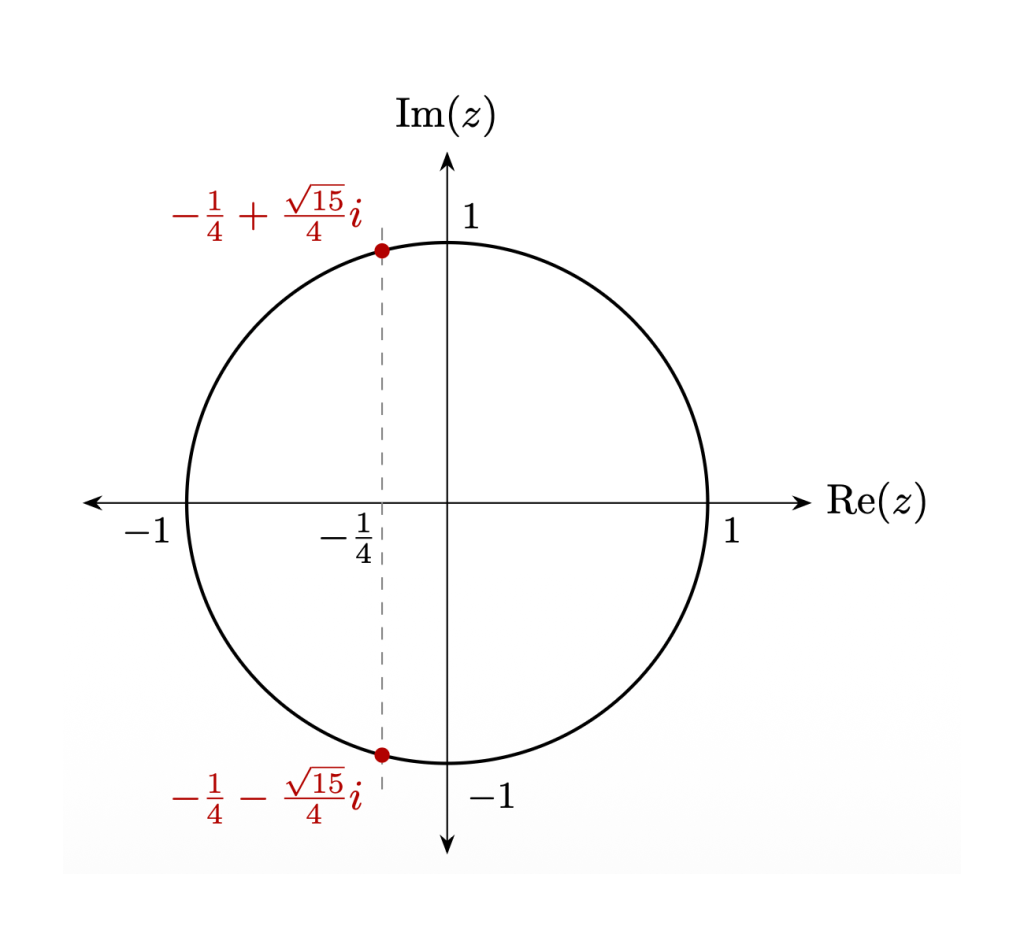
with equality when ![c = -\frac 14 \in [-1, 1]](https://s0.wp.com/latex.php?latex=c+%3D+-%5Cfrac+14+%5Cin+%5B-1%2C+1%5D&bg=ffffff&fg=000&s=0&c=20201002)


(d) (iv) The minimum occurs when 

We mark these as follows.
Question 10. Parametric Curves in 3D
Solution. (a) Using the double angle identity 

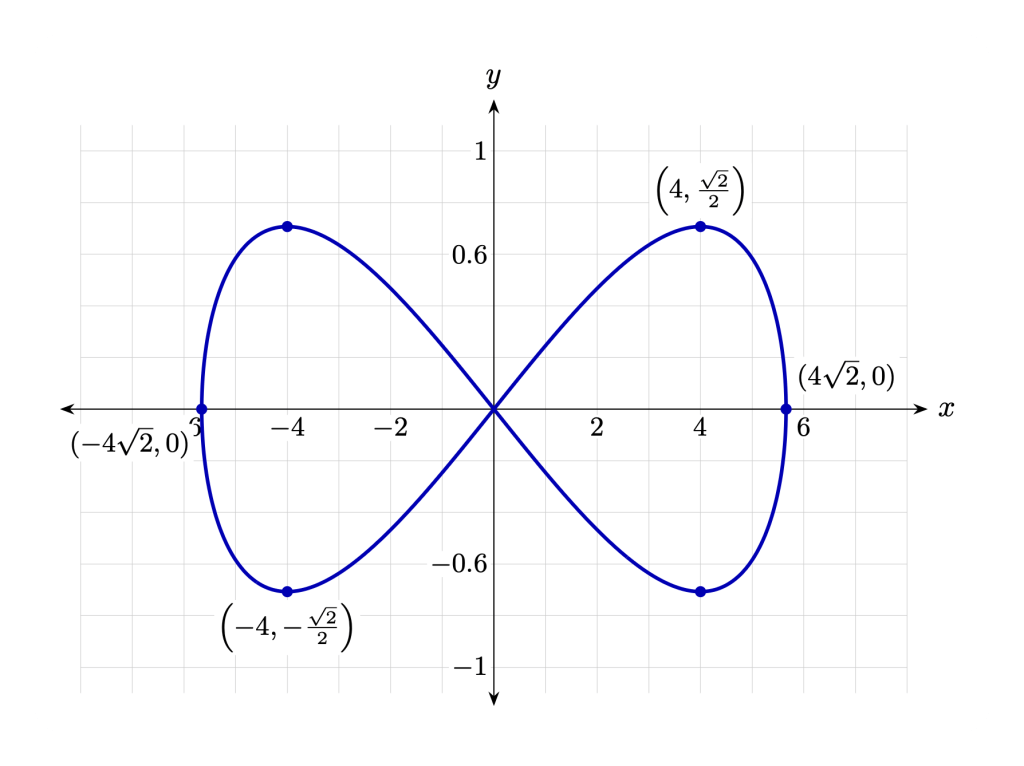
(b) The curve is a figure of eight through the origin, with 


We sketch as follows.
(c) (i) Differentiating each component with respect to 
![\displaystyle \mathbf v = \left[ 4\sqrt 2 \cos t,\ \sqrt 2 \cos 2t,\ 4 \right].](https://s0.wp.com/latex.php?latex=%5Cdisplaystyle+%5Cmathbf+v+%3D+%5Cleft%5B+4%5Csqrt+2+%5Ccos+t%2C%5C+%5Csqrt+2+%5Ccos+2t%2C%5C+4+%5Cright%5D.&bg=ffffff&fg=000&s=0&c=20201002)
(c) (ii) Writing 


Since 

(c) (iii) The distance travelled is the integral of the speed. By (a) and (c) (ii),
![\displaystyle \begin{aligned} \int_{\pi/4}^{3\pi/4} (2\sqrt 2 \cos^2 t + 3\sqrt 2)\, \mathrm dt &= 2\sqrt 2 \left[ \frac t2 + \frac 14 \sin 2t \right]_{\pi/4}^{3\pi/4} + 3\sqrt 2 \cdot \frac{\pi}{2} \\ &= 2\sqrt 2 \left( \left( \frac{3\pi}{8} - \frac 14 \right) - \left( \frac{\pi}{8} + \frac 14 \right) \right) + \frac{3\sqrt 2 \pi}{2} \\ &= 2\sqrt 2 \left( \frac{\pi}{4} - \frac 12 \right) + \frac{3\sqrt 2 \pi}{2} \\ &= \sqrt 2 \left( \frac{\pi}{2} - 1 + \frac{3\pi}{2} \right) \\ &= \sqrt 2 (2\pi - 1). \end{aligned}](https://s0.wp.com/latex.php?latex=%5Cdisplaystyle+%5Cbegin%7Baligned%7D+%5Cint_%7B%5Cpi%2F4%7D%5E%7B3%5Cpi%2F4%7D+%282%5Csqrt+2+%5Ccos%5E2+t+%2B+3%5Csqrt+2%29%5C%2C+%5Cmathrm+dt+%26%3D+2%5Csqrt+2+%5Cleft%5B+%5Cfrac+t2+%2B+%5Cfrac+14+%5Csin+2t+%5Cright%5D_%7B%5Cpi%2F4%7D%5E%7B3%5Cpi%2F4%7D+%2B+3%5Csqrt+2+%5Ccdot+%5Cfrac%7B%5Cpi%7D%7B2%7D+%5C%5C+%26%3D+2%5Csqrt+2+%5Cleft%28+%5Cleft%28+%5Cfrac%7B3%5Cpi%7D%7B8%7D+-+%5Cfrac+14+%5Cright%29+-+%5Cleft%28+%5Cfrac%7B%5Cpi%7D%7B8%7D+%2B+%5Cfrac+14+%5Cright%29+%5Cright%29+%2B+%5Cfrac%7B3%5Csqrt+2+%5Cpi%7D%7B2%7D+%5C%5C+%26%3D+2%5Csqrt+2+%5Cleft%28+%5Cfrac%7B%5Cpi%7D%7B4%7D+-+%5Cfrac+12+%5Cright%29+%2B+%5Cfrac%7B3%5Csqrt+2+%5Cpi%7D%7B2%7D+%5C%5C+%26%3D+%5Csqrt+2+%5Cleft%28+%5Cfrac%7B%5Cpi%7D%7B2%7D+-+1+%2B+%5Cfrac%7B3%5Cpi%7D%7B2%7D+%5Cright%29+%5C%5C+%26%3D+%5Csqrt+2+%282%5Cpi+-+1%29.+%5Cend%7Baligned%7D&bg=ffffff&fg=000&s=0&c=20201002)
Remark 3. The 

Remark 4. The diagrams have been drawn and the solutions have been verified with the help of Generative AI.
—Joel Kindiak, 17 Oct 26, 0022H


Leave a Reply