Questions are publicly available. Do comment if you spot any errors. Download the solutions here.
Remark 1. In SACE Stage 2 Specialist Maths, the following equivalent notation is used:
Furthermore, for any planar shape , we denote its area by . Finally, we use row vector notation for vectors:
Question 1. Polynomials
Solution. (a) Since has real coefficients, is also a zero by the conjugate root theorem. Therefore, a real quadratic factor is
(b) (i) By the factor theorem, :
(b) (ii) By the remainder theorem, :
(b) (iii) Adding and subtracting the equations in (b) (i) and (b) (ii), and .
(c) By (a) and (b),
for some , where we compared constant terms. Comparing the coefficients of , so that . Therefore,
Question 2. Planes and Lines
Solution. (a) The normal vectors and of and are not scalar multiples of each other (comparing the first two components would require the scalar to be both and ). Therefore, the planes are not parallel.
(b) Applying ,
Setting , the second row yields , so that . The first row then yields
Therefore, the planes meet along the line with parametric equations
(c) Setting , we obtain , and . Hence, lies on .
(d) The plane contains the point on , the direction vector of , and the vector
Hence, a normal vector of is
Taking the normal vector and the point ,
As a check, satisfies
Question 3. Matrices and Mathematical Induction
Solution. (a) Denote . Using ,
(b) For the base case , , as required. Fix such that
Then
Since the identity holds for and it holds for whenever it holds for , the identity holds for all by mathematical induction.
(c) Since and , and . By (b),
Therefore, by (a),
Question 4. Vector Geometry
Solution. (a) (i) Since is the midpoint of , .
(a) (ii) Similarly, .
(b) Since , their dot product is zero:
Rearranging, .
(c) Let . By the cosine rule in triangle ,
since by definition.
(d) By (b), . Substituting into (c),
Remark 2. Equivalently, : whenever two medians of a triangle are perpendicular, the squares of the two sides they bisect sum to five times the square of the third side.
Question 5. Inverse Functions and Volumes
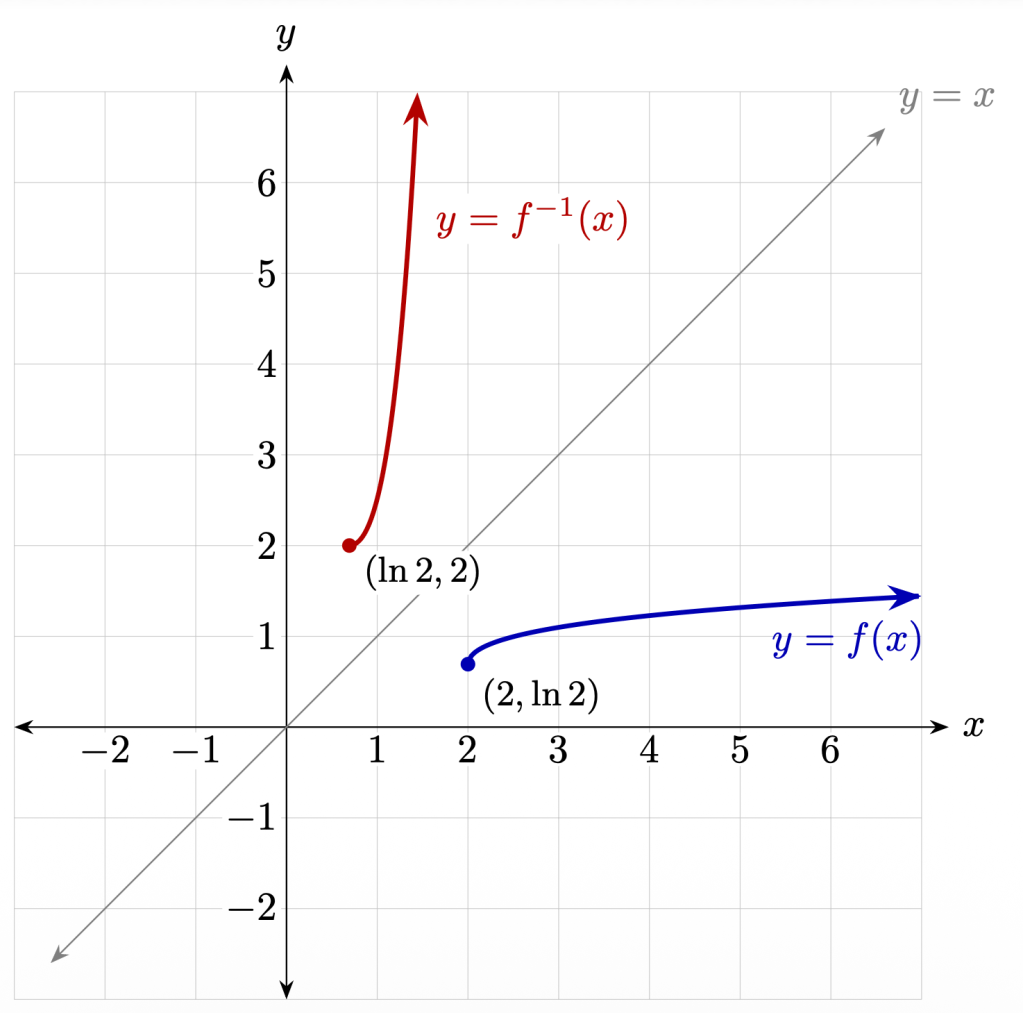
Solution. (a) The curve starts at and increases slowly, e.g. through . We sketch it in blue below, together with in red for (b) (iii).
(b) (i) Let . Then
where squaring is reversible since . Swapping and ,
(b) (ii) The domain of is the range of . Since is increasing with and as , the domain of is .
(b) (iii) The graph of is the reflection of in the line . It starts at and increases steeply; see the red curve in the figure in (a).
(c) (i) The integral
only depends on the integrand and the limits, not on the name of the variable. Replacing by gives the volume formed when is rotated about the -axis from to . Geometrically, by Figure 3, reflecting the region in swaps the two solids, so their volumes are equal.
(c) (ii) Using software,
Question 6. Complex Roots
Solution. (a) (i) Let with and . By De Moivre’s theorem,
so that and . Matching the positions in Figure 4,
(a) (ii) Since is the conjugate of ,
so that .
(b) (i) The triangle has two sides of length with included angle . Hence,
(b) (ii) By symmetry, the hexagon consists of six such triangles, so its area is .
(c) The solutions of lie on a circle of radius , spaced apart. As in (b), the hexagon has area
Therefore, works (and so does ).
Question 7. Integration by Parts
Solution. (a) Integrating by parts with
we obtain
(b) By (a),
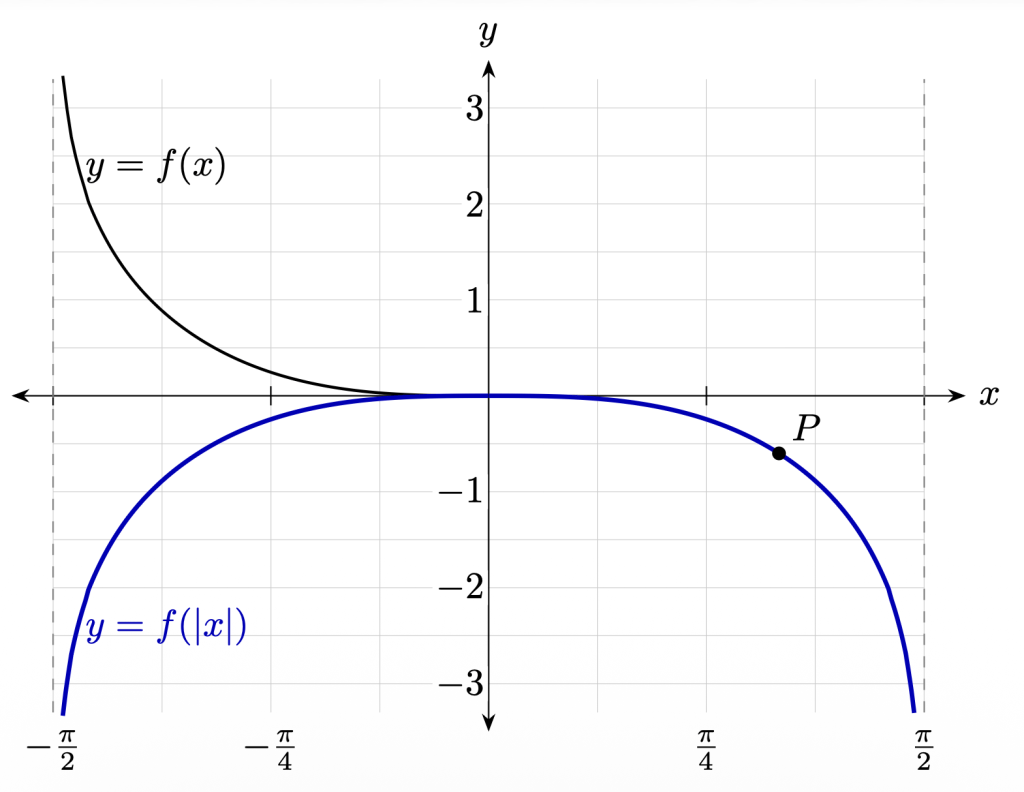
(c) For , . For , the graph of is the reflection of the right half of in the -axis. We sketch as follows.
(d) Since is odd,
for , and the two curves coincide for . Hence, the bounded region lies in , where
Its area is
where we used (b) and the substitution together with .
Question 8. Parametric Curves
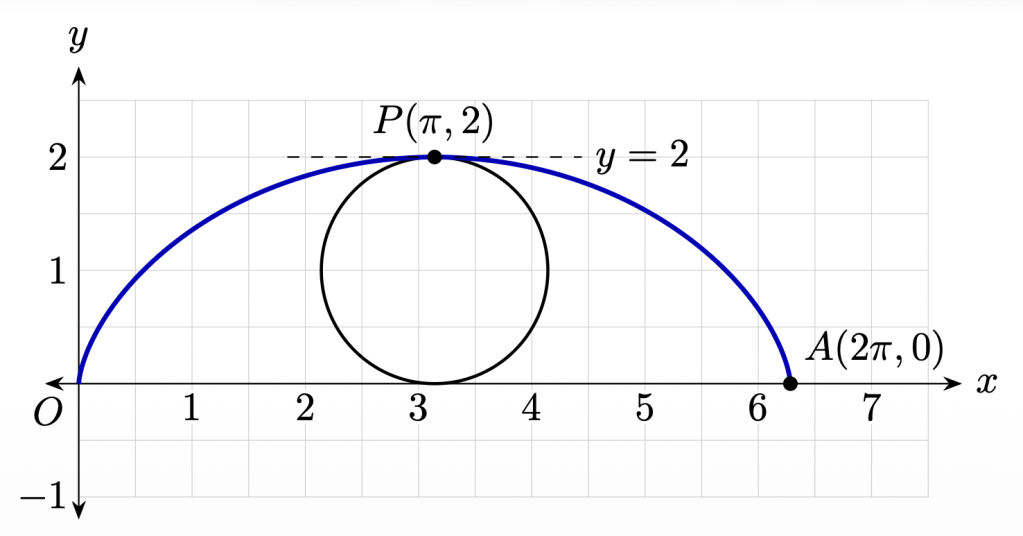
Solution. (a) The curve is a cycloid: it starts at , rises to its maximum at , and returns to at . We sketch as follows.
(b) (i) Differentiating implicitly with respect to ,
(b) (ii) By the chain rule,
(c) The point lies on the circle since , and on the parametric curve with . By (b) (i), the circle has gradient at . By (b) (ii), the parametric curve has gradient
at . Therefore, both curves have the common horizontal tangent at .
(d) By symmetry of the curve about , the arc has the same length as the arc , and the length of each arc is greater than the length of the corresponding chord. By the triangle inequality in triangle ,
Since the circle has radius , its circumference is . Hence, the length of the parametric curve is greater than the circumference of the circle.
(e) (i) Since and ,
using the double angle identity . For , , so that the length of the curve is
(e) (ii) By (e) (i),
Remark 3. This confirms (d): . In fact, the bound in (d) is , since .
Question 9. Differential Equations
Solution. (a) (i) By the method of separable variables,
where we set .
(a) (ii) Setting and ,
As , , so that
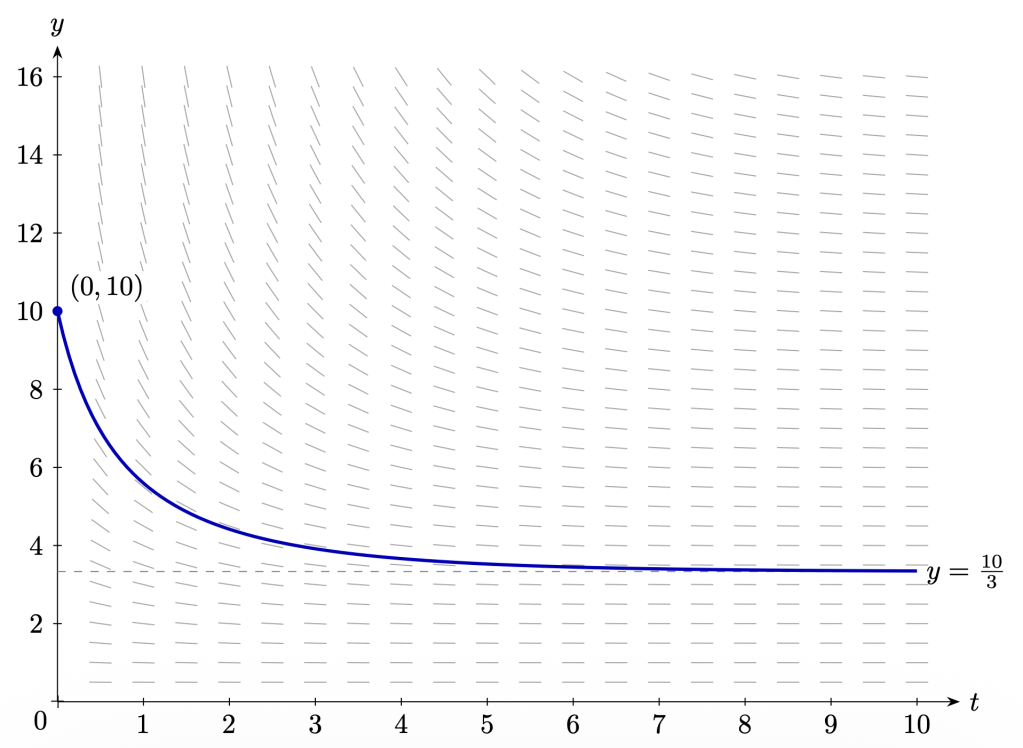
(b) The solution curve starts at , decreases, and approaches from above. We sketch as follows.
(c) Differentiating with respect to using the product rule and the chain rule,
(d) Since (as ), by (c),
Write . By (a) (ii),
so that
Therefore, , so that .
Question 10. Complex Roots and Regions
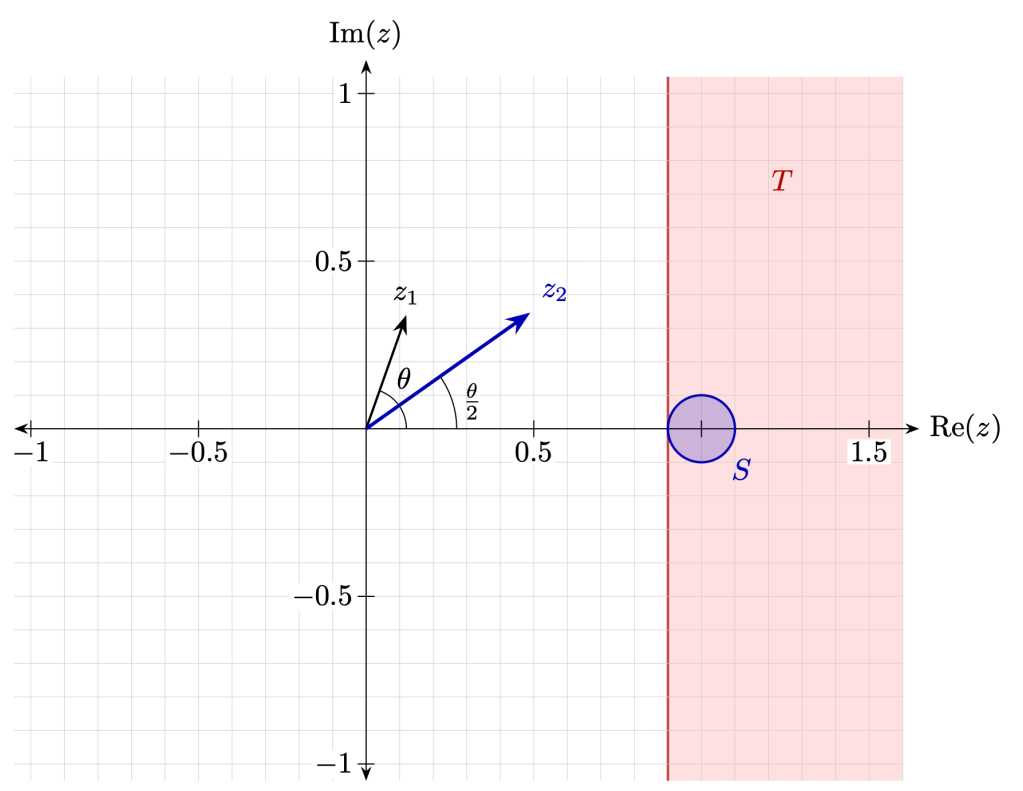
Solution. (a) (i) By De Moivre’s theorem, satisfies . Since , is in the first quadrant.
(a) (ii) The point has modulus and half the argument of , shown in blue in the figure below.
(b) (i) The set is the closed disc of radius centred at , shaded in blue below.
(b) (ii) The set is the closed half-plane on and to the right of the line , shaded in red below.
(c) (i) Since ,
where we multiplied by . Therefore, the smallest such integer is .
(c) (ii) By De Moivre’s theorem, , which is in the first quadrant since .
(c) (iii) (1) Setting , . In cartesian form,
(c) (iii) (2) Yes. Since , is in . (This is guaranteed by (c) (i), since with .)
(c) (iii) (3) No. We compute
so that is not within .
Remark 4. In particular, is a proper subset of , and lies in : it is close enough to the real axis to satisfy , but its imaginary part is too large for it to lie within of .
Remark 5. The diagrams have been drawn and the solutions have been verified with the help of Generative AI.


![[x,y,z] \equiv \begin{bmatrix} x \\ y \\ z \end{bmatrix}.](https://s0.wp.com/latex.php?latex=%5Bx%2Cy%2Cz%5D+%5Cequiv+%5Cbegin%7Bbmatrix%7D+x+%5C%5C+y+%5C%5C+z+%5Cend%7Bbmatrix%7D.&bg=ffffff&fg=000&s=0&c=20201002)


![[1,2,-3]](https://s0.wp.com/latex.php?latex=%5B1%2C2%2C-3%5D&bg=ffffff&fg=000&s=0&c=20201002)
![[1,1,2]](https://s0.wp.com/latex.php?latex=%5B1%2C1%2C2%5D&bg=ffffff&fg=000&s=0&c=20201002)


![\left[ \begin{array}{ccc|c} 1 & 2 & -3 & 9 \\ 1 & 1 & 2 & 5 \end{array} \right] \to \left[ \begin{array}{ccc|c} 1 & 2 & -3 & 9 \\ 0 & -1 & 5 & -4 \end{array} \right].](https://s0.wp.com/latex.php?latex=%5Cleft%5B+%5Cbegin%7Barray%7D%7Bccc%7Cc%7D+1+%26+2+%26+-3+%26+9+%5C%5C+1+%26+1+%26+2+%26+5+%5Cend%7Barray%7D+%5Cright%5D+%5Cto+%5Cleft%5B+%5Cbegin%7Barray%7D%7Bccc%7Cc%7D+1+%26+2+%26+-3+%26+9+%5C%5C+0+%26+-1+%26+5+%26+-4+%5Cend%7Barray%7D+%5Cright%5D.&bg=ffffff&fg=000&s=0&c=20201002)


![[-7, 5, 1]](https://s0.wp.com/latex.php?latex=%5B-7%2C+5%2C+1%5D&bg=ffffff&fg=000&s=0&c=20201002)
![\overrightarrow{AQ} = [-10,12,0] - [-13,14,2] = [3, -2, -2].](https://s0.wp.com/latex.php?latex=%5Coverrightarrow%7BAQ%7D+%3D+%5B-10%2C12%2C0%5D+-+%5B-13%2C14%2C2%5D+%3D+%5B3%2C+-2%2C+-2%5D.&bg=ffffff&fg=000&s=0&c=20201002)
![\begin{aligned} [-7, 5, 1] \times [3, -2, -2] &= [5 \cdot (-2) - 1 \cdot (-2),\ 1 \cdot 3 - (-7) \cdot (-2),\ -7 \cdot (-2) - 5 \cdot 3] \\ &= [-8, -11, -1]. \end{aligned}](https://s0.wp.com/latex.php?latex=%5Cbegin%7Baligned%7D+%5B-7%2C+5%2C+1%5D+%5Ctimes+%5B3%2C+-2%2C+-2%5D+%26%3D+%5B5+%5Ccdot+%28-2%29+-+1+%5Ccdot+%28-2%29%2C%5C+1+%5Ccdot+3+-+%28-7%29+%5Ccdot+%28-2%29%2C%5C+-7+%5Ccdot+%28-2%29+-+5+%5Ccdot+3%5D+%5C%5C+%26%3D+%5B-8%2C+-11%2C+-1%5D.+%5Cend%7Baligned%7D&bg=ffffff&fg=000&s=0&c=20201002)
![[8, 11, 1]](https://s0.wp.com/latex.php?latex=%5B8%2C+11%2C+1%5D&bg=ffffff&fg=000&s=0&c=20201002)




![\begin{aligned} \int_0^{\pi/3} \sin x \ln(\cos x)\, \mathrm dx &= \left[ -\cos x \ln(\cos x) + \cos x \right]_0^{\pi/3} \\ &= \left( -\tfrac 12 \ln \tfrac 12 + \tfrac 12 \right) - (-1 \cdot \ln 1 + 1) \\ &= \tfrac 12 \ln 2 + \tfrac 12 - 1 \\ &= \tfrac 12 \ln 2 - \tfrac 12. \end{aligned}](https://s0.wp.com/latex.php?latex=%5Cbegin%7Baligned%7D+%5Cint_0%5E%7B%5Cpi%2F3%7D+%5Csin+x+%5Cln%28%5Ccos+x%29%5C%2C+%5Cmathrm+dx+%26%3D+%5Cleft%5B+-%5Ccos+x+%5Cln%28%5Ccos+x%29+%2B+%5Ccos+x+%5Cright%5D_0%5E%7B%5Cpi%2F3%7D+%5C%5C+%26%3D+%5Cleft%28+-%5Ctfrac+12+%5Cln+%5Ctfrac+12+%2B+%5Ctfrac+12+%5Cright%29+-+%28-1+%5Ccdot+%5Cln+1+%2B+1%29+%5C%5C+%26%3D+%5Ctfrac+12+%5Cln+2+%2B+%5Ctfrac+12+-+1+%5C%5C+%26%3D+%5Ctfrac+12+%5Cln+2+-+%5Ctfrac+12.+%5Cend%7Baligned%7D&bg=ffffff&fg=000&s=0&c=20201002)









![\displaystyle \int_0^{2\pi} 2 \sin \left( \frac t2 \right) \mathrm dt = \left[ -4 \cos \frac t2 \right]_0^{2\pi} = -4(-1) + 4 = 8\ \text{units}.](https://s0.wp.com/latex.php?latex=%5Cdisplaystyle+%5Cint_0%5E%7B2%5Cpi%7D+2+%5Csin+%5Cleft%28+%5Cfrac+t2+%5Cright%29+%5Cmathrm+dt+%3D+%5Cleft%5B+-4+%5Ccos+%5Cfrac+t2+%5Cright%5D_0%5E%7B2%5Cpi%7D+%3D+-4%28-1%29+%2B+4+%3D+8%5C+%5Ctext%7Bunits%7D.&bg=ffffff&fg=000&s=0&c=20201002)






Leave a Reply