H2 Math 2026 Suggested Answers (Paper 1)

Questions have not been uploaded due to copyright reasons. Do comment if you spot any errors. Download the solutions here.

Question 1. Recurrence Relations

Solution. Setting n = 1, 2, 3 in the recurrence relation,

\displaystyle \begin{aligned} u_2 = Au_1 + B + C \quad &\Rightarrow \quad 8A + B + C = 22, \\ u_3 = Au_2 + 2B + C \quad &\Rightarrow \quad 22A + 2B + C = 49, \\ u_4 = Au_3 + 3B + C \quad &\Rightarrow \quad 49A + 3B + C = 102. \end{aligned}

Solving this system of linear equations using the GC, A = 2, B = -1 and C = 7. Therefore,

\displaystyle u_5 = Au_4 + 4B + C = 2(102) + 4(-1) + 7 = 207.

Question 2. Geometric Series

Solution. (a) The distances run in successive 15-minute intervals form a geometric sequence with first term 2.5 and common ratio 0.95. The interval between 1 hour and 1 hour 15 minutes after the start is the 5th interval, so she runs a distance of

\displaystyle 2.5 \times 0.95^4 = 2.036265625 \approx 2.04 \text{ km}.

(b) The half-way point is at 26 km. Let S_n km be the distance she has run after n intervals. She reaches the half-way point in the nth interval, where n is the least integer such that S_n \geq 26. Since \ln 0.95 is negative, dividing by it flips the inequality:

\displaystyle \begin{aligned} S_n \geq 26 \quad &\iff \quad \frac{2.5(1 - 0.95^n)}{1 - 0.95} \geq 26 \\ &\iff \quad 50(1 - 0.95^n) \geq 26 \\ &\iff \quad 0.95^n \leq 0.48 \\ &\iff \quad n \geq \frac{\ln 0.48}{\ln 0.95} \approx 14.3. \end{aligned}

Hence n = 15, since S_{14} \approx 25.6 < 26 \leq 26.8 \approx S_{15}. The 15th interval runs from 14 \times 15 = 210 to 225 minutes after the start, so she reaches the half-way point between 3 hours 30 minutes and 3 hours 45 minutes after the start.

(c) Since 0 < 0.95 < 1, the total distance S_n increases towards the sum to infinity

\displaystyle S_\infty = \frac{2.5}{1 - 0.95} = 50 < 52.

Thus S_n < 50 < 52 for every n, so according to the model, she will never complete the ultramarathon, however long she runs. In reality, athletes do complete such races, since a runner does not keep slowing down by a constant factor indefinitely. Therefore, the model is not suitable.

Question 3. Vectors

Solution. (a) Since A, B and C are distinct, the vectors \overrightarrow{BA} = \mathbf a - \mathbf b and \overrightarrow{CA} = \mathbf a - \mathbf c are non-zero. Their cross product is zero, so they are parallel. Since they share the point A, the points A, B and C are collinear.

(b) Since \mathbf c - \mathbf d = \overrightarrow{DC} and \mathbf b is a unit vector, |\mathbf b \cdot (\mathbf c - \mathbf d)| is the length of the projection of \overrightarrow{DC} onto the line OB.

(c) Since \mathbf b is a unit vector and OA is perpendicular to OB,

\displaystyle \begin{aligned} \mathbf a \cdot \mathbf b = 2p - 3q + 4q = 2p + q &= 0 \quad \Rightarrow \quad q = -2p, \\ |\mathbf b|^2 = p^2 + q^2 + q^2 = p^2 + 8p^2 &= 1 \quad \Rightarrow \quad p = \pm \frac 13. \end{aligned}

Therefore, p = 1/3 and q = -2/3, or p = -1/3 and q = 2/3.

Question 4. Differential Equations

Solution. (a) Since y = vx, the product rule yields \displaystyle \frac{\mathrm dy}{\mathrm dx} = v + x \frac{\mathrm dv}{\mathrm dx}. Substituting into the differential equation, and then dividing both sides by x^3, where x \neq 0,

\displaystyle \begin{aligned} x^2 \left( v + x \frac{\mathrm dv}{\mathrm dx} \right) &= v^2 x^2 + vx^2 \\ x^3 \frac{\mathrm dv}{\mathrm dx} &= v^2 x^2 \\ x \frac{\mathrm dv}{\mathrm dx} &= v^2. \end{aligned}

(b) Separating the variables, and then substituting v = y/x,

\displaystyle \begin{aligned} \int \frac 1{v^2}\, \mathrm dv &= \int \frac 1x\, \mathrm dx \\ -\frac 1v &= \ln |x| + c \\ -\frac xy &= \ln |x| + c \\ y &= \frac{x}{-c - \ln |x|} = \frac{x}{A - \ln |x|}, \end{aligned}

where c is an arbitrary constant and A = -c.

Remark 1. The function y = 0, which corresponds to v = 0, also satisfies the differential equation. It is lost when we divide by v^2 to separate the variables.

Question 5. Complex Numbers

Solution. The second equation yields w = z - 4 + 4i. Substituting into the first equation,

\displaystyle \begin{aligned} 2z + 7i &= -i(z - 4 + 4i) = -iz + 4 + 4i \\ (2 + i)z &= 4 - 3i \\ z &= \frac{4 - 3i}{2 + i} \cdot \frac{2 - i}{2 - i} \\ &= \frac{8 - 4i - 6i + 3i^2}{5} \\ &= \frac{5 - 10i}5 = 1 - 2i. \end{aligned}

Therefore, z = 1 - 2i and w = z - 4 + 4i = -3 + 2i.

Question 6. Inequalities

Solution. (a) Since the sign of x + 1 is unknown, we do not multiply across. Instead,

\displaystyle \begin{aligned} \frac 2{x+1} - (3 - 2x) &< 0 \\ \frac{2 - (3 - 2x)(x + 1)}{x + 1} &< 0 \\ \frac{2x^2 - x - 1}{x + 1} &< 0 \\ \frac{(2x + 1)(x - 1)}{x + 1} &< 0. \end{aligned}

The critical values are -1, -1/2 and 1. Checking the sign of the left-hand side on each interval, the inequality holds for

\displaystyle x < -1 \quad \text{or} \quad -\frac 12 < x < 1.

(b) Replacing x with \sin \theta, we need \sin \theta < -1, which has no solutions, or -1/2 < \sin \theta < 1. For 0 < \theta < 2\pi, we have \sin \theta > -1/2 exactly when 0 < \theta < 7\pi/6 or 11\pi/6 < \theta < 2\pi, and \sin \theta < 1 exactly when \theta \neq \pi/2. Therefore,

\displaystyle 0 < \theta < \frac \pi2, \quad \frac \pi2 < \theta < \frac{7\pi}6 \quad \text{or} \quad \frac{11\pi}6 < \theta < 2\pi.

Question 7. Integration by Parts

Solution. (a) By the chain rule,

\displaystyle \frac{\mathrm d}{\mathrm dx} \left( e^{\cos 2x} \right) = -2 \sin 2x\, e^{\cos 2x}.

(b) By the double angle formula \sin 4x = 2 \sin 2x \cos 2x, the integrand is -\cos 2x multiplied by the derivative in (a). Integrating by parts,

\displaystyle \begin{aligned} \int_{\pi/4}^{\pi/2} e^{\cos 2x} \sin 4x\, \mathrm dx &= \int_{\pi/4}^{\pi/2} (-\cos 2x) \cdot \left( -2 \sin 2x\, e^{\cos 2x} \right) \mathrm dx \\ &= \left[ -\cos 2x\, e^{\cos 2x} \right]_{\pi/4}^{\pi/2} - \int_{\pi/4}^{\pi/2} 2 \sin 2x\, e^{\cos 2x}\, \mathrm dx \\ &= \left[ -\cos 2x\, e^{\cos 2x} \right]_{\pi/4}^{\pi/2} + \left[ e^{\cos 2x} \right]_{\pi/4}^{\pi/2} \\ &= \left[ (1 - \cos 2x)\, e^{\cos 2x} \right]_{\pi/4}^{\pi/2} \\ &= 2e^{-1} - 1 = \frac 2e - 1. \end{aligned}

Remark 2. The answer 2/e - 1 \approx -0.264 is negative, as expected, since \sin 4x < 0 for \pi/4 < x < \pi/2. It agrees with the value given by the GC.

Question 8. Rational Functions

Solution. (a) Rearranging y(2x - 1) = 2x^2 yields the quadratic equation 2x^2 - 2yx + y = 0 in x. For real values of x, its discriminant must be non-negative:

\displaystyle \begin{aligned} (-2y)^2 - 4(2)(y) \geq 0 \quad &\iff \quad 4y(y - 2) \geq 0 \\ &\iff \quad y \leq 0 \quad \text{or} \quad y \geq 2. \end{aligned}

Furthermore, x = 1/2 never satisfies the quadratic equation, since it would give 1/2 = 0. Therefore, y cannot take values in the set \{ y \in \mathbb R : 0 < y < 2 \}.

(b) (i) By long division, 4x^2 + 1 = (2x - 1)(2x + 1) + 2, so that

\displaystyle y = \frac{4x^2 + 1}{2x - 1} = 2x + 1 + \frac 2{2x - 1}.

Thus a = 2, b = 1 and c = 2. As x \to \pm \infty, 2/(2x - 1) \to 0, and as x \to 1/2, |y| \to \infty. Therefore, the asymptotes of D are x = 1/2 and y = 2x + 1.

(ii) Observe that

\displaystyle 2 \left( x + \frac 1{2x - 1} \right) + 1 = 2x + 1 + \frac 2{2x - 1}.

Therefore, the graph of y = x + 1/(2x - 1) is transformed onto D by a stretch parallel to the y-axis with scale factor 2, followed by a translation of 1 unit in the positive y-direction.

Question 9. Maclaurin Series

Solution. (a) Since a > 0 and 1 + \sin x > 0 on the domain, f(x) = \ln a + \ln(1 + \sin x). By the chain rule, and then the quotient rule,

\displaystyle \begin{aligned} f'(x) &= \frac{\cos x}{1 + \sin x}, \\ f''(x) &= \frac{-\sin x (1 + \sin x) - \cos^2 x}{(1 + \sin x)^2} \\ &= -\frac{\sin x + \sin^2 x + \cos^2 x}{(1 + \sin x)^2} \\ &= -\frac{1}{1 + \sin x}, \end{aligned}

so that k = -1.

(b) Writing f''(x) = -(1 + \sin x)^{-1}, the chain rule yields f'''(x) = (1 + \sin x)^{-2} \cos x. Setting x = 0, we have f(0) = \ln a, f'(0) = 1, f''(0) = -1 and f'''(0) = 1. Therefore,

\displaystyle f(x) = \ln a + x - \frac{x^2}{2} + \frac{x^3}{6} + \cdots.

(c) (i) Setting a = 2 and using the series in (b),

\displaystyle \begin{aligned} \int_0^{1.2} f(x)\, \mathrm dx &\approx \int_0^{1.2} \left( \ln 2 + x - \frac{x^2}2 + \frac{x^3}6 \right) \mathrm dx \\ &= \left[ x \ln 2 + \frac{x^2}2 - \frac{x^3}6 + \frac{x^4}{24} \right]_0^{1.2} \\ &\approx 1.35. \end{aligned}

(ii) Using the GC,

\displaystyle \int_0^{1.2} \ln (2 + 2\sin x)\, \mathrm dx \approx 1.32.

(iii) The Maclaurin series is truncated after the term in x^3, so it approximates f(x) well only for x close to 0. On most of the interval [0, 1.2], x is not small, so the omitted higher-order terms are significant.

Remark 3. The next term of the series is -x^4/12. Including it changes the estimate in (c) (i) by -1.2^5/60 \approx -0.041, to about 1.31, which is much closer to the actual value.

Question 10. Functions

Solution. (a) For x \leq 3, |3 - x| = 3 - x, so that f(x) = e^{3 - x} is strictly decreasing, and hence one-one. Thus f^{-1} exists when m \leq 3. If instead m > 3, then for 0 < h \leq m - 3, both 3 - h and 3 + h lie in the domain of f, with f(3 - h) = e^h = f(3 + h). Then f is not one-one, and f^{-1} does not exist. Therefore, the greatest value of m is 3.

(b) Let y = e^{3 - x}, where x \leq 3. Then 3 - x \geq 0, so that y \geq 1, and

\displaystyle 3 - x = \ln y \quad \Rightarrow \quad x = 3 - \ln y.

Therefore, f^{-1}(x) = 3 - \ln x, with domain \mathrm D_{f^{-1}} = \mathrm R_f = [1, \infty).

(c) Since f(f^{-1}(t)) = t for every t \in \mathrm D_{f^{-1}}, the expression f(f^{-1}(|x|)) is defined exactly when |x| \geq 1, in which case

\displaystyle f(f^{-1}(|x|)) = |x| \geq 1.

Therefore, the solution is x \leq -1 or x \geq 1.

(d) The composite function f^{-1}g exists if and only if \mathrm R_g \subseteq \mathrm D_{f^{-1}} = [1, \infty). Since \sqrt{x - 4} takes every value in [0, \infty) for x \geq 4, we have \mathrm R_g = [n, \infty). Then [n, \infty) \subseteq [1, \infty) if and only if n \geq 1, so the smallest value of n is 1.

Question 11. Parametric Equations

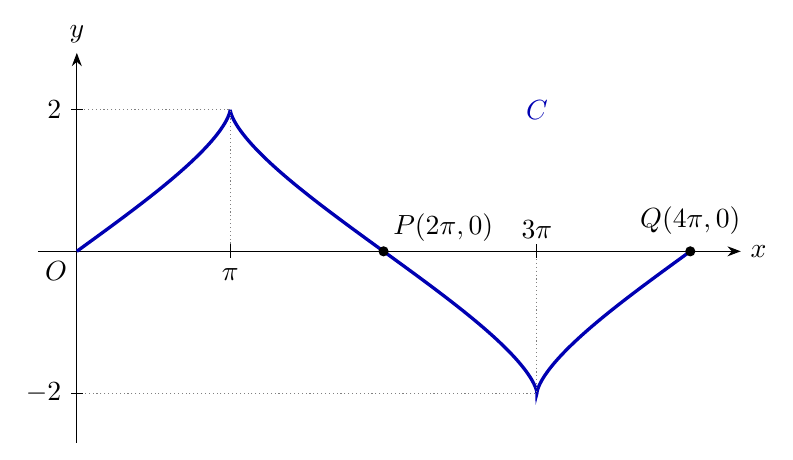
Solution. (a) We have y = 0 exactly when \sin \theta = 0, that is, \theta = 0, \pi or 2\pi, giving the points (0, 0), (2\pi, 0) and (4\pi, 0). The value of y = 2 \sin \theta changes sign at \theta = \pi, so C crosses the x-axis at P(2\pi, 0). The curve ends at \theta = 2\pi, where it meets the x-axis at Q(4\pi, 0).

(b) (i) Using the double angle formula \cos 2\theta = 2\cos^2 \theta - 1, and for \cos \theta \neq 0,

\displaystyle \begin{aligned} \frac{\mathrm dx}{\mathrm d\theta} &= 2 + 2\cos 2\theta = 4 \cos^2 \theta, \\ \frac{\mathrm dy}{\mathrm d\theta} &= 2 \cos \theta, \\ \frac{\mathrm dy}{\mathrm dx} &= \frac{\mathrm dy/\mathrm d\theta}{\mathrm dx/\mathrm d\theta} = \frac{2 \cos \theta}{4 \cos^2 \theta} = \frac 12 \sec \theta. \end{aligned}

(ii) Since |{\sec \theta}| = 1/|{\cos \theta}| \geq 1, the gradient \displaystyle \frac{\mathrm dy}{\mathrm dx} = \frac 12 \sec \theta is never zero. Therefore, the graph of C has no stationary points.

(iii) At \theta = \pi/3, we have x = 2\pi/3 + \sqrt 3/2, y = \sqrt 3, and the gradient is (1/2) \sec (\pi/3) = 1. The tangent therefore has equation

\displaystyle \begin{aligned} y - \sqrt 3 &= x - \left( \frac{2\pi}3 + \frac{\sqrt 3}2 \right) \\ y &= x - \frac{2\pi}3 + \frac{\sqrt 3}2. \end{aligned}

Setting y = 0 and x = 0 in turn, the tangent meets the axes at R(2\pi/3 - \sqrt 3/2, 0) and S(0, \sqrt 3/2 - 2\pi/3). Hence OR = OS = 2\pi/3 - \sqrt 3/2, and by Pythagoras’ theorem,

\displaystyle RS = \sqrt 2 \left( \frac{2\pi}3 - \frac{\sqrt 3}2 \right) = \frac{\sqrt 2 (4\pi - 3\sqrt 3)}6 \approx 1.74.

Question 12. Planes

Solution. (a) The plane contains the vectors \overrightarrow{AB} and \overrightarrow{AC}, so their cross product is a normal vector to the plane:

\displaystyle \begin{aligned} \overrightarrow{AB} &= \begin{bmatrix} 5 \\ 8 \\ -40 \end{bmatrix} - \begin{bmatrix} 10 \\ 15 \\ -60 \end{bmatrix} = \begin{bmatrix} -5 \\ -7 \\ 20 \end{bmatrix}, \\ \overrightarrow{AC} &= \begin{bmatrix} -5 \\ 10 \\ -50 \end{bmatrix} - \begin{bmatrix} 10 \\ 15 \\ -60 \end{bmatrix} = \begin{bmatrix} -15 \\ -5 \\ 10 \end{bmatrix}, \\ \overrightarrow{AB} \times \overrightarrow{AC} &= \begin{bmatrix} (-7)(10) - (20)(-5) \\ (20)(-15) - (-5)(10) \\ (-5)(-5) - (-7)(-15) \end{bmatrix} = \begin{bmatrix} 30 \\ -250 \\ -80 \end{bmatrix} = 10 \begin{bmatrix} 3 \\ -25 \\ -8 \end{bmatrix}. \end{aligned}

Taking the normal vector \mathbf n with components 3, -25 and -8, and since A lies on the plane,

\displaystyle \mathbf r \cdot \mathbf n = \begin{bmatrix} 10 \\ 15 \\ -60 \end{bmatrix} \cdot \begin{bmatrix} 3 \\ -25 \\ -8 \end{bmatrix} = 30 - 375 + 480 = 135.

Therefore, the plane has cartesian equation 3x - 25y - 8z = 135. As a check, B gives 15 - 200 + 320 = 135 and C gives -15 - 250 + 400 = 135.

(b) The ground z = 0 has normal vector \mathbf k. The acute angle \theta between the ground and the mineral layer satisfies

\displaystyle \begin{aligned} \cos \theta &= \frac{|\mathbf n \cdot \mathbf k|}{|\mathbf n| |\mathbf k|} = \frac{|{-8}|}{\sqrt{3^2 + 25^2 + 8^2}} = \frac 8{\sqrt{698}}, \\ \theta &\approx 72.4^\circ. \end{aligned}

(c) Points on the vertical line through P have coordinates (-17, 188, \lambda), where \lambda \in \mathbb R. Substituting into the equation of the plane,

\displaystyle \begin{aligned} 3(-17) - 25(188) - 8\lambda &= 135 \\ -4751 - 8\lambda &= 135 \\ \lambda &= -610.75. \end{aligned}

Therefore, the vertical distance from P to the plane is 610.75 m, or 611 m to 3 significant figures.

(d) Let F be the foot of the perpendicular from P to the plane. Then \overrightarrow{OF} = \overrightarrow{OP} + \mu \mathbf n for some \mu, and since F lies on the plane,

\displaystyle \begin{aligned} \left( \overrightarrow{OP} + \mu \mathbf n \right) \cdot \mathbf n &= 135 \\ \overrightarrow{OP} \cdot \mathbf n + \mu |\mathbf n|^2 &= 135 \\ -4751 + 698\mu &= 135 \\ \mu &= 7. \end{aligned}

Thus F has coordinates (-17 + 21, 188 - 175, 0 - 56) = (4, 13, -56), and the shortest distance from P to the plane is

\displaystyle PF = 7 |\mathbf n| = 7 \sqrt{698} = \sqrt{34\, 202} \approx 184.9 \text{ m}.

Remark 4. Alternatively, the shortest distance is the vertical distance in (c) multiplied by \cos \theta from (b): 610.75 \times 8/\sqrt{698} \approx 184.9 m. This is because the vertical line and the perpendicular to the plane meet at the angle \theta between the ground and the mineral layer.

Remark 5. The diagrams have been drawn and the solutions have been verified with the help of Generative AI.

—Joel Kindiak, 3 Nov 26, 1430H

,

Published by


Responses

  1. Anonymous Avatar
    Anonymous

    Yo for the functions qns (c) is it not just x great or equals to 1 because you need to account for the Domain of f inverse which is [1, inf)?

    Like

    1. joelkindiak Avatar
      joelkindiak

      All we require is |x| in [1, inf), so that |x| ≥ 1. Unraveling the modulus yields the two-sided result.

      Like

  2. Anonymous Avatar
    Anonymous

    why is the last qn needing just 1 step 6m any ideas on mark allocation?

    Like

    1. joelkindiak Avatar
      joelkindiak

      No clue TBH

      Like

Leave a Reply