Questions have not been uploaded due to copyright reasons. Do comment if you spot any errors. Download the solutions here.
Section A: Pure Mathematics [40 marks]
Question 1. Vectors
Solution. A vector perpendicular to both given vectors is their cross product:
Since , a unit vector perpendicular to both given vectors is
Remark 1. The negative of this vector is the only other unit vector perpendicular to both given vectors.
Question 2. Volumes of Revolution
Solution. (a)(i) The volume generated is
(ii) Rotating the line , for , through radians about the -axis generates a cone of height , whose base has radius at . Setting in (i),
(b) Substituting and into the equation of the curve, and then multiplying by ,
Thus or . Since at this point, the possible values of are and .
Question 3. Complex Numbers
Solution. (a) Since the coefficients and are real, the conjugate is also a root, so that
is a factor of the cubic. Let be the third root. Then, for every ,
Comparing the coefficients of , , so that . Then comparing the coefficients of and the constant terms,
Therefore, the other roots are and , with and .
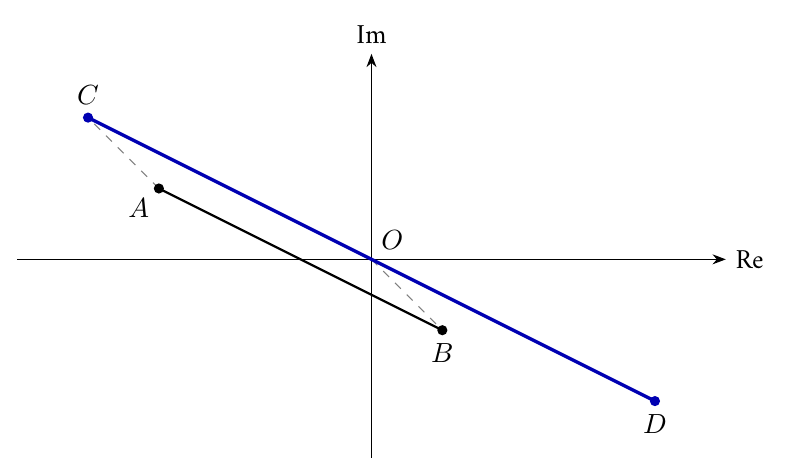
(b)(i) Since represents the vector , the point satisfies , so that is a parallelogram. Furthermore, , so is the image of under a rotation of radians about .
Therefore, and are symmetric about the origin: is the midpoint of , with .
(ii) Taking the conjugate of a complex number reflects its point in the real axis. Since and represent and , the line is mapped onto the line by a reflection in the real axis.
Question 4. Arithmetic and Geometric Series
Solution. (a) Equating the given terms,
The first equation yields . Multiplying the second equation by , substituting, and then dividing by ,
Since , we have or . If , then and , which is impossible. Hence , and since ,
Conversely, for every non-zero real , the values and satisfy all the given conditions. Therefore, the set of possible values of is .
(b) Since and , the two sums are
Since the sums differ by , and dividing by ,
Since and , the number is not a power of . Therefore, .
Question 5. Applications of Differentiation and Integration
Solution. (a) By the double angle formula ,
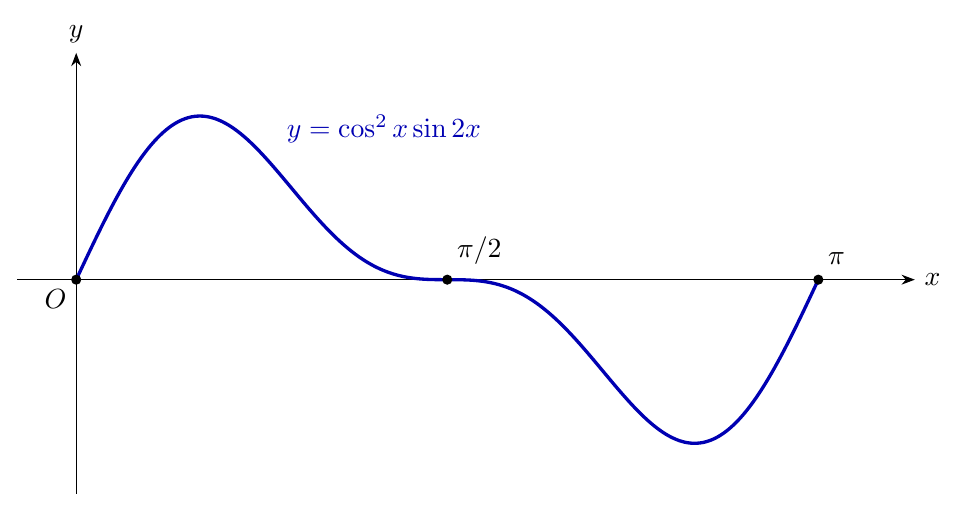
For , we have exactly when or , that is, , or . Thus the curve meets the -axis at , and . Furthermore, for and for . Because of the factor , the curve crosses the -axis at with zero gradient.
(b) By the product rule and the chain rule,
Stationary points therefore occur where or , that is, , or . The maximum point lies where , so , and
Therefore, the maximum point is .
(c) Since for , and , the required area is
Section B: Probability and Statistics [60 marks]
Question 6. Sampling, Permutations and Combinations
Solution. (a) The manager wishes to learn the opinions of all the employees of the company, so the population consists of all employees. The employees who return the questionnaire are only part of this population, so they comprise a sample.
Remark 2. This sample is not representative of the population, since no employees from the Green team or the Yellow team are included.
(b) In a random sample, every employee has the same chance of being chosen, so the committee is free from any bias in the manager’s choice of employees, and is more likely to represent the opinions of all the employees.
(c) Let , , and be the numbers of members from the Red, Blue, Green and Yellow teams, with , , and greater than each of , and .
If , then the other teams have at most member altogether, so at most two teams are represented. If , then , which is impossible. If , then , and are each at most , with sum . If , then , with and a third team represented. Therefore, the possible cases are as follows:
Therefore, the committee can be formed in ways.
Question 7. Probability
Solution. (a) Let there be red, yellow and blue balls, where . There are equally likely pairs of balls, so
Adding the equations, and then using ,
If , then is not an integer. Therefore, there were red balls originally in the bag, with yellow balls and blue balls.
(b)(i) The events , , and partition the sample space, so that
Therefore, and are not mutually exclusive.
(ii) Using (i),
Then . Therefore, and are not independent.
Question 8. Correlation and Linear Regression
Solution. (a) Tang should draw a scatter diagram of the data to check whether the points lie close to a straight line. A product moment correlation coefficient close to does not by itself imply that the relationship is linear, since points lying on a curve can also give such a value.
(b)(i) Since the product moment correlation coefficient is approximately , there is no linear correlation between the amount of fertiliser used and the crop yield. However, Xi should not conclude that the crop yield is unrelated to the amount of Fertiliser B used, since there may still be a non-linear relationship between them.
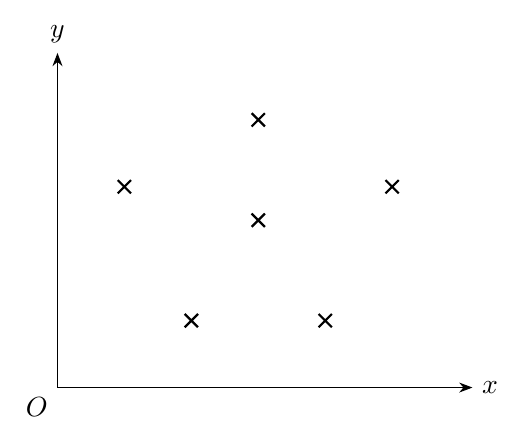
(ii) The following scatter diagram shows no linear trend, and its product moment correlation coefficient is .
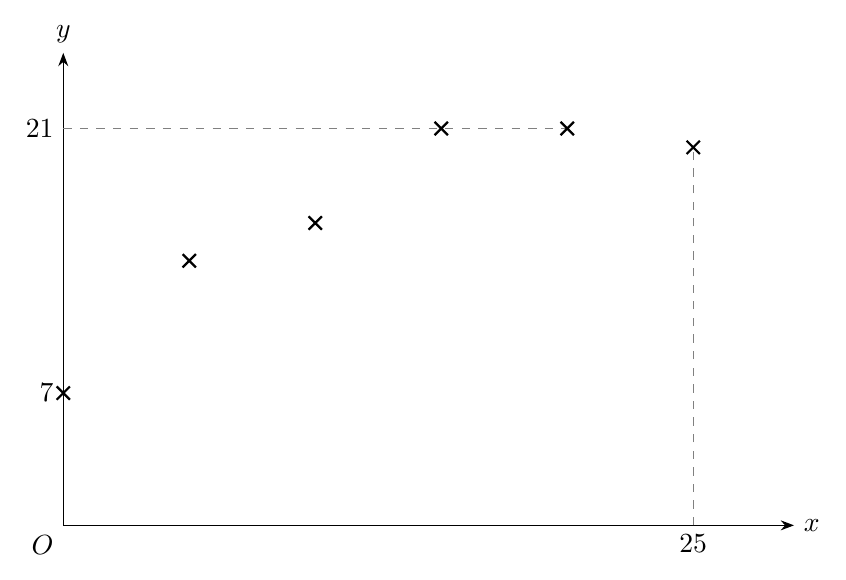
(c)(i) The scatter diagram of Leia’s data is as follows.
As increases, increases at a decreasing rate, and levels off from onwards, with a slight decrease at . The points lie on a curve rather than close to a straight line, so the crop yield is not linearly related to the amount of fertiliser used.
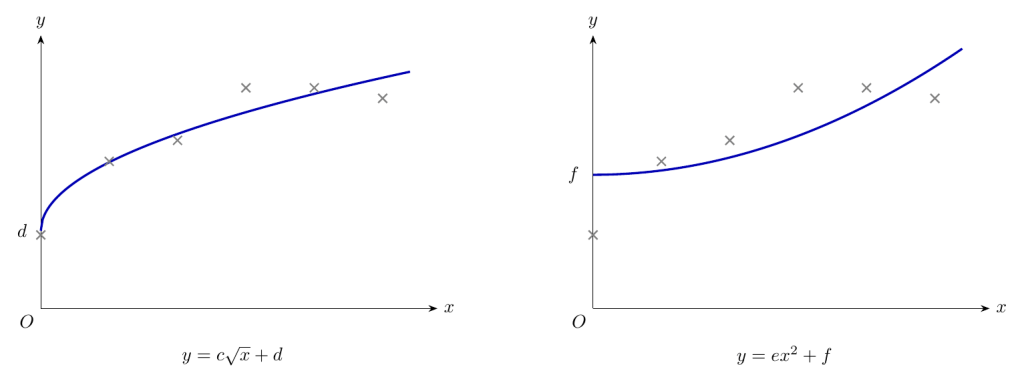
(ii) The sketches of the two models, with the data points shown in grey, are as follows.
Since and are positive, the curve increases at a decreasing rate, whereas increases at an increasing rate. The data show increasing at a decreasing rate, so is the better model.
Remark 3. This agrees with the product moment correlation coefficients: between and , but only between and .
(iii) Using the GC, the least squares regression line of on is
Therefore, when , the estimated crop yield is
Remark 4. This estimate is reliable, since lies within the range of the data and the product moment correlation coefficient between and is close to .
Question 9. Binomial Distribution
Solution. (a) The packets contain Tringos altogether, of which the number of green Tringos is
Therefore, the estimated probability that a randomly chosen Tringo is green is .
(b) Let denote the number of red sweets in a packet. The required probability is
(c) Let denote the number of packets, out of , that contain fewer than red sweets. The required probability is
(d) Since a carton contains randomly chosen Tringos, let denote the number of red sweets in a carton. The required probability is
(e) Let denote the number of yellow sweets in a packet. Then
Solving for using the GC, or .
Question 10. Normal Distribution
Solution. (a)(i) Let denote the time taken, in minutes, for a journey between Aytown and Beetown using the usual route. The required probability is
(ii) Let denote the time spent at the shops, and let and denote the times for the two journeys. Defining ,
Hence , and since hours is minutes, the required probability is
(iii) Let denote the time taken using the alternative route. Then
Hence , and the required probability is
(b) Let denote the time taken, in minutes, for a journey from Aytown to Seatown. Then and . Using -scores,
Subtracting the second equation from the first, , so that
Therefore, the required probability is
Question 11. Hypothesis Testing
Solution. (a)(i) Let grams denote the population mean mass of bird seed in a packet. The hypotheses are
(ii) The unbiased estimates of the population mean and variance are
Since is large, by the Central Limit Theorem, approximately under . For a two-tailed test at the level, is rejected when
Therefore, correct to decimal place, the critical region is or .
(iii) Since lies in the critical region, we reject . There is sufficient evidence at the level of significance to conclude that the mean mass of bird seed in a packet is not grams.
(b)(i) Let grams denote the population mean mass of pet food in a bag. The owner is testing whether the mean mass of pet food in a bag filled by the machine is greater than the stated grams.
(ii) For a one-tailed test at the level, the critical -value is , correct to significant figures.
(iii) Firstly, the sample is not random. Only the last bags filled on Monday, Wednesday and Friday can be chosen, so bags filled earlier in the day, or on Tuesday or Thursday, have no chance of being selected. Bags filled at the end of the day may also differ systematically from the others.
Secondly, the sample of bags is small, so the Central Limit Theorem cannot be used to approximate the distribution of the sample mean by a normal distribution. The -test is therefore valid only if the masses are known to be normally distributed, which is not given.
Remark 5. The diagrams have been drawn and the solutions have been verified with the help of Generative AI.










Leave a Reply